
The Pipeline Monitor covers recent developments in autoimmune disease drug development. This is a themed edition covering the rapidly evolving CAR-T, CAR-NK, and related cell therapy landscape in autoimmune disease. Five spotlights, each with a Buy/Sell/Hold rating.
Can we cure autoimmune diseases with a single infusion? Three years ago that was an obvious “No.” Today, Kyverna Therapeutics is preparing to file the first-ever BLA for a CAR-T therapy in autoimmune disease, the FDA has signalled williness to lower the bar for approval, and industry has spent roughly $7 billion acquiring startups who can help them join the potential gold rush.
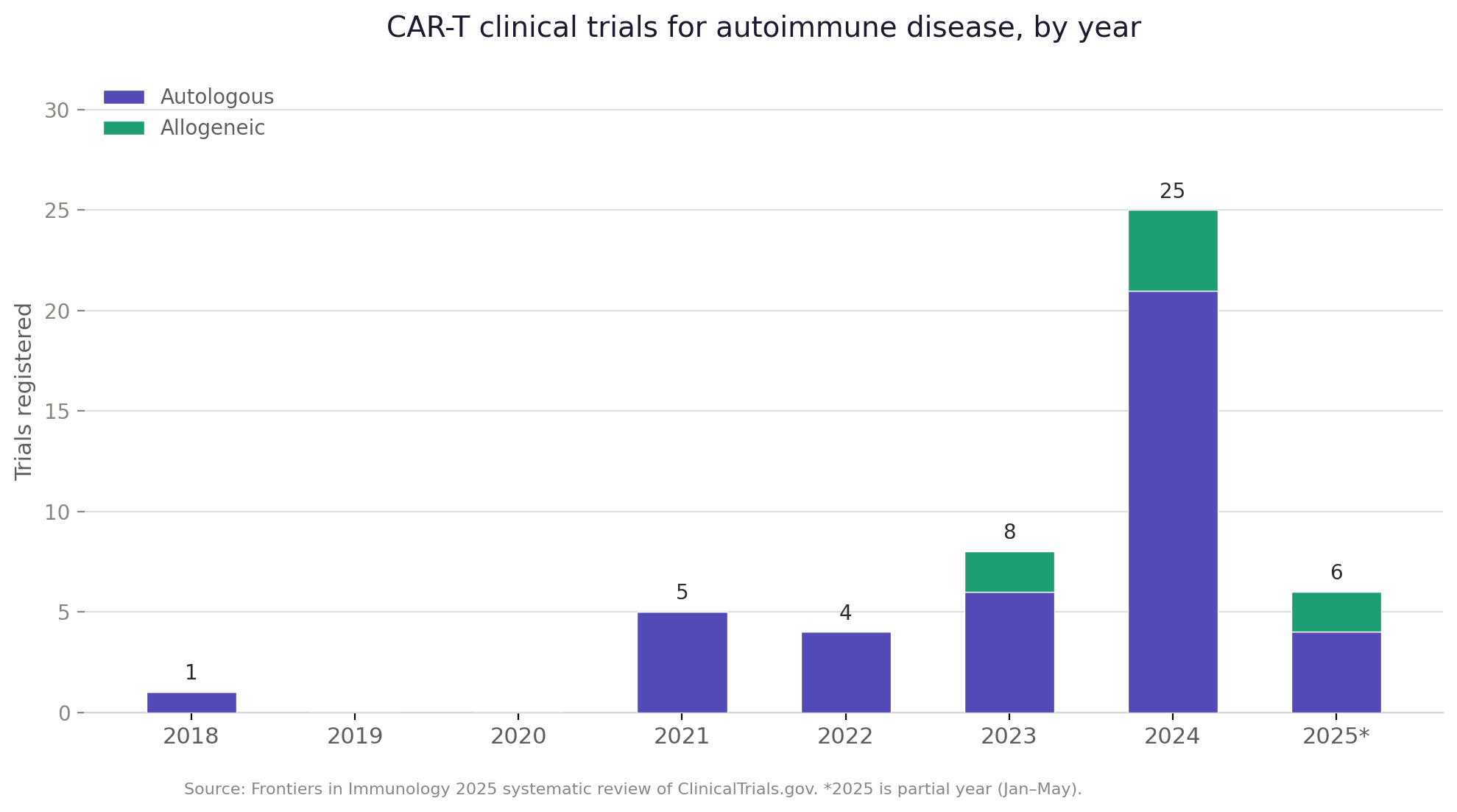
The growth has been staggering. From 1 registered trial in 2018 and a COVID hiatus from 2019-2020, the yearly number of registered CAR-T trials climbed to 5 in 2021, then 8 in 2023, and then exploded to 25 in 2024 (Figure 1). The field is moving fast enough that I thought it warranted a full Pipeline Monitor to map where everyone is and what to watch for.
I should say upfront that I find this space genuinely exciting and genuinely concerning in roughly equal measure. Patients in the preliminary studies have gone into remission (off therapy!) and Very Serious Investigators (VSI’s) are saying the word “cure” on conference stages.
But almost all of the data come from small, uncontrolled, open-label studies, and “almost all” is generous. The largest published case series in rheumatology is 24 patients from a single basket trial. The field is building a regulatory and commercial edifice on a foundation that would not survive critical appraisal in any other context. Whether that’s justified by the magnitude of the clinical responses or reckless given the lack of controlled data is going to be the central question of this Pipeline Monitor.
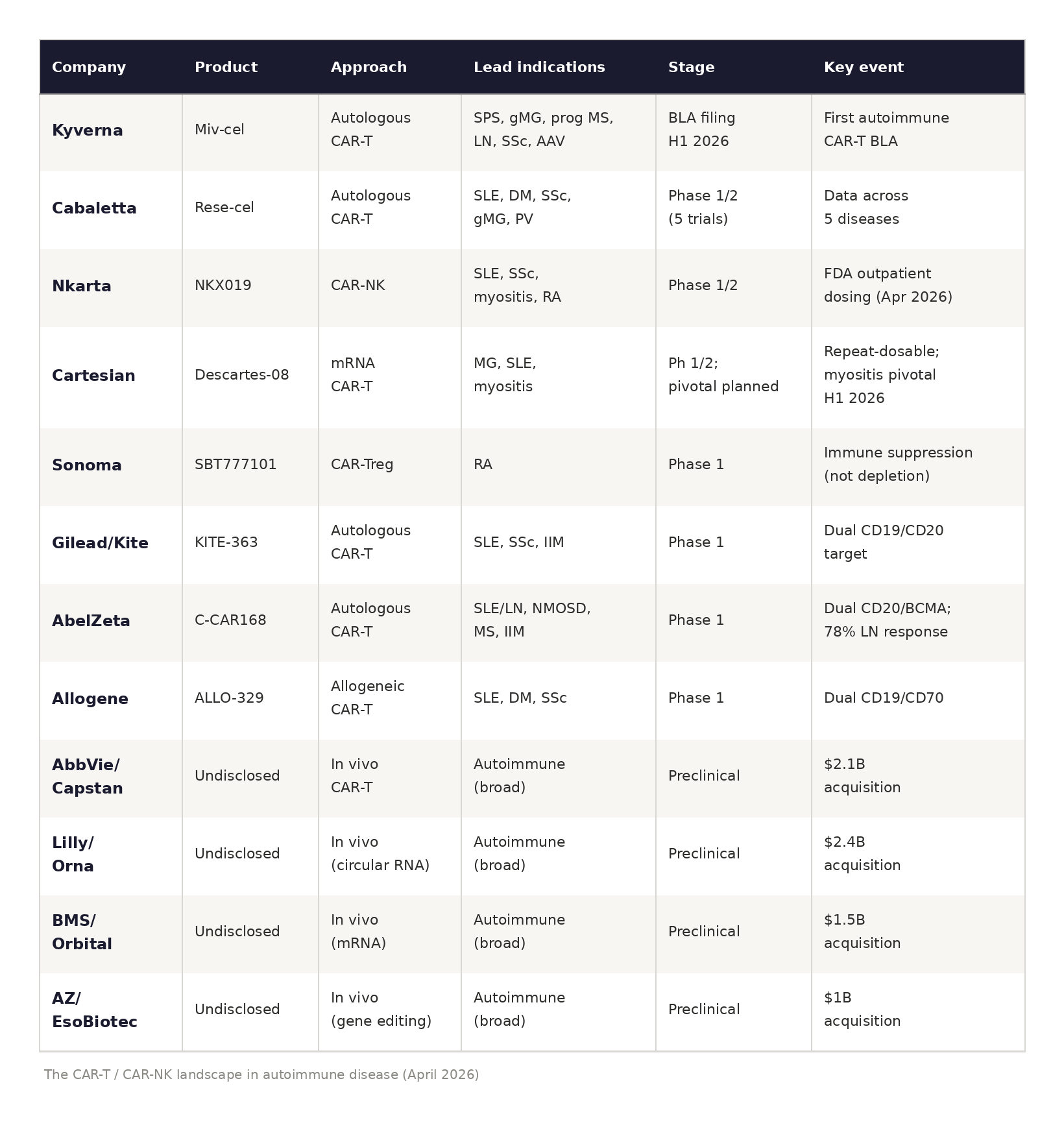
The furthest along. Miv-cel is an autologous CAR-T, meaning the patient’s own T cells are collected, engineered in a manufacturing facility to express a chimeric antigen receptor targeting CD19 on B cells, expanded, and infused back. This is the same basic approach used in blood cancer CAR-T and the same approach described in Georg Schett’s original NEJM paper. It carries the same logistical baggage that led me to complain about the potential barriers to CAR-T in Lancet Rheumatology last year: manufacturing takes weeks, it costs a fortune, and only centers with specialized oncology infrastructure can use it. Also, we don’t yet understand the potential risks.
Kyverna is also out in front and is on track to file its BLA in the first half of 2026 for stiff person syndrome, based on the registrational KYSA-8 trial. Press releases said they met all primary and secondary endpoints, including a median 46% improvement on the timed 25-foot walk at 16 weeks, reversal of disability scores, and elimination of chronic immunotherapies after a single infusion. No high-grade CRS or ICANS was observed, but pretty much everyone had lower grade events (92% CRS, 12% ICANS, 62% grade 3/4 neutropenia). I have never actually seen a patient with stiff person syndrome (it’s more autoimmune-neuro), but that’s a big change in a disease where the current standard of care is off-label benzodiazepines and IVIG. Outside of neurology indications they have active phase 1 trials in lupus nephritis in the US and Germany and a phase 1/2 in diffuse cutaneous systemic sclerosis.
They are also focusing on RA and at ACR 2025, Kyverna presented preliminary data from the COMPARE trial, which is (as far as I can tell) the first randomized controlled CAR-T trial in RA. The design is head-to-head against rituximab, which directly tests whether the deep B-cell depletion from CAR-T is meaningfully better than conventional anti-CD20 therapy. Only 2 patients had been treated at the time of submission, but both showed complete peripheral B-cell depletion and ACPA values that dropped to 19% and 5% of screening values. CRS was grade 1-2 and resolved. Two patients is not much, but it will make a big splash if they can pul lthis off.
I should note that KYSA-8 for stiff person syndrome was a single-arm, open-label, phase 2 study of 26 patients with 16 weeks of follow-up. No placebo arm, no blinding. The FDA appears willing to accept this given RMAT designation, the rarity of the disease (~1 in a million), and the severity of the unmet need, but this is a historically soft evidentiary bar for a BLA. I have been genuinely concerned about the precedents we are setting; if the first approval in autoimmune diseases comes on the back of 26 unblinded patients, the pressure to match that bar (rather than exceed it) will be enormous.
Rating: BUY. First mover advantage in a disease with zero approved therapies. Multiple autoimmune indications including (surprisingly to me) RA. I suspect the precedent this sets will matter more than the drug itself.
The broadest autoimmune CAR-T portfolio. Rese-cel uses the same autologous manufacturing approach as miv-cel, but where Kyverna has gone registrational in neuroimmunology first, Cabaletta has gone wide across rheumatic diseases, including five RESET phase 1/2 trials that are running simultaneously in SLE, myositis, systemic sclerosis, myasthenia, and pemphigus vulgaris.
The data so far are compelling, if early. The 32 patients they have reported include responses in 5/6 patients with myositis (moderate or better TIS), 7/7 patients with SLE (SLEDAI-2K reductions off all immunomodulators and steroids), and 2/2 patients with SSc (meaningful mRSS improvements off IMT). The safety profile has been reassuring (94% with no CRS or only grade 1). Cabaletta has received FDA Fast Track designation in DM, SLE/LN, SSc, MS, and myasthenia, plus RMAT designation in myositis and lupus.
Recurring theme of this newsletter: Cabaletta’s data are open-label, uncontrolled, and small. If the Kyverna precedent holds and the FDA accepts single-arm data for autoimmune CAR-T, Cabaletta’s path to approval in one of their five indications becomes considerably easier. The question of whether these responses are durable (and whether they would survive a placebo-controlled design in diseases with high placebo rates like SLE) remains entirely open.
Rating: BUY. Good (ish lol) early data across multiple rheumatic diseases. Mystifying (and annoying) to me that they would not pursue ANCA associated vasculitis given the breadth of their program, but so far encouraging returns in multiple arenas
Not a T cell? NKX019 uses natural killer cells instead of T cells, which is a fundamentally different approach. NK cells are theoretically less likely to cause cytokine release syndrome and graft-versus-host disease, which matters a great deal for autoimmune patients who are (by definition) not dying of cancer and therefore have a lower tolerance for treatment-related toxicity. Nkarta just received FDA agreement on outpatient dosing for the Ntrust-1 and Ntrust-2 trials, eliminating the need for overnight hospital stays and enabling administration at community rheumatology centers.
That last part is the real story. Every other CAR-cell program on this list requires an academic medical center with oncology infrastructure. If Nkarta can make outpatient, community-based CAR-NK work, they’ve solved the access problem that limits this entire field. They are also adding an RA cohort (aggressive, given the risk-benefit calculus for cell therapy in RA) and the FDA granted them the option to redose patients, which could address durability concerns.
Rating: HOLD. Any modality that removes the cumbersome and resource intensive requirements for autologus CAR-T will be taking a huge leap forward. Can we have our cake and eat it too? It seems likely to me that ease of use and safety will come at the cost of efficacy
The repeat-dose option. Descartes-08 uses mRNA (not permanent DNA integration) to express the CAR construct, which means the engineered cells have a defined half-life and the therapy can be dosed repeatedly rather than given once. Every other CAR-T on this list permanently(ish) modifies the patient’s T cells with a single infusion. Descartes-08 is more like a biologic you can give again if the disease comes back.
The company has clinical data in myasthenia gravis and SLE and plans to initiate a seamless adaptive Phase 2 trial in the first half of 2026 with a potential path to a single pivotal study after interim analysis. For autoimmune disease, where the goal is immune reset rather than the ongoing surveillance and killing you need in cancer, there is a real argument that transient CAR expression may be sufficient and safer. Similar to CAR-NK, I’ll have to see the magical-efficacy-persisting-with-magical-safety-emerging before I believe it.
Rating: HOLD. The repeat-dosing angle solves a real concern about what happens when disease relapses after a one-time infusion, and if durability turns out to be a problem for conventional CAR-T, Cartesian’s approach suddenly looks a lot more attractive.
Big Pharma’s biggest bet. In vivo CAR-T skips the manufacturing step entirely by delivering the CAR construct directly into the patient’s body (usually via lipid nanoparticles or circular RNA), where it reprograms the patient’s own T cells in situ. No leukapheresis, no manufacturing facility, no 3-week wait. In theory, you turn CAR-T from an oncology-infrastructure procedure into something closer to an infusion a community rheumatologist could administer.
Four major acquisitions tell you where the smart money thinks this is headed: AbbVie bought Capstan Therapeutics for $2.1 billion, Lilly bought Orna Therapeutics for $2.4 billion, BMS bought Orbital Therapeutics for $1.5 billion, and AstraZeneca bought EsoBiotec for $1 billion. The first human proof-of-concept was just published in the NEJM, showing that in vivo CD19 CAR T-cell generation via lipid nanoparticles produced B-cell depletion and reduced disease activity in refractory SLE with no major toxicity, though the dataset is tiny and follow-up is short.
Rating: HOLD. Markets speak louder than pundits. The fact that smart companies are spending big to acquire assets in this channel tells you this may be the long term upside. Every single one of these programs is preclinical or very early clinical, with real technical hurdles around controlling CAR expression and avoiding off-target effects.
The five spotlights above cover the programs furthest along, but ACR 2025 made it clear that the competitive landscape is wider and stranger than a simple CD19 CAR-T horse race.
Dual-target CAR-T is coming fast. The limitation of CD19-only CAR-T is that long-lived plasma cells (which produce the autoantibodies that cause disease) often lose CD19 expression and survive the depletion. Two programs are attacking this problem. KITE-363 from Gilead/Kite targets both CD19 and CD20, and their preclinical data showed variable expression of CD19 and CD20 across B-cell subsets in SLE, SSc, and myositis patients, with some B cells expressing one but not the other. A phase 1 in autoimmune rheumatic diseases is underway.
More impressive is C-CAR168 from AbelZeta, which targets CD20 and BCMA (the plasma cell marker) simultaneously. Their ACR 2025 late-breaker reported on 16 patients across SLE/LN, NMOSD, progressive MS, and myositis. In proliferative lupus nephritis, 7 of 9 patients (78%) achieved a renal response, including 3 complete responses. One patient’s bone marrow biopsy confirmed complete plasma cell depletion, and BCR repertoire analysis showed loss of clonally expanded B cells and emergence of a naive repertoire, which is the closest thing to direct molecular evidence of immune reset that anyone has published. Again, though: 16 patients, no control arm, median follow-up of 177 days.
CAR-Tregs are a fundamentally different idea. Every other program in this Pipeline Monitor works by killing B cells. Sonoma Biotherapeutics is doing the opposite: engineering regulatory T cells with a CAR that targets citrullinated proteins in the synovium, so the cells migrate to inflamed joints and suppress the immune response locally rather than depleting anything systemically. No lymphodepletion required. Their ACR 2025 late-breaker (Regulate-RA) treated 6 patients with refractory RA, and 4 of 6 had a 50% or greater reduction in swollen and tender joint counts by week 4 with no CRS or ICANS. This falls into my regular “Big if True” bucket, where it sounds like sci fi but may land like rituximab.
1. I would expect the first autoimmune CAR-T approval by 2027. The FDA published a framework signaling flexibility for autoimmune CAR-T (recently covered!). I cannot decide whether I am more excited for the potential or more annoyed at the evidentiary bar we may be embracing.
2. The real competition is between the modalities. Autologous CAR-T works but is expensive and brutal from a cost/logistic perspective. CAR-NK may be safer and more accessible but has no efficacy data; mRNA CAR-T can be redosed but is early; in vivo CAR-T could solve everything but is years away; CAR-Tregs don’t kill anything but suppress locally; T-cell engagers and bispecific antibodies (multiple programs presented at ACR 2025) stand to win it all if they can prove they work.
3. $7 billion in industry acquisitions is the brightest signal of all. Approvals for in vivo will be awhile in teh future, but your best bet is often the horse with the most wagers. It feels like in vivo may be the future, whether that comes in 5 years or 10 years and what the space looks like then is an open question.
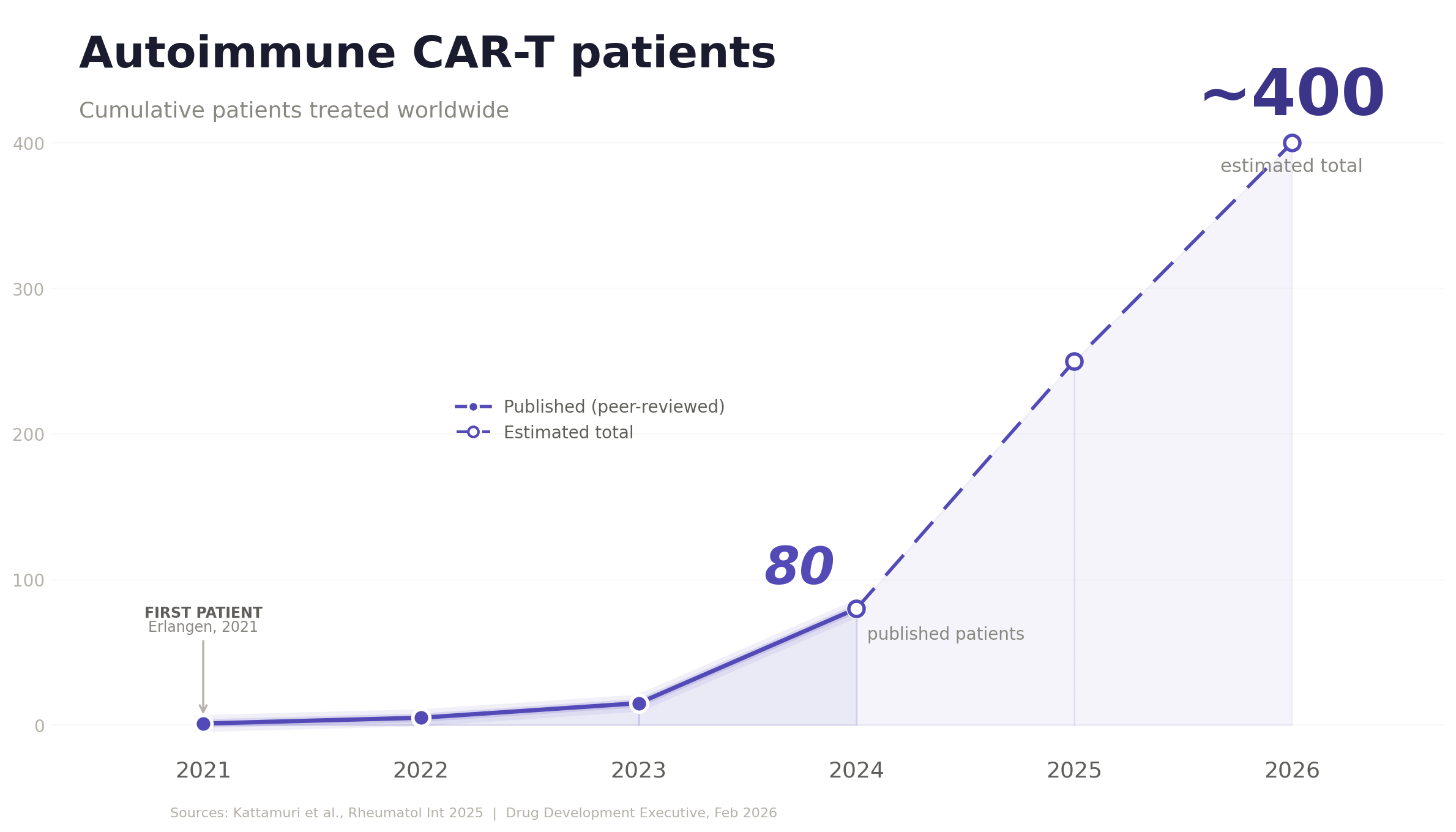
4. We are flying blind on safety. A systematic review identified roughly 80 published autoimmune CAR-T patients across 24 studies through 2024. A generous current estimate is around 400 total treated worldwide as of early 2026 (Figure 2). For context, the FDA needed 34,400 oncology CAR-T patients before it detected the T-cell lymphoma safety signal that triggered a boxed warning in 2024. The short-term data look reassuring (low-grade CRS, minimal ICANS among reported cohorts), but it will be even longer before we fully understand the risk/benefit calculus for CAR-T.
No posts
Comments
Nothing yet. Say the first thing.
Sign in to join the conversation.