
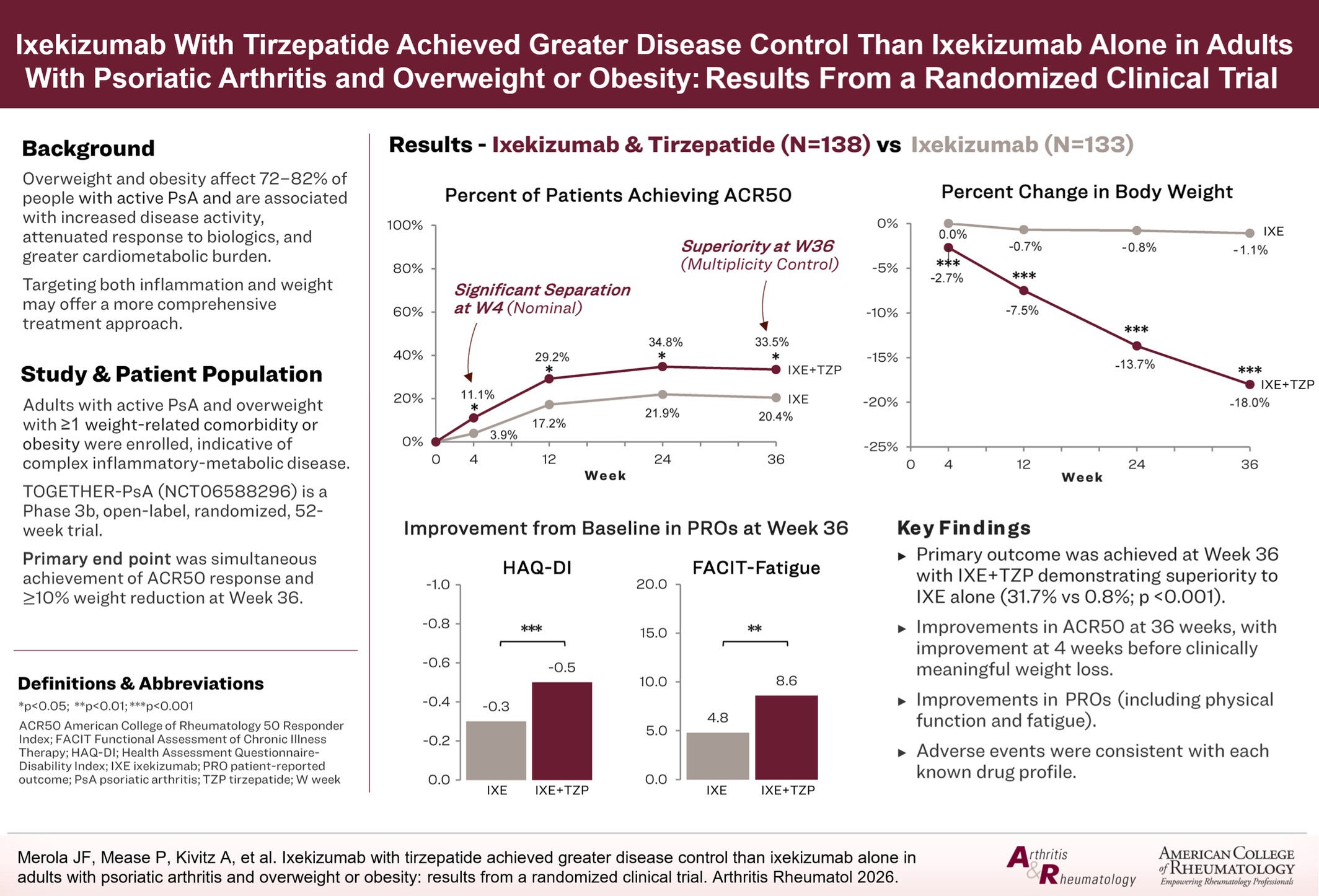
The EBR Journal Club Companion applies my adapted version of the JAMA approach to critical appraisal to an important RCT in rheumatology. Each review covers four domains: Does this apply to my patients? What is the risk of bias? How great are the benefits and harms? And what didn’t they show me? Feel free to use this in your own journal clubs! This edition: TOGETHER-PsA (ixekizumab + tirzepatide in psoriatic arthritis).
TRIAL: TOGETHER-PsA (NCT06588296)
DRUG: Ixekizumab (Taltz, IL-17A monoclonal antibody) concomitantly with tirzepatide (Zepbound, dual GIP/GLP-1 receptor agonist)
DISEASE: Active psoriatic arthritis with overweight + comorbidity or obesity
DESIGN: Phase 3b, open-label, randomized 1:1, multicenter (US only), N=271, 36-week interim of a 52-week trial
JOURNAL: Arthritis & Rheumatology, April 2026
SPONSOR: Eli Lilly and Company
PRIMARY ENDPOINT: Simultaneous achievement of ACR50 + ≥10% weight reduction at week 36. MET (31.7% vs. 0.8%, p<0.001). Really though the thing that mattered was the ACR50, which it also met!
THE TAKE: A useful trial that locks in the cardiometabolic case for adding a GLP-1 to a biologic for patients with obesity + PsA. The composite primary endpoint and open-label design flatter the disease-activity benefit; the ACR50 delta is still 13 points, which is real but modest. I have already been prescribing more GLP-1s in this population (and said as much when I covered this topic in The Differential in January); this gives tacit support for that practice
Who they enrolled: 271 adults with active PsA, had to meet CASPAR criteria (≥3 tender, ≥3 swollen). Mean BMI 37.6 with obesity related comorbidities; 87.5% had a BMI ≥30. Baseline DAPSA 51 (high disease activity), 70% women, which is notable because women historically respond worse to biologic therapy in PsA. Most had recieved prior b/tsDMARD and 1 in 5 had failed two or more classes. Overall a more refractory and heavier population than your typical pivotal PsA trial.
Diversity: 84% White, 26% Hispanic/Latino, only 3% Black or African American. US-only enrollment (including Puerto Rico). Less geographically diverse than the SPIRIT program, and underrepresentation of Black patients is unfortunate given the well-documented inequities in PsA recognition and care.
Who they excluded: Patients with prior IXE or TZP exposure, prior IL-17 or GLP-1 failure, or failure of more than three advanced classes. All pretty reasonable. Notably, Lilly is running a separate trial (NCT06864026) that adds TZP to existing IXE
Background therapy: Stable csDMARDs permitted. All participants got dietician counseling for diet and exercise. Both arms got real lifestyle co-intervention, which is often missing from biologic trials.
Bottom line: The patients look like the patinets with obesity + PsA in my clinic, with the caveat that nobody had previously failed an IL-17 and the racial diversity could have been better
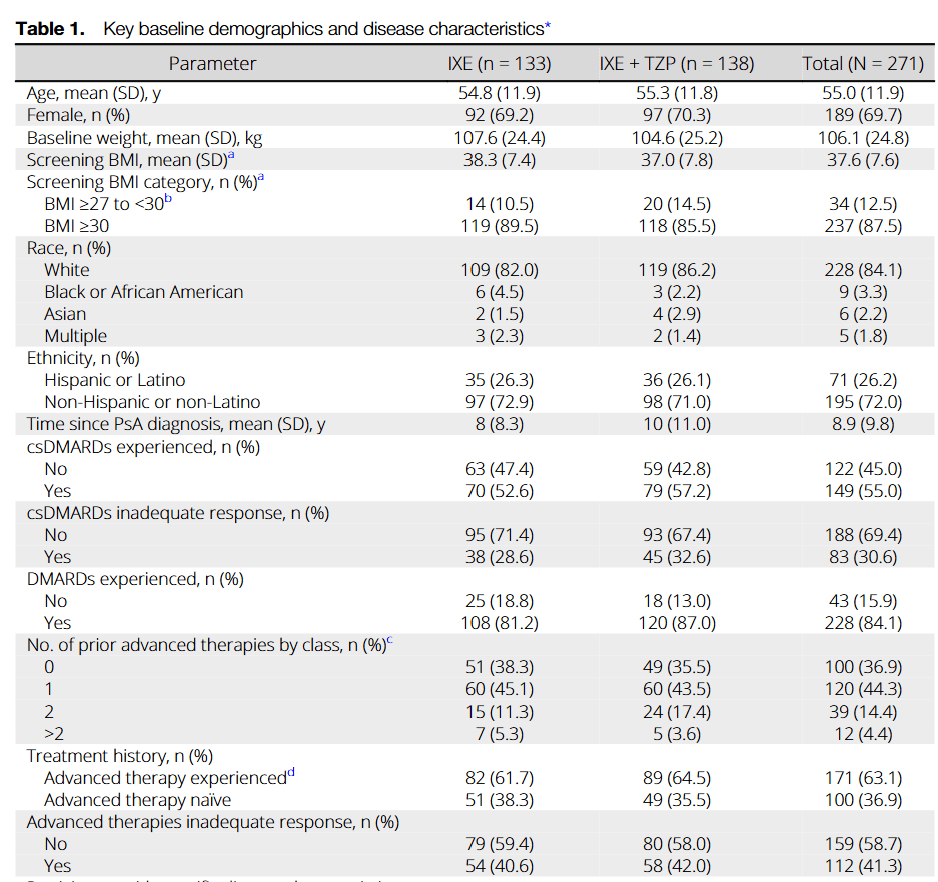
Randomization: 1:1, stratified by sex, prior advanced therapy use, and baseline BMI category. Baseline characteristics looked reasonably balanced, with some imbalance in DAPSA (55 in IXE alone vs. 47 in IXE + TZP). Minor, probably not consequential.
Blinding: LOLZ. The trial was open-label for sites, participants, and the sponsor. The investigators justified this by arguing that early weight loss would unblind anyone who got TZP regardless, which is honestly pretty fair. They tried to mitigate with blinded joint and skin assessors, so kudos for doing the best you could.
RED FLAG: Open-label design plus a long list of patient-reported outcomes (FACIT-F, PsAID, pain VAS, SF-36) is a recipe for expectancy-driven inflation. The HAQ-DI difference was 0.2 (clinically meaningful threshold is 0.35), and most of that signal probably comes from people feeling better because they’re losing weight and they know they’re getting the active arm. Blinded joint counts help. Patient-reported outcomes do not have that protection (and neither does ACR50, which includes them)
Comparator: IXE alone, with no IXE + saline injection arm. So we can’t separate the pharmacologic effect of TZP from the experience of taking weekly injections of an active drug that produces visible results. This matters more than it might sound, because the question “does adding TZP help PsA disease activity” gets confounded with “does feeling thinner make patients report better PsA outcomes.”
Attrition: 33% discontinuation in IXE alone vs. 15% in IXE + TZP at week 36. That is a big differential, mostly driven by lack of efficacy (6.8% vs. 0.7%) and patient withdrawal (12% vs. 2.2%). Patients in the IXE-alone arm essentially knew they were getting the boring arm and bailed. The hypothetical estimand handles this with multiple imputation, which is the right statistical move, but no estimand fully solves a 2:1 differential dropout. Also, multiple imputation is sorcery, so there’s that.
Sponsorship: Lilly designed, funded, ran, analyzed, and wrote the trial. Lilly makes both drugs
Bottom line: The methodology is fine for a phase 3b commercial-use study, but the open-label design and differential dropout meaningfully limit how much weight (pun intended) you should put on the patient-reported outcomes.
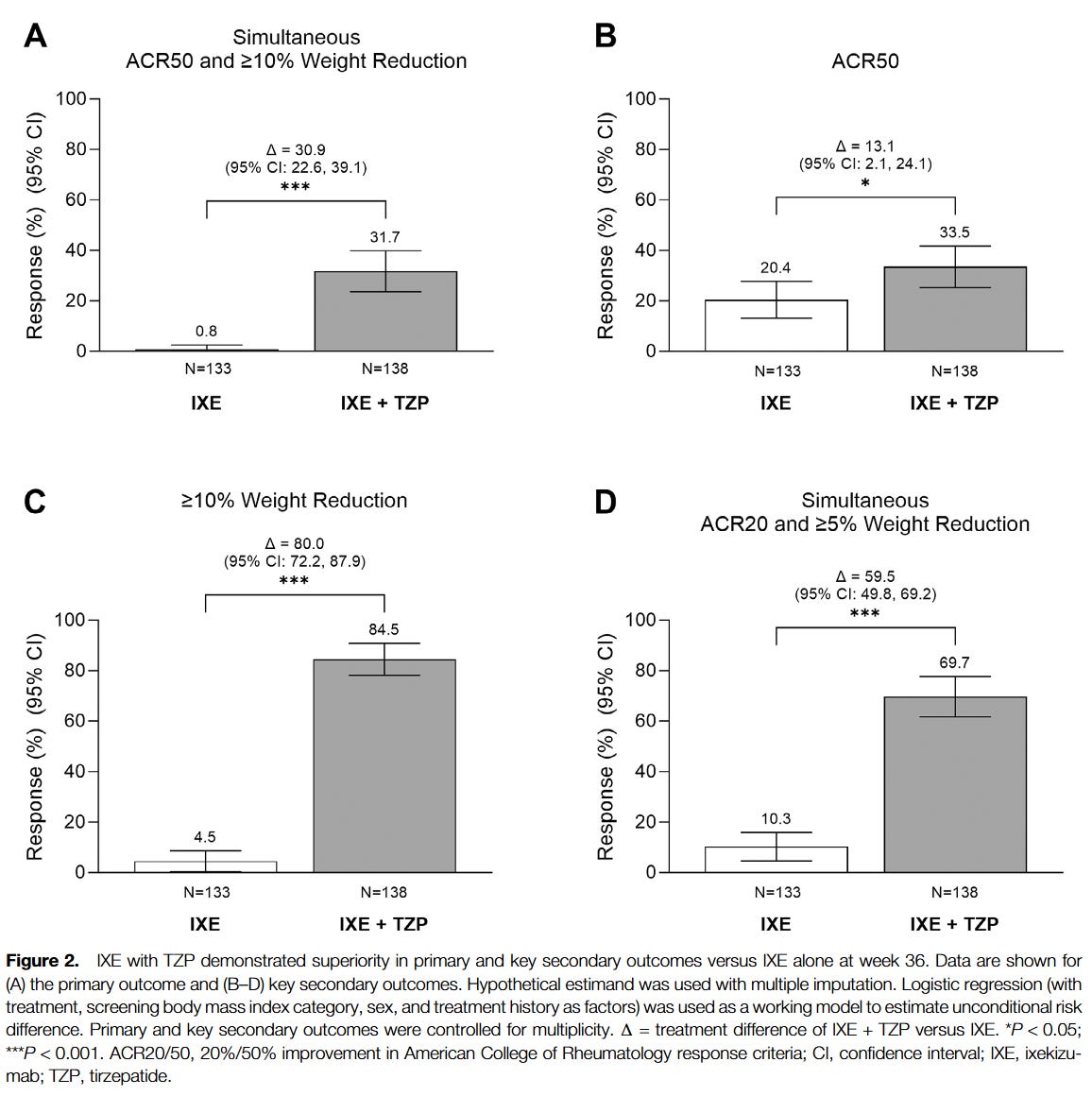
Primary endpoint (composite ACR50 + ≥10% weight loss at week 36): 31.7% vs. 0.8%, Δ 30.9% (95% CI 22.6 to 39.1; p<0.001). This headline is striking but tautological. Achieving ≥10% weight loss requires TZP. IXE doesn’t make people lose weight (4.5% achieved this in the IXE arm, basically lifestyle responders). The composite primary endpoint is essentially asking “does TZP cause weight loss?” with extra steps.
ACR50 alone (the PsA-specific question): 33.5% vs. 20.4%, Δ 13.1% (95% CI 2.1 to 24.1; p=0.02). NNT around 8. Real and statistically significant, but not transformative. For context, SPIRIT-H2H reported ACR50 around 36% with IXE alone in biologic-naïve PsA at 24 weeks; here we get 20.4% in a heavier, more refractory population at 36 weeks. The biologic-resistance-of-obesity story holds.
Early separation: ACR50 differed by week 4 (11.1% vs. 3.9%), well before clinically meaningful weight loss. Two interpretations: TZP has a direct anti-inflammatory effect (hsCRP did drop more in the TZP arm, and the SURMOUNT investigators have argued for this), or early unblinding from injection-site reactions and GI symptoms drove differential subjective response. Listeners of my podcast will know that I am skeptical of pathophysiology, so I’ll let you guess where I land. Probably some of both, honestly.
Weight, cardiometabolic: -18% body weight, -6.3 BMI units, -7 mm Hg systolic, -23 mg/dL glucose, -0.7% HbA1c, -39 mg/dL triglycerides, all in line with SURMOUNT-1. TZP works for weight loss when given to patients with PsA. Not a surprise.
Safety: Nausea 30% vs. 3%, diarrhea 18% vs. 4%, vomiting 11% vs. 1%. Typical incretin GI signature, none of it new. SAEs lower in IXE+TZP (3.6% vs. 7.6%); no deaths. Discontinuation for GI AEs was 2.9% in IXE+TZP, comparable to SURMOUNT-1. No surprises.
Bottom line: The cardiometabolic benefit is the most clinically compelling and clearly real. The disease-activity benefit is real but modest, and the open-label design probably inflates the patient-reported outcomes.
RED FLAG: No active comparator. We learn that IXE + TZP beats IXE alone, but we don’t learn whether IXE + TZP beats a more potent biologic alone (risankizumab, deucravacitinib, upadacitinib, the bimekizumab class). We also don’t learn whether GLP-1s pair specifically well with IL-17, or whether you’d see the same effect with a TNFi or JAKi.
The trial I wish I had: A factorial 2x2 of (biologic vs. biologic) by (TZP vs. placebo). Or, more practically, a head-to-head of IXE + TZP vs. risankizumab alone in obese PsA. The clinical question I face in clinic isn’t “should I add TZP to IXE?” It’s “should I switch this patient’s current biologic, or add a GLP-1, or both?” Kind of asking for too much there I suppose.
Other gaps: PsO endpoints were exploratory because most patients didn’t have moderate-to-severe psoriasis (the dedicated PsO trial, NCT06588283, will answer that). There’s no information on patients who fail IL-17 first and add TZP later. The 52-week data are coming.
Bottom line: The biggest gap is the absence of any comparator other than the same drug minus the GLP-1. Useful, but doesn’t tell us where this combination sits in the broader treatment hierarchy.
For my obese PsA patient on or starting a biologic, I am increasingly confident about adding a GLP-1. The cardiometabolic case is now locked in with phase 3 data, and the disease-activity signal, though modest after you discount the trial’s design choices, adds reassurance rather than changing the calculus.
The composite primary endpoint is doing PR work. “31.7% vs. 0.8%” is a press-release number. The actually interesting clinical number is the standalone ACR50 (33.5% vs. 20.4%, Δ 13 points). When you read about TOGETHER-PsA in talks and tweets, separate the ACR signal from the weight signal.
Open-label design plus a wall of patient-reported outcomes is a structural problem. When patients know they’re losing weight, they tell you they feel better. The HAQ-DI, FACIT-F, and PsAID effects in this trial should be interpreted with that in mind. Blinded joint counts are the cleanest signal; everything else is contaminated. But does that really matter? If I met inclusion criteria for this trial, I would have happily enrolled in the treatment group.
The trial we still need is one that asks whether adding a GLP-1 to a biologic outperforms switching to a more effective biologic alone. Until then, the question of which biologic to pair with the GLP-1 is ongoing.
EBR Journal Club accompanies the Evidence Based Rheumatology Podcast. Disclosure: I prescribe many of the medications I discuss in this newsletter. I also participate in clinical trials, unbranded educational activities, advisory boards, and consulting. Views my own, not those of my employer.
No posts
Comments
Nothing yet. Say the first thing.
Sign in to join the conversation.