
The EBR Journal Club Companion applies my adapted version of the JAMA approach to critical appraisal. Each review covers four domains: Does this apply to my patients? What is the risk of bias? How great are the benefits and harms? And what didn’t they show me? Feel free to use this in your own journal clubs! This edition: VALOR (brepocitinib in dermatomyositis).
TRIAL: VALOR (NCT05437263)
DRUG: Brepocitinib — oral, selective TYK2/JAK1 inhibitor (blocks IFN, IL-6, IL-12, IL-23 signaling)
DISEASE: Active dermatomyositis (skin + muscle, treatment-refractory)
DESIGN: Phase 3, randomized, double-blind, placebo-controlled, 1:1:1, N=241, 52 weeks, 90 sites / 20 countries
JOURNAL: NEJM, March 28, 2026
SPONSOR: Priovant Therapeutics (Roivant subsidiary)
PRIMARY ENDPOINT: Mean Total Improvement Score (TIS) at week 52 — MET (30 mg only)
THE TAKE: First targeted therapy to ever succeed in a registrational DM trial. FDA Priority Review with Q3 2026 PDUFA. Will become first-line add-on for refractory DM, but 10% serious infection rate needs careful attention & honestl I have no idea where it fits with MTX/MMF/AZA or how it interacts with IVIG (together? replaces?)
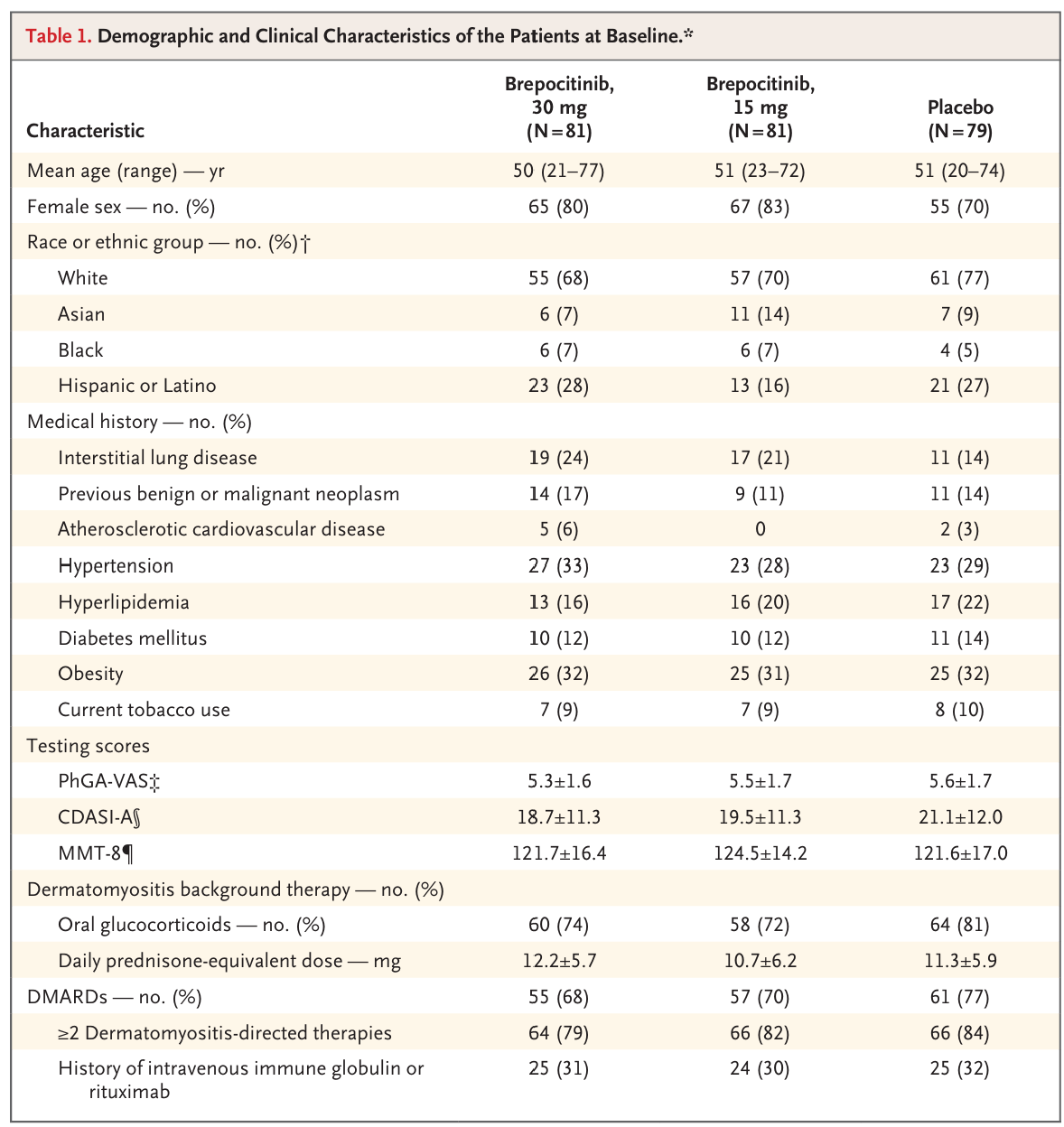
Who they enrolled: Adults 18–75, definite/probable DM by 2017 EULAR/ACR criteria, with both active skin (CDASI-A ≥6) and active muscle (MMT-8 80–142). All had failed ≥1 prior systemic therapy. Mean age 51, 78% female. Mean CDASI-A 19.8, mean MMT-8 122.6 — solidly moderate-to-severe. 81% on ≥2 DM-directed therapies at baseline, 75% on oral steroids (~11 mg/day prednisone equivalent), 25% with prior IVIG, 11% prior rituximab. This is a treatment-refractory population (and it looks like your clinic).
Diversity: 72% White, 10% Asian, 7% Black, 7.5% Mestizo, 24% Hispanic/Latino. Twenty countries. 91 of 241 patients from the US. Reasonable global representation for a rare disease.
Who they excluded: Treatment-naïve patients (fair), overlap myositis except secondary Sjögren’s (fine but a bummer; overlap is common in practice), severe end-stage organ disease, anyone on JAK inhibitors or rituximab within 6 months. The rituximab washout means the hardest-to-treat RTX failures may be underrepresented & no IVIG is super annoying
Comorbidities: Deliberately permissive enrollment; 14% prior neoplasm, 20% ILD, 65% with ≥1 CV risk factor. This was smart given the JAK safety overhang (good trial design decision!).
Background therapy: Stable DMARD + antimalarial permitted. Steroids tapered to ≤20 mg before randomization, mandatory taper to ≤5 mg by week 36, further tapering encouraged.
Bottom line: These patients map well to the refractory DM patients I see, with the notable exception of overlap myositis and recent RTX failures / IVIG use
Randomization: 1:1:1 stratified by physician global assessment (mild-moderate vs. moderate-severe). Baseline characteristics well balanced. The three-arm design is probably FDA mandated and worked - nice to see a dose response
Blinding: Double-blind, identical oral capsules. Lab changes (lymphocytes, CK) could theoretically unblind, but no systematic unblinding concerns reported. TIS relies partly on physician-assessed components (PhGA-VAS, MMT-8); any unblinding leaks into efficacy. Not unique to this trial but worth noting.
Comparator: Placebo + standard therapy with mandatory steroid taper. Right design for first-in-disease registration, but without a comparator (say, IVIG), the clinical positioning is “add to standard therapy” not “use instead of X.” I think? Hard to know.
Attrition: Excellent completion: 87% overall. 30 mg arm completed at 93% vs. placebo at 82% (the drug kept people in the trial). Rescue meds: 15% on 30 mg vs. 30% on placebo (drug worked). Sensitivity analyses (MI and treatment-policy estimand) both confirmed the primary result; MI showed slightly attenuated but still significant effect (12.5 vs 15.3 point difference).
Sponsorship: Priovant funded, provided drug, collaborated on design/analysis. Three Priovant employees among authors. Independent DMC and independent AESI adjudication committee; appropriate safeguards, but this is a single-company program with no independent replication yet.
Bottom line: Well-executed trial with low overall bias risk. The internal dose-response adds credibility. Main interpretive limitation is placebo comparator — fine for registration, not enough for clinical positioning vs. IVIG.
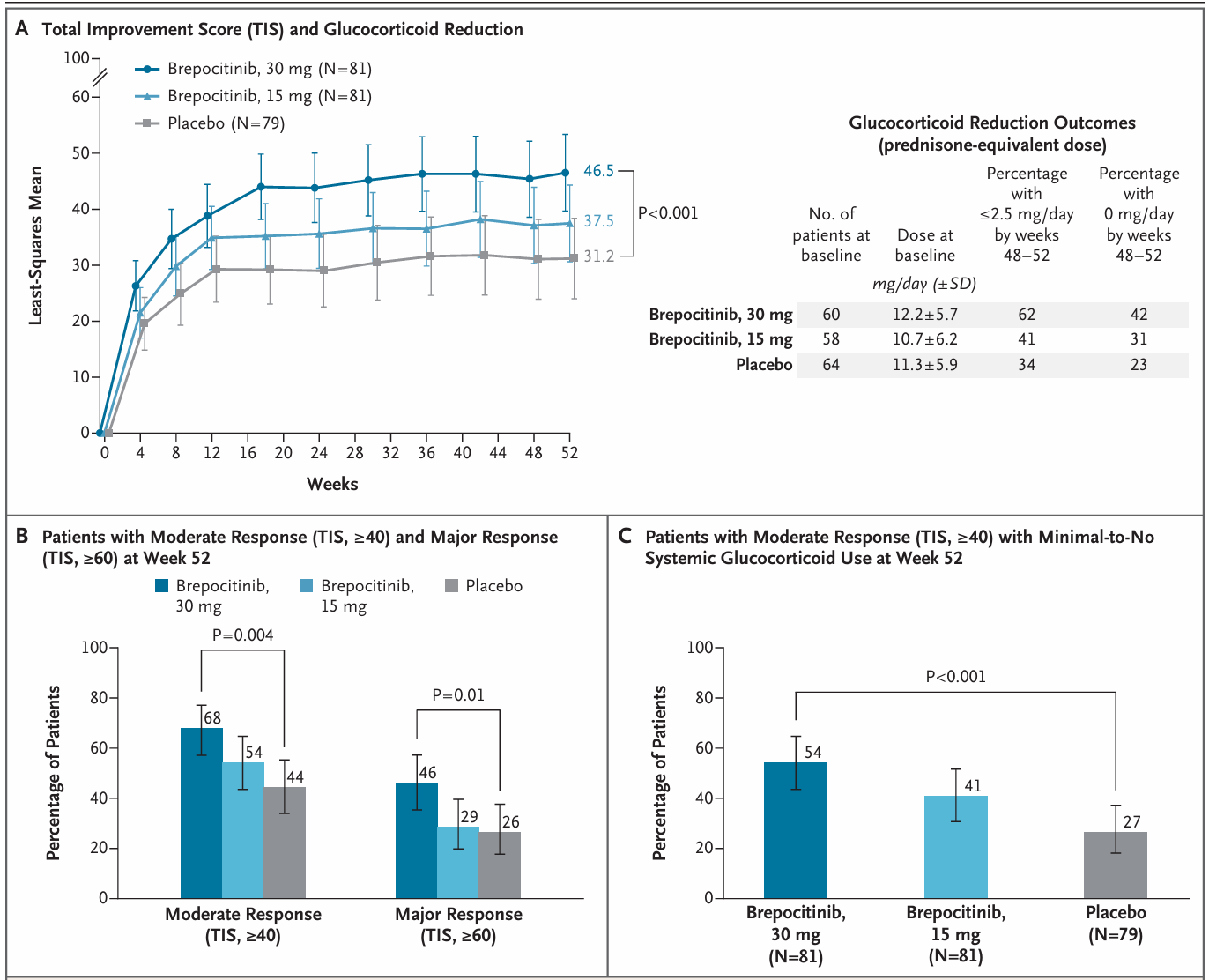
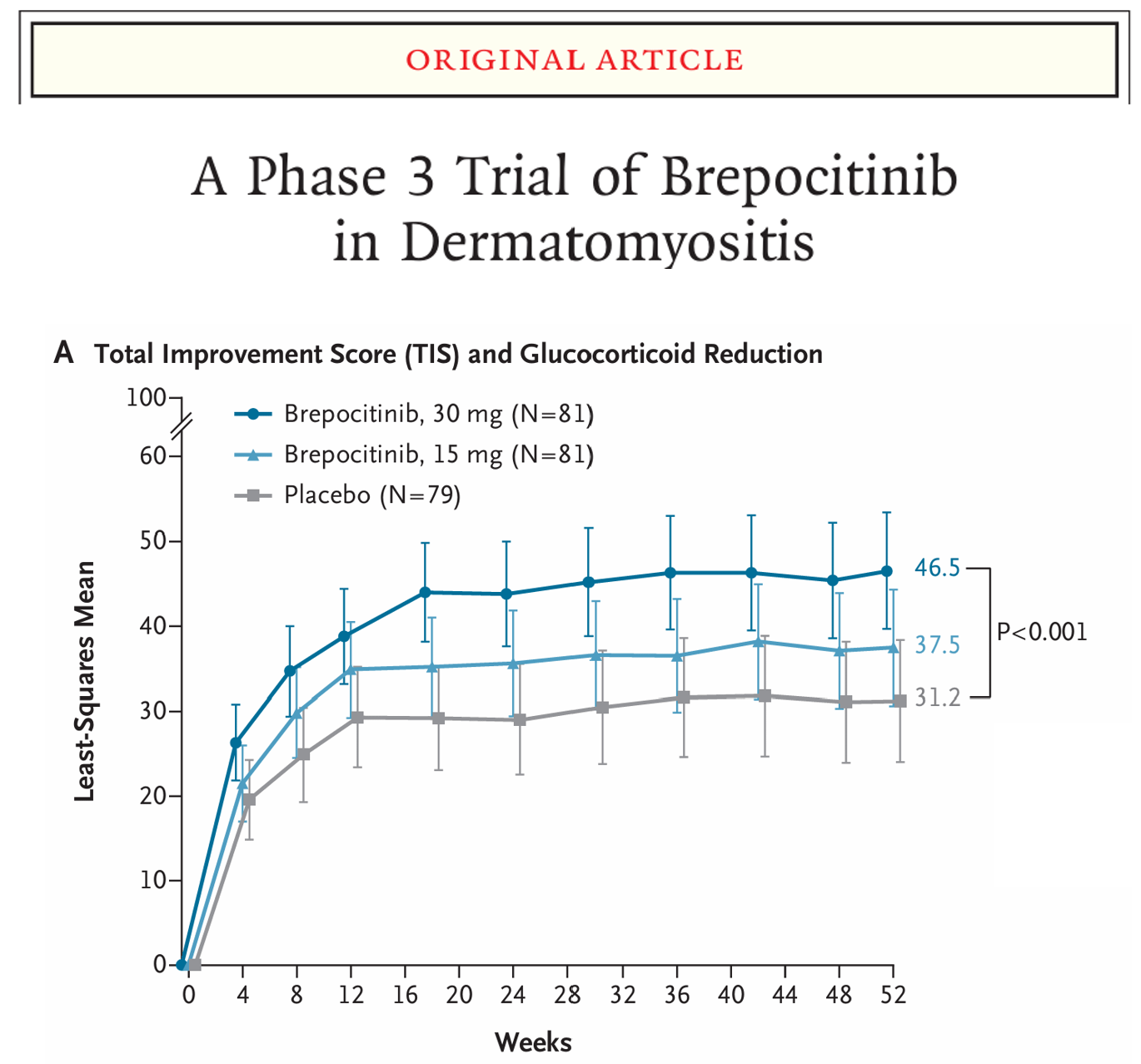
Primary endpoint (TIS at week 52): 46.5 (30 mg) vs. 31.2 (placebo), Δ 15.3 (95% CI 6.7–24.0, P<0.001). For context: TIS ≥40 = moderate improvement, ≥60 = major. Placebo didn’t clear moderate; 30 mg did. The 15 mg landed at 37.5 — numerically between, statistically not different from placebo (that’s the dose-response story).
Responder analyses (all met in hierarchical testing): Moderate response (TIS ≥40): 68% vs. 44% (NNT ~4); major response (TIS ≥60): 46% vs. 26% (NNT ~5); moderate response + steroid ≤2.5 mg/day: 54% vs. 27% (NNT ~4) — historical 1-year DM remission rate on standard therapy is ~14%, so these numbers are genuinely impressive
Steroid sparing: Among those on steroids at baseline, 62% of 30 mg group tapered to ≤2.5 mg/day, 42% got to 0 mg (vs. 34% and 23% placebo). Cumulative steroid exposure weeks 12–52: 1,383 mg vs. 1,778 mg. That’s ~400 mg less prednisone over 10 months (clinically meaningful for bones, glucose, and infection risk).
Skin: CDASI-A improvement significant by week 4 (−6.4 vs. −3.5, P<0.001). Among moderate-to-severe skin at baseline, 44% achieved cutaneous remission (CDASI-A ≤5) at week 52 vs. 21% (for a skin-defining disease, that’s a big number!).
Function: HAQ-DI change exceeded MCID (−0.337 vs. −0.042, difference −0.295 vs. MCID 0.22). Patients could actually tell they were better (DM trials historically struggle to move patient-reported function).
Safety: Overall AE ~90% all groups. The signal: serious infections 10% (30 mg) vs. 2% (15 mg) vs. 1% (placebo) — real, dose-dependent, and will be front-and-center at FDA. All thromboembolic events, malignancies, and CV events (except one CVA on 30 mg) occurred in the placebo arm — plausibly reflects baseline DM risk + chronic steroids. Really no deaths in the entire 52-week trial (notable for comorbid DM!).
Bottom line: Brepocitinib 30 mg delivers clinically meaningful improvement in muscle, skin, function, AND steroid sparing simultaneously. An unusually clean sweep for DM / CTD. The 10% serious infection rate is real and dose-dependent, but also steroid sparing will mitigate this
RED FLAG: No systematic MSA subtyping. Jo-1 was captured from classification criteria but no systematic testing for MDA5, Mi-2, NXP2, TIF1γ, etc. Post-hoc Jo-1 subgroup (n=34) showed similar treatment effects — but we don’t know how IFN-high subtypes (especially anti-MDA5) respond. The mechanistic rationale predicts they’d respond well
RED FLAG: No ILD-specific efficacy data. 20% had ILD at baseline, but the only pulmonary data is a supplemental FVC table with tiny n’s (9–16 per arm) showing stable lung function. ILD is the leading cause of DM mortality. This gap matters most for the anti-MDA5 population, especially given that funky tofa paper from a few years back.
The trial I wish I had: Brepocitinib vs. IVIG head-to-head OR brepocitinib vs MTX with IVIG background therapy. ProDERM (IVIG in DM, NEJM 2022) used the same TIS endpoint — mean 55.4 at week 40 in the active arm, but crossover design with different baseline severity makes naive comparison hazardous. The real prescribing question will be: oral daily pill vs. monthly infusion… or both? Patient preference, insurance, ILD status, and infection tolerance will all be big mitigating factors.
Other gaps: Background DMARDs locked for 52 weeks (in practice you’d taper — the OLE will tell us about real-world de-escalation). No formal dose-finding preceded VALOR, but this found the dose
Bottom line: The MSA subtype story is the biggest unanswered question — and the one that’ll determine how precisely we can deploy this drug.
Brepocitinib 30 mg is the first targeted therapy to succeed in a registrational DM trial. 15-point TIS delta, clean sweep of all nine secondaries, strong steroid-sparing… a landmark result for a disease that has defeated multiple drug programs (RIP lenabasum). Expect FDA approval by late 2026.
The narrow therapeutic window is the design vulnerability. 15 mg failed; 30 mg works but carries 10% serious infections. No middle ground to test. In practice this means attentive infection surveillance in patients who are basically all on background immunosuppression already.
The real prescribing question is brepocitinib vs. IVIG, and we don’t have that trial. Oral pill vs. monthly infusions. Cost, ILD status, and infection risk tolerance will decide… but Priovant hasn’t disclosed pricing yet.
Without MSA subtyping, we’re treating DM as one disease. It isn’t. If you prescribe this, consider MSA testing at baseline to build your own real-world subgroup data — because the trial didn’t do it for us.
EBR Journal Club accompanies the Evidence Based Rheumatology Podcast. Disclosure: I prescribe many of the medications I discuss in this newsletter. I also participate in clinical trials, unbranded educational activities, advisory boards, and consulting. Views my own, not those of my employer.
No posts
Comments
Nothing yet. Say the first thing.
Sign in to join the conversation.