
Critical Commentary takes a deep dive into one argument on a systemic problem in autoimmune drug development - trial design, regulatory strategy, industry incentives, or the gap between evidence and practice.
In late July the FDA’s Pharmacy Compounding Advisory Committee will spend two days deciding whether a handful of “peptides” should move one step closer to legal compounding. The headliner is “BPC-157,” a substance whose PubMed footprint now runs north of two hundred papers. Those publications include fewer than 40 actual humans, there is no identified high-affinity receptor for BPC-157 in the human body, and no randomized trial has ever demonstrated any evidence that it works. So why is the FDA spending time on this topic?
Mostly because it’s “having a moment.” BPC-157 has been a frequent guest on the Joe Rogan podcast, receives backing from Gary Brecka (a purveyor of nasal-sprayed BPC-157 for $375 a pop), and got a boost on Andrew Huberman’s popular neuroscience-ish podcast. The formula is pretty simple: health-guru-dude shares a personal anecdote on a podcast segment, the segment gets picked up and shared through social media, and one of my patients is now spending a small fortune to have their Lyme disease cured by BPC-157.
To date the reporting on BPC-157 has been surprisingly credulous, with a few notable exceptions. This will not be one of those pieces. I think BPC-157 is an expensive placebo being shilled for cash on the back of anecdotes and vibes. It is pseudoscientific nonsense of the first order. Despite that, your patients (and the FDA) will be talking about this a lot. This one turned into a wild ride - hope you enjoy!
What’s a peptide and why is it so peppy?
Let’s start with the word “peptide,” because I think it’s carrying an outsized amount of weight. “Peptide” is a short and punchy word. “Peptide” rolls off the tongue and suggests it’ll give you a pick-me-up; like Dr. Pepper, it’ll put some pep in your step. Many non-medical people (and apparently some medical people as well) seem to think peptides are some exciting new discovery in the world of medicine. This is ridiculous. Peptides are not some novel biomedical invention. A peptide is just a short chain of amino acids, bigger than a single amino acid and smaller than a full protein. That’s it.
As a drug class, peptides are about as far from fringe as it gets. Notable peptides include oldies-but-goodies like insulin, hospital workhorses like vasopressin, and cancer drugs like leuprolide. GLP1’s like semaglutide and tirzepatide are also peptides, which I suspect adds to the confusion. “Everyone is on peptides now!” These are neither new discoveries nor fringe science; they are some of the most important drugs we have, and they’ve been around for a long time. BPC-157 is just another peptide - a string of 15 amino acids that is selling like hot cakes.
I should note here that being a string of 15 amino acids is also remarkably un-special. Amino acids can be arranged in any order you like, so a chain of 15 amino acids has 20^15 possible sequences, or about 3.3 x 10^19, which is 33 quintillion possibilities. A few of those 33 quintillion might be a blockbuster drug. Some might (probably would*) be carcinogenic or outright poisonous. The vast, vast majority (many quintillions of them) would be completely inert: random strings of amino acids in some incoherent order that your body simply metabolizes back into its constituent parts and repurposes into something that’s actually useful. The word “peptide” tells you nothing about the chemistry of whatever you’re putting into your body, and nothing at all about the evidence for its utility.
Just a Guy with a Dream
BPC-157 existed long before podcasts, iPhones, or really even the internet for that matter. I strongly recommend the recent reporting by Undark if you want the full rundown. The quick summary is remarkably fun and occasionally (unintentionally?) hilarious. In short, in 1975 a medical student in Zagreb named Dr. Predrag Sikiric decided that the stomach, which can be injured by stress, must logically make its own protective anti-stress compound. He set out on a quest to discover this substance, which sounds glamorous and exciting but was really just him subjecting hordes of rats to various smelly liquids he isolated from various gastric juices. After years of effort he eventually isolated what he called “Body Protection Compound 157,” or BPC-157 for short.
When they first isolated it, the scientists in Zagreb did not have the tools to fully characterize it. The 15-amino-acid sequence they eventually settled on (GEPPPGKPADDAGLV) is published and public; what was never published in any reproducible way is a parent protein or the original isolation. Moreover, no gene encoding the peptide’s particular sequence has ever turned up in the human genome or the gut microbiome. Asked recently whether the molecule is even what the original team believed it was, one of Sikiric’s collaborators told Undark, “As long as it works and has no side effects, who cares?”
If you read my work, you know I’m not big for pathophysiology. Listen to my episode a while back about TNFs and heart failure; we went from thinking they would reverse it completely to worrying that TNFs actively cause exacerbations. This is different because the entire case for BPC-157, as far as I can tell, boils down to “I know someone who took it and was cured of something. Also, it’s real science.” Anecdotes are no basis for public policy, and since when do we not care that the origin story of a molecule appears to be nonsense?
Even a cursory read through the established facts is pretty shocking. Fifty years on, three decades of publishing, and still nobody has shown what BPC-157 actually binds. A 2026 biopharmaceutical review in a journal I do not trust said there is no identified high-affinity receptor, no validated molecular target, and a wide disconnect between the tidy preclinical effects and any coherent pharmacology. When even quasi-predatory journals are publishing skeptical think pieces, you should pause a beat.
Almost every peptide we use works by latching onto a specific receptor, the way insulin finds the insulin receptor. The claim that BPC-157 can heal half the body’s ailments without any evidence that it has any actual target in the human body is an astonishing claim. I am usually happy to hold a mechanism loosely and let the data lead. But “we can’t find a receptor, can’t name a target, and can’t find a gene for it in your genome” is just giving up on science entirely.
Speaking of #Science
I would forgive BPC-157 its shady origin story if not for its remarkably shoddy (nonexistent?) clinical development program. Over fifty years of hype, and BPC-157 has never published a single double blind randomized controlled trial. Forget DBRCT - it has never published any controlled efficacy trial of any variety in human beings. As far as I can tell, here is the actual human ledger:
Two industry trials from the early 2000s, when the Croatian firm Pliva developed BPC-157 for inflammatory bowel disease. They ran a Phase I safety study of rectally administered BPC-157 and a randomized, double-blind, placebo-controlled Phase II enema study in ulcerative colitis. Neither were published and Pliva was so excited about the results it abandoned the drug entirely
One Phase I safety and pharmacokinetics trial of oral BPC-157, registered in 2015, that has no public results and appears to have been withdrawn or abandoned
Three small and nonrandomized uncontrolled pilot studies from a single for-profit clinic in Florida, which included a 16-patient knee-pain chart review, a 12-woman interstitial cystitis study, and a small intravenous safety study
One legitimate entry: a registered Phase 2 trial of BPC-157 for acute hamstring strain. I’m actually curious to see how that one plays out.
My first plan for this topic had been to do a quick podcast on the data behind BPC-157, but there is literally nothing to talk about. There is no data. There are no studies. There is no clinical science, and the “basic science” is remarkably alarming.
You Can’t Fix Perfection
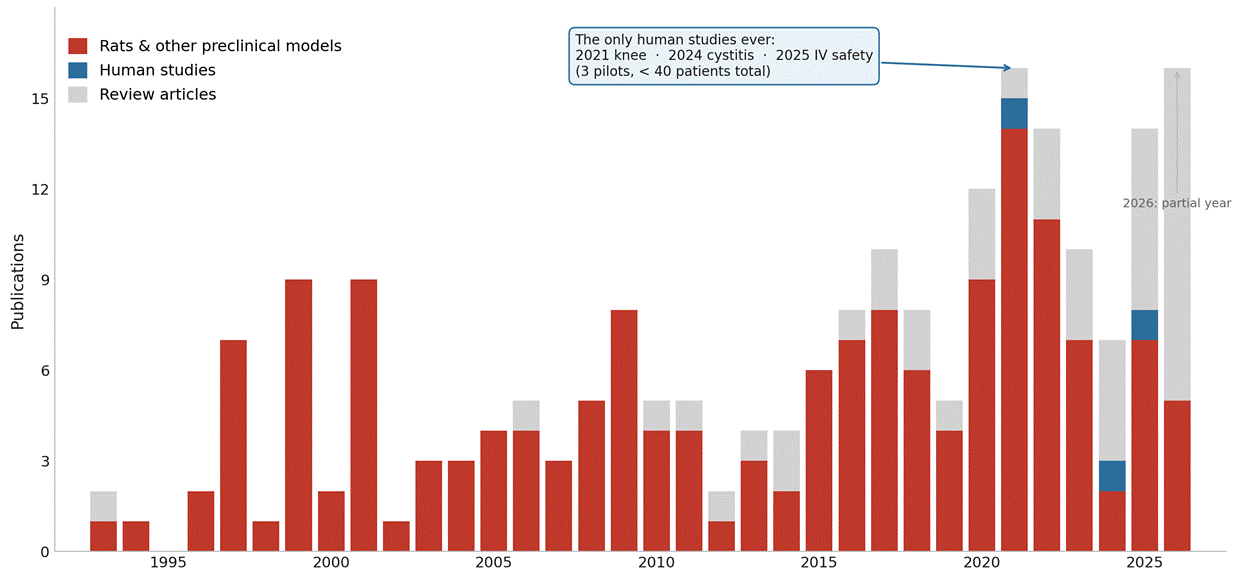
I just alluded to that mountain of papers, almost none of which merit even passing discussion in a journal club. So what, exactly, is all that publishing about? I scraped PubMed in May and June of 2026, discovering 211 BPC-157 records. This included 166 original reports, 45 review articles, and not a single study tagged as a clinical trial. Charted by year, the literature tells the whole story.
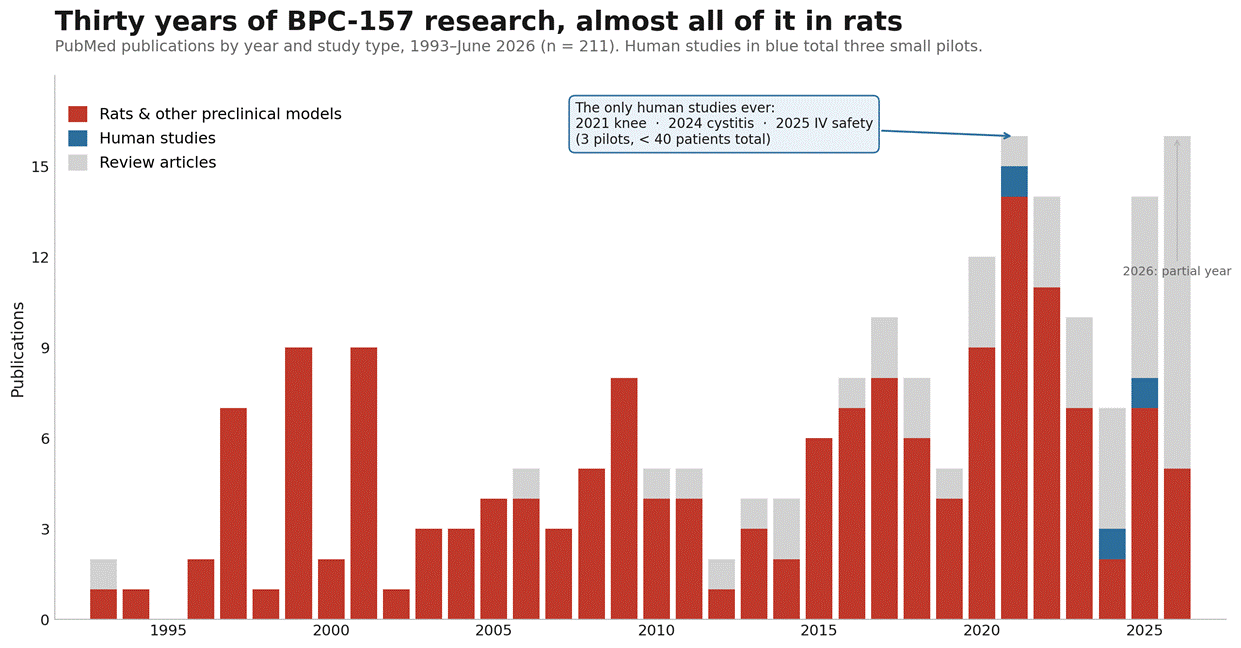
BPC-157 PubMed publications by year and study type, 1993 to June 2026 (n = 211)
First, the post-2020 surge in the figure is driven by a proliferation of review articles that recycle the same data from the same rodent experiments. The ratio of review articles to original studies is something like two to one in 2026. We are not seeing an explosion of new research; we are seeing an explosion of hype, repackaging older studies.
Second, the original research seems determined to prove James Heathers’s “In Mice” meme. The majority of the studies (see above in red) are preclinical studies in rodents, the vast majority of which have been done by a single research group in Croatia, which has been rinsing and repeating the same approach for decades. Feel free to click through yourself, but here are some entertaining highlights:
BPC-157 shortens bleeding time in rats and also boosts platelet aggregation and clot formation.
BPC-157 treats high blood pressure AND low blood pressure, occasionally in the same rat
BPC-157 rescues rats from too much nitric oxide AND too little. It reverses the effects of L-arginine (the NO precursor) and L-NAME (the NO blocker). Whatever your nitric oxide problem, the peptide is somehow the answer.
BPC-157 is an antidepressant in the forced-swim test, anxiolytic in the light/dark test, and active against both the positive-like and negative-like symptoms of schizophrenia. One molecule, the entire psychiatric formulary.
BPC-157 blocks amphetamine stereotypy and rescues haloperidol-induced catalepsy
BPC-157 is anti-nociceptive in an incisional-pain model but if you need it in a pinch it counteracts morphine’s analgesia and lithium toxicity
BPC-157 corrects basically any electrolyte problem in any direction: hyperkalemia, hypermagnesemia, and honestly you should just read this litany of various electrolyte disturbances that BPC-157 handles with ease
BPC-157 reverses both atropine mydriasis and drug-induced miosis in the same rats and guinea pigs.
BPC-157 antagonizes thiopental, counteracts lidocaine toxicity, and shortens corneal numbing.
BPC-157 works in rats, mice, rabbits, dogs, guinea pigs, broiler chicks and - I’m not even kidding - saves honeybee colonies from infestation
The volume, breadth, and audacity of these assertions strain credulity to the breaking point, but somehow they are only the second most incredible thing about BPC-157. The most incredible thing about BPC-157 is that nothing bad (supposedly) has ever happened to any rat (or human or honeybee) who has been exposed to it. I found 34 papers that commented on safety, asserting BPC-157 to be “safe,” “well-tolerated,” or “harmless.” Sikiric’s group has actually claimed that the LD1 dose has not been achieved, essentially asserting that no reasonable quantity of BPC-157 even could be harmful.
This would be an astonishing discovery in the history of science; a highly active molecule with a perfect safety record. It’s a molecule that has a plasma half-life under thirty minutes that nonetheless fixes whatever ails you, in whichever direction you happen to need it fixed, with no side effects whatsoever. And also fixes the bees. It is magic beans or it is pseudoscientific nonsense. I am betting on pseudoscientific nonsense.
Compounding Interest
Why then has the FDA scheduled a hearing to discuss it? The answer has almost nothing to do with science and almost everything to do with the bureaucratic weirdness of compounding laws.
Compounding pharmacies make customized medicines for individual patients, and under section 503A of the Food, Drug, and Cosmetic Act, a pharmacy can compound from a bulk substance only if that substance has an official quality monograph, is a component of an FDA-approved drug, or has been formally added to an approved “bulks list.” BPC-157 qualifies on none of those counts, which is why the FDA placed it in “Category 2” of its 503A bulk-substance review in September of 2023. This is a list of nominated substances that may present significant safety risks in compounding. For BPC-157, the agency cited the potential for immunogenicity, peptide-related impurities, problems characterizing the active ingredient, and a lack of safety data for the proposed routes of administration. Nothing in the published literature has changed.
What is happening this July is that the agency has reopened the question and convened its advisory committee to weigh whether BPC-157, along with six other nominated peptide-related bulk substances, should be added to the 503A bulks list. For BPC-157 the proposed indication is ulcerative colitis, a callback to that abandoned Pliva program. The committee will provide a recommendation, which is not FDA approval or an endorsement of its effectiveness. Even a favorable vote would still require separate, formal rulemaking before anything actually changes.
I suppose a better question is whether that prior determination should have happened at all. It’s not entirely clear to me that BPC-157 is unsafe. If I had to guess, I would say it is a functionally inert string of amino acids with no real safety or efficacy signal at all. This puts me in the strange position of neither believing it works nor believing the FDA is obligated to ban it. On balance I think the FDA should ban it, but the libertarian argument for letting not-obviously-dangerous-things exist seems reasonable.
There is also an upside to allowing legitimate compounding. A large and largely unregulated gray market for BPC-157 already exists. My patients are buying unstandardized and contaminated research-grade vials of who-knows-what off the internet and injecting it into themselves. I have no idea if BPC-157 is safe, but it would be nice to know my patients are actually receiving it from a licensed pharmacy.
Rheum for Doubt
It is fun to point out the madness of BPC-157 in a Substack. It is a lot harder to sit in clinic and discourage someone from using a therapy that their friends and family and favorite podcasters swear by. I have always had three rules for complementary therapies:
1. The therapy is not dangerous.
2. The therapy does not substitute for things I know work.
3. The therapy does not break the bank.
For starters, BPC-157 and the current crop of peptides do not seem to be obviously dangerous, in the way that Diet Coke and Twinkies and acai berries are not obviously dangerous. The unfortunate truth is that big risk signals (let’s say the kind you get from drinking antifreeze) can be spotted from the anecdotal experience of people in the world just trying things, but small-but-serious risk signals (let’s say cardiovascular disease with tofacitinib) are really hard to identify without a proper trial or a proper observational study. Neither of those exist for BPC-157, but I am reasonably confident it is at least safer than drinking antifreeze.
As for pushing out things I know work? This will be highly patient-dependent. I have patients doing peptides on Monday and showing up for their rituximab on Thursday. For those patients, I tend to take a laissez-faire attitude toward complementary therapies that are not obviously-dangerous. It gets more complicated when someone wants to use peptides instead of rituximab in a case where I know rituximab will benefit them. Embracing dual-use in a situation like that may be the right tactic, if for nothing else than to maintain your own credibility. Then of course there is the third group, the one you likely do not meet in your clinic until it’s too late. The people who don’t trust the medical establishment at all and are trying to treat their autoimmune hepatitis with peptides. The tragedy of cases like that fuel a lot of the frustration doctors have with “complementary” medicine.
Breaking the bank is complicated and, again, patient-dependent. The numbers add up fast. Brecka’s nasal spray runs $375, the patch version $575 a month, and almost nobody takes a single peptide. The standard advice is to “stack” BPC-157 with TB-500 and whatever else the podcast of the week pushed that day. None of it is covered by insurance. At least in my experience, the patients most drawn to miracle cures are often the ones least able to afford them. When I hear stories of people skipping vacations to get their BPC-157, I typically provide some gentle pushback.
At the end of the day, doctors can only do so much to oppose pseudoscientific nonsense. If you fight too hard against it, you risk losing your chance to do something useful. Determining what therapies will be available if people want to pursue them is not my job; that responsibility lies with the FDA. We’ll see what they decide.
Where This Leaves Us
1. There is no credible clinical evidence that BPC-157 works. After three decades and more than two hundred papers, there is still no published randomized controlled trial showing efficacy. “Lots of publications” is not the same as “evidence.”
2. If BPC-157 doesn’t trigger your snake-oil antenna then nothing will. It reportedly fixes bleeding and clotting, high and low blood pressure, ulcers and tendons and nerves and tumors, all with no meaningful side effects. That is either one of the great therapeutic discoveries in modern medicine or the too-often melding of shoddy science with the potential for financial gain.
3. I suspect most peptides are safer than the FDA fears, but that is because they just don’t work. Peptides are not magic sauce or a novel invention. They’re just a bunch of amino acids. Most will be harmlessly metabolized away.
4. The FDA meeting is about access, not efficacy, but the grifters will sell the difference. A favorable vote would not make BPC-157 FDA-approved and would not prove that it works; it would clear one compounding obstacle. It will also be seen as regulatory endorsement.
5. If the peptide world is so sure it works, run the trial. Drugs with miraculous benefits require very few patients to meet bars for statistical significance. If this is a parachute, it won’t take much to prove it.
Disclosure: I prescribe many of the medications I discuss in this newsletter. I also participate in clinical trials, unbranded educational activities, advisory boards, and consulting. None of these are relevant to BPC-157. Views my own, not those of my employer.
Comments
Nothing yet. Say the first thing.
Sign in to join the conversation.