
The EBR Journal Club Companion applies my adapted version of the JAMA approach to critical appraisal to an important RCT in rheumatology. Each review covers four domains: Does this apply to my patients? What is the risk of bias? How great are the benefits and harms? And what didn’t they show me? Feel free to use this in your own journal clubs! This edition: REPLENISH (secukinumab in polymyalgia rheumatica).
TRIAL: REPLENISH (NCT05767034)
DRUG: Secukinumab (Cosentyx): a fully human monoclonal antibody against IL-17A, already approved across psoriasis, PsA, axSpA, and a handful of other indications
DISEASE: Relapsed polymyalgia rheumatica
DESIGN: Phase 3, double-blind, 1:1:1 randomized, placebo-controlled; N=381 (127/arm); 52 weeks; 148 sites, 28 countries
JOURNAL: NEJM, June 3, 2026 (NEJMoa2602567)
SPONSOR: Novartis
PRIMARY ENDPOINT: Sustained remission at week 52 (SEC-300 vs placebo). MET (SEC-150 met it too)
THE TAKE: PMR finally has a second mechanism, and I think I would favor it over an IL6 inhibitor. REPLENISH was bigger and cleaner than SAPHYR with a real but modest benefit (NNT ~5). Surprisingly, 150 mg is enough and I would favor that dose. Fungal infections were a known problem beforehand and will be an ongoing concern after. Regardless, I expect FDA to approve
Who they enrolled: Relapsing PMR, so another “not necessarily upfront” trial. Entry required a relapse while tapering prednisone (≥5 mg/day) in the prior 12 weeks, plus an elevated CRP or ESR. Mean age 70, ~70% women, median 1.2 years since diagnosis. Very similar to SAPHYR, the comparison-begging trial in this space
Diversity: ~70% White, ~13% Asian, ~16% other.
Who they excluded: Anyone with a whiff of GCA (roughly 1 in 8 patients with PMR will have GCA, so this is “pure” PMR). They also excluded prior IL-6 inhibitor failures, so we don’t know whether secukinumab rescues a sarilumab non-responder. “Refractory-ish” is my vibes.
Background therapy: Stable methotrexate (≤15 mg/week) was allowed and about a third of patients were on it, balanced across arms. FWIW I don’t think MTX works in this disease, really at all. All three arms got the same protocolized 24-week prednisone taper from 10 or 15 mg, depending on their dose at entry
Bottom line: If your patient keeps bouncing on the taper (and has no GCA features - more on that in the next podcast), this trial is for them.
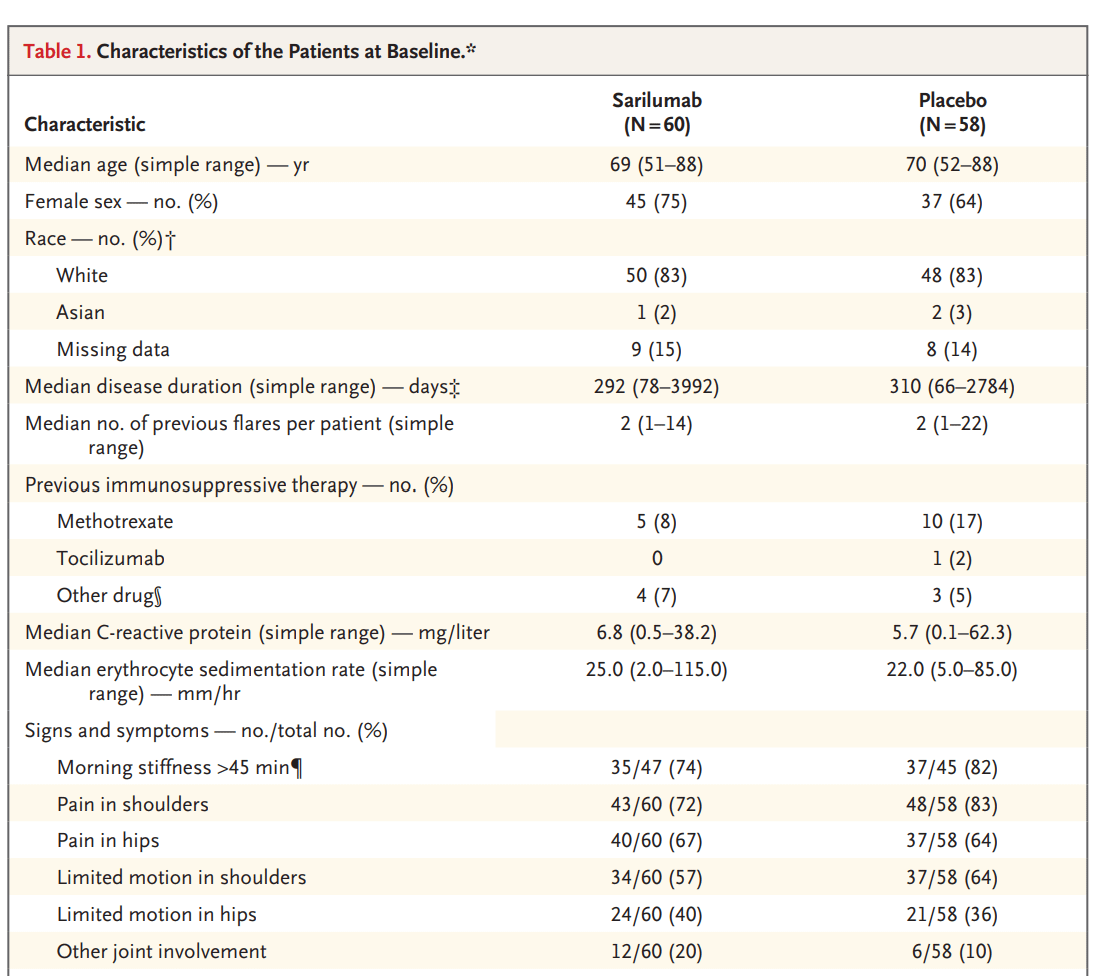
Randomization: 1:1:1 to SEC-300, SEC-150, or placebo, stratified by region and baseline prednisone dose. 474 screened, 381 randomized, arms well balanced.
Blinding: Double-blind, placebo-controlled, matched injection schedules. Critically important issue to note: ESR and CRP were concealed from investigators and left out of the primary endpoint, designing out the unblinding-by-biomarker problem that haunts IL-6 trials (and drives me crazy)
Comparator: Placebo plus a 24-week taper. I think this is still reasonable and ethical in 2026. We haev options, but most of my relapsing patients still get steroid monotherapy (more and more getting IL6 or leflunomide as well)
RED FLAG: No active comparator. We now have two working mechanisms in PMR (IL-6 and IL-17A) and exactly zero head-to-head data. The trial answers “is secukinumab better than nothing?” not “What’s the best DMARD to add?”
Attrition: 76% completed treatment, with higher dropout in the placebo arm (32% vs 17-21%), generally what you’d expect when placebo patients flare and bail for rescue. Discontinuers were counted as non-responders and a tipping-point analysis didn’t tip (some nice graphs in the supplement). Reasonably robust and if you’re going to have high dropout, you want it to be in the placebo group.
Sponsorship: Novartis funded it, designed it, and ran the analysis; the first and last authors drafted the manuscript. Standard pharma-sponsored phase 3.
Bottom line: Internal validity is good, design is a skosh better than SAPHYR, depending on how you feel about the steroid tapers
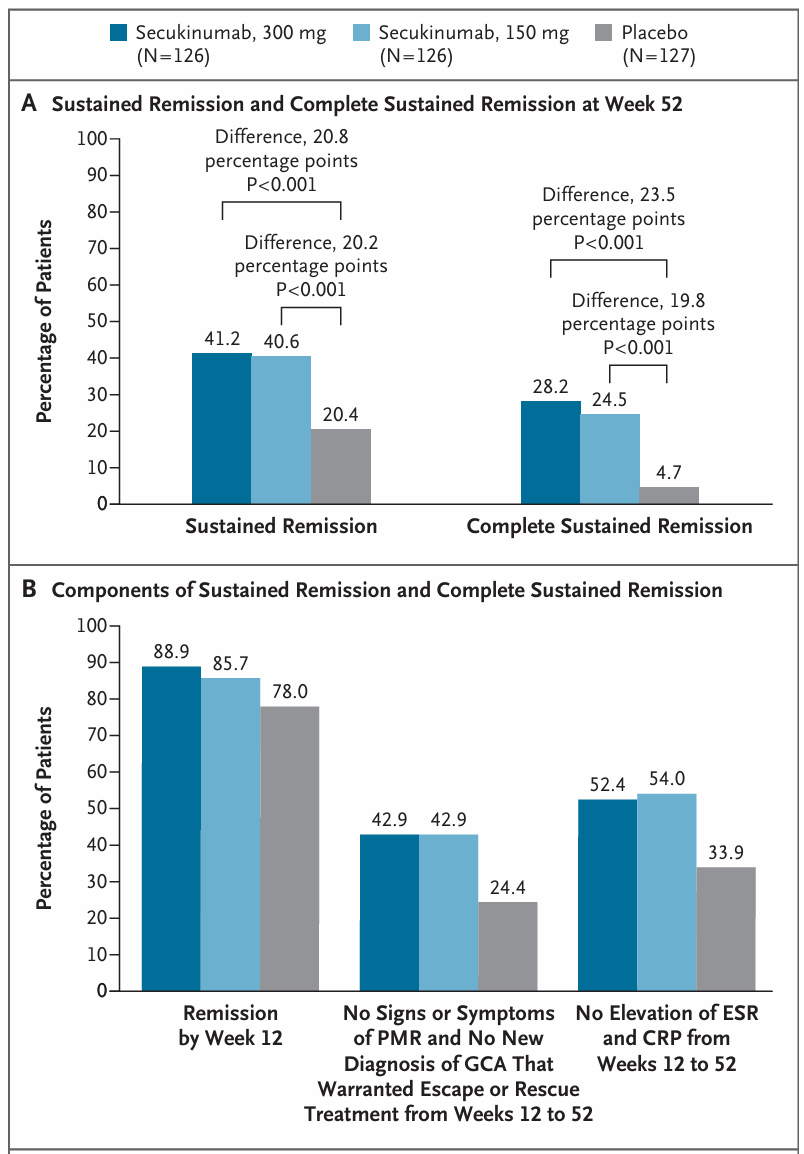
Primary endpoint (sustained remission at week 52): SEC-300 41.2% vs placebo 20.4% (Δ ~21 points, NNT ~5); SEC-150 40.6% (NNT ~5). Both P<0.001. Not bad! And the two doses are interchangeable (41.2 vs 40.6), a theme that repeats on every endpoint. (Favor 150.)
Compared to SAPHYR? REPLENISH’s primary left CRP/ESR out (correct); SAPHYR’s required CRP normalization (aggravating) but reported CRP-less results as well (still worked). So the primary isn’t apples-to-apples with the sarilumab data. The matched endpoint (complete sustained remission including biomarkers): SEC-300 28.2% vs placebo 4.7% (NNT ~4). That 28% lands right on sarilumab’s 28% in SAPHYR, albeit against a much lower placebo (4.7% vs 10%). The low placebo rate is likely due to a lower taper (ie 24 weeks in REPLENISH vs 52 in SAPHYR), hard to interpret. You should never compare between trials, but we kind of always do. I see these as roughly similar based on this?
Steroid sparing: Adjusted annual cumulative prednisone 1604 mg (SEC-300) vs 2093 mg (placebo), ~489 mg/year less, about 20%. This is much less than SAPHYR, but SAPHYR required a much-faster taper for the treatment group. I like that because it’s a high bar; I don’t like that because it confounds the “steroid sparing” claim (ie maybe people were just forced onto less steroid?). The steroid sparing in REPLENISH is helpful but not transformative; the Glucocorticoid Toxicity Index agreed, GTI-AIS of 32 vs 84.
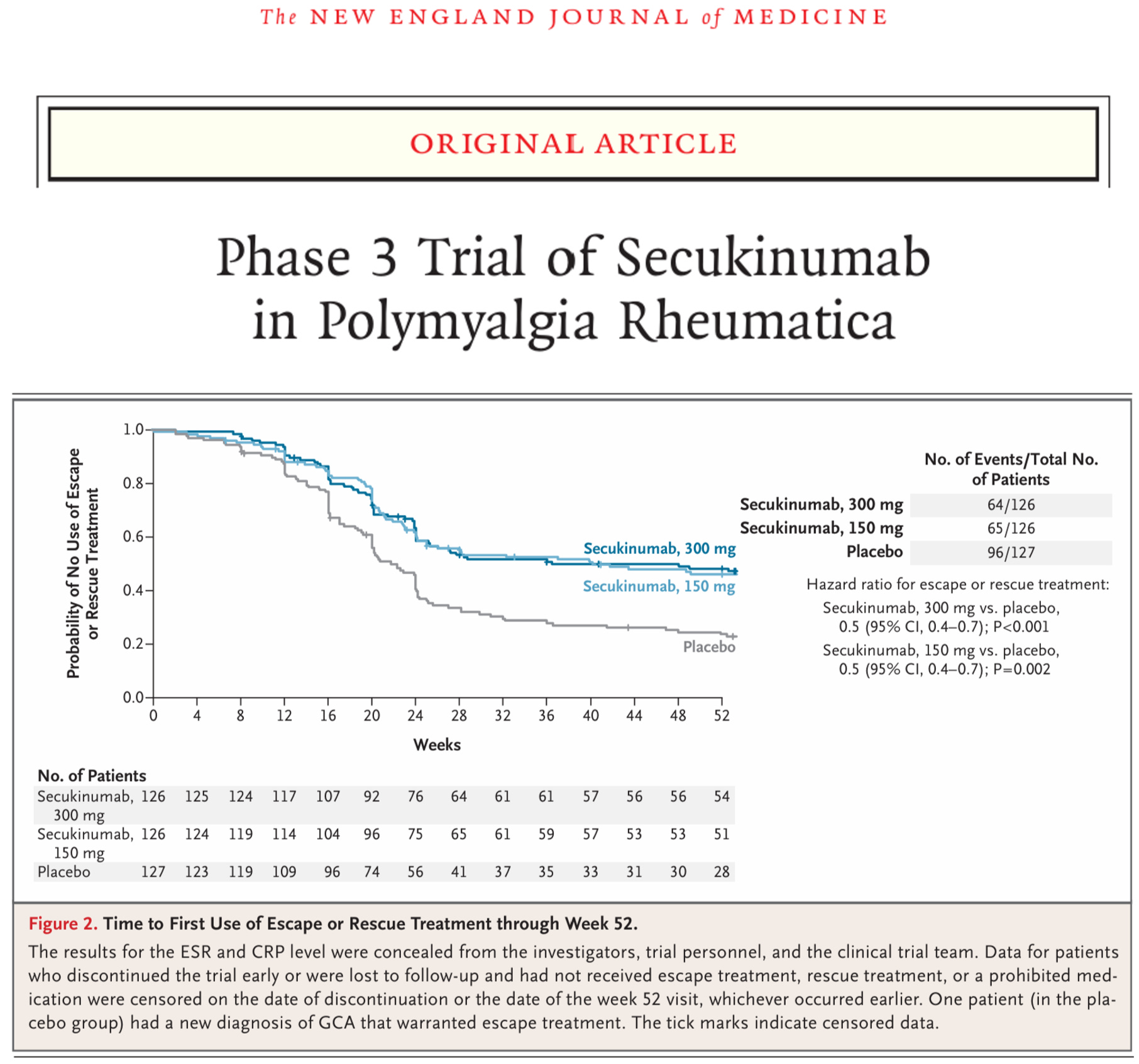
Escape/rescue and PROs: Half the secukinumab patients still needed escape or rescue treatment (51% vs 76% placebo; HR 0.5). Fatigue and function both favored secukinumab (FACIT-Fatigue ~6 points, HAQ-DI ~0.44), clearing usual minimal-important-difference thresholds, which is a big deal to me.
GCA? This trial excluded people with GCA, but it is notable that virtually nobody developed GCA either. I honestly would not have expected much of that - I’m skeptical of the GPSD business - but I think it is worth noting that people who start steroid +/- an IL17 rarely ‘progress’ to GCA.
Safety: The reassuring part: serious infections were flat across arms (~3%), serious AEs were flat (13.5/15.9/14.2%), and fewer secukinumab patients discontinued for AEs than placebo. As expected, fungal infections ran higher on secukinumab (6-10% vs 3%, the expected IL-17 candida tax). One SEC-150 patient died of cryptococcal meningitis, which is pretty disturbing… but perhaps somewhat idiosyncratic? The investigators pinned it on 15-plus years of steroid immunosuppression and called it “potentially related” (See page 26 of the supplement for that little gem). I’m torn. I haven’t seen that with SEC, but also a fatal opportunistic CNS fungal infection isn’t a great look. Hypersensitivity was up as well (14% vs 9%), all nonserious.
Bottom line: A genuine, modest, dose-independent benefit with a fair steroid-sparing signal, shadowed by a fungal-infection story that may carry outsized weight
RED FLAG: No efficacy data beyond 52 weeks and no withdrawal data. Re-randomization at week 52 should be required for pretty much any study that could ethically do it.
The trial I wish I had: Secukinumab versus sarilumab, head-to-head, same taper. Also, secukinumab upfront for newly diagnosed PMR. Oh also secukinumab vs leflunomide. Honestly there are an infinite of needed-trials in PMR. I’ll take a nice phase 3 any day, but long term we need to know (1) which steroid sparing is best and (2) which patients actually need it.
Other gaps: No signal on who responds; 59% didn’t sustain remission and nothing predicts the 41% who did. Nothing on the IL-6-blocker-failure patient. And nothing on the PMR-GCA overlap, by design.
Bottom line: They proved secukinumab beats steroids alone over one year for relapsing patients. Lot’s more to do, but happy to see a big phase 3!
1. Secukinumab works in relapsing PMR (sustained remission 41% vs 20%, NNT ~5) and is the first non-IL-6 mechanism to do so. It’s steroid-sparing (~20%, ~489 mg/year), not steroid-eliminating; half of treated patients still needed rescue.
2. The 150 mg and 300 mg doses are indistinguishable on every single endpoint. If and when this is approved, there’s no efficacy case for 300 mg. I would not have run a trial with both doses (seems wasteful), but the FDA was right and I’d use the 150mg dose to (hopefully) cut down on toxicity.
3. Watch fungal infections in your elderly, steroid-exposed patients. Serious infections weren’t elevated overall, but a fatal cryptococcal meningitis plus a 6-10% incidennce (up from 3% in placebo) is notable
4. I’m not sure where this stands? I would rather take an IL17 than an IL6 myself, so I think I would favor this over sarilumab going forward. I’d expect approval for PMR in the near future.
Disclosure: I prescribe many of the medications I discuss in this newsletter, including secukinumab. I also participate in clinical trials, unbranded educational activities, advisory boards, and consulting. Views my own, not those of my employer.
No posts
Comments
Nothing yet. Say the first thing.
Sign in to join the conversation.