
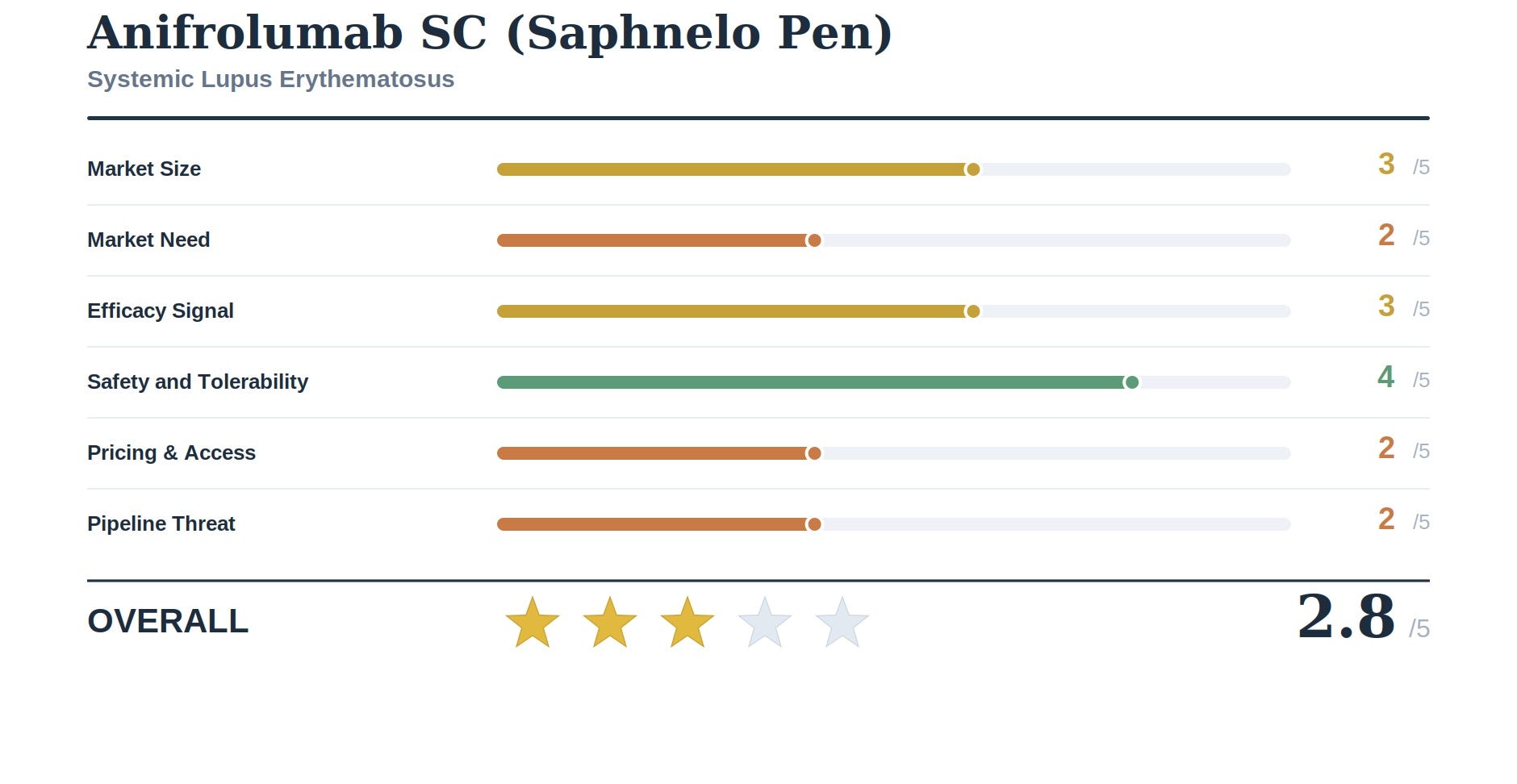
The Regulatory Breakdown covers updates from the FDA or EMA, explaining development programs, trial data, and the implications for both clinical practice and the market. Each issue includes a scorecard (see above!)
Back in October 2021 I wrote my second-ever newsletter (at Figure 1) about the original anifrolumab approval, asking whether we should be excited about them. My answer at the time was a hedged maybe-for-skin: anifrolumab offered an underwhelming but measurable benefit in moderate-to-severe SLE, the signal was concentrated in skin disease and steroid sparing, and there was no convincing role for it in NPSLE or lupus nephritis.
The TULIP trials also pulled a classic endpoint-shenanigans move, deciding to swap one esoteric outcome measure (the SRI-4) for an equally esoteric outcome measure (the BICLA) just prior to unblinding. This is technically permissible and I do believe they did this prior to unblinding. TULIP-2 actually hit on both SRI-4 and BICLA; if they knew the results, they likely would not have pulled any shenanigans at all (it was ultimately an unnecessesary shenanigan). It still kind of gives me the ick and has not aged well =in light of the rather astonishing shenanigans Chemocentryx was pulling around the same time.
On April 27, 2026 the FDA approved a subcutaneous autoinjector formulation of anifrolumab, the “Saphnelo Pen,” for adults with moderate-to-severe SLE on standard therapy. The approval came after a complete response letter in February and was based on the phase 3 TULIP-SC trial, published in Arthritis & Rheumatology in January 2026. I would expect your local specialty pharmacy to have access by late June.
The upside is pretty clear; same drug, same indication, smaller needle, no infusion chair. The trial was pretty clear; anifrolumab SC works about as well as anifrolumab IV. The more interesting question for today is what we have learned over three TULIP trials about not only the drug, but also the pathophysiology of SLE itself.
TULIP-SC randomized 367 adults with moderate-to-severe SLE 1:1 to once-weekly 120 mg SC anifrolumab or placebo for 52 weeks, on top of standard therapy. The population was basically the same as TULIP-1 and TULIP-2 in every way that matters: no active severe lupus nephritis, no severe NPSLE, mostly IFN gene signature high at screening (for whatever that’s worth), nearly half the cohort on ≥10 mg/day of prednisone-equivalent at baseline. Same primary endpoint as TULIP-2 (BICLA at week 52).
Not surprisingly, they found about the same result. The absolute difference in BICLA response was about 20%, equating to roughly 1 additional BICLA responder for every 5 patients treated. For a trial in SLE, that’s actually pretty good! The trial also hit on the steroid-tapering endpoint (~20% delta favoring anifrolumab patients; those who started at baseline ≥10 mg/day got to ≤7.5 mg/day and stayed there from week 40 to 52), an effect nearly identical to TULIP-2’s 51.5% vs 30.2%). Similar story for DORIS remission (14% difference favoring anifrolumab), LLDAS (14% difference favoring anifrolumab), and of course the previously-abandoned SRI-4 (~15% difference favoring anifrolumab). CLASI-50 favored anifrolumab (76.9% vs 61.2%) and I’m guessing that’s what drove lots of the BICLA/DORIS/LLDAS differences above.
The failures were similar to the failures from the prior studies. TULIP-SC did not clearly hit on flare outcomes, reflecting the broader TULIP program where flare data has been mixed, although pooled analyses favor anifrolumab and I suspect it works. Safety was also similar, with a little extra herpes zoster for the anifrolumab group (about 1 in 35 patients) and injection site reactions in 1 out of every 6 (likely causing some unblinding). You could quit here and call it a success, which I think is pretty fair. This is a useful drug that now comes in a useful formulation, which brings about statistically significant benefits for various (opaque) SLE measures and clinically meaningful benefits benefits for patients with SLE affecting their skin.
Perhaps a more interesting angle on the ongoing TULIP story is what we’ve learned about SLE biology. The original case for anifrolumab was a pathophysiology case. SLE is an IFN-driven disease, the story went. Blocking the IFN receptor should help the patients with the most IFN activation more than the patients with less. Three positive-by-BICLA trials later, that story has not held up.
In the pooled TULIP-1/2 subgroup analysis (Vital et al., Lupus Sci Med 2022), “interferon signature high” patients showed an 18% difference in the BICLA (whatever that is) as compared to a 17% difference in the total population. That’s basically a rounding error’s difference for what was purported to be a central driver of SLE immunopathology. Meanwhile, in the same paper, Asian race (29% treatment difference) and abnormal baseline serologies (23%) showed bigger subgroup signals than the biomarker that’s supposed to identify responders.
Checking interferon signatures is also not something many of us do with any regularity. I suspect AstraZeneca is fine with that, because the drug was not approved for “interferon driven SLE.” It was approved for SLE. The benefit was attenuated among interferon-low subgroups, but those folks still had a (directional) benefit as compared to placebo. The difference was 9.6% for the interferon low group, which tells us very little. Either way, the IFN biology isn’t doing the work the marketing implies it does.
Listeners of my podcast will know I’m skeptical of pathophysiology-driven drug development. The three TULIP trials are exhibit A for why. We developed a drug for a precision-biology-esque hypothesis. The drug actually failed its first trial but has since had two positive trials. If you look at the totality of the data, the thing the drug is supposed to address does not appear to be a strong or meaningful signal, aside from the obvious signal that it does work. At the end of the day, all I can say is that anifrolumab works in SLE - mostly for the skin - and that prescribing should probably be to people with a skin-ish phenotype.
The other ongoing pattern is missing patient-reported outcomes. PROs were collected in TULIP-1 and TULIP-2 but omitted from the primary publications, which prompted me to write a Letter to the Editor in NEJM in April 2020 making the obvious point: few rheumatologists could name the components of BICLA or SRI, fewer still use them, and a simple clinically meaningful question, “do you feel better?”, could clarify the entire BICLA-vs-SRI methodological debate. Both trials had SF-36, FACIT-Fatigue, and Patient Global Assessment data. AstraZeneca eventually published TULIP-1/2 PROs in 2022 in a paper that treated the PROs as a means to validate the BICLA. PROs exist to tell us whether a drug made people feel better, not to show that people who felt better had better BICLA.
TULIP-SC continues the pattern, though I did find the patient global assessment, buried on page 18 and Table S4. PtGA is a continuous measure and it was statistically significantly different, but the magnitude of effect was marginal at best (-0.23 difference, typically would look for a full 1-1.5 points for minimal clinically important difference).
The other thing the pen doesn’t change is the competitive landscape. Drug development has taken off in SLE and the 2026 pipeline is hot. Telitacicept recently showed a 67% SRI-4 vs 33% placebo response in its phase 3 trial, an NNT of 3. That would put it in a different category from anything else in lupus, though I suspect the FDA is suspicious of the data and may force more trials before approval. In the next year or two I’d expect to see litifilimab, deucravacitinib, upadacitinib, and possibly ianalumab report phase 3 data. After that, we may get CAR-T and bispecific antibodies.
I have a standing position that LTEs are typically worthless: underpowered for safety signals, usually unblinded, almost always analyzed in ways that flatter the original treatment group. The magical part of randomized trials is the randomization and the blinding. LTEs typically have neither, instead functioning as poorly reported case series that get published many years too late to be helpful. TULIP-LTE (Strand et al., Lancet Rheumatology 2025), which reported 4-year PRO data, is a somewhat-notable exception.
Unlike most LTEs, TULIP-LTE was actually run as a double-blind, placebo-controlled, 3-year extension. Patients on anifrolumab in TULIP-1 or 2 continued anifrolumab, while patients on placebo were re-randomized to anifrolumab or placebo at LTE entry. This is great and should be the standard in drug development. If you’re going to follow patients for 4 years, lets learn something useful from it!
Now the problems, all of which the authors flag.
Dropout was hugely differential: 52% of placebo patients dropped out over 3 years vs 31% of anifrolumab patients. The repeated-measures model assumes missing-at-random, which is almost certainly not the case; placebo patients who stay enrolled for 4 years are by definition the ones doing well enough to stay. Notably, this may mean the drug was just working, a nod in its favor.
The protocol relaxed in the LTE. The mandated glucocorticoid taper from the feeder trials became tapering “encouraged”, and investigators were allowed to adjust background therapy as needed. By year 3 the two arms were on different real-world cocktails.
The PRO data are softer than the abstract reads. At week 208 the least-squares mean differences were “numerically greater” across the board for SF-36 bodily pain, mental health, and EQ-5D. “Numerically greater” appears to be the end of that story; confidence intervals for all of them crossed 0 when compared to placebo.
I love that TULIP-LTE maintained blinding and re-randomized patients after the initial trials finished. It answered a real and useful question, but unfortunately the answer was the same one we got with the original trials; anifrolumab works, most likely for skin, and has marginal benefits with respect to quality of life.
1. This does not change much for target populations. My target patient is the same one I described in October 2021: moderate-to-severe SLE with prominent skin involvement and/or a stuck steroid taper, not active severe lupus nephritis or NPSLE, willing to tolerate the herpes zoster risk and ideally vaccinated against it.
2. For existing IV patients on stable disease, I’ll offer the SC switch as a convenience option. The pharmacokinetic bridging data and TULIP-SC’s consistency with TULIP-1 and TULIP-2 passed muster and I will be viewing them as equivalent going forward. Patients who prefer the convenience of home injection have a new option, which is great.
3. I’m not impressed by interferons, interferon signatures, or really SLE-pathophysiology writ large. Interferons certainly matter for SLE, but not enough for them to drive prescribing. I do not send interferons and do not think anyone else on the adult side should be regularly sending them either. I would make an exception for some of the interferonopathies / pediatric SLE syndromes.
4. SLE remains a hot area for drug development. It seems plausible that we will have more new indications for SLE in the next five years than we had in the previous 50. That is a great thing for a patient population that desperately needs better options.
Disclosure: I prescribe many of the medications I discuss in this newsletter. I also participate in clinical trials, unbranded educational activities, advisory boards, and consulting. Views my own, not those of my employer.
No posts
Comments
Nothing yet. Say the first thing.
Sign in to join the conversation.