
The EBR Journal Club Companion applies my adapted version of the JAMA approach to critical appraisal to an important RCT in rheumatology. Each review covers four domains: Does this apply to my patients? What is the risk of bias? How great are the benefits and harms? And what didn’t they show me? Feel free to use this in your own journal clubs! This edition: INDIGO (obexelimab in IgG4-related disease)
TRIAL: INDIGO (NCT05662241)
DRUG: Obexelimab (no brand name yet) - bifunctional monoclonal antibody that co-engages CD19 and FcγRIIb to inhibit B-cell activity without depleting B cells
DISEASE: Active IgG4-related disease
DESIGN: Phase 3, double-blind, randomized, placebo-controlled; 194 patients (97 per arm); 52 weeks; mandatory GC induction then protocolized taper to discontinuation by week 8; subcutaneous 250mg injection weekly
JOURNAL: N Engl J Med, June 2, 2026.
SPONSOR: Zenas BioPharma (BLA submitted to FDA May 28, 2026)
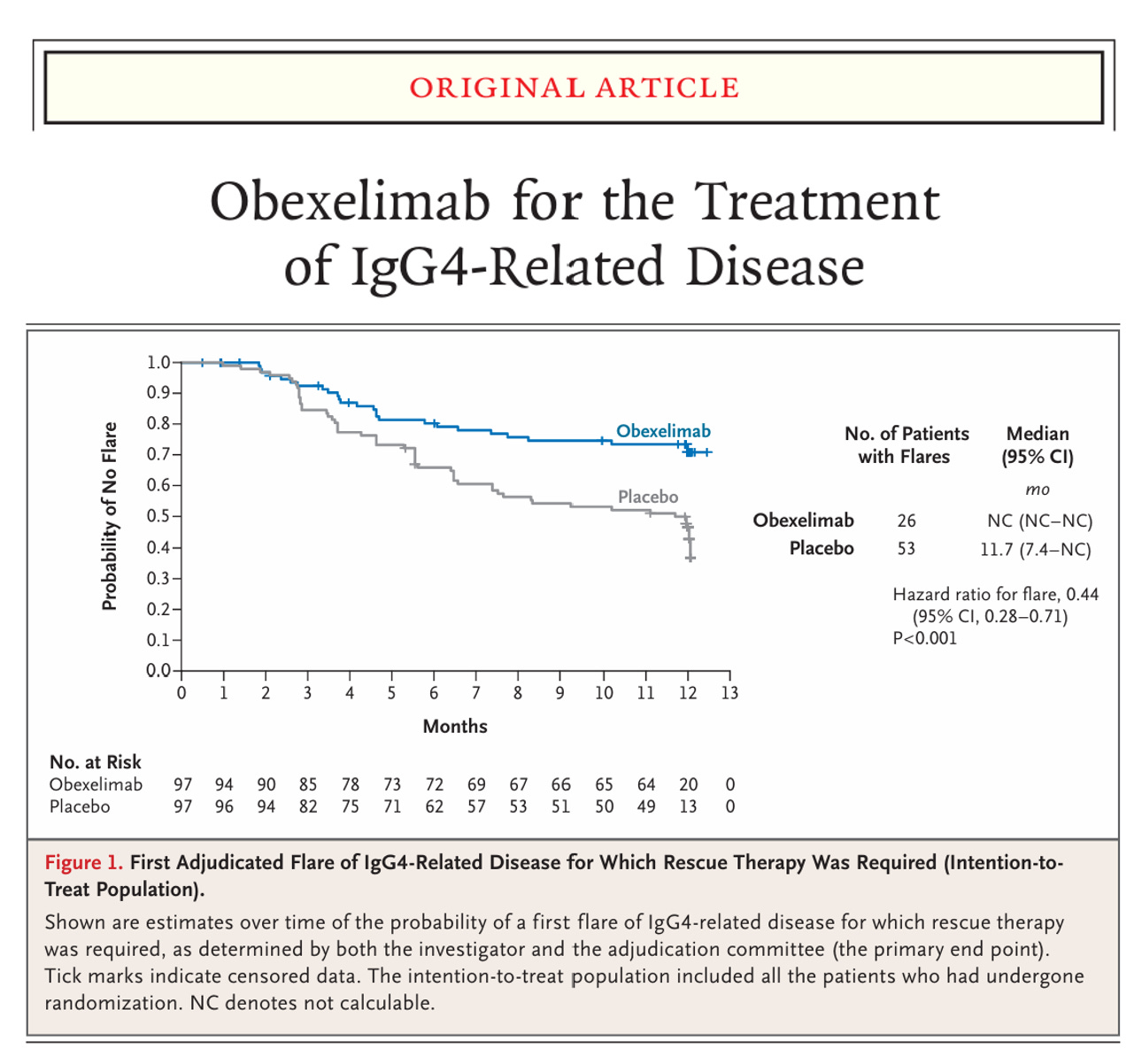
PRIMARY ENDPOINT: Time to first adjudicated flare requiring rescue therapy - MET (HR 0.44, 95% CI 0.28-0.71, P<0.001; 27% vs. 55% flared)
THE TAKE: Obexelimab works! Whether it works well enough to earn a preferred slot alongside the already-approved inebilizumab or the likely-much-cheaper rituximab is a harder question. In a disease where most patients do well, perhaps less-B cell destruction is the way forward?
Does This Apply to My Patients?
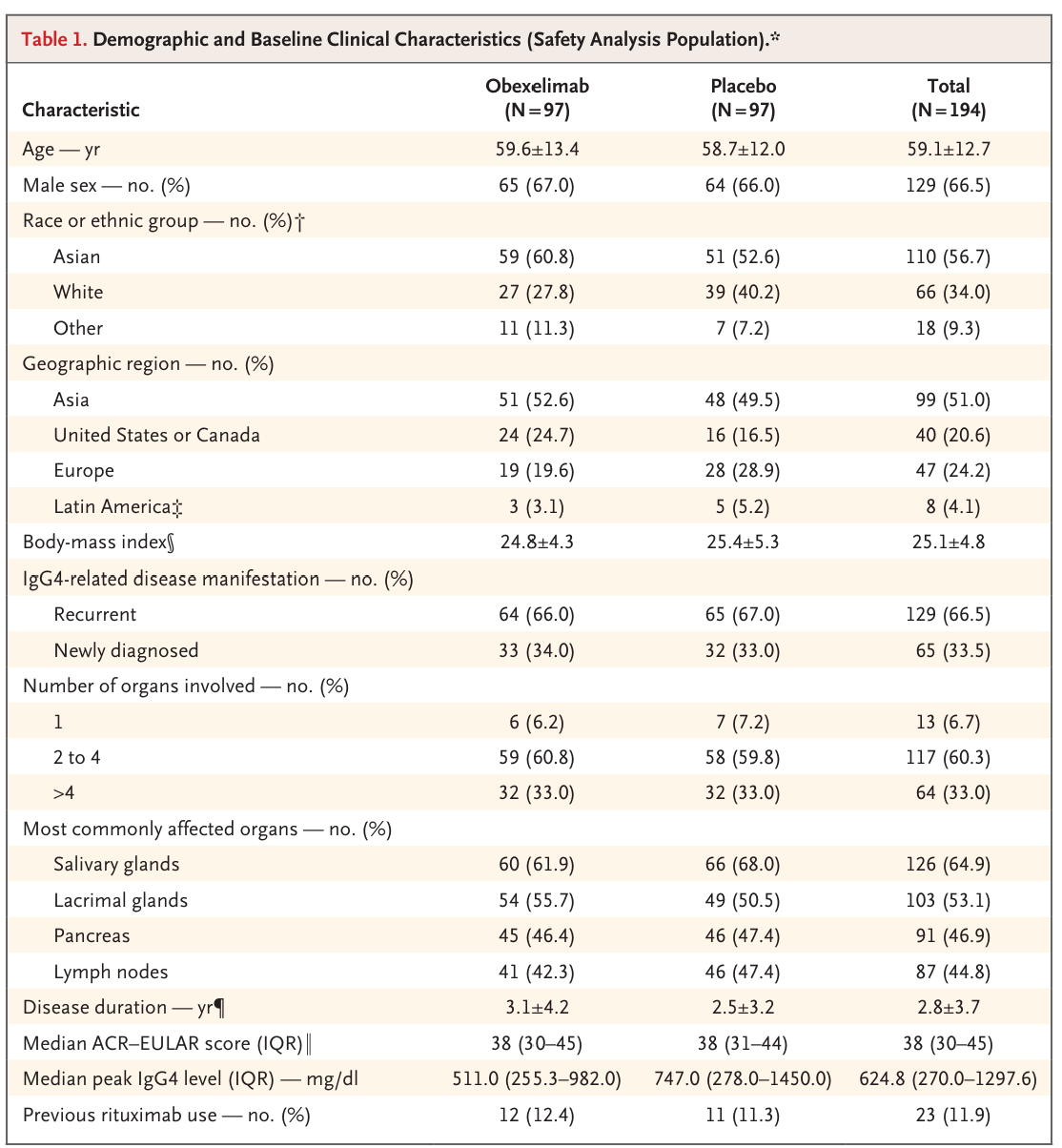
Who they enrolled: Mean age 59, 67% male - jives with my clinical practice. 67% had recurrent disease, which is common for those on prednisone monotherapy but rare among those receiving any B cell depletion/inhibition. 93% had two or more organs involved. About 12% had prior rituximab (all > 6months prior), and median baseline IgG4 was ~625 mg/dL, so active serologically-supported disease.
Diversity: 57% Asian, 34% White, across 19 countries - reasonable global representation for a disease more prevalent in Asia. Worth noting: the obexelimab arm skewed more Asian (61% vs. 53%) and the placebo arm more White (40% vs. 28%). The authors flag this as a potential generalizability concern, which is fair. I’m not worried about it; like math, B cells are the same in every country1
Who they excluded: Active infection, prednisone >60mg within 4 weeks, B-cell-depleting therapy or other immunomodulators within 6 months. All reasonable.
Background therapy: Protocolized GC induction for all patients, then mandatory taper to discontinuation by week 8. Concomitant immunosuppressants prohibited throughout. This taper is likely faster than you’d use in the real world, which is common in trials these days (need people to flare to show a benefit)2
Bottom line: Applies well to the steroid-dependent relapser who hasn’t failed B-cell depletion, which is going to be the majority of patients. Less clear for patients already on background immunosuppression or for those who failed rituximab or inebilizumab.
What Is the Risk of Bias?
Randomization: 1:1, stratified by organ count and disease status (newly diagnosed vs. recurrent). Baseline characteristics were well balanced except for the racial imbalance noted above. Methodologically clean.
Blinding: Double-blind with matching subcutaneous placebo. The main unblinding risks are arthralgias (19.6% vs. 11.3%) and urticaria (6.2% vs. 1.0%) - both visible enough that patients could piece together their assignment. They tried to mitigate that (the primary endpoint required agreement between the treating investigator AND an independent adjudication committee) but unblinding is unblinding.
Comparator: Placebo plus the same mandatory GC taper, with rescue steroids permitted for confirmed flares. The placebo flare rate (~55%) is consistent with the natural history of IgG4-RD and matches the MITIGATE placebo arm (~60%), so the control group performed as expected. There’s no active comparator arm, which was OK when this was designed but probably not-ok going forward
Attrition: 88.7% completed 52 weeks. Adverse-event-related discontinuations were three times higher in obexelimab than placebo (9.3% vs. 3.1%).
Sponsorship: Fully sponsor-funded; Zenas BioPharma employees as co-authors; sponsor-funded medical writing. Standard for a Phase 3 registrational trial. Noted.
Bottom line: Credible approach. Dual-adjudication is nice but doesn’t entirely fix unblinding, which is a relatively small issue here. I think this generalizes well and is a reasonable design.
How Great Are the Benefits and Harms?
Primary endpoint (time to first adjudicated flare, 52 weeks): 27% vs. 55% flared; HR 0.44 (95% CI 0.28-0.71), P<0.001. NNT ~4. Impressive for a disease that had no approved therapy until 14 months ago! Kaplan-Meier separation began around month 3, which makes sense; steroids work great, but when you take them away flares are common.
Key secondary endpoints (all MET hierarchically):
Annualized adjudicated flare rate: 0.34 vs. 0.70/year; rate ratio 0.48 (P<0.001)
Complete remission at week 52: 37.1% vs. 19.6%; NNT ~6 (P=0.005)
Cumulative GC rescue dose: 329.5mg vs. 929.8mg; 65% reduction (P=0.004)
GTI Cumulative Worsening Score: 28.2 vs. 39.6; difference 11.4 points (95% CI 1.7-21.1)
That last one deserves a note: the MCID for the GTI-CWS is 15 points. The observed difference (11.4) didn’t reach it, but I bet it would if you compared typical-steroids to minimal-steroids+OBEX.
Benchmarks: MITIGATE (inebilizumab, NEJM 2025) - the first Phase 3 trial in IgG4-RD - found 10% vs. 60% flare rates (HR 0.13, NNT ~ 2-3). Cross-trial comparison is fraught, but we always do it. This also makes sense with my priors. Killing all the CD19 B cells with inebiliuzmab is likely more effective than simply (mostly?) suppressing them. I would also bet that it is more toxic.
Safety: Overall AE rates similar (98% vs. 96%). Serious AEs were lower in obexelimab (10.3% vs. 18.6%), which is directionally reassuring and probably reflects efficacy + steroid sparing more than safety per se. More common with obexelimab included arthralgias, hypersensitivity, diarrhea, urticaria, pyrexia. I suspect that is people just receiving less steroid and so feeling more symptoms, which is a win? I think? There were no deaths and I do not think the 3 cancers in the OBEX group are related to the drug (squamous-cell carcinoma, prostate cancer, and a renal-cell carcinoma).
Bottom line: NNT of ~4 for flare prevention is good! The numerical comparison with inebilizumab is less flattering from an efficacy standpoint. The cancer signal is likely noise
What Didn’t They Show Me?
RED FLAG: No patient-reported outcomes. The GTI gives us something on steroid toxicity, but where did my PROs go? Knowing 37% achieved complete remission is useful; did that (and the steroid sparing effect) actually improve their quality of life?
The trial I wish I had: Obexelimab vs. inebilizumab vs. rituximab. The pitch for each is pretty clear; rituximab is dirt cheap, inebilizumab kills all the things; obexelimab works with less killing. I would also love to see a study about withdrawing this among patients who develop bad infections. Can we actually “stop the drug” in a way that matters? For both RTX and INE, you’re just in it to win it. Being able to pull back could be a real feature, if it’s real.
Other gaps: 52 weeks of blinded data for what will be a years-long maintenance therapy. No data after prior B-cell depletion. No data with concomitant immunosuppression. And while the ongoing 3-year open-label extension will fill some gaps, OLE data in a self-selected, monitored cohort always looks better than real-world durability. From published protocols it does not look like we’ll get re-randomization.
Bottom line: Solid study with some interesting implications. IgG4-RD has moved into the “only comparative studies are ethical from here forward zone” remarkably quickly. Curious to see the PROs and we’ll probably have to leave it to RWE to see how these stack up against each other.
Practice Points
Obexelimab has a real, clinically meaningful effect in active IgG4-RD. An NNT of ~4 for flare prevention and a 65% reduction in rescue GC exposure are compelling numbers. I would expect FDA approval
The central clinical question isn’t whether obexelimab works; it’s where it fits relative to inebilizumab and rituximab. Cross-trial inference suggests inebilizumab is more potent (HR 0.13 vs. 0.44), but that cuts both ways. It is also likely more toxic. This may be a particularly good option for folks with infection history, hypogammaglobulinemia, or those who really need their vaccinations (ie older, frailer).
I do not think patients should receive csDMARDs for IgG4-RD. The data for B cell depletion across two trials and lots of RWE strongly favors RTX, INE, or OBEX.
EBR Journal Club accompanies the Evidence Based Rheumatology Podcast. Disclosure: I prescribe many of the medications I discuss in this newsletter. I also participate in clinical trials, unbranded educational activities, advisory boards, and consulting. Views my own, not those of my employer.
Yes, that is definitely a Mean Girls reference
Yes, that is of questionable ethical-ness
Comments
Nothing yet. Say the first thing.
Sign in to join the conversation.