

The EBR Journal Club Companion applies my adapted version of the JAMA approach to critical appraisal to an important RCT in rheumatology. Each review covers four domains: Does this apply to my patients? What is the risk of bias? How great are the benefits and harms? And what didn’t they show me? Feel free to use this in your own journal clubs! This edition: ALLERGORY(obinutuzumab in SLE)
TRIAL: ALLEGORY (NCT04963296)
DRUG: Obinutuzumab (Gazyva) — glycoengineered type II anti-CD20 monoclonal antibody
DISEASE: Active SLE (without proliferative/membranous lupus nephritis)
DESIGN: Phase 3, randomized, double-blind, placebo-controlled, N=303 (1:1), 52 weeks
JOURNAL: NEJM, March 6, 2026
SPONSOR: F. Hoffmann-La Roche
PRIMARY ENDPOINT: SRI-4 at week 52 — MET
THE TAKE: Surprisigly solid trial in SLE… perhaps the most solid trial ever? Will easily merit an expanded label at the FDA. Need more data to understand specific use case (what manifestations, exactly, improved here?) but we can say with confidence that OBI works in SLE.
Who they enrolled: Mean age 41, ~90% female. Mean SLEDAI-2K 13.1 (solidly moderate-to-severe); 65% had scores ≥12. ~90% had active mucocutaneous and musculoskeletal disease, 57% on prednisone ≥10mg/day at baseline, ~70% on background immunosuppressant (azathioprine, methotrexate, or mycophenolate), 80% on antimalarials
Diversity: 15% Black, 29% American Indian, 50% Hispanic/Latino (really good for SLE trials!)
Who they excluded: Proliferative or membranous lupus nephritis (covered separately in REGENCY), Severe CNS lupus, prior anti-CD20/CD19 <9 months with low B-cell counts, 56% screen failure rate (690 screened → 303 randomized) → this was a highly selected population
Background therapy: Stable standard-of-care permitted (antimalarials, immunosuppressants, steroids). Mandatory steroid taper attempted before week 40 for patients on >5mg/day. No belimumab, anifrolumab, or other biologics permitted
Bottom line: These patients look like the moderate-to-severe SLE patients I see in clinic - surprisingly good diversity & reasonable background therapies
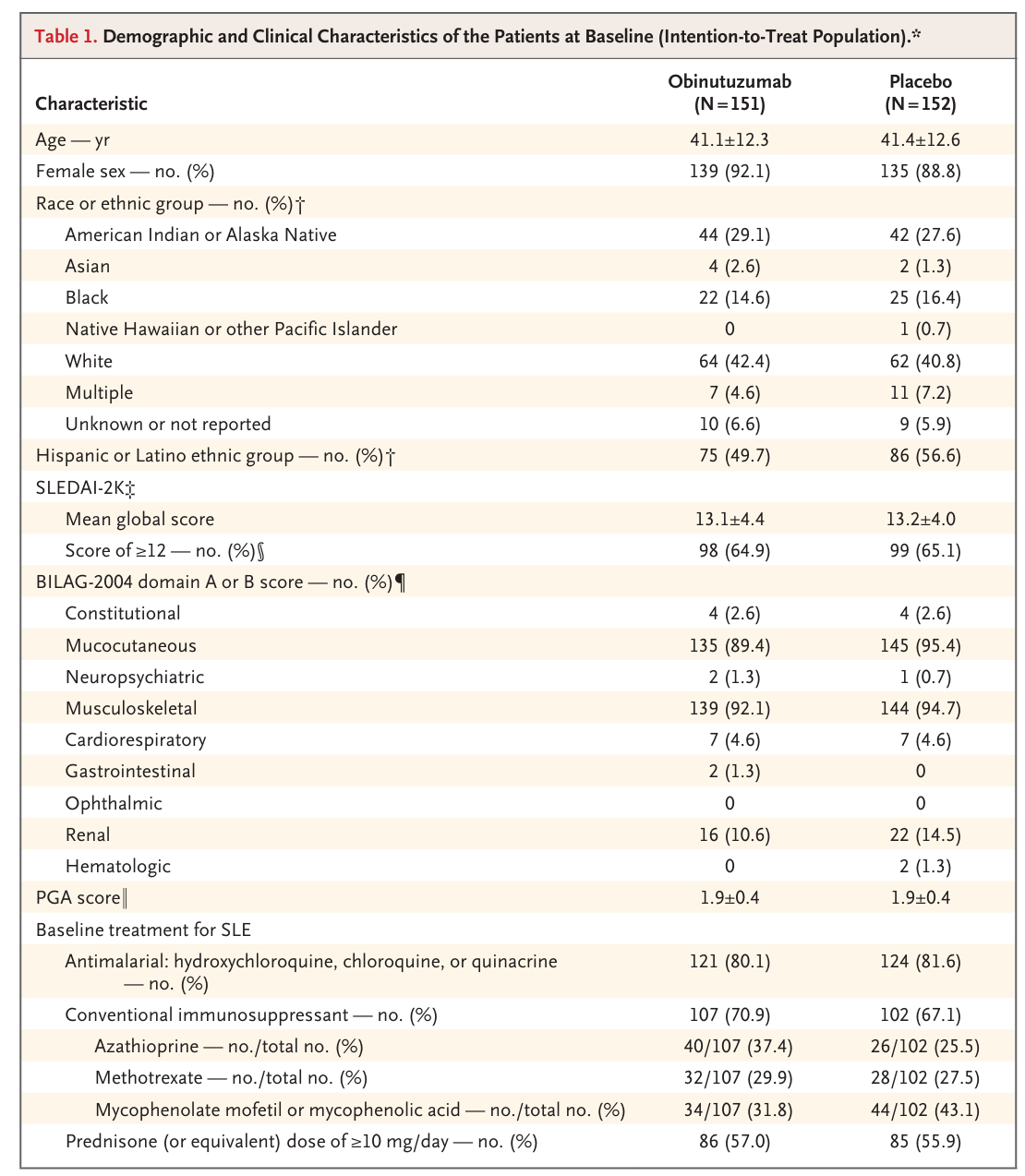
Randomization: Adequate. 1:1 via centralized, stratified by SLEDAI-2K (<12 vs ≥12) and prednisone dose (<10 vs ≥10mg/day). Baseline characteristics well-balanced.
Blinding: Double-blind, placebo-controlled IV infusions.
RED FLAG: Infusion-related reactions 12% obinutuzumab vs 3% placebo, predominantly with first infusion. Patients who flush and get short of breath during an infusion can probably guess they’re not on placebo.
Comparator: Placebo + standard therapy. Appropriate for a first-in-indication trial but without a comparator the use case is less clear.
Attrition: Low overall dropout: 4.6% obinutuzumab vs 10.5% placebo discontinued, ie favoring the treatmetn arm. Intercurrent events far more common on placebo (suggests drug worked): major concomitant-therapy violation 12% vs 28%, rescue medication 1% vs 7%.
Sponsorship: Roche-designed, Roche-analyzed. Penultimate author (Roche employee) wrote first draft. Academic first author had full data access.
Bottom line: Well-conducted trial with standard SLE design. The unblinding risk from infusion reactions and the differential intercurrent event rate are the two main concerns.
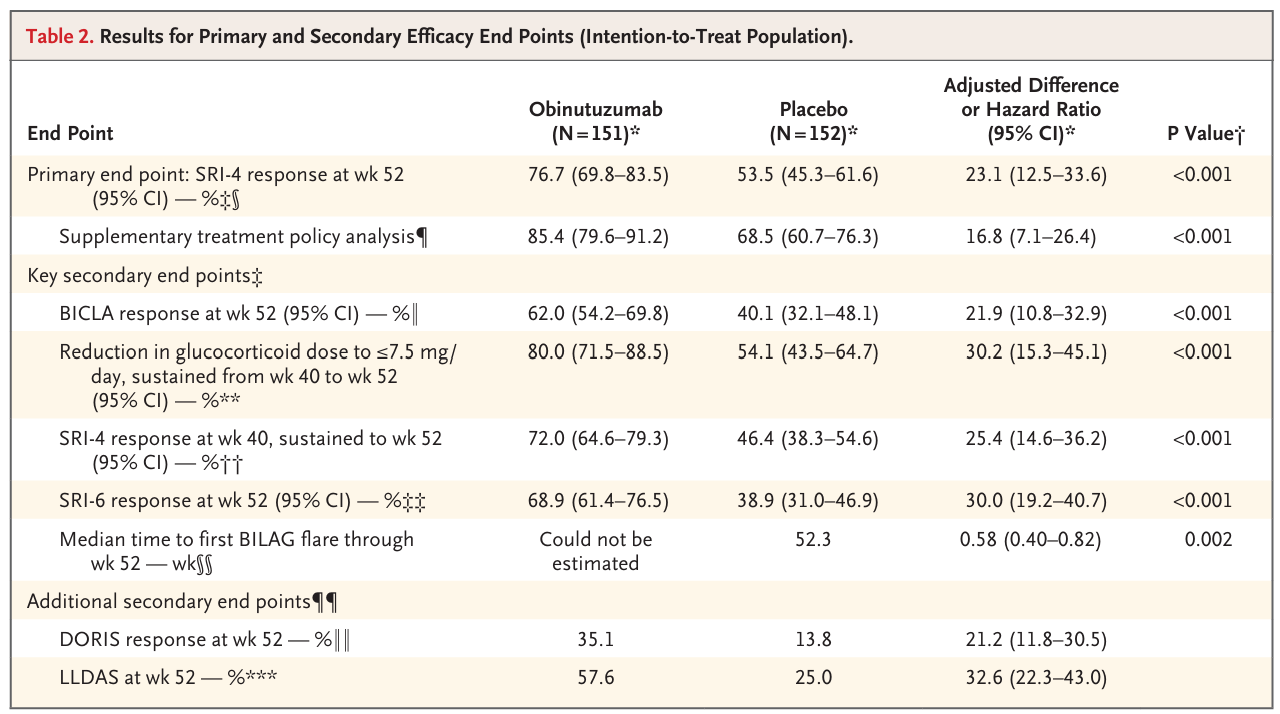
Primary endpoint (SRI-4 at week 52): Composite variable strategy (prespecified): 76.7% vs 53.5% (Δ 23.1, p<0.001). That’s a big delta! Treatment policy strategy (NEJM-requested post hoc): 85.4% vs 68.5% (Δ 16.8, p<0.001). The ~6-point gap is driven by differential intercurrent events, not differential disease activity. NNT ~ 4 (composite variable) or ~ 6 (treatment policy)
Key secondary endpoints (all met, hierarchically tested): BICLA response: 62.0% vs 40.1% (Δ 21.9) → roughly the same; sustained steroid reduction to ≤7.5mg (among those on ≥10mg): 80.0% vs 54.1% (Δ 30.2) — strongest signal; sustained SRI-4 (weeks 40-52): 72.0% vs 46.4% (Δ 25.4); SRI-6: 68.9% vs 38.9% (Δ 30.0); time to first BILAG flare: HR 0.58 (0.40-0.82)
Additional endpoints (not multiplicity-controlled): DORIS remission: 35.1% vs 13.8%, LLDAS: 57.6% vs 25.0% (impressive!)
Benchmarks generally beat existing SLE therapies: Belimumab BLISS-76: SRI-4 Δ ~9 points, anifrolumab TULIP-2: SRI-4 Δ ~17 points (BICLA was primary)
Safety: Any AE: 89% vs 82%, serious AE: 16% vs 12%, infections: 68% vs 54% (serious infections: 9% vs 5%); Really no deaths: 1 (0.7%) obinutuzumab vs 3 (2.0%) placebo; neutropenia: 5% vs 2% (all resolved, ~35 days average). No PML or HBV reactivation
Bottom line: The steroid-sparing and flare-prevention data are the most clinically compelling findings. The primary SRI-4 effect is real, mayyybe inflated by “composite variable”" strategy but I’m not sure I believe in the “treatment policy” business NEJM had them do. Safety profile is consistent with potent B-cell depletion; infection rate requires monitoring but is manageable.
Missing data: No analysis by race/ethnicity despite diverse enrollment, probably fine.
RED FLAG: No patient-reported outcomes in the publication (I would have expected them if they hit). Similar pattern from TULIP trials, where PROs were delayed many years
The trial I wish I had: This one is pretty closee! Ideally would have been head-to-head against initiating MMF (or perhaps RTX), but would likely required too-big a study. RTX failed in EXPLORER and LUNAR but remains widely used off-label for severe lupus. Difficult to say where this fits without comparison to standard of care.
Other gaps: 52-week data only; long-term safety and durability unknown; open-label extension (up to 104 additional weeks) ongoing; IV methylprednisolone 80mg premedication before each infusion could contribute to early efficacy signal (though similar in both arms)
Bottom line: The missing PROs and running a potent B cell inhibitor against placebo are the two biggest gaps. The trial was well-designed for what it was, but what it was not was a comparison to the drugs most of us actually use for severe lupus.
1. ALLEGORY is the strongest phase 3 trail in SLE for some time now. Even using the more conservative treatment policy analysis (17 points delta), this matches or exceeds the effect sizes seen with belimumab and anifrolumab.
2. Know your estimands. The 23-point headline number includes differential intercurrent events (protocol violations, rescue), which is consistent with SRI-4 response. The 17-point number better reflects the drug’s actual effect on disease activity in actual practice, but is kinda weird tbh.
3. The steroid-sparing data are the strongest clinical argument. 80% of patients on ≥10mg prednisone at baseline got to ≤7.5mg and stayed there. That’s the outcome my patients care about most… but where are the PROs?
4. Unblinding is a minor concern; the lack of PROs and the absence of a comparator are more bothersome. We need head-to-head data and more trials that ask about unblinding.
EBR Journal Club accompanies Episode 133 of the Evidence Based Rheumatology Podcast. Disclosure: I prescribe many of the medications I discuss in this newsletter. I also participate in clinical trials, unbranded educational activities, advisory boards, and consulting. Views my own, not those of my employer.
No posts
Comments
Nothing yet. Say the first thing.
Sign in to join the conversation.