
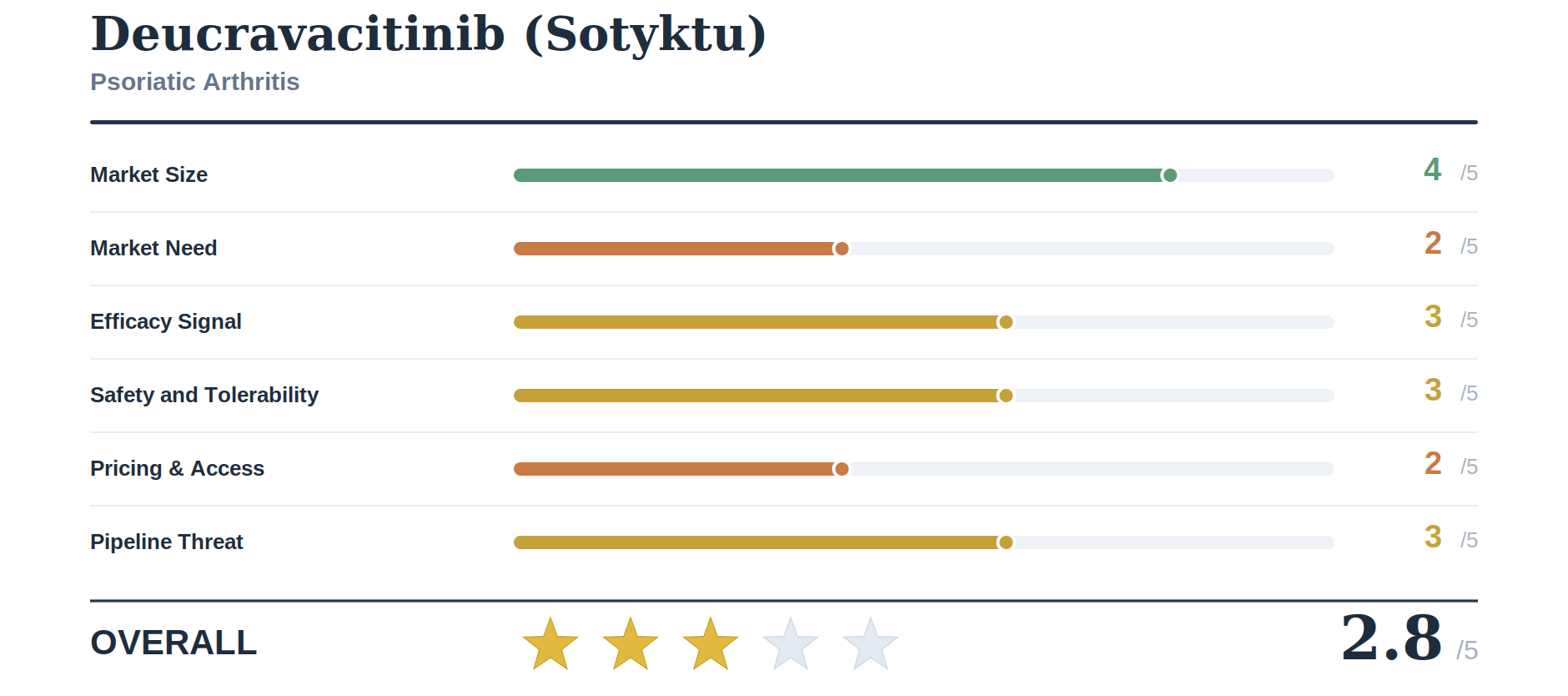
The Regulatory Breakdown explains updates from the FDA or EMA, explaining development programs, trial data, and the implications for both clinical practice andt he market. Each issue includes a scorecard (see above!) and ends with The Verdict.
On March 6 of 2026, the FDA approved deucravacitinib (Sotyktu) for adults with active psoriatic arthritis, making it the first TYK2 inhibitor to carry a PsA indication. Bristol Myers Squibb would like you to know this is a differentiated oral option and will likely play up the favorable safety profile. I have a bigger picture question: who, exactly, is this for?
PsA is not a disease starved for therapies. Rheumatologists in 2026 can choose from five TNF inhibitors, IL-17 inhibitors (secukinumab, ixekizumab, bimekizumab), IL-23 inhibitors (guselkumab, risankizumab, and off label tildrakizumab), IL-12/23 inhibition (ustekinumab), JAK inhibitors (tofacitinib, upadacitinib), and apremilast. The explosion of highly efficacious therapies for psoriasis has made PsA one of the few areas (RA being the other) where we genuinely have enough options for the vast majority of patients. The question isn’t whether deucravacitinib works (it does!); the question will be whether modest efficacy in the most competitive market in rheumatology will earn a place in anyone’s prescribing algorithm.
The Data: Competent but Not Compelling
The approval rests on two phase 3 trials. POETYK PsA-1 enrolled over 650 bDMARD-naive patients and hit its primary endpoint (ACR20 54.2% at week 16 vs 34.1% for placebo); POETYK PsA-2 enrolled over 600 patients (a mix of bDMARD-naive and TNF-experienced) and also beat placebo (54.2% for deucravacitinib vs 39.4% for placebo). As is increasingly common, the FDA approval has landed before the studies themselves. A future Critical Commentary will cover my frustrations with this. That said, we know a lot already.
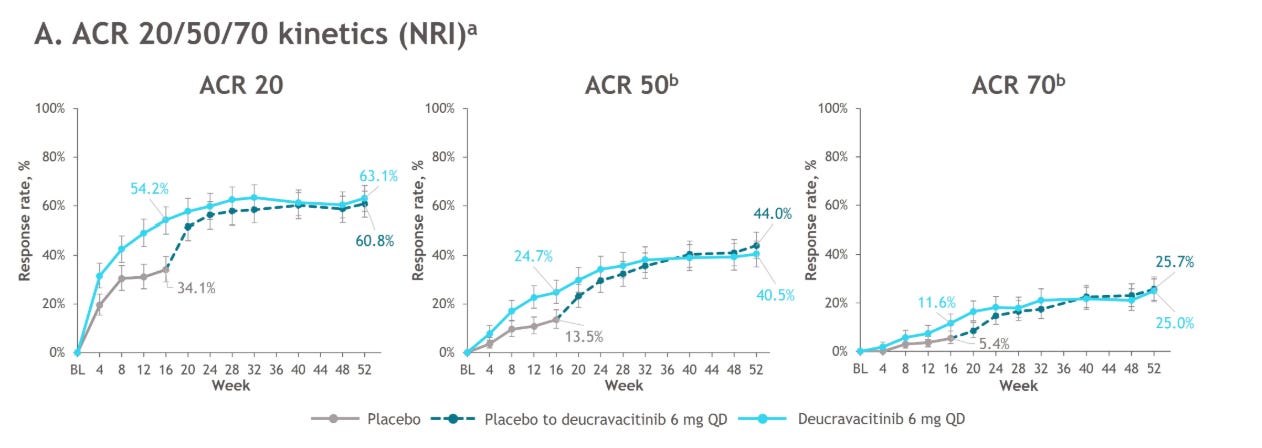
Those numbers are fine but unremarkable by PsA standards. For context, adalimumab typically hits ACR20 rates in the high 50s to low 60s in PsA trials, secukinumab lands in the mid 50s, and guselkumab reached 64% in DISCOVER-2. Upadacitinib cleared 70% in SELECT-PsA 1. Deucravacitinib’s 54% sits at the bottom of this range, roughly comparable to apremilast in historical comparisons (which is consistent with an earlier POETYK subanalysis showing deucravacitinib outperforming apremilast by about twofold for joint outcomes in patients with concomitant PsA and psoriasis). That’s better than apremilast but worse than pretty much everything else, which is not a fatal flaw, but neither is it a selling point.
Secondary endpoints told a similar story. PASI 75 responses were solid (this is still a TYK2 inhibitor, and TYK2 inhibitors are good at skin), and minimal disease activity rates improved over placebo. There was a signal for inhibition of radiographic progression in a post-hoc analysis of PsA-1, which is worth noting but not worth celebrating until it’s a prespecified endpoint in an adequately powered study. PsA-2 included 52-week data showing that clinical responses were maintained, with ACR20 reaching about 62% by week 52 in continuous-treatment patients. That’s reassuring for durability, but open-label extensions are mostly worthless (more on that, again in an upcoming Critical Commentary).
Safety signals so far have been unremarkable and consistent with the psoriasis program. Importantly, deucravacitinib does not have the black box warning that has plagued the JAK inhibitors, though the label does call out the JAK risk. I suspect BMS will lean on this heavily in promotional materials, which is reasonable. “Safe oral option for PsA” is a pretty good pitch.
One conspicuous absence: there are no data on axial disease. The POETYK PsA trials did not enroll patients specifically for axial manifestations, and there’s no axial subgroup analysis that I’m aware of. IL-23 inhibitors have struggled with axial PsA (a persistently weird finding that still lacks a satisfying mechanistic explanation), and TYK2 inhibition, which acts partly through IL-23, may face the same limitation. Until we see axial data, I would hesitate to use deucravacitinib in patients with meaningful axial symptoms. Ditto for uveitis, where TNF inhibitors will remain the first line option. That’s two important exclusions in a disease where axial involvement is common and uveitis is scary.
The Wrong Comparator
The POETYK PsA trials did not include an active comparator arm for efficacy. PsA-2 included apremilast, but only as a safety reference, which is moderately silly. If you’re launching a new oral therapy into PsA in 2026, one question you do not need to answer is, “is this better than apremilast?” Apremilast is a mediocre drug, at best, and far behind adalimumab et al in prescribing preferences.
The real question is: “does this compete with adalimumab?” Biosimilar adalimumab is now the price-competitive, well-understood, broadly effective default for most rheumatologists treating PsA. A head-to-head trial against adalimumab would have answered the only question that matters (commercially and clinically): can an oral TYK2 inhibitor hold its own against cheap, effective TNF inhibition?
I suspect BMS was worried a non-inferiority trial against adalimumab was risky. Given deucravacitinib’s ACR20 numbers, I think that was correct. In a space replete with active comparators, we are left doing the thing I recommend never doing (but always do); ad-hoc comparisons of raw numbers between disparate RCTs.
Oral, Safe, and Running Out of Room
So where does it fit? I think the honest answer is narrow, and it depends on how much weight you give the safety argument.
The pitch for deucravacitinib goes something like this: it’s oral, it’s once daily, its safety profile is notably cleaner than JAK inhibitors, and it avoids the injection burden of biologics. For the subset of PsA patients who really-super-duper want a pill, can’t tolerate apremilast (or found it ineffective), and are nervous about JAK safety, deucravacitinib occupies a real (if small) niche.
I think that’s a legitimate argument. After the ORAL Surveillance trial showed increased cardiovascular events and malignancy with tofacitinib vs TNF inhibitors in RA, the entire JAK class got a boxed warning. I am cautious with JAKs in PsA for a few reasons. The PsA population is younger, competing options are numerous and highly efficacious, and cardiovascular disease is a known issue. If I’m going to reach for an oral therapy in PsA, I would much rather reach for one that doesn’t carry a boxed warning.
That safety advantage may have an expiration date. Generic tofacitinib is coming, and when it arrives it should be the cheapest oral (non MTX, which I do not use much) therapy in PsA by a wide margin. For cost-sensitive patients and payers, a generic JAK inhibitor with known risks may be more attractive than a branded TYK2 inhibitor with a (probably & marginally) cleaner safety profile but a premium price tag. Deucravacitinib’s commercial window depends partly on how quickly generic tofacitinib enters the market and how aggressively payers push patients toward it.
The problem is that I rarely need to reach for an oral agent in PsA at all. TNFs are cheap, especially now that biosimilar adalimumab has cratered the price floor. IL-23 inhibitors are extraordinarily effective for skin and increasingly my go-to for all patients who lack axial disease. IL-17A inhibitors cover axial disease and have strong joint data; bimekizumab is promising greater efficacy and actually running head to head against IL-23 (bold!) for skin. The patient who specifically needs an oral, non-JAK, non-apremilast option exists, but I suspect they’re less common than BMS’s commercial projections assume.
There is another variable here worth considering: dermatology. Deucravacitinib is already approved and presumably familiar to dermatologists who prescribe it for psoriasis. I think many early PsA prescriptions will come from dermatology. Whether that constitutes a large enough market to justify the development program for deucravacitinib depends on how many psoriasis patients develop clinically significant PsA during treatment (probably not zero, but probably not a blockbuster number either).
The Bigger Play: SLE, Sjogren’s, and the TYK2 Platform
If the PsA story is “nice drug, crowded market,” the broader deucravacitinib story is more interesting. BMS has phase 3 programs running in SLE and Sjogren’s disease, two indications where the unmet need is greater and the competitive landscape is thinner. TYK2 inhibition affects IL-23, IL-12, and type 1 interferon. I am skeptical of interferons in lupus and Sjogren’s, but anifrolumab does work for skin in SLE. If those programs read out positively, the PsA approval becomes a platform anchor rather than a standalone commercial proposition.
I have long advocated for companies to develop therapies across indications. Rheumatologists are friendly people who also like to develop friendships with specific drugs. Single indication therapies are much less likely to become the “go to option” for a rheumatologist than those that cross borders.
For investors, that’s probably the right lens. The PsA approval adds revenue optionality and demonstrates regulatory repeatability, but the real value inflection is in lupus. I covered deucravacitinib’s SLE prospects briefly in Pipeline Monitor #1, and I’ll return to this when the data mature. For now, the PsA label is a foundation, not the ceiling.
The Verdict
1. Deucravacitinib works in PsA, but its ACR20 numbers (54% in both trials) sit at the low end of the PsA therapeutic landscape. It is better than apremilast and modestly worse than most injectable biologics in (my admittedly ad hoc) cross-trial comparisons. The absence of a head-to-head trial against adalimumab is the most significant gap in the evidence.
2. The clearest clinical niche is the patient who wants an oral therapy, can’t tolerate or has failed apremilast, and is uncomfortable with JAK inhibitor safety. That’s a real patient, but it’s not a large population.
3. Safety is the strongest card in BMS’s hand. In a post-ORAL Surveillance world, a selective TYK2 inhibitor with a less-concerning cardiovascular and malignancy profile has genuine appeal over tofacitinib and upadacitinib. Generic tofacitinib is coming and the fascistic pharmacoindustrial complex will be pushing people to it.
4. The bigger story is the TYK2 platform. PsA is a stepping stone. Phase 3 programs in SLE and Sjogren’s disease are the value drivers. If those programs succeed, this approval looks smart. If they don’t, deucravacitinib becomes another crowded-market also-ran with real but limited commercial upside
Disclosure: I have not prescribed deucravacitinib for psoriasis as of this writing, but I may in the future. I have no financial relationships with Bristol Myers Squibb.
Comments
Nothing yet. Say the first thing.
Sign in to join the conversation.