
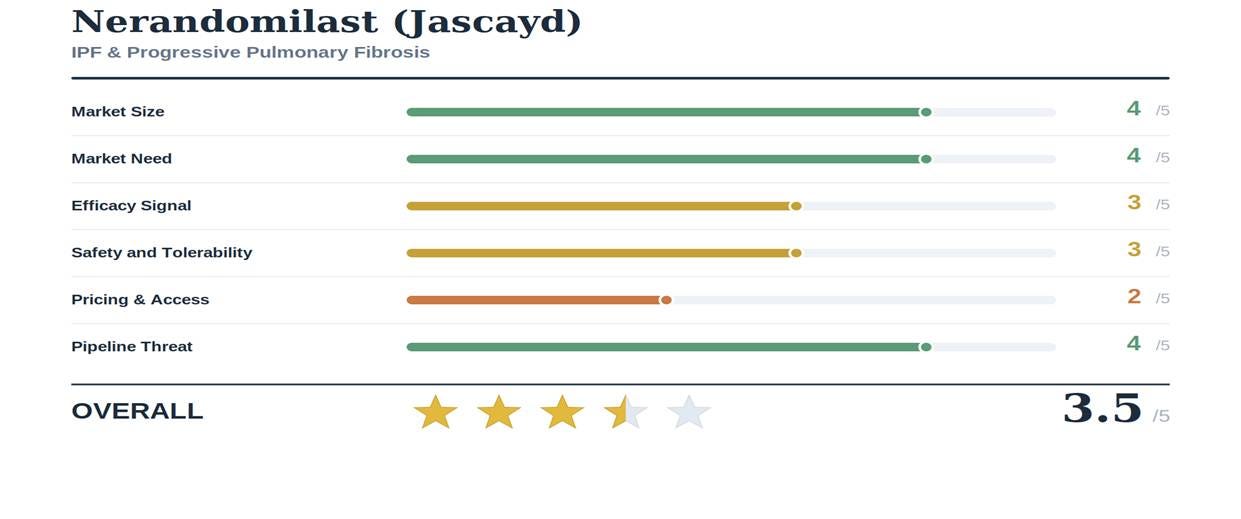
The Regulatory Breakdown covers updates from the FDA or EMA, explaining development programs, trial data, and the implications for both clinical practice and the market. Each issue includes a scorecard (see above!) and ends with The Verdict.
For the most part, rheumatologists have been content to let our pulmonary colleagues take point on managing interstitial lung disease (ILD). I generally feel we should take at least a collaborative role in management, especially because I suspect progressive fibrosis in autoimmune-related ILD is downstream from inflammation. The recent approval of nerandomilast (Jascayd) for both idiopathic pulmonary fibrosis and progressive pulmonary fibrosis straddles both worlds; a drug that will be mostly-prescribed by pulmonologists but appeared to be most-important for rheumatology.
I’ll keep the IPF story brief, but it is worth interrogating. FIBRONEER-IPF randomized 1,177 IPF patients to nerandomilast 18mg twice daily, 9mg twice daily, or placebo. Nearly 78% were already on nintedanib or pirfenidone. Both doses met the primary endpoint of reduced FVC decline at 52 weeks: the 18mg dose provided 69ml less-worsening than placebo and the 9mg dose provided 45ml of less-worsening than placebo. For reference, the original nintedanib trials showed roughly a 110ml difference in IPF, so nerandomilast’s effect is smaller, albeit in a possibly-sicker population.
Two practical details worth flagging. First, pirfenidone cuts nerandomilast plasma levels by 50%, rendering the 9mg dose useless in that combination. The label mandates 18mg twice daily with pirfenidone, so no option for dose reduction in those patients. Second, diarrhea affected 41% of the 18mg group overall and 62% of those also taking nintedanib. Stacking two diarrhea-prone drugs is going to be a tough sell - especially for our patients with SSc - and it is worth noting that 13% of patients on the combo discontinued for diarrhea alone.
Additionally, the rest of the data were pretty uninspiring. The composite secondary endpoint (acute exacerbation, respiratory hospitalization, or death) showed no benefit at either dose. Dyspnea, cough, and fatigue scores were identical to placebo. Nobody felt better based on the PROs. Taken alone, this would have been a worthwhile but unremarkable approval.
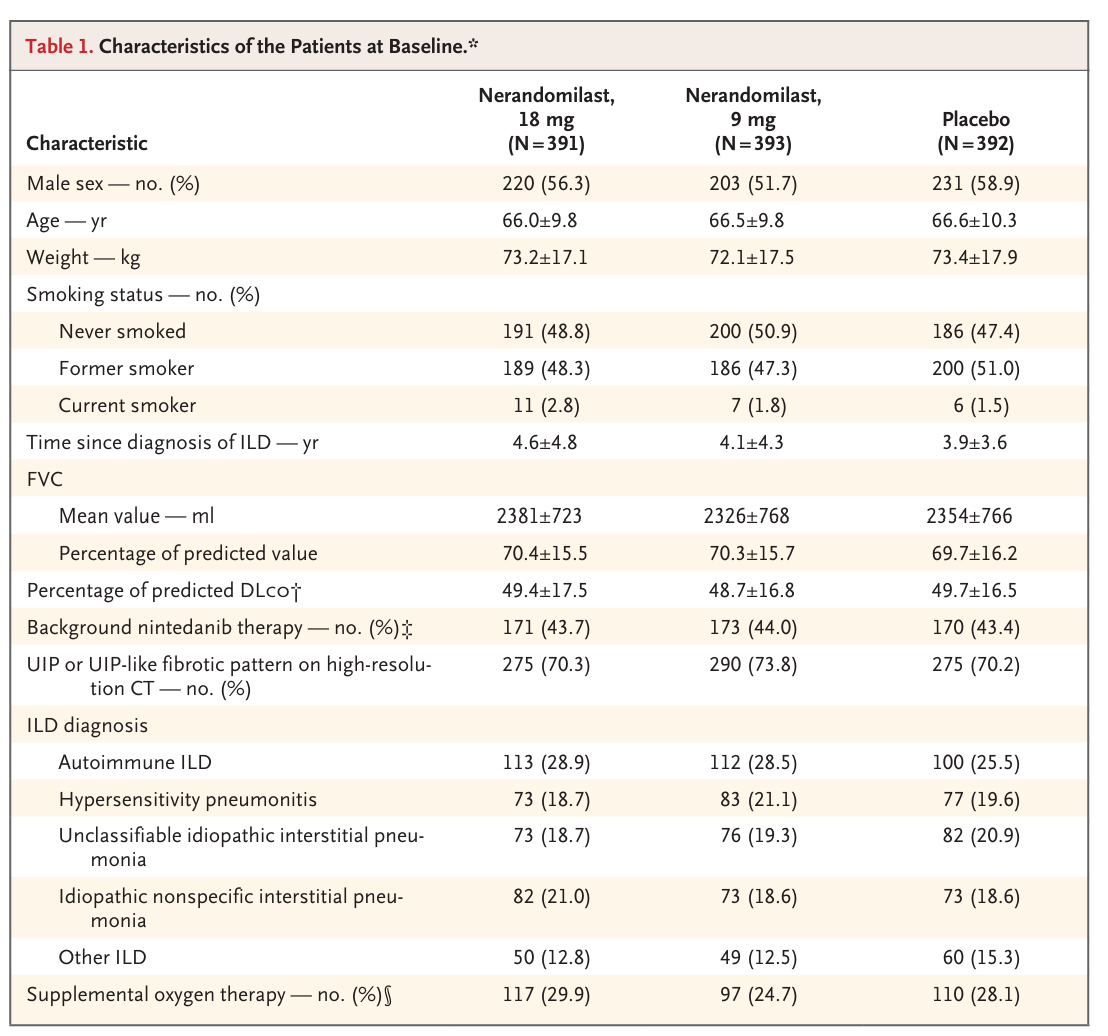
FIBRONEER-IPF did not land in isolation, but instead was published shortly before FIBRONEER-ILD, which randomized 1,176 patients with progressive pulmonary fibrosis (non-IPF ILD) in the same three-arm design. Nearly half were on background nintedanib. The population was heterogeneous: 28% autoimmune ILD, 20% hypersensitivity pneumonitis, 20% unclassifiable IIP, 19% idiopathic NSIP, and the rest a mix of other diagnoses.
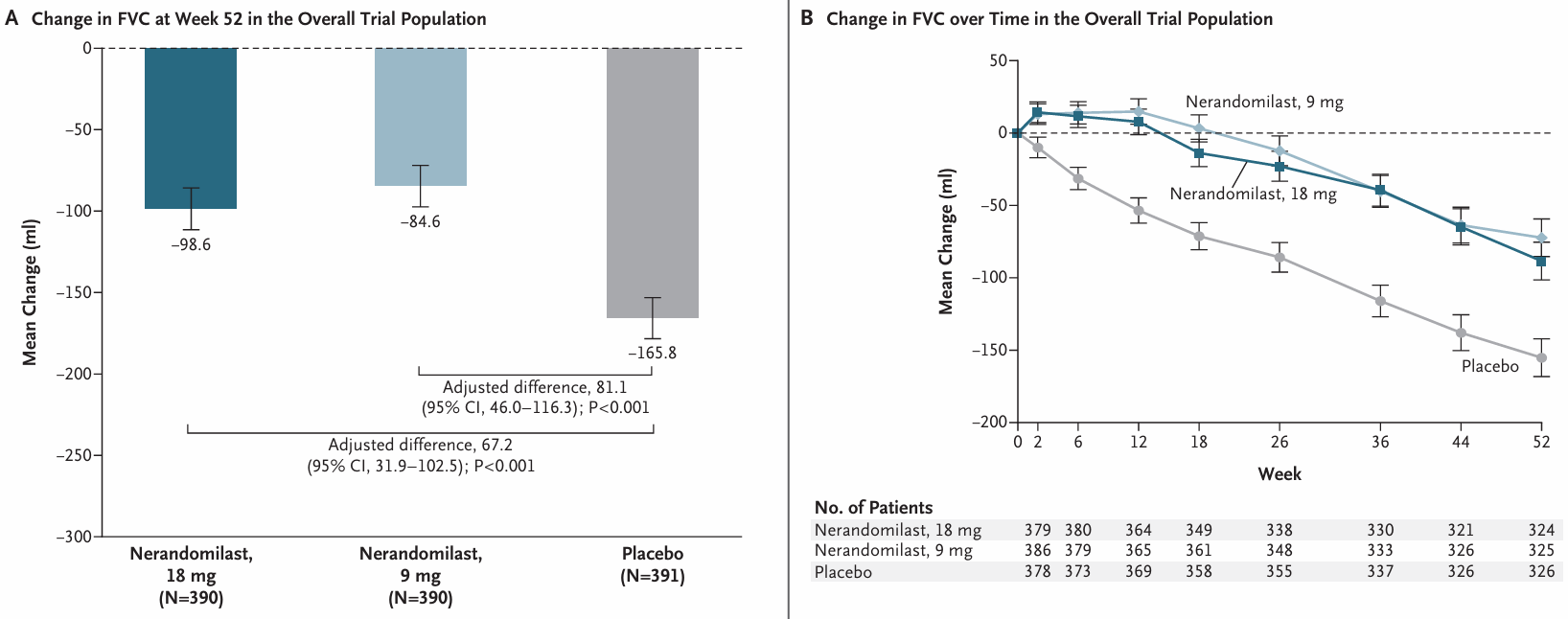
The FVC results mirrored the IPF trial. Both doses significantly reduced lung function decline by 67–81ml over placebo, with the 9mg dose actually outperforming the 18mg dose (possibly because the pirfenidone interaction wasn’t a confounder?). PROs were yet again ompletely flat and patients on nerandomilast did not report improvements in dyspnea, cough, or fatigue.
This would have been a similarly worthwhile but unremarkable approval if not for the mortality data. Over 52 weeks, 6.1% of patients on the 18mg dose died, compared with 12.8% on placebo. The hazard ratio was 0.48 (95% CI 0.30 to 0.79) and the effect was dose-dependent. In absolute terms, that’s a 6.7% risk reduction, yielding an NNT of roughly 15. For mortality. For context, beta blockers in heart failure carry an NNT of ~25 and statins for secondary prevention of coronary disease land ~30. An NNT of 15 for mortality would make this one of the more impressive drugs in modern medicine.
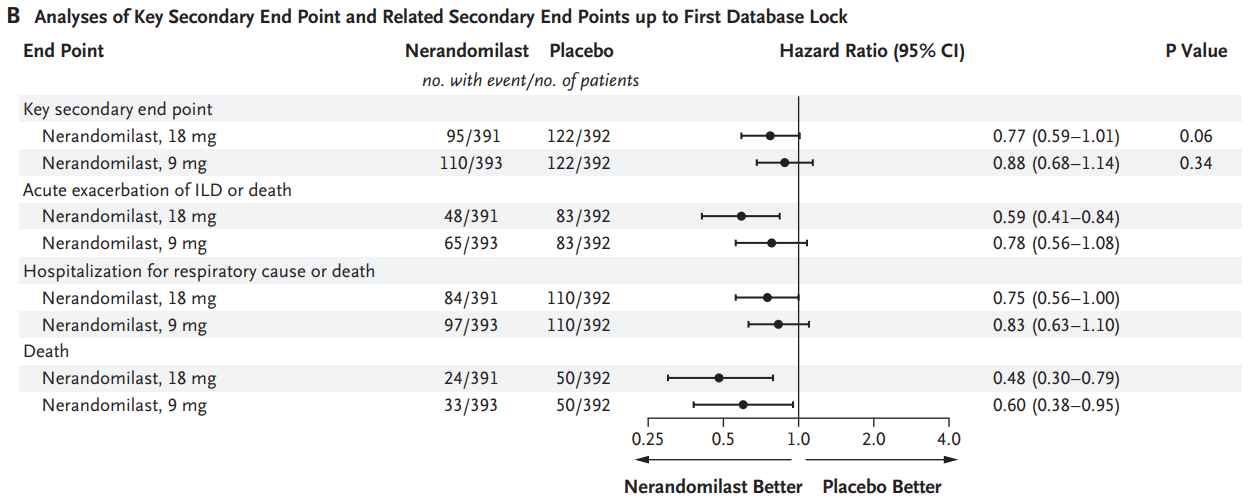
I find it difficult to reconcile a mortality reduction of this magnitude with everything else in the dataset. Patients in the treatment group were hospitalized at similar rates as compared to those in the placebo group. Their symptoms were unchanged. The composite key secondary endpoint (exacerbation, hospitalization, or death) was not significantly different (almost made it - HR 0.77, P=0.06). This purported mortality benefit was not prespecified. I can think of half a dozen strong arguments to dismiss this finding as a lucky roll of the dice.
What if we instead assume this is real? The 67ml of less-worsening of FVC was modest, but perhaps that kept some patients above some critical threshold. FVC decline in progressive ILD isn’t linear in its clinical consequences; the difference between 55% predicted and 45% predicted is far more consequential than between 75% and 65%. A small upward shift in the FVC trajectory could plausibly keep a meaningful number of patients out of the danger zone.
A second plausible explanation is more science-y, and listeners of my podcast will know that I am skeptical of pathophysiology. Here’s my best try; PDE4B inhibition raises intracellular cAMP, which has downstream anti-inflammatory and immunomodulatory effects beyond pure antifibrotic activity. If nerandomilast is dampening the inflammatory component of ILD progression, maybe it reduces the frequency or severity of acute deteriorations that don’t get captured cleanly as “acute exacerbations?” The fact that the mortality signal appeared in progressive ILD (where inflammation plays a larger role) but not IPF (where fibrosis dominates) is circumstantially consistent with this.
At the end of the day, I suspect this mortality signal is real(ish). It may have been inflated and needs replication. If it holds, however, nerandomilast is probably the most important drug in rheumatology you’ve never heard of.
Notably, FIBRONEER-ILD was not specifically built for patients with autoimmune ILD. The autoimmune ILD subgroup (325 patients, 28% of the trial) is the largest randomized cohort of autoimmune ILD patients in any antifibrotic trial. We learned more about these patients during an oral session at ACR Convergence 2025, which really should have been a Plenary.
The autoimmune ILD cohort included 36% w/RA, 23% w/systemic sclerosis, 15% w/MCTD, mix of other stuff. Most importantly, the possible mortality benefit persisted. This was driven by a small number of events (43 in all), but within the cohort of patients with autoimmune ILD the other outcomes also looked better (see screenshot from ACR below).
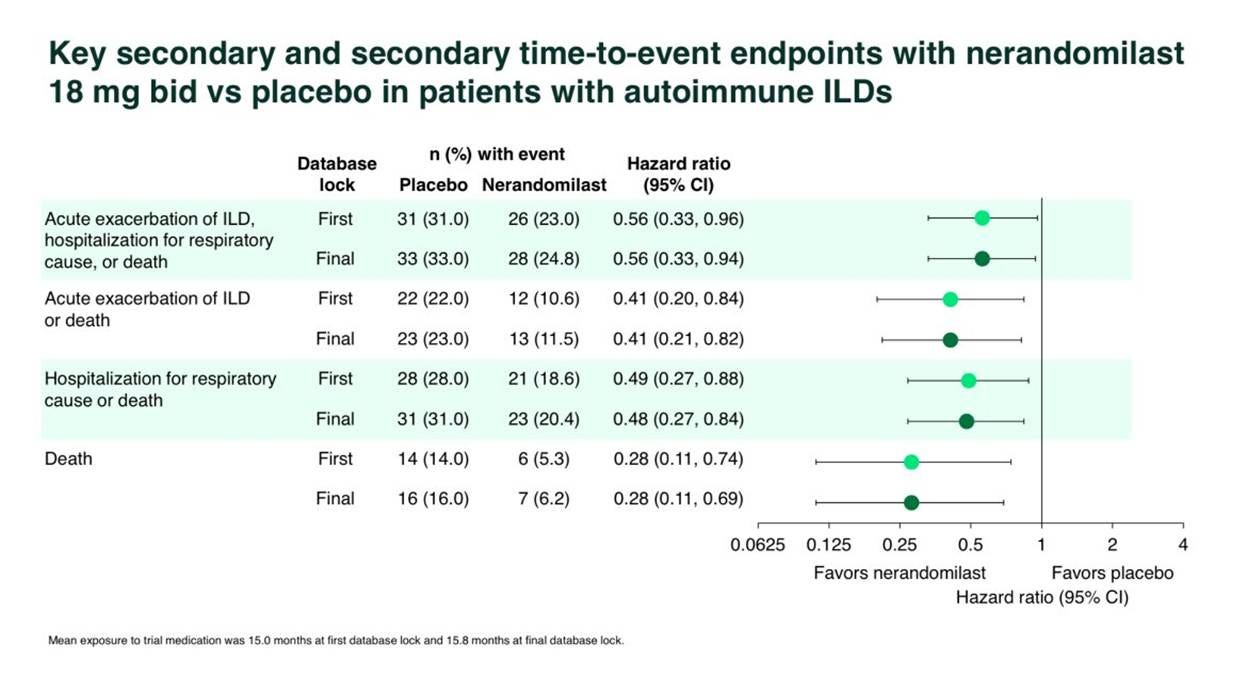
Unfortunately, patients receiving mycophenolate, rituximab, tocilizumab, or cyclophosphamide were excluded. For RA-ILD or SSc-ILD, immunotherapies are often not optional. Nerandomilast isn’t immunosuppressive and cannot prevent joint destruction or skin tightening. The relevant clinical question for a rheumatologist is whether you’d add it on top of immunosuppression, not as therapy by itself. I am left feeling like we ought to use this drug, but not sure when or how to implement it.
So who is this drug for, from a rheumatologist’s perspective? I think the target patient is someone with progressive fibrotic ILD whose systemic autoimmune disease is otherwise controlled. Think of the SSc patient on mycophenolate whose skin score is stable but whose HRCT shows worsening fibrosis, or the RA patient on a biologic whose joints are quiet but whose FVC keeps dropping. It could be argued that situations like that should be considered treatment failures. Add tocilizumab to your patient with SSc or swap rituximab for TNF in your patient with RA. Perhaps now we should be adding nerandomilast instead?
This also answers a related question for me, which is when to use nintedanib. My answer based on these data – and in the context of autoimmune-ILD – would be “not often.” Nintedanib may confer a similar level of not-worsening, has a worse tolerability profile, and does not have data in an RCT for mortality benefit. I will be looking to swap any patient who is having tolerability issues on nintedanib to nerandomilast and I would preferentially start nerandomilast over nintedanib. It would be a rare case where I would use both; diarrhea stacking (49% in the combo) will be a limiting factor.
1. Nerandomilast (Jascayd) is the first new antifibrotic for IPF in a decade and the second approved therapy for progressive pulmonary fibrosis. It works by a novel mechanism (PDE4B inhibition) and can be layered on top of nintedanib or pirfenidone. The FVC benefit is modest but real, and it adds to existing therapy rather than replacing it.
2. The mortality signal in FIBRONEER-ILD is the story. HR 0.48 for the 18mg dose, absolute risk reduction of 6.7%, NNT of roughly 15. This was not controlled for multiplicity and needs replication, but the consistency and magnitude are difficult to dismiss. Watch for the open-label extension and real world data.
3. For rheumatologists, the target patient is someone whose systemic autoimmune disease is controlled but whose lungs are progressing despite immunosuppression. Nerandomilast isn’t immunosuppressive and cannot replace “backbone” therapies like mycophenolate or rituximab. It’s a potential antifibrotic add-on for the fibrosis-is-winning phenotype
4. Nerandomilast works both as monotherapy and on top of nintedanib, but I will likely be prescribing a lot less nintedanib.
5. Pricing will be a barrier. At nearly $200,000 per year, nerandomilast will be a tough sell to payors and cost-conscious healthcare systems. Expect prior authorization battles, particularly for patients who are already on costly biologic therapies.
No posts
Comments
Nothing yet. Say the first thing.
Sign in to join the conversation.