
In my last post, I wrote that considering the question of ownership was important to using AI effectively and ethically. By the “question of ownership” I don’t mean intellectual property, though that’s certainly a thorny issue for generative AI, which is usually trained on other people’s work without compensation. (Lately my agent has been sending emails to her clients about the Anthropic settlement.) Nor do I meant the question of who owns the AI’s output, at least not in the sense of who is allowed to copyright it and profit from it. What I really mean is: when does using AI cross a line beyond which I can no longer say, “I did this?”
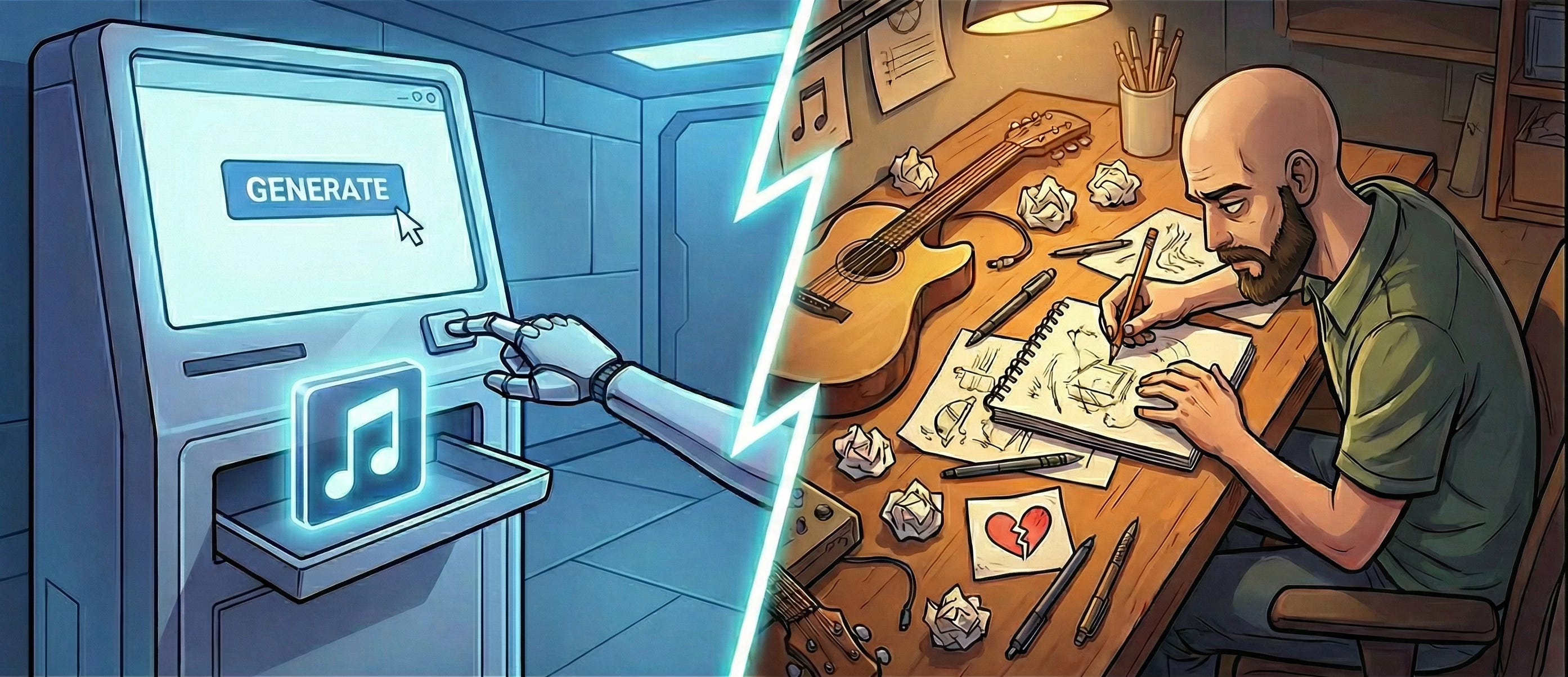
Or, to phrase it another way, where is the line between using AI to accelerate my human abilities, effort, and contribution, and using AI to replace them? And when is using AI as a replacement for my efforts okay, and when is it not?
That line is not always easy to find.
In my last post, I described using Gemini to make a website, and said that I’d offloaded the work of web design to something that could better realize “my vision.” Since I provided the “vision,” does that make the end product meaningfully mine? I don’t think so. If I’d worked with a web designer instead of an AI, I wouldn’t say “I made this website.” I would instead say, “I had this website made.” There’s a difference.
But in the case of the website, what’s important (at least to me, the “client”) is that that the web site exist. It doesn’t have to be a site I made. And it doesn’t have to express anything more meaningful than “This book exists; go here to get it!” So I don’t feel I crossed a line to use AI to create the site.
But what if I used AI to create something, well, creative?
Over the last couple years, I’ve been slowly learning music composition and production, and with much labor—literally months per track, at my skill level—I can create a track which I can enjoy listening to. But recently I gave Suno a prompt for the project I was considering next, and immediately lost heart, because Suno did a better job than I could, and it did it in seconds. So what’s the point of trying myself?
If all I wanted was the result: great, I guess it exists now. But if what I wanted was to own the result in some way, to be able to say, legitimately, “I did this,” and have it reflect genuine ability on my part—and not just technical ability, but artistic choice and feeling and expression—well, all I did was come up with an idea. I didn’t actualize it in any meaningful way. So is the result really mine?
I have to admit, I’ve been sorely tempted by Suno. I keep trying to find some way to integrate it into my creative process that will still allow me to say, at the end, “I did this.” I haven’t yet found a way to do that that feels authentic. But there are a lot of people out there who are as delighted with Suno as I was with Gemini’s web design chops—and who will also proudly tell you, “I made this song.”
On the plus side, my Suno angst did give me a nice analogy to play with in a student guide to AI.
Now, it’s one thing to simply provide a prompt and then claim the output. But what if I provided more vision? What about, say, the company that used AI to put together a truly awful Christmas commercial for McDonalds? Responding to the inevitable backlash, the CEO of the production company wrote probably had AI write, “To me, [the commercial is] evidence of something much bigger: that when craft and technology meet with intention, they can create work that feels genuinely cinematic. So no – AI didn’t make this film. We did.”
Believe it or not, I can get behind this. The CEO isn’t claiming her company created each individual scene, but rather that they decided what each scene should be, then auditioned versions from the AI and strung them together into a coherent whole that matched their (horrible, Grinch-y, corporate dystopian) vision. I think they can legitimately claim a significant level of ownership over the end product. I wouldn’t want to see a Hollywood movie made like that, but I think that’s more down to the quality of what AI can do than to the process. If some visionary young kid comes along and manages to make a genuinely compelling film-length story using AI-generated images, I’m not going to say the use of AI invalidates it.
But suppose it’s a book. I’m fortunate that my main creative outlet, long form fiction, is still something generative AI is really bad at. LLMs can be trained to write convincing passages in the voice of a particular author, but right now they can’t do the structural heavy lifting needed to write an actual story, with a plot and subplots and characters that develop and change in ways carefully choreographed to feel organic, meaningful, and satisfying. For instance, when I asked Gemini for suggestions on how to shorten my book to try to hit my publisher’s word count limit, it told me to get the plot twists out of the way up front. (It wasn’t wrong! That would certainly have shortened the book!) But what if some visionary kid uses AI to write a bunch of scenes and puts them together into a coherent book-length story? Is that any different from the movie scenario? Because while I’d watch the movie, I wouldn’t want to read the book. And if I read it, and liked it, and then found out that the moment-to-moment sentences were generated by AI, I would feel cheated.
What makes me feel differently about the book than the movie? Is it because I’m a writer myself, and so value human effort and intentionality in writing more than in film? Or is it because a single human can write a whole book, but it takes an army to make a movie, so in the case of a book AI is replacing at least some of the artist’s human expression and effort, while in the case of a movie it’s enabling a single artist to access a kind of artistic expression previously reserved only for elites?
I keep coming back to the word “vision.” Maybe I used that word wrong initially. It’s a pretty presumptuous way to describe having an idea for a web site. If we imagine a spectrum between “typed a prompt into an AI” and “used AI in a deeply intentional manner to support a human endeavor,” perhaps “idea” describes what the human brings to the table on one end of that spectrum, and “vision” describes what the human brings on the other end. And perhaps what makes AI use problematic in the creative arts is less what the AI is doing and more what the human is not doing.
There’s a reason the word “slop” is so often paired with “AI.” Partly the term reflects the low effort of most things made with AI, and partly it reflects the limitations of AI, which often generates things that feel like they coagulated from the ether with no humanity behind them. We tend to value human creations for the effort and the human intentionality and meaning that go into them, so diminishing those elements devalues the end result/
This brings up a the question of what art actually is, which I won’t get into here. I’m in the camp that believes that the best art expresses something more than the self, but it’s still the self of the artist doing the expression. When a child proudly show a drawing to their parents and says “Look what I made!” they are also saying: look what I gave life to, look what larger reality I participated in and reflected. The human urge to create includes the desire to be involved in an essential way in that process, and something is lost, for both the artist and the receiver of the art, when too much human agency is offloaded to machines.
So, just like the question of trust, the question of ownership regarding AI is contextual. For a given situation, how much is the human bringing to the table, and, in that context, is that amount appropriate?
That line, like many contextual lines, can be fuzzy, but that doesn’t mean it’s not there.
I’m still thinking about Suno. Maybe I’ll find a way to use it that feels like it’s helping me instead of replacing me, just as I’m currently using Gemini to help me research my next book project.
But when Gemini kept asking if I wanted it to write scenes for me, I went into its settings and added a permanent prompt directing it to never, ever ask that question again. For me, that line is very clear.
No posts
Comments
Nothing yet. Say the first thing.
Sign in to join the conversation.