
So I recently created a web site.
Or, to be more accurate, I had Google Gemini create the website for me.
Thanks for reading Root and Leaf - Anthony Tardiff! Subscribe for free to receive new posts and support my work.
I was given a little one-sheet press printout from my publisher with a synopsis of my novel, the publication date, and so on. I made that a PDF, fed it to Gemini, and told it to make me a website.
The first draft was almost perfect.
I went back and forth for a bit telling it what I wanted. It was very much like I imagine it would be to talk to a web designer: “Hey, can you do this? Oh, cool, that looks good, but maybe tweak it this way.” Essentially, I gave up direct control, but offloaded my vision to some(thing) with a far better ability to execute it.

I am gobsmacked by how easy this was. It also makes the expensive “easy” web design app I bought a while back completely redundant.
But I feel kinda sorry for all the web developers out there.
I’ve been thinking a lot lately about what can or should be offloaded to AI, especially as it gets more capable. AI is a tool. Like all tools, it can be used well, or used poorly. As I see it, there are one fundamental understanding and two fundamental questions governing effective and ethical AI use: the understanding that AI has no understanding, the question of trust, and the question of ownership.
AI has no understanding
A significant idea in my novel, The Final System, is that of Artificial General Intelligence: a machine that is conscious and able to think like a human. In early drafts, the amazing breakthrough that indicated that the machine was conscious was . . . its ability to speak coherently.
Obviously I had to revise that in later drafts!
But this criterion, speech, was for decades the litmus test for a truly thinking machine. For the entirety of our history as a species, speech was a capability which belonged to us alone. The very nature of speech was the expression of rational thought: the packaging of ideas, intentionality, and meaning, and the transmission of them from mind to mind.
Alan Turing famously proposed a test in which a human observer conversed remotely with a human and a computer and tried to determine which was which. If the computer could fool the human into thinking it was human, it passed the test. It’s telling that Turing called his test the “imitation game.” He explicitly rewrote the question “Can machines think?” to “Can machines fool a human into thinking they’re thinking?” At the time, it seemed obvious that if computers could do the latter, they must necessarily be doing the former—or close enough as to make no practical difference.
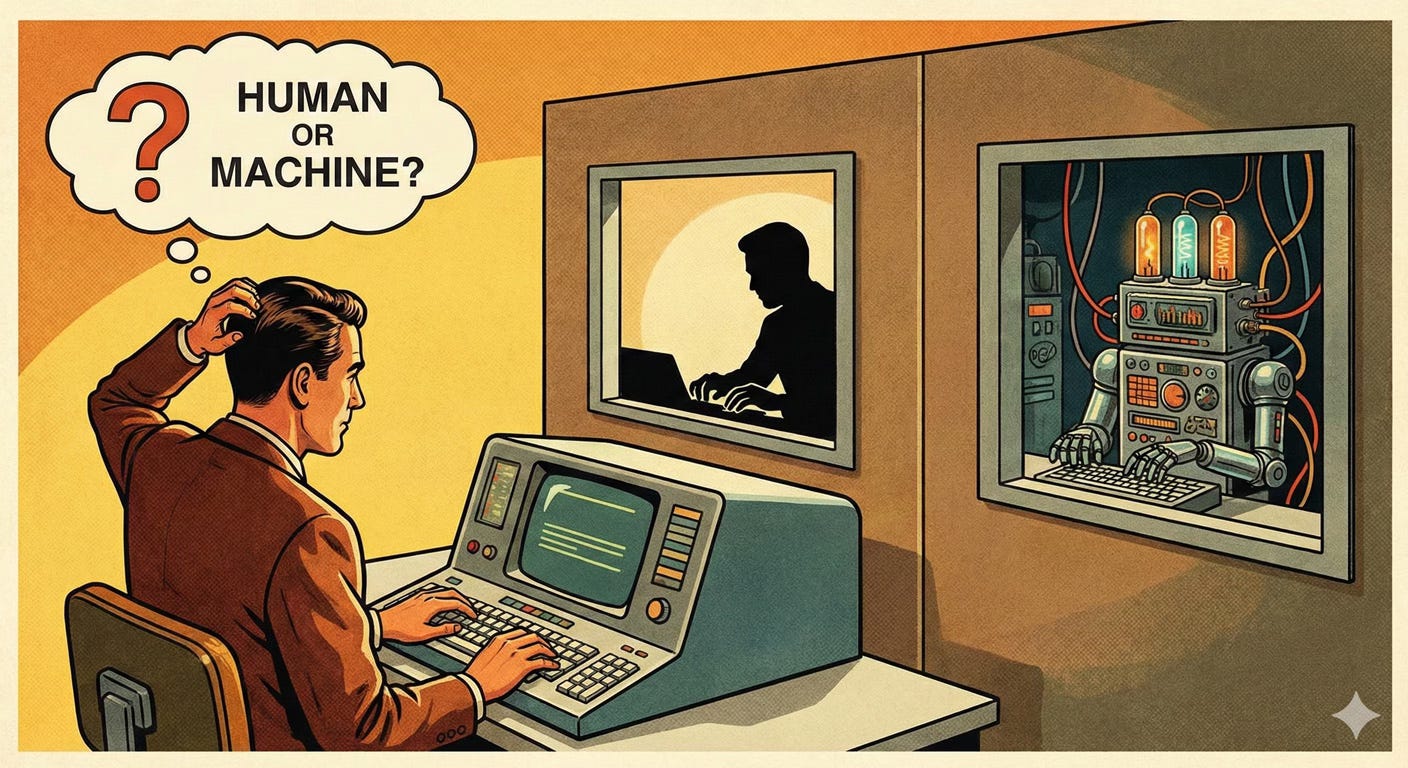
For years, passing the Turing Test was a holy grail of sorts for AI researchers, ever out of reach, ever just over the border of science fact into science fiction. I remember playing with a version of Eliza on my family’s Mac as a kid, and in college I got amusement from with early, pre-LLM (Large Language Model) chatbots like Jabberwacky and Cleverbot. These bots could imitate human speech and behavior fairly convincingly within limited constraints, but if the user stepped outside those quite narrow boundaries the illusion broke very quickly.
Then the generative AI boom happened. Suddenly, our devices are conversing with us in ways that are right out of Star Wars or 2001. Any LLM today can easily pass the Turing Test. In academia, where I work, there’s an ongoing, panicky struggle to determine which student-submitted papers represent genuine human writing, and which are AI. But there’s no foolproof way to judge that. LLMs can generate language with such contextual sophistication, such complexity, such seeming nuance as to be indistinguishable from human writing more often than not. It’s no wonder some people believe AI is conscious. Language, it seems, is no longer ours alone.
Except that it is.
What LLMs do is not language, but a simulation of language. I don’t have space to go into the details of how LLMs work here, but I recommend the page as a good starting point:

The important point is that LLMs are highly sophisticated pattern continuation engines. Given a prior pattern of human language—the input of the user, plus the invisible system prompt prefacing the user’s input—an LLM will generate the most probabilistically likely continuation of that pattern. LLMs are stochastic parrots, mathematically mimicking the patterns of human language with no human thought, intentionality, or meaning behind that language.
This doesn’t mean generative AI isn’t an astounding breakthrough! There are a million and one ways a human language simulator is useful. But a prerequisite to using it well is understanding what it’s doing—and what it isn’t doing. It isn’t conscious, and it isn’t thinking.
Trusting the System . . . When It Can Be Trusted
I sent my enthusiastic Gemini web design story to a colleague, who is very interested in AI, and he wrote back that it was “the slightest bit ironic to hear you say you gave up direct control and link to a page with ‘Trust the System? Not on your life’ right up front.”
Ha! Fair point.
I tell my students that an important part of AI literacy is having an appropriate level of trust. (Or maybe I should say an appropriate level of suspicion.) The appropriate level of trust is often contextual. It requires knowing what the tool is capable of, and what it is doing under the hood, which is often different than what it appears to be doing. But it also requires knowing what you are attempting to do, with enough self-awareness—enough metacognition—to understand the interplay between your desires and the tool’s capabilities, and between your actions and the tool’s reactions.
I’m currently using Gemini to help me with research for what I hope will become my next book, and it’s been shockingly useful. But I have to double check it constantly, not just because it can make mistakes, but because it is so easily led to give me the answers I want rather than what is correct. I often ask it, “What parameters will give me this result?” But once I have a plausible-seeming scenario, if I start a new chat and ask for the results of that scenario, it will often tell me something different than it did when I started with the endpoint I wanted.

Worse, even though I turned off learning from past chats, it still references things I asked about in previous chats, which is 1) creepy, and 2) contaminates its replies because it keeps leaning towards the results I asked it about before, even when I specifically avoid asking leading questions in my new chat.
So when using AI for information seeking, I lean hard into the “verify” side of the old Russian proverb “trust but verify.” I triangulate, asking the same question multiple times in multiple ways and comparing answers. I start fresh chats for each question to avoid the LLM “learning” things that would lead its pattern generation down a path I don’t want. And I verify the final results with my own research outside of the AI. In other words, I adjust my behavior to account for the nature of the AI as a language simulator which is not conscious and does not understand what it is saying, much less what I am asking, and I continually interrogate my own use of the AI, evaluating if the way I am using it is effective and ethical.
Self-interrogation is important not only to the question of trust, but also to the question of ownership. But that, I think, deserves its own post . . .
Thanks for reading Root and Leaf - Anthony Tardiff! Subscribe for free to receive new posts and support my work.
Comments
Nothing yet. Say the first thing.
Sign in to join the conversation.