
It’s easier to put on slippers than to carpet the whole world.
- Al Franken
Hello there, readers! Happy 2026.
I’ve been MIA the last few weeks traveling in Milan, Gothenburg, and Ljungby. My current job titles include CEO, research director, community builder, and designer of customized erotic immersive ordeals. That means lots of teams and lots of cultures.
One of the features of these trips, and my life as a collaborator, was/is People Being Annoying. This has recently included people:
Getting excited about an idea and spending lots of money before assessing its viability
Taking on a project, not communicating their needs, and then getting resentful
Being angry but refusing to talk about it directly
Setting “boundaries” with no consequences, and telling me I have to fix the resulting violations for them
…plus all the usual annoyances like “cashiers I talk with fluently in a foreign language who then talk back to me in English” and “TSA agents who harass my ethnically ambiguous husband in US airports”.
Oh man, y’all. People. Everyone (but me) is just so imperfect sometimes.
Anyways, all of this has triggered me to write an article I’ve been thinking about for a couple of years, as the social justice movements have crested and plateau’d, and the Western world has moved from its historical stance of “life is unfair, get back to work” to “life should be fair and social criticism IS work”.
This article is about what it takes to lovingly, effectively, and creatively make change.
A lot of amazing things have come out of the social justice movement. The Black Lives Matter movement led to more consciousness of racial inequality and discrimination. “Me Too” made it more acceptable to speak out against sexism. Occupy Wall Street helped us understand that sitting on rich people’s porches does not actually make them leave.*
But these movements have also led to a rise in protectionism, political schisms, victim-glorification, and mistrust. Each of them focused on the “against” - what the other side did wrong, and how they need to repair - rather than the “with”: what it might look like to move forward together. This has rippled into our individual lives, where we seem to expect that telling someone they did wrong is all we need to do to effect change.

It seems to me that a lot of the time, these days, we are trying to guilt and shame other people into [action? I can’t quite tell what the positive intent is, actually]. We tell them, “You’re bad because you’re a white man/a black man/a conservative/a liberal/rich/poor. You are, in fact, irredeemable, and the sins of your fathers are visited upon you too.”
Brene Brown, in her marvelous TED talk, says that:
Shame is a focus on self, guilt is a focus on behavior.
Guilt: “I’m sorry. I made a mistake.” Shame: “I’m sorry. I am a mistake.”
- Brene Brown
Thing is, if you’re bad because of something you are, rather than something you do, there isn’t much benefit to changing your behavior. At least in the old Catholic church we could say Hail Marys to make up for our sins; now they are painted on us as the color of our affiliation or our skin.
We end up feeling judged for things we can’t easily change, hemmed in by a society that seems like it will tear our hearts out for admitting weakness.
This doesn’t just happen on a societal level. On a personal level, misunderstandings and missed expectations are a fact of life. Our multicultural world allows for few spaces of easy shared context, so even if we don’t break promises or rules, we are bound to be accused of it at some point.
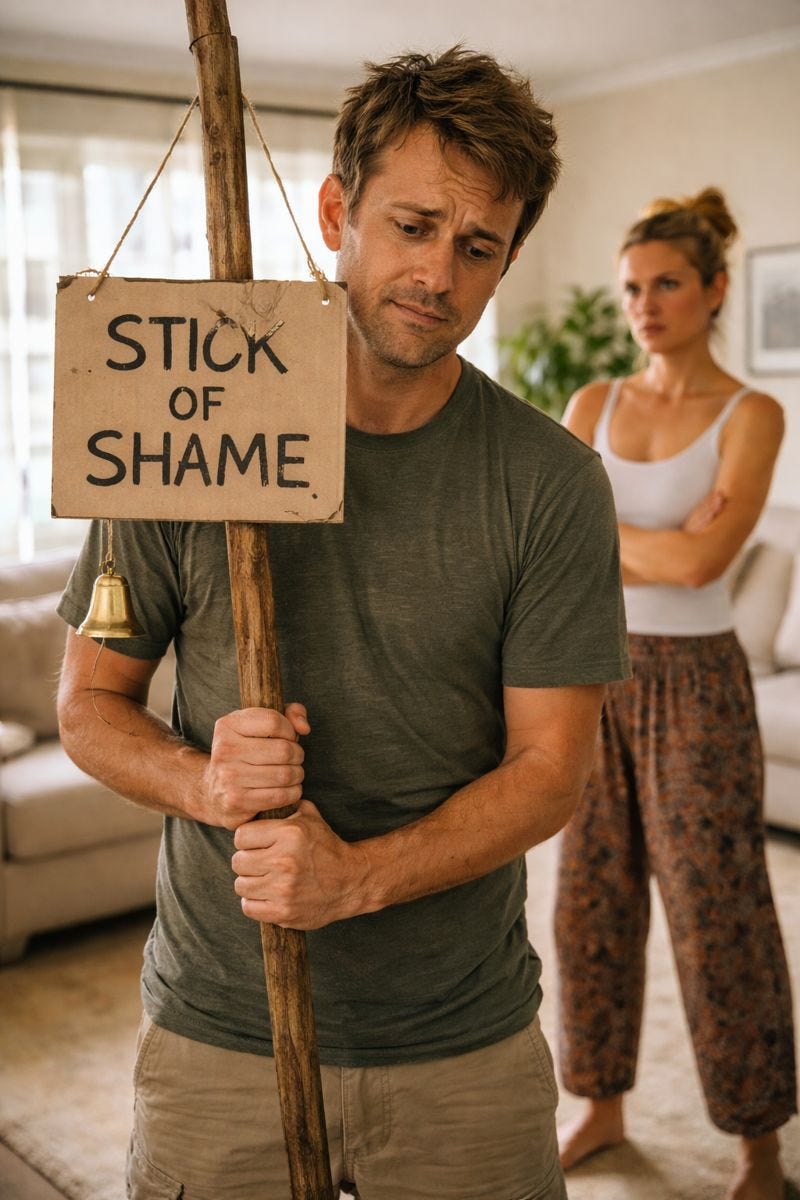
How do we resolve such pains - personally, socially - without wielding the blunt Stick of Shame to get our way?
Comments
Nothing yet. Say the first thing.
Sign in to join the conversation.