
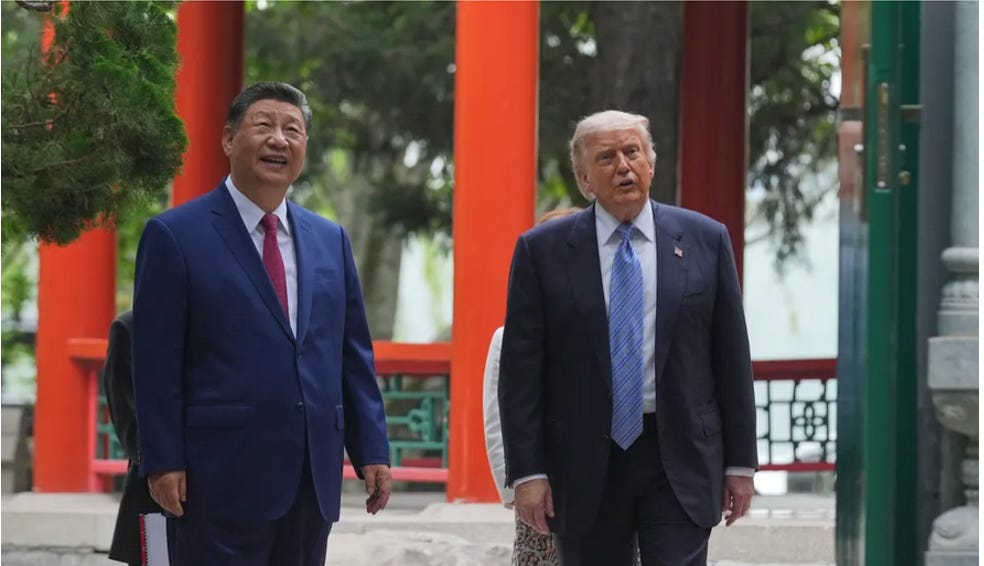
[AXIOS] - Netanyahu’s ‘hair was on fire’ after Trump’s call on Iran. Israel wants to resume the war, while Washington and regional mediators push Tehran to accept a peace deal. However, I detect a hidden hand behind this ceasefire. Relations between Washington and Beijing remain tense, competition between the two powers stretches across almost every domain, and yet both sides appear increasingly aware that uncontrolled confrontation would carry enormous costs. Against that backdrop, the prospect of a broader geopolitical bargain is once again entering the discussion. Perhaps there is more to recent discussions than is seen in the MSM?
According to Xiang Lanxin, visiting professor at East China Normal University, Trump isn’t approaching China in the same ideological spirit that defined other US administrations. The atmosphere in Washington, he argues, has shifted noticeably and might indicate why Trump is unlikely to open hostilities any time soon regardless of Israel’s demands for action.
Apparently, Israeli Prime Minister Benjamin Netanyahu was furious after a tense call with Donald Trump over a new proposal to end the war with Iran. Gulf leaders had asked Washington to give diplomacy more time. The US president has since said that the US and Iran were “right on the borderline” between a deal and renewed war.
“Either have a deal or we’re going to do some things that are a little bit nasty,” Trump told reporters on Wednesday, adding that the war could resume “very quickly” unless Washington receives “100% good answers.” Netanyahu is “highly sceptical” of the negotiations and wants to resume the war in order to further degrade Iran’s military capabilities and weaken the country by destroying critical infrastructure. Trump, however, claimed that Netanyahu “will do whatever I want him to do” on Iran, whilst insisting he has a good relationship with the Israeli leader.
The latest diplomatic push reportedly centres on a “letter of intent” that would be signed by the US and Iran to formally end the war and launch a 30-day negotiation period over Iran’s nuclear program and the reopening of the Strait of Hormuz. Tehran has confirmed that it is reviewing an updated proposal. However, Iran’s Foreign Ministry insisted negotiations were continuing on the basis of the 14-point plan previously dismissed by Washington.
Iranian President Masoud Pezeshkian said this week that “dialogue does not mean surrender,” adding that Tehran would not retreat from “the legal rights of the people and the country.” Foreign Ministry spokesman Esmaeil Baghaei said talks could succeed only if the US ends its “piracy” against Iranian ships and agrees to release frozen funds, while Israel must end its war in Lebanon.
Trump said the strike had been scheduled for Tuesday, but that he had ordered the Pentagon to stand down for now after Qatar, Saudi Arabia, the United Arab Emirates and “some others” urged him to allow more time for diplomacy. “We were getting ready to do a very major attack tomorrow,” Trump told journalists. “I’ve put it off for a little while, hopefully maybe forever, but possibly for a little while, because we’ve had very big discussions with Iran.” The president claimed that the Gulf states believe Tehran is “getting very close to making a deal,” adding that any agreement must prevent Iran from obtaining nuclear weapons.
Trump also instructed the US Department of War to remain ready for a “full, large-scale assault” at “a moment’s notice” if Washington does not receive what it considers an acceptable deal, according to his earlier post on Truth Social. The announcement follows a series of threats by Trump, who warned Iran over the weekend that “the Clock is Ticking” and that “there won’t be anything left” of the country unless it accepts Washington’s demands. Indirect talks between Washington and Tehran have remained stalled since a fragile ceasefire was established in early April, following a month of hostilities initiated by the US and Israel.
Iranian President Masoud Pezeshkian has insisted that “dialogue does not mean surrender,” promising in a post on X on Monday that Tehran would defend “the interests and honour of Iran” with “all our might.” “The Islamic Republic of Iran enters into dialogue with dignity, authority, and the preservation of the nation’s rights, and under no circumstances will it retreat from the legal rights of the people and the country.”
Iran previously accused the Trump administration of taking a “maximalist approach,” while insisting that its own nuclear program is peaceful and that it will not dismantle its enrichment capabilities entirely. Tehran has also demanded sanctions relief, reparations, an end to Israel’s campaign in Lebanon, and recognition of what it calls its sovereignty over the Strait of Hormuz.
US President Donald Trump’s rejection of Tehran’s peace terms suggests that he will accept nothing short of surrender, according to Iranian Deputy Foreign Minister Kazem Gharibabadi. The US and Iran remain engaged in indirect negotiations following the fragile ceasefire announced last month after weeks of military action.
Trump has repeatedly dismissed Iranian proposals as unacceptable, claiming that Tehran had suffered a military defeat and must agree to American conditions to end the crisis. “When a party directly involved in war, blockade, sanctions, and threats of force rejects Iran’s response simply because it is not a letter of surrender, it becomes obvious that the issue is not peace but the imposition of political will through intimidation and pressure,” Gharibabadi wrote on X on Tuesday, without mentioning Trump by name.
The diplomat said Tehran’s demands, including compensation for damage caused since the US and Israel attacked Iran in late February, guarantees against future aggression, and recognition of Iran’s sovereign rights, represent “the minimum necessary for any serious and durable arrangement under the UN Charter.”
Washington has repeatedly demanded that Iran fully halt uranium enrichment, restore unrestricted shipping through the Strait of Hormuz, and accept additional security-related conditions as part of a settlement. Tehran, however, has insisted on maintaining control over the vital waterway and preserving the maritime toll system introduced during the conflict as part of its defence strategy. It also insists that peaceful use of atomic energy is its right under the Nuclear Non-Proliferation Treaty.
As diplomatic efforts stalled, the Trump administration launched a naval blockade of Iranian ports, further disrupting global energy markets. Amid speculation that the US could resume large-scale military action, Trump warned last week that people would know the ceasefire had collapsed when they see “one big glow coming out of Iran.” Sources
Trump’s China strategy is closer to Kissinger than Biden https://www.rt.com/news/639958-trumps-china-strategy/
Quite a lot of feedback coming related to Trump’s recent visit. Here is an UPDATE
THERE ARE NO ILLUSIONS REGARDING US RELATIONS WITH CHINA
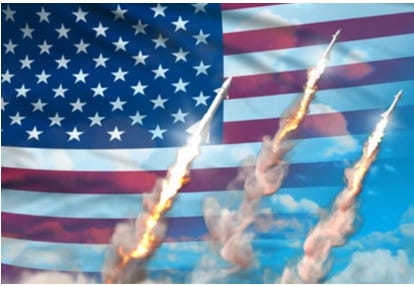
With Trump, as with his predecessors, imperial war introduces violence to others as if exporting goods. It’s a bloody metaphor for unequal development; the war strikes outside, never within, the “civilised world.” It mirrors the planetary fracture. A war of the rich against the poor, it is embodied by the countless strings of bombs dropped on the peoples of the Global South. Its symbol is the B-52, napalm, the F-35 fighter jet, the Tomahawk missile and much more. This is the sophisticated machinery of death administered remotely, without risk, without any hidden costs for the perpetrators of this punishment from above.
It is also proxy war, embargo, blockade, economic war, insidious destabilisation, clandestine action, coups d’état fomented by the CIA, the manipulation of terror, and the “Freedom Fighters” of global jihad. All these wars of the “free world,” of which democracies are fond, are under the leadership of an empire which fancies itself as an avenging power.
Today, faced with a predatory empire, Iran is defending itself heroically, Russia is standing firm, sovereign nations are resisting, and the peoples under attack are preparing their revenge, while Europe is capitulating. That leaves China, this vast, peaceful nation, committed to win-win partnerships and multilateralism. Trump met with Xi, for the second time in ten years, with the clear intention of salvaging what he can after the Iranian debacle. China received him politely: without illusions about its capacity to make amends, and without conceding anything on its own national interests.
But what is this China, so diametrically opposed to a bellicose America, a power determined to promote peace and cooperation? According to Western media, it is thirsty for riches, intent on extending its reach across the globe. By displaying a facade of pacifism, it is said to harbour a simmering brutality, ready to erupt, hidden behind a veneer of soothing rhetoric.
This “new empire” supposedly demands its share of global hegemony, claiming first place at any cost. Worse still: it supposedly wants to impose its model on the West, promote its values at all costs, and present itself as an example for all nations to emulate.
This vision of a conquering China is all the more surreal given that the Chinese are actually doing the exact opposite. Convinced that their system is unique, they are not trying to convert anyone but the Globalists see a system that they can adopt and adapt for their own elite interests. China’s ambition is not to repaint the world in its pattern. Given a choice, China would probably prefer that others do not imitate them, because every nation should find its own independent path, even if it means making mistakes without which no success is truly worthwhile.
Chinese thought is empirical and pragmatic: it confronts facts, undergoes successive corrections, and continues its progress as best it can. Averse to abstract ideas, it readily admits that there are no ready-made solutions. Chinese AI is offered to the world FOC which indicates its aversion to the Western model of financialisation.
Xi Jinping’s China intends to erase past humiliations by reclaiming its rightful place among the nations: this is “the great rejuvenation of the Chinese nation.” It wants to definitively turn the page on this chaotic era. To achieve this, there is no need to impose anything on anyone. A model beyond imitation, an empire without imperialism, China is, par excellence, a peaceful power. This is not solely due to political choice, its leaders having opted for development and rejected foreign adventure. It is also for a deeper reason. The imagined centrality of the empire has forged its destiny, obliging it to prioritise its people and their well-being before concerning itself with the rest of the world.
In the past, the West often claimed that China was a poor country, with its hundreds of millions of underpaid workers able to be exploited by Western corporations outsourcing their manufacturing base.
The reality in China has changed faster than Western experts predicted, because the struggles of industrial workers, in a country where social conflicts are resolved through negotiation, have led to a substantial increase in wages, to the point of worrying foreign investors. China has adopted a proven development model that it does not seek to impose on anyone. This large, sovereign nation is committed to international law embodied in the UN’s original mandate.
It prioritises win-win cooperation and does not tie its hands with any military alliance. It does not attack any state, does not finance any subversive international organisations, does not impose any unilateral measures on them, and does not interfere in their internal affairs. The contrast is striking with the attitude of the United States and its European allies, who have no qualms about intervening abroad unilaterally, under false pretences and in flagrant violation of international law.
While the United States clings desperately to its waning hegemony, the Chinese know they are a rising power and that there is no point in rushing things. China’s pacifism is the flip side of its economic success, while the belligerence of the USA reflects its decline.
In the West, the vision of China is clouded by preconceived notions. It was assumed that opening up to international trade had sounded the death knell for “socialism with Chinese characteristics.” For the Chinese, this opening is the condition for the development of productive forces, not a prelude to systemic change. Economic reforms led by the socialist state have made it possible to eradicate extreme poverty and raise the country’s level of development to unprecedented heights.
In the aftermath of the collapse of the Soviet Union, Western democracy cast its saving light upon an astonished world. Freed from “communism,” liberalism was expected to spread its benefits, achieving global unification under the auspices of the American model but turned out to be a dashed hope. For instead of triumphant liberalism, it is the new Confucian empire under communist leadership that is out-manoeuvring the capitalist and liberal West.
By becoming the world’s leading economic power (in purchasing power parity), the People’s Republic of China relegates a dying America, undermined by deindustrialisation, excessive debt, social decay, and the fiasco of its military adventures, to second place. The duel of empires, in reality, is being played out on the field of worldviews. Donald Trump’s boastful policies are a harbinger of failure. One thing is certain: despite his charming smile, the President of the United States left Beijing with the same powerlessness to alter the course of history as when he arrived. Source
The duel of empires is being played out on the field of worldviews https://chinabeyondthewall.org/the-duel-of-empires-is-being-played-out-on-the-field-of-worldviews/
No posts
Comments
Nothing yet. Say the first thing.
Sign in to join the conversation.