
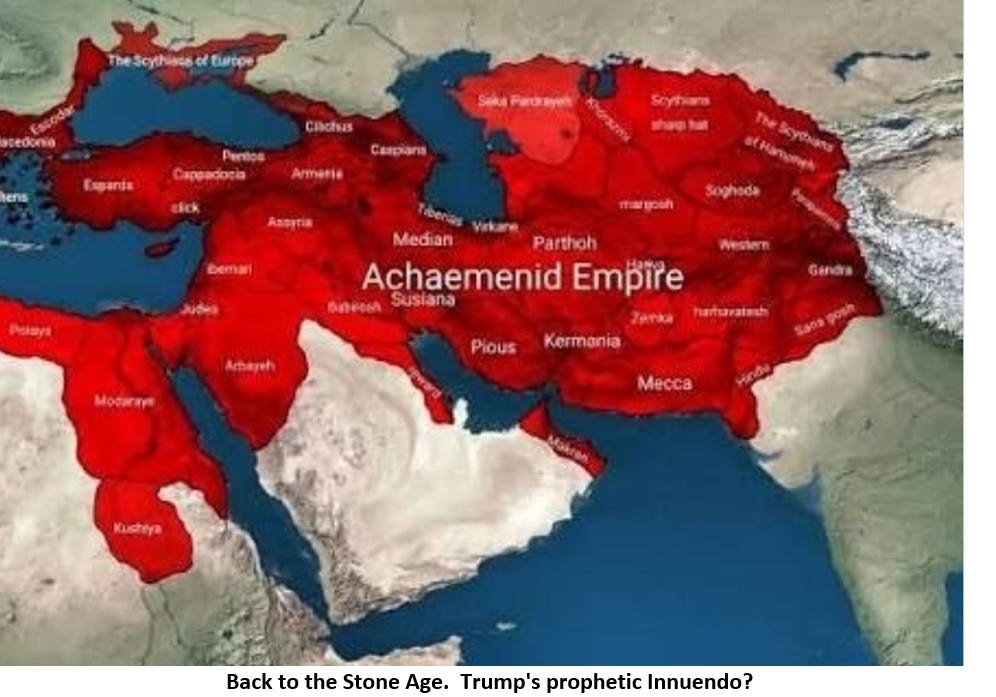
The Achaemenid Empire, also known as the Persian Empire, was an ancient Iranian empire founded by Cyrus the Great around 550 BC and lasted until 330 BC. It was the largest empire of its time, stretching from the Balkans to the Indus Valley, and is recognised for its centralised administration and cultural diversity. So much for Trump’s hopes.
Last week I asked: “What Next?” The answer has now appeared as “Two weeks to flatten the curve?” The rising risk of escalation in the Iran war reached a sudden halt in the early hours of Wednesday, April 8. Then it wobbled on Thursday. Donald Trump’s deadline for Iran to capitulate was interrupted by an apparent temporary two-week ceasefire to allow time to formalise an agreement. It appears that Trump acceded to at least one of Iran’s 10-point plan here, that Iran will not be threatened militarily by the USrael and thus implied that the US withdraws its bases from the Gulf and ME states.
In return, Iran must commit to ‘open’ the Strait of Hormuz, which it can’t do because it’s not in their remit. Most believe that Iran unilaterally closed off the Strait; it was not closed by Iran, but by the City of London, through its banksters and the Lloyds Insurance Market, with its monopoly of insurers and reinsurers. Thus, this is not a ‘ceasefire’, it is a ‘stay of execution’ and is following a path of so many other past agreements. It will be violated by both sides from day one draped in a cloak of obscurity as demonstrated in Gaza and Lebanon. The cracks had already appeared on Thursday, April 9.
My guess is that eventually a “Council of Peace” will be proposed whilst the war rumbles on behind the curtain. The US/Israeli objective of decimation of Iran as a civilisation has not been revoked, as again is demonstrated in Gaza. Israel has lent quiet lip service to this ‘ceasefire’ without any obvious enthusiasm but continues attacks in Lebanon. Apparently Iran missed this vital addendum to the US demands. Probably buried in the small print. Iran has told mediators it will not open Hormuz or attend Islamabad talks unless Lebanon included in ceasefire.
Thus, we have yet another endless war to add to those prevailing in Ukraine, Gaza, and Lebanon but what about Iran’s proxies? The Houthis are funded by both sides; weapons from Iran; money from the Saudis. They are waiting. It seems that a new concept of undeclared continuous wars has normalised the old and dying international order. I suspect there’s more to come in that the Houthis may well act, when instructed, in the same way that Hamas has rejected the ‘ceasefire’ in Gaza.
There is a pattern here that may be described as The Interregnum, which is a period during which a leadership role is vacant. The Anglosphere has many vacancies for the role of adult leadership. Writing from a Fascist prison in the early 1930s, Antonio Gramsci diagnosed a condition that resonates with uncanny precision in 2026: The Interregnum. He wrote “The crisis consists precisely in the fact that the old is dying and the new cannot be born; in this interregnum a great variety of morbid symptoms appear.”
In 2026, this is the post-1945 Western order: its institutions (the UN, IMF Bretton Woods, NATO et al), its norms (non-proliferation, civilian protection, freedom of navigation), and its theoretical frameworks (realism, liberalism, constructivism as developed within Western institutions) are losing relevance. The order has not yet expired because its institutions persist, its norms are invoked, and its theories continue to be taught, but its capacity to organise, regulate, and stabilise the international system is manifestly declining.
The ‘new’ has not yet been birthed. BRICS+ led by China proposes alternatives (the Belt and Road Initiative, the Global Security Initiative) but has not yet constructed a substitute order. The Global South asserts agency but lacks institutional coherence. Iran demonstrates resilience but offers no systemic alternative. The new order is gestating but remains unformed.
The ‘morbid symptoms’ are visible everywhere: proxy wars, energy weaponisation, institutional paralysis, the return of territorial logic, and the reforming of geopolitical conflicts as eschatological struggles. The 2026 Iran war is, in Gramsci’s terms, the quintessential morbid symptom of “The Interregnum”. Gramsci’s diagnosis cuts across the realism–liberalism divide. It is not, strictly speaking, a theory of international relations. It is a theory of historical transition. The 2026 crisis is not a puzzle within an existing paradigm. It is evidence that the paradigm itself is in transition.
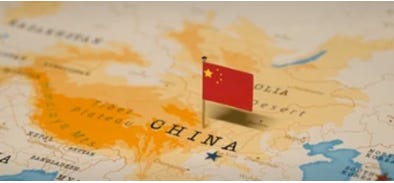
This is no better illustrated than by China’s posture in the 2026 conflicts which defies classification within Western theoretical frameworks. China avoids direct confrontation contrary to Mearsheimer’s prediction of inevitable great power conflict. It leverages interdependence without stabilising it. It operates within the existing structure but reshapes it indirectly:
Malek Bennabi, the Algerian thinker whose work on civilisational dynamics remains underappreciated in Western thought, offers a more illuminating framework. Bennabi’s central concept of colonisabilité posits that civilisational vulnerability is an internal condition that precedes and enables external domination. Conversely, civilisational readiness, the alignment of ideas, people, and material resources within a coherent social project is the precondition for effective action in the world.
China’s behaviour in 2026 exhibits the characteristics of Bennabi’s civilisational readiness. Beijing does not seek to dominate the 2026 crisis. It seeks to outlast it. China continues to diversify its energy supply routes, accelerate domestic technological development, strengthen alternative payment systems, and build parallel institutional architectures like BRICS, the Shanghai Cooperation Organisation, and the Asian Infrastructure Investment Bank. It absorbs the shocks of the 2026 conflicts, including potential Hormuz disruptions that threaten its oil imports, not by confronting the US militarily, by constructing the internal conditions for long-term strategic autonomy.
This is power as temporal advantage rather than immediate dominance. It is legibility through Bennabi’s principles: the patient construction of civilisational capacity as the foundation for eventual systemic influence. Where the West escalates, destroys and fragments, China builds and waits. Bennabi’s framework, developed in the context of decolonisation and not great power competition, proves relevant for describing the most consequential strategic posture of the twenty-first century. Sources
This is only a temporary stay of hostilities. Nothing permanent has been agreed
The 2026 war involving Iran, Israel, and the United States constitutes a systemic rupture in the architecture of international relations. https://www.globalresearch.ca/war-energy-fragmentation-global-power-2026/5921346
Here are three scenarios after the pause https://www.rt.com/news/637760-gulf-has-new-boss-here/
No posts
Comments
Nothing yet. Say the first thing.
Sign in to join the conversation.