
The end of the 5th week - where next? Mohammad Ghalibaf, Speaker of Iran’s Parliament and military leader, warned that the war has entered “a new phase”: “Israel’s skies are defenceless … It seems the time has come to implement the next phase of our pre-designed plans …”. There is little doubt, according to military commentator Will Schryver, that US magazine depth (the US’ storage sites) is approaching exhaustion and sortie generation has collapsed due to maintenance backlogs and logistical limitations.
US manned aircraft are not penetrating deeply into Iranian airspace. Iran however, claims that their own magazine depth is plentiful. Trump, in the last few days has given Iran an ultimatum: “Open Hormuz by April 6 or your civilian power plants will be progressively destroyed” although Trump often continues to offer variations on the US war objectives, so nothing is written in stone. Earlier this week, Trump announced:
Austrian’s Newsletter is a reader-supported publication. To receive new posts and support my work, consider becoming a free or paid subscriber.
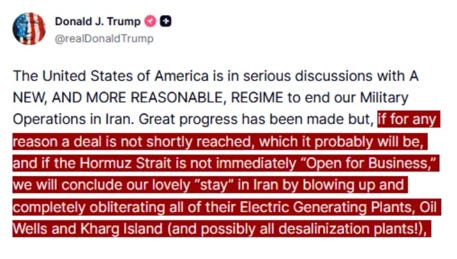
But later, Trump signalled his willingness to end the war without reopening Hormuz and the Gulf states are not happy. It must be said that this conflict is more narrative theatre than a valid military expedition, although the bombs and destruction appear to be real and people on all sides are dying.
Although Iran has been subjected to intensive bombardment, the US military effectiveness is far from evident. Iran’s ability to strike back at US and Israeli interests in Gulf States continues with increasing power; its leadership operates effectively in its deliberately-chosen opaque mode (mosaic); and Iran persists with regular missile and drone attacks, with increased sophistication of its missile barrage. Popular support for the Iranian State has consolidated.
The US and Israeli barrages are causing serious damage in Iran, but there is little evidence that these strikes have destroyed Iran’s dispersed and deeply buried missile ‘cities’ spread across the extent of the country. The evidence suggests rather, that in failing to destroy Iran’s hidden military infrastructure, the US and Israeli civil targets aimed at demoralising the people is also failing.
Western military planners are pessimistic about the chances of reopening Hormuz by military means alone. The geography of the area and technology available to Iran, includes drones that can be operated many miles from the shoreline, means that even naval escorts cannot guarantee the safety of commercial traffic.
That leaves a negotiated agreement with Iran as the most realistic option for which Iran has clearly listed its terms. Iran sees this as the Next Phase. The Iranian regime is reckoning on future revenues from tolls as well as offering favours or punishments to countries all over the world. In short, the next few weeks will likely see ‘virtual’ negotiations as the US gradually implements a plausible exit. However, the question remains as to whether Israel will go along with a US withdrawal; they are pressing for a land invasion.
Iran carefully constructed a strategy that is unfolding in distinct phases. Trump however, has no plan, rather indicating confusion and contradiction. Israel does have a plan, which calls for the elimination of Iran in its entirety. Israel’s design is for Iran to be dismembered, divided into ethnic and sectarian regions, and reduced to anarchy based on the Syrian model.
For now, the US stated objectives are represented as punctuated threats of escalation ranging from attacks on economic infrastructure (South Pars gas facilities) to two meaningful hits in the very near vicinity to Iranian nuclear sites at Nantaz, the joint Iranian-Russian operated Bushehr nuclear plant. Iran messaged in kind with a missile strike on Dimona town, in close proximity to Israel’s Dimona nuclear facility.
Presumably these near missile strikes are intended as ‘messages’ to imply the possibility of a US or Israeli escalation to the nuclear level. After the Dimona strikes caused heavy damage, Iran made a significant and pointed statement: It claimed it had achieved “missile dominance.” This assertion was based on the fact that Israel had been unable to launch any air defence interceptors in the face of Iran’s strike against one of its most heavily guarded strategic state sites.
Ayatollah Mojtaba Khamenei’s ultimatum to Trump was a structured 12-minute address, moving from familiar rhetoric into something far more consequential. Lebanese commentator, Marwa Osman reported “Midway through, the tone shifted from retrospective to strategic. Khamenei outlined three concrete demands, each with a defined timeline”:
A rapid US military withdrawal from the Middle East
A full rollback of sanctions within 60 days
Long-term financial compensation for economic damages.
Then came the ultimatum: “Fail to comply, and Iran escalates, economically, militarily, and potentially nuclear. Not hypothetically, but operationally: Closing the Strait of Hormuz, formalising defence ties with Russia and China, and moving from ambiguity to declared nuclear deterrence”.
Within hours, both Beijing and Moscow issued statements aligning in a carefully worded, yet unmistakable way, with the new Supreme Leader’s framing, suggesting coordination. The war is entering a new phase. Trump & Co are searching wildly to find an exit from the war that, by the summer, might project a plausible ‘win’ for Trump but such a thing is not even possible as week 5 ends inconclusively.
Simplicius suggests “that Trump’s potential coming attacks against Iran’s energy grid is to be a destabilizing and distracting effect meant to allow U.S. Marines and 82nd Airborne to take Kharg Island, or other Iranian islands. “Senior official” sources continue to claim that the boots-on-ground operation is still highly probable”.
Iran evidently is ready to match Trump on the escalatory ladder. Iran’s leadership style has changed with the new Supreme Leader: He is no longer interested in incremental ‘toing and froing’. Iran’s leadership is going for decisive outcomes that will change the West Asian geo-strategic landscape. And Iran believes that Hormuz represents the leverage required.
Iran has established a select and safe shipping corridor for approved and IRGC-vetted vessels to transit the Hormuz Strait provided that the cargo is paid in yuan and subject to a fee. It is estimated that Iran potentially could earn $800 billion a year in fees from such a Suez Canal-type regulatory regime. This, in theory, allows the energy market to be supplied, but with the proviso that Iran would simply close the Strait completely were Trump to implement his ultimatum.
Professor Michael Hudson notes that Iran’s new demands are so “far-reaching that they seem unthinkable to the West: That Arab OPEC countries must end their close economic ties to the United States, starting with the U.S. data centres operated by Amazon, Microsoft and Google … And that they [must] divest their existing petrodollar holdings that have subsidised the U.S. balance of payments since the 1974 [petrodollar] agreements”.
“The recycling of petrodollars has been the basis of America’s financialisation and weaponisation of the world’s oil trade, and its imperial strategy of isolating countries that resist adherence to the U.S. rules-based order (no real rules, but simply U.S. ad hoc demands)”, as Prof Hudson puts it.
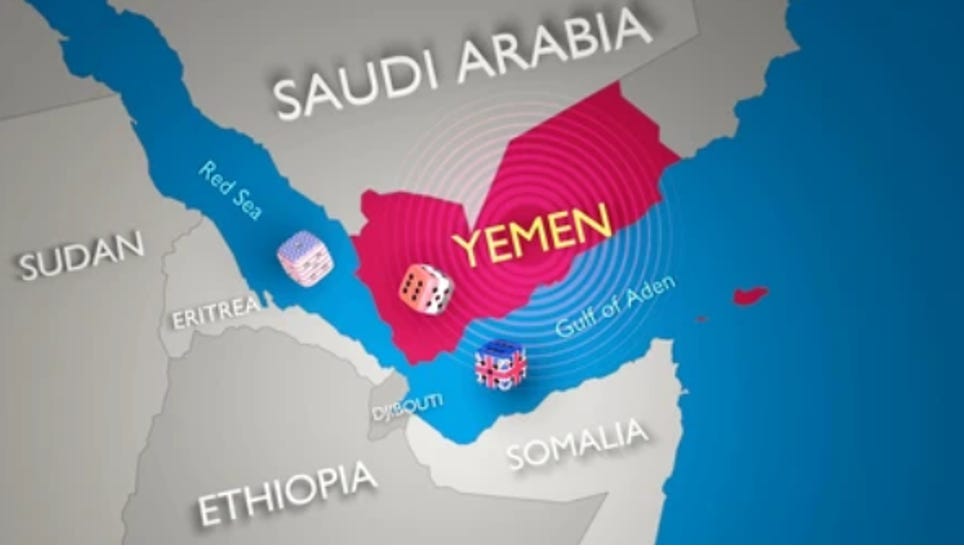
An Iranian choke-hold over Hormuz, plus the Houthi’s control over the Red Sea, could wrest domination over energy and its pricing from the US and, absent the petrodollar inflow to Wall Street, pull the plug on US financialised global domination. What is at issue here is not just Iran’s aspiration to eject the US military from the Middle East, but also a geopolitical transformation as GCC and Asian states (such as Japan and South Korea) are compelled by necessity to become ‘client nations’ of Iran in order to gain access to the Hormuz waterway because only Iran is able to guarantee safe passage. Effectively, should Iran be able to maintain its choke-hold on Hormuz, the geo-politics of Asia would be recast in a new strategic reality. (Edited from Strategic Culture Foundation)
This is the replacement of the unipolar, US-dominated world order by a genuinely multipolar order; all of this under conditions of crisis, as shortages of goods and inflation are likely to persist for many years. This suggests that the current Iran war is acting as a catalyst. It accelerates developments that were already due: the end of the current global (Western) economic order, the end of the US presence in the Middle East, and the end of Western global dominance; also the end of Israel in its current form and the rise of new regional powers.
Otherwise, it only needs to extrapolate current macro-trends over the next 30-50 years to obtain a fairly accurate picture of the world to come. Europe, lacking energy, internally ethnically fragmented, and on the path to de-industrialisation, will continue its decline, leading to civil war scenarios, growing impoverishment, and the partial establishment of police-state dictatorships.
America, with or without Trump, will remain a great power because it is successfully securing key energy and raw material reserves while remaining attractive as an industrial location. At the same time, BRICS powers such as Russia, China, and India will strengthen their positions on the global chessboard, though not always harmoniously, since in the struggle for resources, each ultimately looks out for itself.
Taken together, this phase points towards a world full of tensions and constant conflicts without a “great conflagration,” but far from peaceful. Israel and the United States have already effectively buried international law and instigated a systemic recalibration of the prevailing global order.
The damage has already been done. Generations of citizens the world over share responsibility as now Iran leads the implied Resistance. Europeans would be well advised to seek economic integration with Russia and Eurasia if there remains any interest for relations with what has become a Western model decline. Sources
The lesson is that the real victor is not the one who prevails on the battlefield but rather whoever gains power from the conflict https://www.unz.com/article/america-has-already-lost-the-iran-war/
A New Explanation for Tariffs and Bombings: The underlying problems are energy-related https://ourfiniteworld.com/
UK Government signalling a naval presence in Hormuz reveals a critical misjudgement https://www.globalresearch.ca/economic-collapse-decline-sea-power-royal-navy/5920674
Austrian’s Newsletter is a reader-supported publication. To receive new posts and support my work, consider becoming a free or paid subscriber.
Comments
Nothing yet. Say the first thing.
Sign in to join the conversation.