
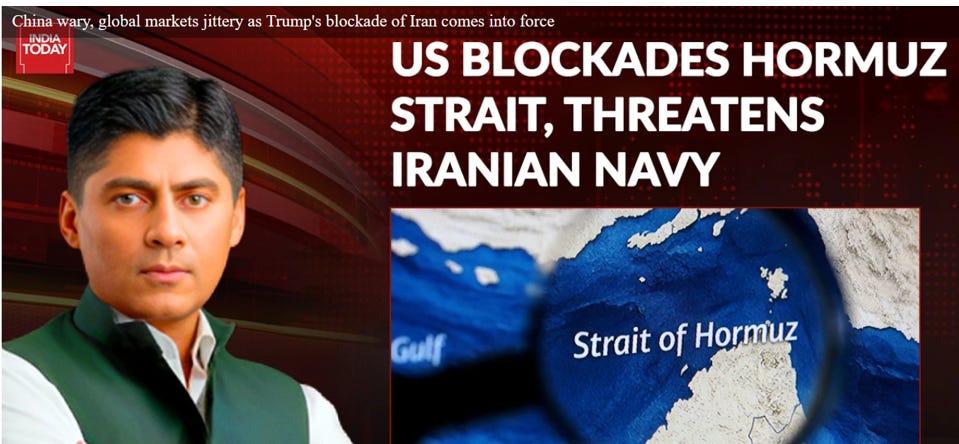
This week opened the next phase of the conflict within the context of a fragile ceasefire and the US blockade of shipping on Monday. Global power centres are watching closely. Russia and China have interests in the region, and any major eruption would further impact energy markets, migration flows, and supply chains.
China stepped in immediately with a warning: “Don’t interfere”: China fired a warning shot at US over their Hormuz blockade. Defence Minister Admiral Dong Jun’s warning coincided with the start of the US naval blockade and cautioned US not to interfere in China’s bilateral relations with Iran.
“We have trade and energy agreements with Iran; we expect others not to interfere in our affairs,” Jun said, adding that the Strait of Hormuz remains open for China. The waterway is an important energy source for Beijing, but it’s not crucial, as they have plentiful strategic reserves as well as tapping Russia. This is only one reason why China has supported a ceasefire although for China this is not a crisis as found in European and Asian economies.
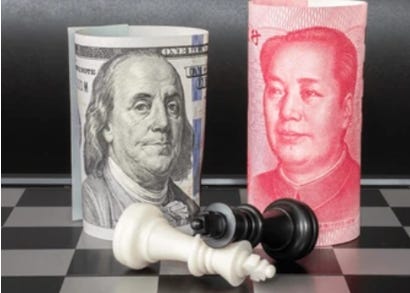
According to some experts, Trump’s naval blockade is driven by the need to reinforce US dollar supremacy by targeting the Chinese yuan, now used by vessels transiting the critical Gulf chokepoint. This is seen as a challenge to the decades-old petrodollar system and a means to counter US sanctions. In this sense the war itself is rooted in high finance and economics as are most conflicts. Always follow the money.
Meanwhile, China’s Foreign Ministry has reiterated its support for a ceasefire, arguing that the waterway’s “safety, stability and unimpeded passage” serves the common interests of the international community. “The root cause of disruptions to navigation through the strait lies in the conflict involving Iran, and the way to resolve this issue is to achieve a ceasefire and end hostilities as soon as possible,” quoted by spokesperson Guo Jiakun. He also added that China is ready to play a positive and constructive role in ending the conflict in the Middle East; a region where China is competing with the US for influence and advantage.
The US has warned of “complications” if Beijing gets involved with Iran in such a way that is counter to US interests. Trump has also threatened Beijing with 50 per cent tariffs if it supplies weapons to Tehran. An intelligence assessment claimed that Beijing could be preparing shipments of air defence systems to Iran. However, China has dismissed such reports as “groundless smears and malicious associations.”
As tensions escalate over the US naval blockade, China has firmly opposed any move that could disrupt its strategic and energy interests in Iran. This is not a threat of military action but underscores China’s established strategy of using peaceful advantage in trade, finance, and economics. The standoff underscores deepening divisions between Washington and Beijing, even as calls for a ceasefire continue.
US restrictions apply specifically to ships entering or leaving Iranian ports and coastal zones, whilst transit through the corridor itself would remain open. Mariners have been advised to stay updated through official channels and coordinate with US naval authorities when operating near the Strait. Although the precise contours of the blockade remain uncertain, it is expected to involve arresting and checking certain vessels, and possibly boarding or detaining ships linked to Iran, similar to earlier actions taken in Venezuela.
Iran’s near-complete restriction of movement through the Strait of Hormuz has emerged as a highly effective asymmetric tactic, inflicting significant economic strain while leaving Washington with limited options to counter it, creating considerable frustration. A key objective behind the blockade is to suppress Iran’s oil exports, thereby cutting off a crucial stream of revenue; thus the weapon is financial in nature. However, Iran has managed to disrupt the passage of other countries’ shipments while continuing its own flows. This approach has supported its crude earnings even as it forced increased global energy prices.
This new escalation is likely to trigger more escalations than drive conciliation. The threat alone is likely enough to dissuade legitimate international shipping from exiting the Persian Gulf. Asian economies have already been hit hard by the ongoing energy disruption, and any further curbs on movement through Hormuz would deepen these challenges. The US waiver that had enabled some purchases of Iranian oil now appears to be undermined by the blockade, reversing earlier flexibility.
Countries that explored direct arrangements with Iran may now hesitate, wary of potential friction with Washington, thereby narrowing their options for sourcing fuel. “They are so focused on Iran that they are losing sight of what they are causing to the world,” Jorge Montepeque, managing director at Onyx Capital Group, said in an interview with Bloomberg. “And the pain is in Asia, the pain is in the South Pacific, the pain is in anybody that depends on oil.” Which I guess is just about everybody.
Trump has often tried to frame disruptions in Middle Eastern supply as an opportunity to promote US oil and gas production, highlighting potential gains for a leading energy producer. At the same time, American crude does not always serve as a direct substitute for Middle Eastern varieties. Moreover, rising global oil benchmarks are already feeding into inflation pressures for US consumers.
Iran, for its part, seems to believe it can endure more economic strain than the US. “Enjoy the current pump figures,” Parliament Speaker Mohammad Bagher Ghalibaf, who led the Iranian delegation in Islamabad over the weekend, said in a Twitter post. “With the so-called ‘blockade’, Soon you’ll be nostalgic for $4–$5 gas.”
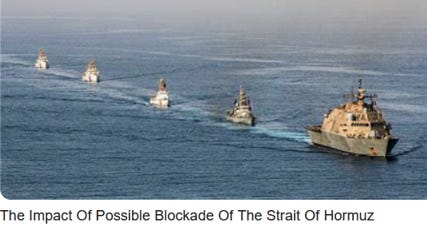
Assuming the US enforces its selective blockade of Iranian shipping, with a significant proportion of operational US naval power, it will be the greatest escalation of the Iran War to date. This is precisely the kind of battle for which Iran has prepared for the past quarter century and it’s well prepared, even for a potential US land invasion, which should not be ruled out at this delicate stage. Even now a third US carrier group is rounding the Cape of Good Hope destined for the Gulf and begs the question, why?
It is hoped that this truce will be extended otherwise it will be an unprecedented disaster for the world at large if hostilities recommence. There is potential for this war to escalate beyond any party’s control. This is the question I keep hearing: “When does this war end?” Perhaps it’s more to the point to ask who has an incentive to extend the war indefinitely and join Ukraine, Gaza, and Lebanon in the forever wars US global paradigm?
The evidence suggests that the world is not simply experiencing a series of apparent unrelated conflicts, but is operating within a system of interconnections through economic, political, and financial institutions. Failure of the former norms of international engagement have given way a state of global instability, when conflict becomes the ‘new normal’, and where the great powers win by force alone using a ‘winner takes all’ strategy.
WINNERS AND LOSERS
America and Israel have already lost in the eyes of the world. Although their malign influence will continue to batter their perceived enemies and allies alike. There is no going back to the old normal.
Russia is already winning extended battles in Ukraine. But Ukraine isn’t really the target. Ukraine is the battlespace. The aggressor is the collective West, specifically the European and American military-industrial complexes that instigated, funded, armed, and sustained this war from the very beginning in 2014. Every dollar flowing into Middle East is a dollar not flowing to Kyiv. Every political fracture in Washington is political capital Russia doesn’t have to spend. Russia benefits from the war continuing. It is that simple.
China has observed the Western strategic playbook and waits patiently. The Western strategy is not subtle: weaken Russia, control their resources, surround China with compliant client states, and then dictate terms to Beijing. Energy is China’s structural vulnerability. Russia and Iran represent energy resources that remain outside Western control. A Western victory in the Middle East doesn’t just hurt Iran. It tightens a noose around Chinese energy security that Beijing cannot afford to ignore. So China watches. It waits. And it has every incentive to see the West bleed resources, credibility, and political agency in a theatre that isn’t Beijing’s problem to solve.
For Iran, this is existential. Not metaphorically. Literally. Even if the bombs stopped tomorrow, Iran’s leadership understands something Westerners won’t say aloud: they’ll be back. Maybe in five years. Maybe ten. Because the strategic objective, control of the region, control of the energy flows, hasn’t changed. It never changes.
Iran has studied Vietnam. The lesson is not complicated: you cannot win a conventional war against a militarily superior force. But you can bleed them. Slowly. Over years. Until the domestic political will to continue collapses under its own weight. This is Iran’s strategy. A sustained war of attrition. And they are prepared to prosecute it indefinitely.
India sits on the fence while the Asians, Australians, and Europeans suffer an economic backlash. All are losers and in danger of structural damage with repairs to be counted in years. Southern Africa sits in quiet contemplation bemused by all the fuss about an energy resource that generally features pretty low on their graduated table.
The Gulf States are the most trapped. They tied their destiny to the Western military-industrial complex decades ago. The arrangement seemed reasonable enough at the time: recycle petrodollars into US Treasuries and US equity markets, and receive American military protection in return. The petrodollar recycling arrangement that has anchored demand for US Treasuries for fifty years traces directly to a 1974 deal between Kissinger and the Saudis. Mutually beneficial. Durable. Or so it seemed. Now they are discovering the problem.
US protection is conditional. The alliances are transactional. Step away from the arrangement and you invite colour revolutions, economic pressure, or worse. Step toward it and you bankroll a military project that is visibly failing. There is no clean exit. The Gulf states are the losers. They are a hostage to a bargain they can’t renegotiate and can’t walk away from and they know it.
Gulf Arab leaders are reconsidering their military alliances. The petrodollar recycling arrangement is now under structural pressure that the current conflict has accelerated into something that can no longer be ignored. Turkey, for its part, has already refused to let Israel and the US use its bases to launch attacks on Iran. That is not a small signal. These are not reversible decisions. Once you’ve publicly refused a request from Washington, the relationship changes permanently.
The Bankers & Co and their political and managerial class lackeys are the ones whose influence expands in proportion to the scale of the crisis. A prolonged conflict is an opportunity. Emergency powers, accelerated procurement, tightened surveillance infrastructure, expanded mandates. As Randolph Bourne wrote in 1918, War is the health of the State. These are not people with a strong personal interest in resolution. The bankers always back both sides and win on the destruction by funding weapons and on the post war reconstruction.
The world has learned new lessons from this conflict. US stealth aircraft can be targeted. US defence equipment, purchased by allies at enormous expense, has performed below expectations in a real shooting war. The invincibility myth that underpinned decades of American deterrence has taken damage that cannot be repaired with a press conference. Africa has gone East. India cannot be relied upon. European nations are discovering their military capacity is considerably thinner than their briefing papers suggested. Alliance quality matters enormously for projecting power, and the quality of the Western alliance has been publicly tested. And the conclusion that matters most for anyone who manages capital: Natural resource ownership is now equivalent to superpower status.
The Strait of Hormuz carries roughly 20 million barrels of oil per day. The Strait of Malacca another 23 million. These are not lines on a map. They are the circulatory system of global industrial civilisation. Every nation that depends on these flows is reassessing its exposure. Every nation that controls or sits adjacent to these flows has discovered it holds leverage it never fully understood.
We are entering a period when all of these chokepoints get contested, not necessarily by military force alone, but commercially, diplomatically, and geopolitically. The former assumption that military supremacy decouples from resource control died somewhere in the fog of this war. Sources
Where is the world heading? China answers with the ‘four perspectives’ https://www.globaltimes.cn/page/202604/1358943.shtml
Economic thinking in doubt https://www.zerohedge.com/energy/strait-hormuz-crisis-exposes-fatal-flaw-economic-thinking
No posts
Comments
Nothing yet. Say the first thing.
Sign in to join the conversation.