
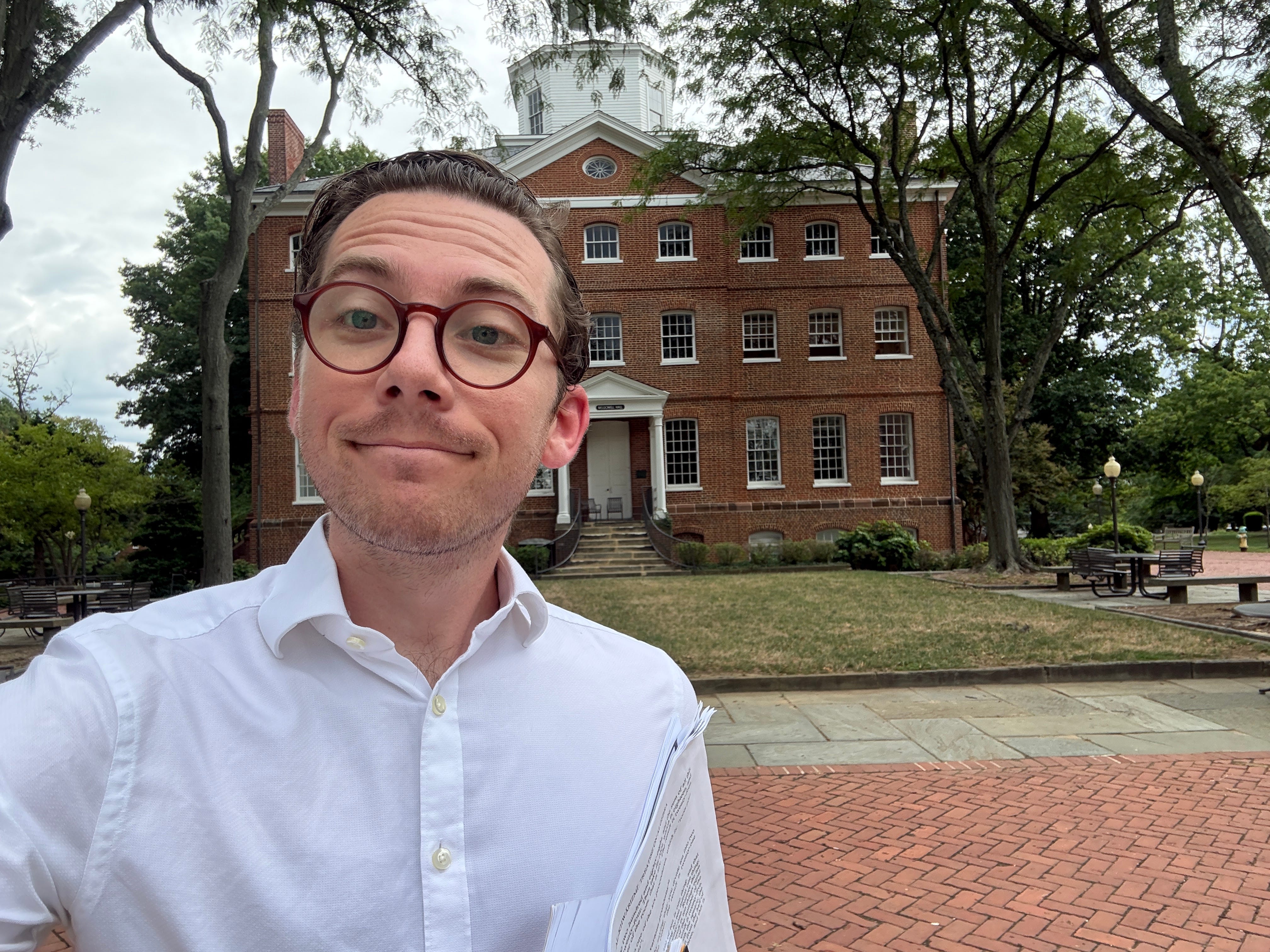
I’m feeling two parts grateful, one part nostalgic, and a touch sad as I prepare for my final class at St. John’s College today where I’ve been studying for my Master of Arts in Liberal Arts. When I began the program, I was working in Public Relations and spending more time than I’d like to admit on LinkedIn, a site which forced me to add the “skills gained” underneath this educational experience in my profile. I remember pausing, wondering what marketable skills I would acquire from studying old books for the next few years. I landed on just one: thinking. That wasn’t one of the auto-fill responses, so I had to manually enter it. Apparently, it’s a niche skill.
I’d been working with B2B Tech companies at a Public Relations agency, the kind of place where people are always networking, looking for the next gig, and, like me, spending too much time on LinkedIn, so before long, I had clients and co-workers making quips about seeing this expensive book club in the form of a degree I’d signed up for. In self-deprecating fashion, I’d simply say, “After getting one economically useless degree (Theology), I decided, why not get another?” That usually did the trick. “At least he knows this is silly,” I imagine was the reassuring thought in their head.
At this point, I’m sure St. John’s administrators would want me to insist that it’s not an economically useless degree, that their alumni go on to lead successful careers in diverse sectors, blah, blah, blah. I don’t dispute that as a factual statement, but, frankly, most people don’t study the Great Books to get a pay raise. Forgive me if I sound hopelessly privileged in saying this, but measuring education in terms of ROI (at least monetarily) is a trend I wouldn’t mind falling by the wayside. Call me crazy, but sometimes we “just” get an education to learn.
And, man, what a joy it’s been to learn over these past few years. For those who don’t know St. John’s, it’s perhaps the most Substack-coded institution on the planet. All students study the same texts, ranging from Homer to Hegel (I’ll include reading lists below), you are graded only on your contribution to discussions, essays, and oral exams. There are no laptops in class, nor are there lectures (except the ones which are optional and well-attended on Friday nights because, you know, what else would you do on a Friday night?). You read classic texts from Mathematics & Natural Science, Theology & Philosophy, Politics & Society, History, and Literature. Then, you sit in a circle and discuss the text. You write about the text—but not research papers littered with citations of secondary sources. Simply extended engagements with the text and a question that you propose about it. A tutor (i.e., professor), reads this, marks it up, then extends the evaluation of the paper to include a 30-minute, one-on-one discussion about the paper which is every bit as important as what’s written on the page. Finally, there are oral exams. You propose a question, then you must discuss it with the tutor, one-on-one for 30-minutes. There are grades, but you’re encouraged not to check them (nor is it easy to do so). If there is a problem, your tutor will discuss it with you during a conference. It’s the closest thing to an AI-proof curriculum I know of.
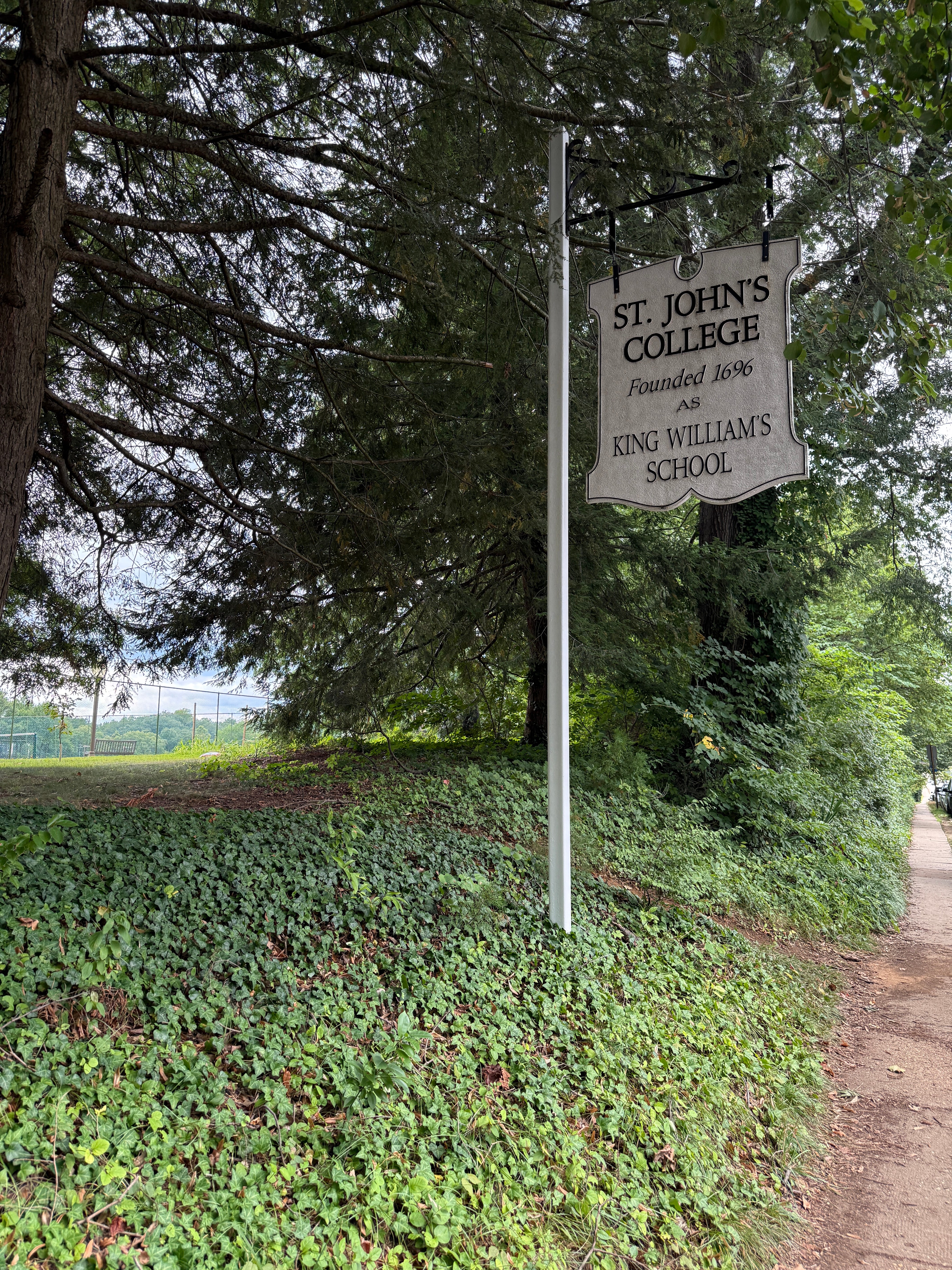
A Few Things I’ve Learned Along the Way
After a few years of this, I’m convinced that the lone skill I put down on LinkedIn at the start of the program was indeed the correct one: thinking. And if we’re forced to speak of education as an investment (and there is indeed a financial cost to this that brings such language close to hand), I can scarcely think of a better investment to make in oneself than in your ability to think. It is a sort of meta-skill that you carry with you all your days. Not to turn this into a gloom and doom piece on AI—the Lord, quite literally, knows there are more than enough of those already—but it does concern me that so many are willing to outsource and atrophy their thinking to machines. Strip reason from man, and what have you left? Perhaps now, more than ever, we need to remind ourselves that reason is the excellence proper to man.
It is this domain, the exercise of reason, the growth of our ability to think clearly and deeply through sustained engagement with texts and peers, that is the element of Great Books education I hold most dear. I count it as something of a shame that the value of Great Books curricula has been subsumed into polarized political discourse. In that arena, studying the Great Books is a fight to save Western Civilization from those who seek to destroy it. Perhaps it helps in that fight. In fact, it probably does. Aristotle might be right about the centrality of politics (he’s usually right), and if by politics here we just mean the common good, then count me in. In fact, we could highlight that liberal learning promotes the common good.
However, I think we’d be wrong to reduce the study of the Great Books to a culture war. Winning culture wars and promoting the common good are not always the same. The latter is far more important. Without being flippant—for I do think Western Civilization has given us much for which to be thankful and seek to preserve—culture war debates don’t really get me out of bed. I don’t read Aeschylus to “own the libs.” I do it because it’s fun. I do it because it challenges me. I do it to enter into conversations that began long before me and will end long after me. I do it to learn. I do it to think. I do it to exercise my own humanity. Lord help us if these aren’t good enough reasons to do something. We must recognize that learning is a good to be pursued in its own right.
Of course, these things have knock-on effects. What I did at St. John’s has not stayed confined to the classroom. I’ve written previously on how St. John’s has shaped my approach to theology, which you can read about below.
I’ve become increasingly more interested in asking good questions than giving definitive answers. Not that the latter has no place—it does—but the mode of inquiry exemplified in the humanistic approach of St. John’s has lodged itself in me in such a way that may be irreversible. In other words, learning to think well is about learning to ask the right questions and explore them with curiosity, sit in the unknown, and not be satisfied by partial answers.
The wide-ranging curriculum has also broadened my interests. I’ve gone from swearing off mathematics as something, at worst, inherently opposed to my preference for the liberal arts, or, at best, irrelevant, to now seeing it as occupying a vital seat at the humanities table (for this, I must thank who wisely told me that my plan to skip the Math & Natural Science segment—you only do four of the five segments—was, in fact, a remarkably terrible idea … or something slightly politer but essentially the same). Perhaps more predictably, I’ve discovered a love for Greek tragedies and a fascination with Plato. But it’s not just the ancients. I’ve benefitted deeply from Hegel and Schopenhauer. I was dazzled by a semester studying Camus’s entire corpus, and the semester I spent with the Republic will go down as a highlight. With all of these, I sense my acquaintance has only just begun, and I look forward to developing the relationship further. Studying the Great Books ought to teach you that the books worth reading are worth re-reading.
Aside from the academics, I find I approach conversations differently. I like to think I’ve learned to listen more carefully. If you leave St. John’s—or any Great Books program—having learned only from books, you’ve failed immensely. Seminars ought to teach you the value in having more voices at the table. Further, they ought to teach you how to comport oneself properly in a group aimed at something as important and nebulous as wisdom. One tutor told us that becoming adept at participating in a seminar is akin to playing in a jazz band. Sometimes, you must put the solo aside in order to play the rhythm. You must attune yourself to the ebbs and flows of the conversation and draw out the best in your bandmates. That is, to learn well, we need to both speak and listen, contributing not only to our growth, but that of the whole.
Most of all, I hope all these books and discussions have taught me something about the good life and prepared me to pursue it more vigorously. That is an elusive thing to measure in yourself, but I do sense I value things differently, and St. Augustine insists that our desires shape who we become. Put differently, the most important lesson of the Great Books is learning to recognize the Good and pursue it beyond the pages of the texts.
I could wax lyrical (or at least attempt to do so) about these past few years ad infinitum, but perhaps it would be most fitting to honor a final lesson from St. John’s: that the discussions worth having don’t really end. What starts with you and the text extends to you and the seminar, then the seminar spills over into discussions on the lawn. It compresses back to you and yourself on the ride home before seeping into dinner discussions or musings on walks. It trickles into essays and books. Most importantly, they lodge in our souls and shape who we become. Today, I leave St. John’s, but the experience stays with me, and for that, I’m exceedingly grateful. Long may St. John’s, the study of these books, and the conversations they spark continue.
Gospel Simplicity is a reader-supported publication. To receive new posts and support my work, consider becoming a free or paid subscriber.
Comments
Nothing yet. Say the first thing.
Sign in to join the conversation.