
The word “liberal” gets bandied about in theological contexts in such varied ways that it appears all but meaningless besides vaguely expressing some amount of consternation for a person or view one deems to be less-than-optimally Christian.1 It is to many Christians what the expression “boo” is to an ethical emotivist: a gut-level response displaying distaste but lacking any rational import.
When “liberal” is applied, well, liberally, to figures ranging from John Shelby Spong to Gavin Ortlund, it appears to take on a semantic range within which we could fit the state of Texas 12 times over. And if the function of a word is to pick out identifiable concepts with regularity, then “liberal” fails to live up to its task.
One of the reasons for this vicious malleability is that the word is not properly native to theological discourse. It is an import from politics—and a most unwelcome import at that. Unfortunately, it seems to be rather difficult to return to its rightful owners. Perhaps we’ve exceeded the 30-day window for such things. Alas. As I’ll argue, the very foreignness of the word and the ideological battle lines it implies, are itself a symptom of the problem of one form of theological liberalism which has lost its ability—or simply refuses—to speak the language of Christian theology.
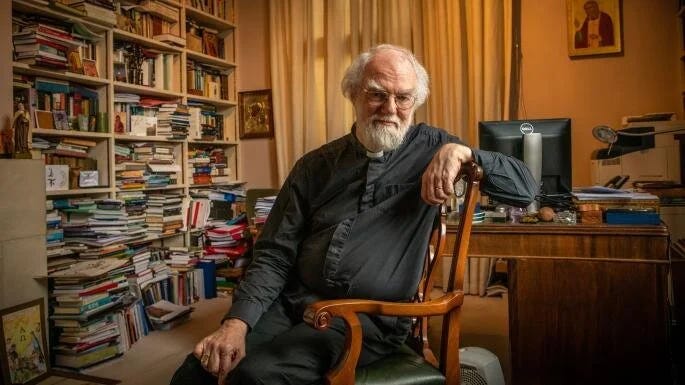
The distinction I will put forward in this essay between two quite different forms of “theological liberalism” is not original to me. Instead, it comes from Rowan Williams, and in particular, his reflection upon the “liberal” 19th century Anglican bishop, B. F. Westcott in Williams’s book, Anglican Identities.
Methodology vs. Conclusions
Before we get to his acute analysis, I want to make a preliminary distinction, that, while faithful to Williams’s vision, is one further step back. That is, a distinction between liberalism as a methodology and a set of conclusions. While Williams will aid us in delineating two divergent liberal methodologies, it strikes me that, today, there is a deeper confusion between theological liberalism as method vs. doctrine.
Naturally, there is a relationship between a theologians’s methods and their conclusions, but they are nonetheless distinct. That two theologians come to the same conclusion does not mean they are doing theology in the same way, anymore than someone taking the train to DC from Baltimore is the same as someone flying to Reagan National from London Heathrow. In other words, in theology, the ends and the means matter.
Unfortunately, this is lost on many people. At least at a popular level, one of the leading candidates for a definition of theological liberalism is simply the affirmation of Women’s Ordination and LGBTQ+ relationships. However, these are only the latest controversial issues that serve as a litmus test for liberalism. In the past, slavery, evolution, inerrancy, and other issues have been the lightning rods around which the cacophonous roar of “liberal!” could be incessantly heard.
Please do not take my slightly pretentious prose as a sign of being flippant. It’s just self-indulgence. Truly, each of these issues matters. And to avoid straw-manning those who find the appellation “liberal” quite useful for these positions and the holders there of, it is true that there’s a positive correlation between those who hold to, say, LGBTQ+ affirmation, and methodological liberalism. Some might even say the correlation is so strong that there is no need to worry about tiresome distinctions between methods and conclusions. Rotten fruit (i.e., conclusions) must mean rotten trees (i.e., methods).
However, even if this is the case, I do think it’s much preferable to look at methodology rather than solely conclusions, if for no other reason than a liberalism tied to the hot-button issues of the day proves to be a moving target. Furthermore, it risks being slightly arbitrary. If it is not tied to a robust sense of a hierarchy of truths, then “liberal” is indexed to little more than whatever is getting attention at the moment, whether its structurally important to Christian belief or not.
For instance, imagine that in the next decade, the hot-button issue is whether women ought to wear gold jewelry. Is one’s position on that really a good indicator of someone being theologically “conservative” or “liberal?” It seems just as likely that an affirmative answer could be a rallying cry for conservatives as it could be for liberals (though never both at once). Do we not risk these terms being nothing more than indicators of whether one sides with the prevailing opinion of the time, be it ecclesial or cultural? Indeed, “liberal” in the Christian space often is accompanied by a sense of “siding with the the spirit of the age” but what do we do when the spirit of the age vacillates? Are yesterday’s liberals today’s conservatives, and is tomorrow a coin-flip?
Finally, if we only wanted to talk about conclusions, then we have better, ready-made terms for that. We really ought to use the language of orthodox and heterodox for conclusions, not “conservative” and “liberal.”
Suffice it to say, if we are going to try to turn “liberalism” into a sensible term in theological discourse, we can’t make it a shibboleth for the theo-cultural war of the day. Instead, we’d do much better to focus on method. And this is where the inestimable Rowan Williams can help us.
Gospel Simplicity is a reader-supported publication. To receive new posts and support my work, consider becoming a free or paid subscriber.
Liberalism as Theological Method
Rather than giving labels to for the two kinds of liberalism he sees in the church, Williams offers representative samples, such as B. F. Westcott vs. Benjamin Hoadly. Helpful as that may be for people neck deep in Anglican lore, my guess is that such examples are not all that meaningful to most of you, even though you lot are remarkably well-read. So, I will venture to provide some haphazard labels for these two approaches that are based upon Williams’s observations, but whatever faults in the labels should not be attributed to him. For now, we’ll speak of the difference between Internal and External Liberalism.2
What both groups of “liberals” share is an openness to change. The only foil Williams offers to liberalism generally is fundamentalism. That is an approach that says, “what has been is what must be, ever and anon.” Williams warns that such theology can end up being little more than a self-justification, a long task of reiterating what has already been said. Over against such ossification, both internal and external liberals say, “not so fast. Are we certain that we’ve said the final word?”
As a brief aside, it’s instructive to me that Williams doesn’t offer a “golden mean” between fundamentalism and liberalism. As ever, he eschews easy answers and forces us to think deeply.
The principle difference between internal and external liberals has to do with the source of their motivation. And as my rather unimaginative titles suggest, one finds impetus for change from within the tradition, the other, from without.
I mentioned at the beginning of this essay that the foreignness of the word “liberalism” to theological discourse is symptomatic of liberalism itself. Though Williams doesn’t make that particular point, it aligns very closely with what he identifies as a key characteristic that distinguishes between two forms of liberalism. That is, some “liberal” theologians—what I’ve called Internal Liberals—are content to work within the context of Scripture and Tradition, taking them as given and then proceed to speak the language of the Tradition as a native speaker exploring the boundaries of possibility that deep familiarity with a language affords. On the other hand, other “liberal” theologians—what I’ve called External Liberals—disdain the very language of Scripture and Tradition, using it only as much as necessary but speaking more properly as natives of some other language. In this way, it is those whose first language is politics that have foisted upon theologians the language of “liberal” and “conservative.”3
One example Williams gives in this regard is the language of “rights” within theology. Without in any way arguing against the existence of human rights or their importance for flourishing society, Williams suggests that a theologian who forms their arguments upon the basis of an abstract notion of rights is showing themselves to be a theological liberal of the second type, one who is not speaking the language of Scripture and Tradition but instead is forming their thinking on some other basis.
Women’s ordination is one area where we can see both forms of “liberalism” showing up, albeit in meaningful distinct ways. For instance, you might see some theologians arguing that women’s ordination is fundamentally a women’s rights issue. All else being equal, women have the right to pursue the same employment opportunities as men, and therefore should be able to pursue a career as an ordained minister. This would be theological liberalism of the second kind. Others, however, argue for the same conclusion but in a quite different manner. Gary Macy and Beth Allison Barr argue for women’s ordination as a retrieval of the past. Sarah Coakley does so from a systematic theology perspective exploring what it means to be in persona Christi. N.T. Wright does so from a biblical theology perspective. The list could go on.
While I’m not sure all—or perhaps any—of these theologians would describe themselves as “liberal theologians,” they would broadly fit Williams definition insofar as they’re saying, “the status quo of not ordaining women is not one that needs to be maintained forever.” However, they are—to varying degrees—doing so from within the tradition.
Approaches to Scripture
One helpful distinction Williams makes between the two types of liberalism has to do with their approach to Scripture. External Liberals tend to think the Bible says less than meets the eye. Internal Liberals tend to think it says more than meets the eye. For instance, sticking with Women’s Ordination, an External Liberal may be inclined to say that Paul’s statements about women are really nothing more than patriarchal cultural assumptions wrapped up in the garb of Scripture. Internal Liberals, however, are often marked by a deep probing of the biblical text, assuming it always has more to tell us, and as such, we should be cautious to pronounce definitive judgments. Moreover, at least within Protestantism, there’s a deep theological tradition which points toward sin’s ongoing effects in man such that we shouldn’t be overconfident in the clarity of our vision.
As Williams notes, this latter approach actually implies a quite high view of Scripture. Westcott, his exemplar of this kind of “liberal,” sought to emulate Origen, who said that every syllable of Scripture was inspired and spent a lifetime meditating on the text, always believing it had more to give, and constantly shuttling between a microscopic view and a birds-eye-view, trusting that meaning was found in the parts and the whole.
Finally, we could further describe the divergences of these two types of liberals vis-a-vis Scripture as follows. The Internal Liberal takes Scripture and Tradition as given but the meaning as open. The External Liberal takes Scripture and Tradition as negotiable but the meaning as fixed. Allow me to quote Williams at length:
“In this context [Westcott’s “Internal Liberalism”], to be cautious about hermeneutical or dogmatic closure is not to discard or relativise sanctioned words; you occupy the territory marked out by those words, but you will not know where the boundaries are, because the search for definite boundaries suggests that you might be ‘in possession’ of the territory, not yourself included in (possessed by?) it. And this contrasts with a scepticism more obviously generated by Enlightenment suspicion of authority [what I’ve called ‘External Liberalism], in which the target of the questioning is the formulae as such and the processes by which they were shaped.”4
There is much to be said about these two sentences, but I’ll highlight for now the final line about the “processes by which they were shaped.” This is in line with my claim that the External Liberals takes the meaning of Scripture and Tradition to be fixed. As Williams goes on to argue, such liberals are often quite confident that they can get “behind” the text such that they can reduce the meaning of the text to the time/culture that produced it. Once again, this is to say Scripture means less than it appears to say. Not to beat a dead horse, but if Paul’s language about women is just patriarchy, then, having discarded patriarchy, we can discard Paul. Without denying that patriarchy might inform Paul, the Internal Liberal insists that God is speaking to us in this text and we have not yet exhausted its meaning.
Conclusion
Hopefully, that’s enough said about what distinguishes these two types of liberalism. Thus far, I’ve intentionally tried to avoid attaching value judgments to these, and Williams himself notes that there can be something to be learned from both. In my own estimation, Williams quite clearly falls into the Internal rather than External Liberal category, so it’s commendable that he is able to see some weaknesses of his “side” and some strengths of his “opponents.”
I should note that one of the difficulties with the clean dichotomy presented here is that it’s not always evident that, just because someone uses the language of Scripture and Tradition that they are truly attempting to think in and with the tradition. I take it that one of the prominent concerns people have even about would-be “Internal Liberals” is that they’re really just using Christian language as a disguise for non-Christian ideas. This is, of course, entirely possible. But I do wish to propose nevertheless that it’s not always the case. And Williams may be the best example of this, at least in my mind.
If we apply the current, conclusions-based criteria for theological liberalism, then Williams fits the bill as he is LGBTQ+ affirming and in favor of Women’s Ordination. For many, that’s case closed. But I suppose part of my inspiration for writing this piece is that reading Williams feels completely different from reading “External Liberals.” In Williams, I find a theologian deeply versed in the tradition whose thinking begins with the classical doctrines of Trinity and Incarnation then extends far from there without leaving that behind while showing a great deal of openness as far as the location of the boundaries of Christian confession. It’s not that Williams would say there are no boundaries and anything goes. However, policing the boundaries or declaring precisely where they are once and for all is not his main work. Instead, he shows a willingness to till the soil he’s been given for a lifetime, ceaselessly striving to see the world through Christ. And that includes seeing the questions the world poses in our time. As much as he loves the tradition, he is not an antiquarian, merely dusting off the relics of a bygone era. Instead, he takes up the task of our forefathers in the faith and continues to apply the heart of Christianity in new and trying times. This isn’t to say he gets everything write—though I can’t hide my admiration for him as a theologian. But, I suppose this essay is, in some sense, a long exercise in trying to express why “liberal” being applied to Rowan Williams in the same way we might apply it to say, John Dominic Crossan, just feels wrong.
In the end, I’d much prefer we exchanged the term “liberal” for something more native to the tradition. But if we insist on using it, might we use it a bit more judiciously?
I hope that’s not too much to ask.
Perhaps I’m showing my general acquaintance with “conservative” theologians. I suppose its equally the case that it is used as a virtue-signaling label that says, “hey, I’m not one of those bad guys!”
These aren’t great, mind you, and I don’t mean to smuggle in a value judgment saying that one type belongs and the other doesn’t. Of course, I do prefer one over the other, but I’m not trying to poison the well with the labels. If you’ve got better ones, I’m all ears.
Or, at least, this is the way in which it has continued. I am not making a historical claim about the origins of language about“liberal" vs “conservative” in theology.
Rowan Williams, Anglican Identities, 81.
Comments
Nothing yet. Say the first thing.
Sign in to join the conversation.