
Thomas found himself pacing back and forth in a room littered with books whose spines were permanently damaged after being bookmarked with pens. Their failure to lay flat resembling the state of his own mind, permanently bookmarked as it was with questions he’d much prefer to never ask again but now formed a part of him. His hair was a mess. He’d run his hands through it so many times that it too wouldn’t lay flat. All was cattywampus. In search of a level, he decided to venture back out to speak to wise old Johannes, a man he’d previously sought out to discuss the church and other such questions.
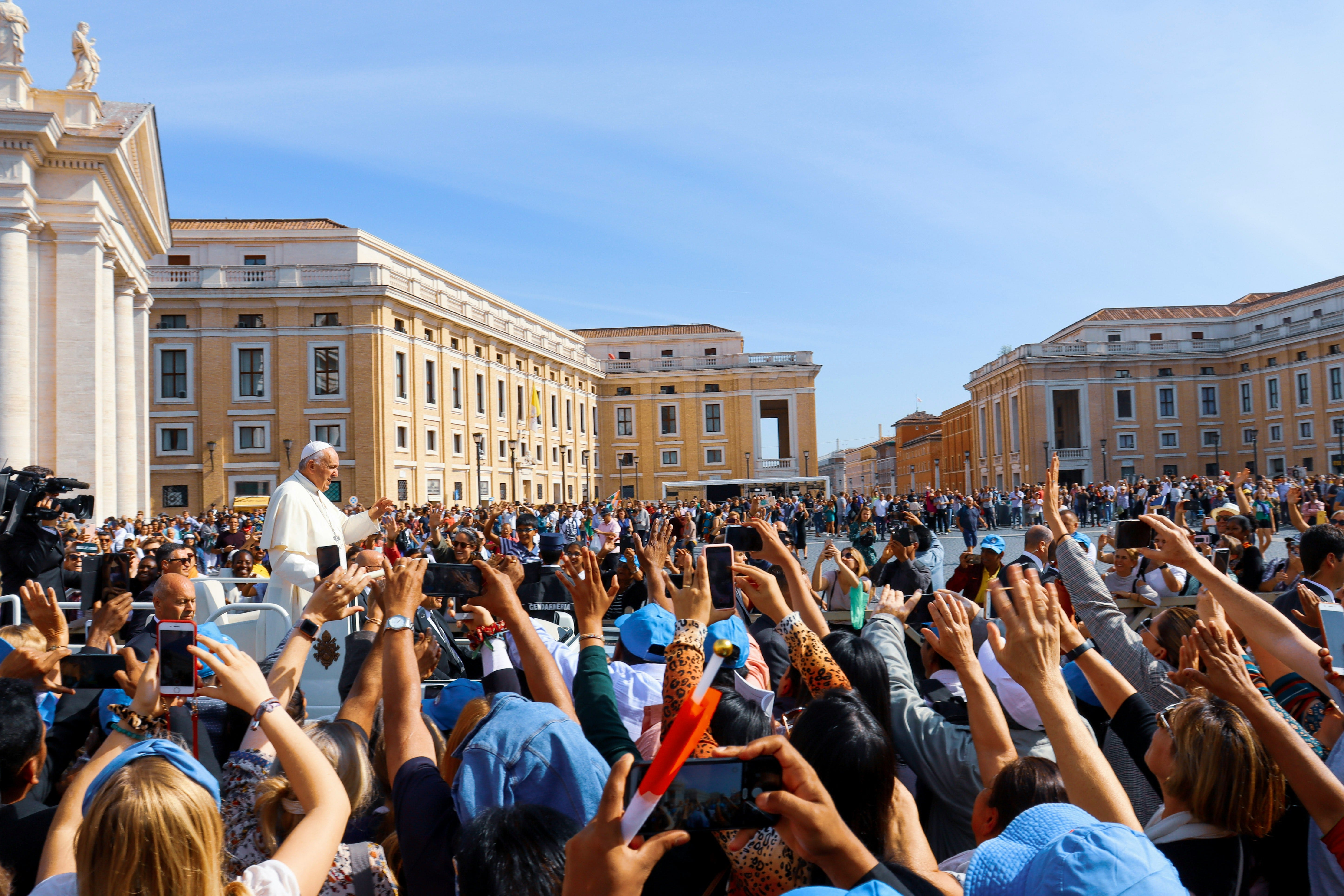
Thomas: Sorry to bother you old friend, but I need to talk to you about the papacy again.
Johannes: Again? I don’t believe we’ve discussed it before.
Thomas: No? I suppose I must have been talking to myself about it then. That guy simply won’t shut up about it!
Johannes: Who?
Thomas: Me! Or, I don’t know. That part of me that asks too many questions. He’s really rather annoying.
Johannes: Hmmm
Thomas: So, here’s the deal, I keep thinking I’ve settled the question of the papacy in my mind, and then—BAM! Back it comes, uninvited. That’s why I need your help. Give it to me straight. Is it true?
Johannes: Forgive me, but what would that mean?
Thomas: What do you mean? I’m just asking if it’s true. Is the papacy true?
Johannes: You’re going to need to be more specific than that.
Thomas: I guess what I mean is, is papal infallibility, as articulated at Vatican 1, true?
Johannes: Well—
Thomas: —Wait, no. Wrong question. Was the papacy as an institution founded by Christ?
Johannes: Ok—
Thomas: —Wait, honestly, that might not even be the question. Can we—the Church, that is—can we live without it? Is there any hope for unity without it?
Johannes: You do realize those are three very different questions, right?
Thomas: I know, I know. I’m sorry. My brain always has all three of those tabs open at once. It’s like a god-forsaken game of whack-a-mole.
Johannes: Why do you care so much?
Thomas: What do you mean? I care about truth! It’s truth I’m after!
Johannes: Why this truth? You’re not keeping yourself up at night asking if Joseph Smith really found those plates or if Neem Karoli Baba really stopped that train with his will.
Thomas: Should I be?
Johannes: If you ask me, it seems you need more sleep, not less.
Thomas: Fair point. I guess the reason this question—or really, set of questions—bothers me so much is that it puts me at odds with myself.
Johannes: Say more, please.
Thomas: Well, when I ask, “did Christ establish the papacy?” The skeptical historian in me says, “Christ promised a kingdom, we got a church. The papacy is a product of that shift.” When I ask, “is papal infallibility, as articulated by Vatican 1, true?” The dogmatist in me says, “If dogma is unchanging—which the same council said—then the pope has affirmed teachings that sure look like he meant to be binding—see Unam Sanctam—that no longer are held. At least, not in the same way. And that sounds like change. Not to mention “councils against councils, popes against popes.” Von Hefele was right. So that doesn’t work. But when I ask, “Is the papacy necessary?” I get stumped. The churchman in me says, “Well, I can’t think of another principle of unity that actually works. Councils, consensus, semper reformanda—they all sound nice. But they’ve been a mess. So is it pragmatically true? But I can’t say that. The papacy won’t let me. I’m not even allowed in with doubts. What nonsense! Or, at least, the old ones wouldn’t allow that. The new ones? I don’t know. Balthasar put “papal infallibility” in air quotes all the time. I like him.
Johannes: So, you’re saying you think it’s necessary, but you think the way it’s been articulated is false?
Thomas: If only it were that simple! The real difficulty is more complicated. Let me show you.
Johannes: Please do.
Thomas: So, I went from skeptical historian to dogmatist to churchman, right?
Johannes: It sure seemed that way. Are they not one and the same?
Thomas: Far from it! I like the skeptical historian on the papacy, but the churchman in me gets uncomfortable when he starts talking about Nicaea. That’s set in stone. The churchman won’t budge.
Johannes: I see.
Thomas: And then the dogmatist? Well, he’s convenient when holding others to their doctrinal standards, telling the Catholics they’ve changed too much, but I need to keep him firmly looking in the other direction. If I’m being honest, he’s a bit of a bore. He puts a straightjacket on development. Don’t tell the Catholics, but I’m not sure Newman went far enough, much less too far!
Johannes: Rules for thee but not for me?
Thomas: But they made the rules!
Johannes: I see. And the churchman?
Thomas: Yes, yes, the churchman, he’s a complicated one. He looks out at the papacy and sees hope for bringing these broken pieces, these wayward children back together. At least, that’s how he sees it today. But get him looking back over history and his blood will boil over what pontiffs have done to put into disarray the very thing that the churchman now thinks needs put back together. The churchman’s enemies and friends wear the same tiara!
Johannes: A bit gaudy, don’t you think?
Thomas: What’s that now?
Johannes: Oh, nothing, just the tiara.
Thomas: Yes! Oh you’re right. There’s another war within me if you really want to know.
Johannes: Apologies, I didn’t mean to further complicate things.
Thomas: No, no, not at all. But you see, there’s the aesthete in me who loves the pomp and circumstance, the smells and bells. The aura as the kids say. But then, oh then, there’s the wily prophet in me, the one who says “woe to you!” The one who says melt it all down and give it to the poor.
Johannes: Any others?
Thomas: And then there’s just the part that’s tired. That just wants to sit under a tree, read MacDonald and never be bothered by it all ever again.
Johannes: I’m quite fond of trees personally.
Thomas: Yes, yes. Me too.
Johannes: So, what shall you do next?
Thomas: I don’t know! I just don’t know. I feel stuck.
Johannes: May I give a suggestion?
Thomas: By all means!
Johannes: Perhaps before settling this question, you need to sit the skeptical historian, the dogmatist, the churchman, the aesthete, the prophet, and the tired, tree-loving, MacDonald-reading part down for a good long chat.
Thomas: That sounds as difficult as getting the Church to unite!
Johannes: Perhaps even more so.
Thomas: I’d need a pope of my own to do that.
Johannes: Perhaps that’s you.
Thomas: What, you’re saying I have to be my own pope? Wait till the apologists hear that one!
Johannes: It might not hurt to care a little less about the apologists every now and again.
Thomas: That’s fair. Can we chat again soon?
Johannes: Anytime, my friend. Anytime.
Before walking home, Thomas sat under a tree and pulled out some MacDonald, the best remedy he knew for a weary soul and the medicine that had kept him sane up till now. Just before he flipped open the book, his phone buzzed. BREAKING NEWS: THE POPE EXCOMMUNICATES THE SSPX. The churchman in him cried. So much for that unity. The dogmatist felt conflicted. The historian laughed. And Thomas himself? He closed his phone and opened his book.
Postscript
Thank you for indulging my foray back into the dialogue format. This is far from a polished piece, but I suppose that’s partially the point. I wanted to give voice to the inner wrestling I’ve experienced when it comes to the papacy. In my own life, I find that questions about the pope come and go. Most days, I’m pretty happily Episcopalian. I used to say, “I wish I could be Catholic, but my mind holds me back.” If I’m being honest, I don’t think that’s quite the case anymore. I love our local Episcopal Church. I love the BCP. I’m increasingly concerned about certain aspects of the trad movement, at least as it exists online. Yes, the Episcopal Church has its many flaws and many, many quirks. I wouldn’t cosign everything that happens within it—far from it. But when I focus less on the abstract and more on the lived reality of parish life, I feel content. In many ways, I feel more settled than I have been in years, probably because for the first time, my devotional and liturgical life match. No more going to a megachurch on Sunday and praying the rosary at daily mass on Monday. That goes a long way toward the integration that, I think, Johannes is getting at in this piece.
And yet, there are still days when I feel that draw toward Rome. Most of the time, it doesn’t have to do with the historical arguments getting any better. It’s just pragmatic. I long for greater unity in the church. I’ve yet to see a better model than the Roman one. That alone isn’t enough for me, but, annoyingly, it’s enough to keep those tabs in my mind open. And then there are the very real questions of double standards. I’ve yet to reconcile the historical-critical part of me with the tradition-loving part of me. I’m sure there are a million other contradictions within me as well, and intellectual exercises like this are a painful, but hopefully purifying, process. We are often mysteries to ourselves, and digging more deeply doesn’t always make things clearer. A large part of me wants the Vatican 2, all-embracing, theory-of-everything type of Catholicism to be the answer. But I wonder how much of that is wanting a simple answer to questions that defy such simplicity. Perhaps, as Johannes says, we must reconcile the parts within us before looking for an answer to do that. Or perhaps that’s a bunch of pop-psychology nonsense. Who knows?
Subscribe for more half-baked, rambling nonsense, and maybe even, accidentally, something profound.
Comments
Nothing yet. Say the first thing.
Sign in to join the conversation.