

Perhaps you have heard the phrase, “smells and bells.” In the context of debates between “low” and “high” church adherents, the conversation is often, “don’t just convert for the smells and bells. Focus on truth.” The implication here is that people are allowing the aesthetics of liturgical traditions to overwhelm their reasoning faculties. Underneath this is a belief that our religious lives should be led with the mind, not the nose or ears.
I do not wish to disparage the intellect, nor would I even object in principle to the idea that, all things being equal, the mind is better positioned to ascertain truth than the nose. However, I equally wish to avoid assuming that there’s nothing to these smells and bells. If our religion is going to call to the entirety of man and offer true transformation, it cannot be something suited only to brains on sticks or disembodied spirits. In many ways, the draw of liturgical traditions is that they rebel against such stunted anthropologies and offer something more fitted to the whole of man. They offer food for thought and for the stomach. Their arguments pass the sniff test but the experience itself also has a holy smell. Such faiths enter the ear not only through syllogisms but also in the sound of bells. Ideas are grasped, yes, but also are sacred objects with our trembling hands.
Such thoughts, especially those related to the smell of religion, have been top of mind for me since I began re-reading Till We Have Faces, which is perhaps the most mature, and most misunderstood, work of C. S. Lewis. He himself considered it his masterpiece as well as the one work he managed to write without preaching. It was also his biggest commercial flop, which goes to show that quality and sales do not always coincide.
If you haven’t read it, TWHF is a retelling of the myth of Cupid and Psyche through the lens of Psyche’s half-sister, Orual. It is a work with many layers, and, as a shameless plug, I’ll note that I’m currently reading it with my Substack/Patreon book club, which you can join and access previous recordings by becoming a paid subscriber.
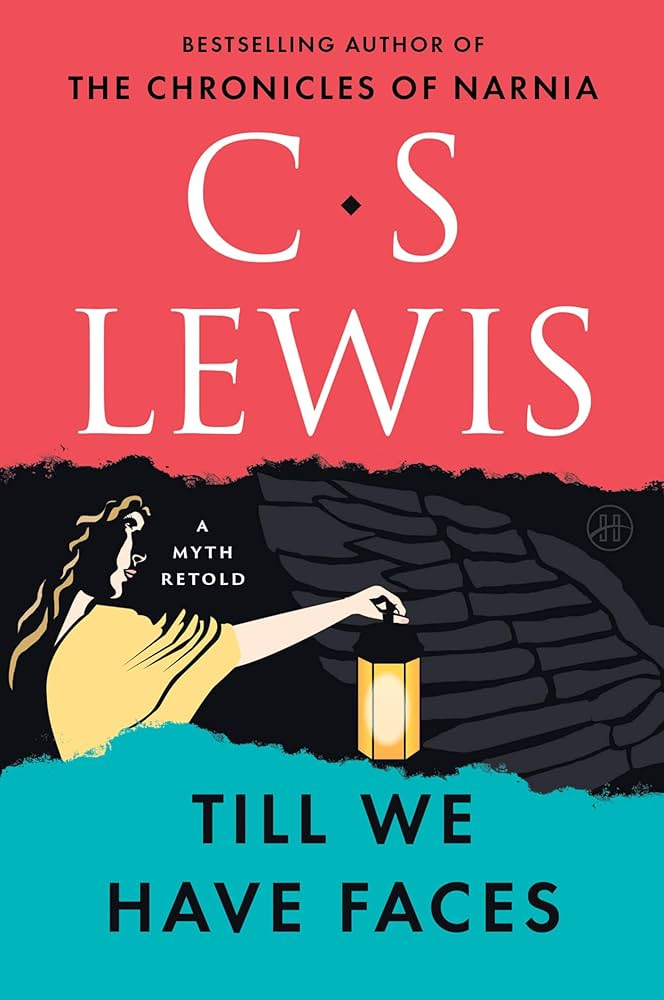
The smell of holiness is a recurring idea in the book. For instance, when the priest of Ungit (Aphrodite) visits the castle of Orual’s father, the narrator records the following: “The smell of old age, and the smell of the oils and essences they put on those girls, and the Ungit smell, filled the room. It became very holy.”1 As the book unfolds, you learn that the word “holiness” has a different meaning than you may initially think. We’re prone to think of holiness as the domain of prim and proper saints with gilded halos, paragons of a certain Victorian vision of virtue. That is not the holiness of TWHF. In this work, we’re confronted with a more raw, ancient, and pagan notion of holiness. This is a holiness that smells of blood and burnt flesh. Later on, Orual is flummoxed by Psyche’s affinity for the gods and lashes out:
“Oh you ought to have been one of Ungit’s girls,’ said I savagely. ‘You ought to have lived in there—in the dark—all blood and incense and muttering and the reek of burnt fat. To like it—living among things you can’t see—dark and holy and horrible.’”2
Clearly, this holiness is not clean and pristine, nor is it even seen as a moral good by Orual. This wrestling with holiness and its hateful smell forms a vital part of a theme woven throughout the work: the conflict between rival visions of religion.
These views are juxtaposed in the figures of two main characters: the Fox and the Priest of Ungit.
The Fox is a Greek slave brought to the Castle of Glome to tutor the king’s longed for son. However, as that son is still wanting, he is left to tutor the king’s daughters: Orual and Redival initially, and later Psyche. His Greek background is not incidental. It reaches beyond the story’s world into our own, and it provides him with a set of views on religion marked by the predominance of philosophy. Much like Socrates, the Fox derides the anthropomorphized gods as the lies of poets, preferring instead a simple Divine Nature. Most of what is deemed supernatural he argues is rationally explicable. If holiness had a smell for the Fox—and I’m not convinced it would have any smell—it would likely be that of old books or perhaps fresh air.
The Priest of Ungit is an altogether different figure. He lives in the world of mystery and blood. A world of sacred rites and slaughter. His is a religion of the senses, and holiness most certainly has a smell.
These two come into conflict in the first half of the book in a disagreement over the value, or superfluity, of a human sacrifice. When the Fox derides the arguments put forward as hopelessly contradictory and lacking sense, the Priest responds by saying this is a feature, not a bug. He criticizes rationalists, saying:
“They demand to see such things clearly, as if the gods were no more than letters written in a book. I king have dealt with the gods for three generations of men, and I know that they dazzle our eyes and flow in and out of one another like eddies on a river, and nothing that is said clearly can be said truly about them. Holy places are dark places. It is life and strength we get in them. Holy wisdom is not clear like water, but thick and dark like blood.”3
In my life as a reader, both inside and outside academic environments, I have found it is almost universally the case that great books—and this is a great book—are best read with others. This was proved true in our first book club discussion about TWHF when a member of the group brought to our attention the way in which this passage directly draws out themes Lewis had explored in other settings, specifically this notion of “thick” vs. “clear” religions.
In a 1946 address on Christian apologetics, Lewis said that religions are a bit like soups, some being thick some being clear. He goes on to explain, “By ‘thick’ I mean those which have orgies and ecstasies and mysteries and local attachments: Africa is full of thick religions.”4 In contrast, “By ‘clear’ I mean those which are philosophical, ethical, and universalizing: Stoicism, Buddhism, and the Ethical Church are clear religions.”5 For Lewis, both are essential. And it’s that striving after synthesis that makes the dialectic in TWHF so interesting.
On the one hand, the thick religion of the Priest of Ungit gives him an unshakeable confidence in the face of danger that the Fox lacks. When the Priest has a knife held to his chest, he doesn’t flinch, but the Fox is only where he is because he allowed himself to be captured in war. It seems evident that Lewis thinks philosophy on its own is not enough to carry deep convictions. Furthermore, Orual, for all her revulsion toward thick religion, cannot deny that the sacrifice appeared to work. The proof is in the pudding, right?
And yet, it’s not quite that simple. Remember, Lewis is striving for synthesis. TWHF is not offering an unqualified endorsement of thick religion. The Priest of Ungit is not the hero here. He recognizes something the Fox lacks, but so too does the Fox see things to which the Priest is blind. Orual finds solace and truth in the Fox’s notion of the Divine Nature. In a thinly veiled reference to Greek philosophy, Psyche even notes that some other Greeks recognized an afterlife, which appears to indicate that the Fox wasn’t so much wrong for being Greek but in not adhering to the best of Greek thought.
Insofar as this is correct, perhaps it’s not entirely accurate to say Lewis isn’t preaching in this book. Perhaps he is still turning his non-fiction into fiction, albeit more subtely. Some would view this as less artistically meritorious. An unwelcome infringement into the supposedly pure world of art. I don’t think this is the case. The beautiful and the true do not exist in isolation. They converge, and here, they do so exquisitely.
If TWHF is meant to teach us something about the nature of religion, then we must return to the opening of this essay, to that notion of the smells and bells. It would seem that Lewis is saying that we need both the clarity of good teaching and the smells of incense and wine. We need rigorous argument and cherubic hymns. If the Fox and the Priest need each other, so too do the doctrinaires and aesthetes.
However, it’s worth pausing to ask if burning incense—or whatever other smells we associate with “high church”—is the only smell of holiness. Several years ago, Pope Francis urged priests to be shepherds who smelled like their sheep. This was a vision of holiness not so much wrapped in mystery and marked by separation, but rather a holiness found in the mire of human existence, a holiness that doesn’t stand far off but invades the mess of the world unafraid of its stain.
Without creating overly stringent dichotomies between the testaments, we can see something here of Old and New Testament holiness. In many ways, holiness in the OT means “to be set apart.” It is the holiness of the religious cult, a holiness that creates sacred spaces, a holiness that smells of blood and guts and reminds you that some places are unlike others because God dwells there. In the NT, we find the diffusion of holiness. The smell of holiness is that of oil poured on the feet of a messiah by a sinful woman. The smell of holiness reached beyond sacred places and mingled with that of donkeys, lepers, and the least of these. In time, that OT smell would go from burnt flesh to burnt incense. What passes for thick religion today is often much clearer and less wild than that of its pre-Christian predecessors. The Priest of Ungit, at least to me, represents less the respectable high church than something altogether absent today.
Still though, we wrestle in our own ways with what holinss ought to smell like. Is it closer to that of Narcan or church naves? Soup kitchens or incense? Sheep or shimmering marble? Perhaps, however, we must reach for the both/and rather than the either/or. Just as we must not neglect the Fox for the Priest of Ungit, we must recognize that the smell of holiness is not singular but plural.
For my own part, I’ve caught wafts of holiness in churches high and low, in sermons and song, on street corners and cathedrals. In many ways, maybe the task for some of us isn’t to determine which smell is that of holiness, but to start by recognizing that it does in fact extend beyond the mind and reach the olfactory. That we can not only know that God is good but taste and see and touch and hear and, yes, smell that God is good.

What I’m Reading: This summer features an odd combination of books. I decided to do a Bulgakov tandem read of The Master and Margarita (Mikhail) and The Sophiology of Death (Sergei). I can’t yet decide if there’s a deeper connection than they share the same last name and country of origin, but it’s a fun combo nevertheless. I’ve also embarked on a somewhat extended study of the history of Marian doctrine and devotion. Right now I’m reading Mother of God by Miri Rubin and Mary in Early Christian Faith and Devotion by Stephen Shoemaker. Both are excellent. For audiobooks, I’ve been inspired by TWHF to return to Lewis, so I’ve listened to The Great Divorce and I’m now trying The Pilgrim’s Regress for the first time. The former I’d read before and was delighted to re-read. The latter is new, and I’ll admit that I’m not fully sold yet. Time will tell.
Camino Pilgrimage 2027: I’ll be leading a pilgrimage along the Camino de Santiago July 8-18, 2027. It’ll be an intentionally ecumenical affair in which Christians from diverse traditions will have the opportunity to walk side by side and in the footsteps of the saints who went before us. Learn more: here.
My Novel: In case you weren’t aware, my novel, The Long Road to Holy Island, is now available for pre-order. I’m delighted that the first endorsement has come in. Here’s what Matthew Levering had to say: "What a delight to read this novel! The characters come alive, and the book is a quest -- following St. Cuthbert's Way, guided by Br. Aidan -- a quest that turns out to be not only a recovery from loss ... but also a passionate search for the wellsprings of Christian unity. Christian unity, grounded in the heritage of the faith and in self-sacrificial acts of love, is the very center of this story."
C.S. Lewis, Till We Have Faces, 50 (emphasis added).
Lewis, Till We Have Faces, 142.
Lewis, Till We Have Faces, 58.
C. S. Lewis, “Christian Apologetics,” 12.
No posts
Comments
Nothing yet. Say the first thing.
Sign in to join the conversation.