
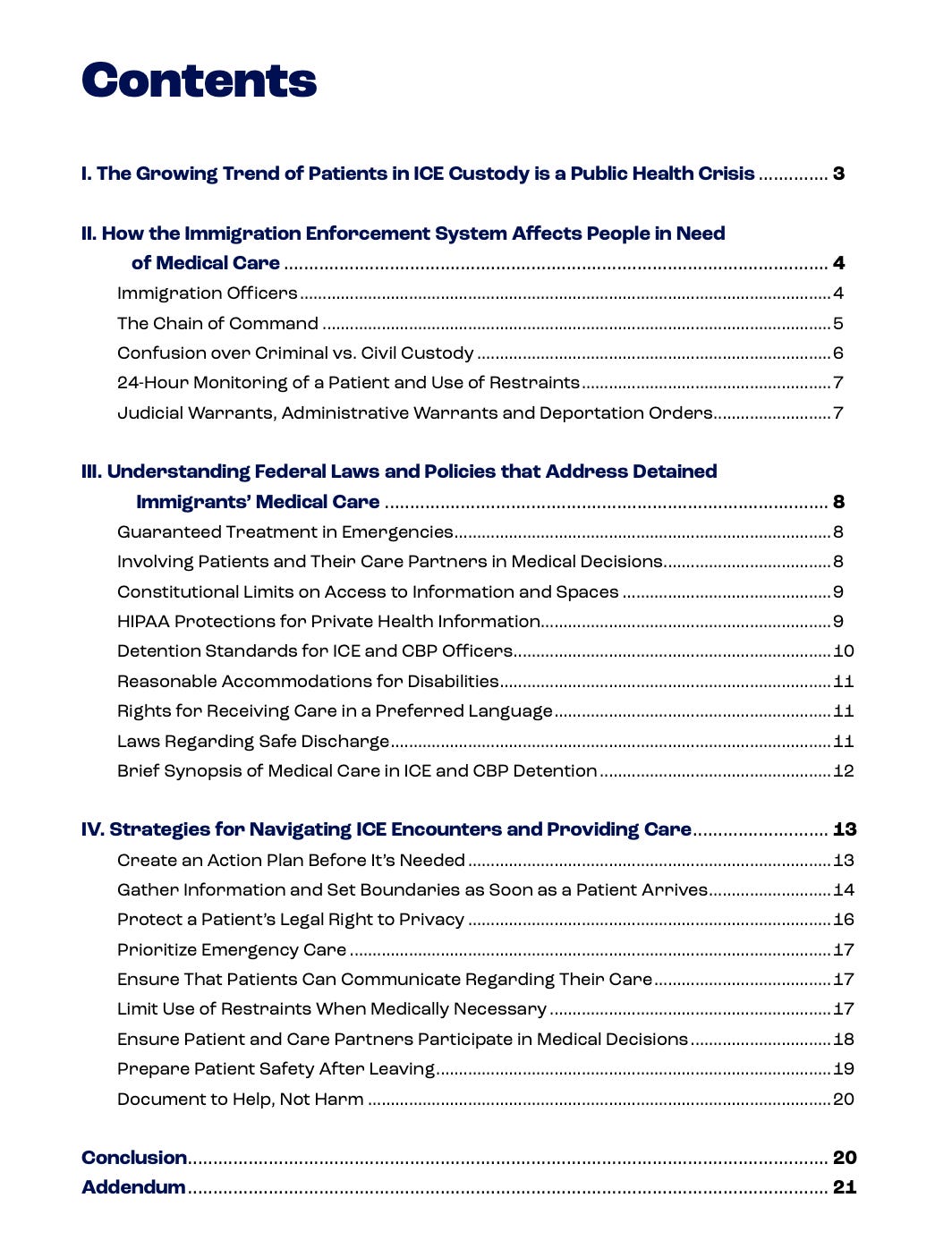
When the Trump administration revoked the longstanding policy that kept immigration agents out of hospitals, the public alarm centered on the prospect of raids inside clinics. A new report from the National Immigration Law Center, “Advocating on Behalf of Patients in Immigration Custody,” takes up a less visible situation created by the same shift. It documents what happens after a person already in immigration custody is brought to a hospital for care and a guard stays in the room while clinicians treat them. With the detention population near 65,000 and medical care inside detention long documented as poor, that scenario now arrives in emergency departments that doctors and nurses have never dealt with at this scale before.
I spent an hour with three of the people who wrote the report, Jennifer Ibañez Whitlock and Matthew Lopas of NILC and Dr. Theresa Cheng, an emergency physician and civil rights attorney. They helped me understand the ethical issues and legal frameworks that frame this issue, and provided practical, proactive next steps that medical facilities can—and should—do to support their staff rather than leaving them to fend for themselves without any guidance.
This Substack is reader-supported. To receive new posts and support my work, consider becoming a free or paid subscriber.
The report focuses on how an immigration officer’s presence raises questions about medical standards and about how doctors and hospitals can prepare rather than a question about immigration authority. Federal law already requires hospitals to evaluate and stabilize anyone facing an emergency regardless of immigration status or ability to pay, and medical privacy rules already limit what any outside party can pull from a patient’s care. Matthew Lopas, who works on health policy at NILC, argued that those existing rules give clinicians a default to measure every request against. Anything an officer asks that departs from ordinary care should register as a deviation the provider is entitled to question. "A doctor should stop and say, why would I be doing this? Should I be doing this? Is there a reason why I would deviate from how I would normally treat a patient? And in most cases, that's gonna be no."
For the clinicians in the room, that reframing attaches legal language to a problem that has been landing on them without much guidance. Dr. Theresa Cheng described the problem as moral injury, i.e., the distress of being pressured to act against one’s own ethics. The person applying the pressure is not always a federal ICE officer. Depending on where the patient is held, Cheng noted, it may be a detention facility employee or a private security guard, sometimes in plain clothes and armed, which makes the authority in the room harder to read and the fear it generates harder to contain. What the report gives her, and other doctors like her, is a way to anchor the clinical instinct in law rather than feeling. “Patients in immigration custody are still patients first,” she said. “Our obligation as clinicians doesn’t change because there is an immigration officer standing in the room.”
Jen, NILC’s senior policy counsel, placed that bedside encounter inside a system that has manufactured its own strain. Late last year, the contract ICE used to pay hospitals for detained patients’ care was canceled, and by her account the replacement has not been fully restored, even as the agency commands a budget larger than some national militaries. She was careful not to assert a direct link to the deaths in custody, which now number fifty under this administration, but she did point to reporting on how preventable many of them have been. She named the underlying decision anyway, noting that ICE holds full authority to release people on bond or through alternatives to detention. “It’s a choice to have this many people in detention, and if you can’t take care of them, then I think that’s quite remarkable.”
Cheng’s broader claim is that enforcement inside hospitals cannot be read apart from the simultaneous cuts to Medicaid and food assistance, because both reach the same patients. When people lose preventive care, she said, they return to emergency rooms later and sicker, at higher cost to a system everyone relies on, which turns a policy aimed at immigrants into a strain on the medical safety net as a whole. Jen drew the practical conclusion from the same logic. The most direct way to keep detained patients out of the emergency room in custody is to reduce the number of people held in custody in the first place. As the government moves to expand detention capacity, she asked people to tell their members of Congress that they want less funding for detention, not more.
What the hour clarified for me is how much analytical weight the medical profession adds to a debate the immigration field has largely been having on its own. When clinicians say, from inside the hospital room, that current enforcement compromises patient safety and their own ethics, they convert a values argument about detention into a professional and evidentiary one. In doing so, ICE’s problematic handling of immigrants in custody inside medical facilities is helping to expand the critique of the U.S. detention system by bringing in the voices of medical professionals.
Something Matthew said to medical professionals was so simple and yet so profound: “Providing dignified care to immigrants is itself an act of resistance because we live in a country that does not want that to happen.” All the report asks is that doctors be allowed to do their jobs. That should not be radical, but it feels radical sometimes. For clinicians who feel powerless against all of this, Matthew’s point carries some reassurance: clinicians do not have to become activists, they only to keep caring for their patients as they always would. At the same time, we are now living in a country where simply doing your job ethically as a doctor could mean being branded as an activist—and that’s dangerous.
My thanks to Jennifer Ibañez Whitlock, Matthew Lopas, and Dr. Theresa Cheng for their time, and to everyone who joined live and is reading now. The report is written for clinicians, but it maps where immigration enforcement now reaches, and it is short enough to hand to a doctor, a nurse, or a clinic in your own neighborhood. Please download the report, read it, and share it.
Resources from the conversation
Jen’s analysis of the new budget law and how it cuts health coverage and food aid for hundreds of thousands of immigrants: Hundreds of Thousands of Immigrants Are Losing Health Care and Food Aid, Thanks to Congress.
The Harbor-UCLA case Cheng raised, MALDEF’s claim alleging discriminatory treatment and privacy violations after a hospital complied with immigration officers: MALDEF administrative claim.
A state model Matthew cited, which did not pass last year: California SB 915.
A local policy already in force that administrators can adapt: Los Angeles County’s hospital policy.
Raised by an attendee, for its work on behalf of people held in prisons, jails, and ICE detention: Medical Justice Alliance.
The panelists’ contact information, shared during the event: Matthew Lopas (lopas@nilc.org), Jennifer Ibañez Whitlock (whitlock@nilc.org), and NILC’s media team (media@nilc.org).
Things You Can Do Right Now
Read and share the report. Download NILC’s Advocating on Behalf of Patients in Immigration Custody and send it to any clinician, nurse, social worker, or clinic you know.
If you work in health care, build a local network. Connect with colleagues at your hospital and others nearby to share information, including the hard-to-find contacts for ICE field offices and facility medical administrators, and use the report to bring legal grounding to conversations with your administrators.
Push for state and local policy. Point your hospital and local officials to models that already exist, like California SB 915 and Los Angeles County’s policy, and connect with immigrant rights and health justice groups in your area.
Tell your member of Congress you do not want detention expansion. As the government signs new contracts to buy and expand facilities, say plainly that you do not want a detention center in your community or your state.
Speak out against the safety net cuts too. You do not have to work in a hospital to push back on the dismantling of Medicaid and SNAP, because these harms stack on top of one another and reach all of us.
Timestamp of key themes
00:00 — Why this conversation, and ICE bringing patients into hospitals
05:35 — How each panelist came to this work
19:19 — What the report is and is not about
23:15 — The doctor’s impossible position and moral injury
27:47 — Where hospital leadership is landing, private equity, and HR1
29:50 — State-level policy and community health clinics under threat
34:50 — The legal frameworks: the Constitution, EMTALA, and HIPAA
40:44 — At the bedside: scripts, handcuffs, and escalation
46:48 — Who pays, the canceled medical-claims contract, and detention deaths
50:41 — Next steps and how to take action
55:51 — Opposing detention expansion and the systemic convergence
58:21 — Closing thoughts from each panelist
Help Keep These Conversations Going
There are plenty of places to read about immigration enforcement. There are very few where two lawyers who helped write the guidance and an emergency physician who treats these patients sit down together and work out, step by step, what a clinician can actually do when someone has custody of their patient. If you think this kind of access deserves a wider audience, a paid subscription is the best way to make it happen.
Comments
Nothing yet. Say the first thing.
Sign in to join the conversation.