
Opening Note
Before diving into this week’s stories, we also wanted to highlight a busy few weeks ahead for the network.
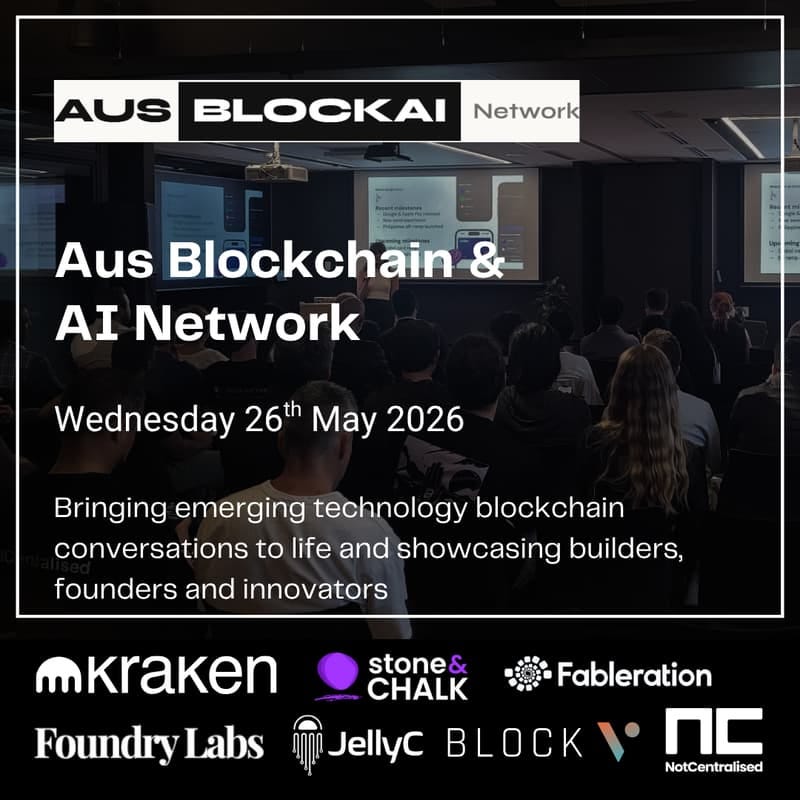
We’re back in Sydney this week for our May 26 meetup, before heading to Melbourne on June 9 as we continue expanding the community nationally. Following that, we’ll also be running a side event alongside the Digital Economy Conference in mid-June back in Sydney.
Sydney 26th May (this week) https://luma.com/gqqnfgil
Melbourne 9th June https://luma.com/2ie8qq06
Sydney 16th June https://luma.com/x5ygy1v2
The momentum around these events has been incredibly encouraging. What continues standing out is the quality of the conversations happening across the community — not just around speculation or headlines, but around infrastructure, workflows, implementation, and what these technologies actually look like in practice.
We’ll include links to all upcoming events below and would love to see more builders, operators, founders, researchers and curious minds join us as the network continues growing.
This past week also felt like another reminder that the conversation around both AI and blockchain is changing quickly.
Not because the technology itself is new anymore, but because the focus is shifting toward implementation, infrastructure, and operational reality. Across both sectors, the language coming from major companies, regulators, and builders is becoming far more practical.
In AI, the market is increasingly moving away from the idea that models alone are the product. The new battleground is deployment — how AI actually integrates into workflows, organisations, and decision-making systems.
In blockchain, particularly within Australia, the conversation continues to mature around tokenised infrastructure, digital money, stablecoins, and the practical rails needed for institutional adoption.
And increasingly, these two worlds are beginning to overlap.
Thanks for reading The Network Dispatch! Subscribe for free to receive new posts and support my work.
This Week in Artificial Intelligence
Nate B Jones: Why AI Hallucinations Are Becoming a Workflow Problem
Nate B Jones released an excellent breakdown this week exploring why many AI hallucination problems are no longer primarily model problems, but workflow and context management problems.
Using the recent Sullivan & Cromwell legal filing incident as the opening example, the video argues that even highly sophisticated organisations using the best available AI tooling can still produce hallucinated outputs if the surrounding workflow is poorly structured. The core thesis is that simply telling models “not to hallucinate” is not enough. Instead, organisations need to rethink how AI agents interact with files, source material, project structures, and context.
One of the more interesting ideas discussed is the rise of the “project room” or “data room” workflow, where AI agents first organise, classify, inventory, compare, and validate source materials before generating any final deliverable. Rather than immediately asking AI to “write the document”, the argument is that the first prompt should instead focus on helping the agent build a structured working environment.
The discussion also touched on why newer models such as GPT-5.5 and Claude Opus 4.7 are particularly important here. These systems are increasingly capable of handling long-running file-based tasks, reviewing large folder structures, identifying conflicts between documents, surfacing missing context, and creating structured inventories of source material before drafting outputs.
For anyone working with AI in enterprise, legal, consulting, research, or operational environments, the video is a strong reminder that context engineering and workflow design are rapidly becoming just as important as the models themselves.
Andrej Karpathy Joins Anthropic
https://www.axios.com/2026/05/19/anthropic-openai-karpathy-andrej-claude
One of the biggest stories this week was Andrej Karpathy joining Anthropic. Beyond being a high-profile talent move, it reinforces how aggressively the frontier AI labs are competing for elite researchers capable of shaping foundational model capabilities. Karpathy’s reputation for practical, systems-focused AI development also aligns closely with Anthropic’s growing emphasis on reliability, training infrastructure, and production-grade deployment.
Forward Deployed Engineers Become One of AI’s Hottest Roles
The concept of the “Forward Deployed Engineer” has rapidly become one of the defining themes across enterprise AI. Borrowed heavily from the Palantir model, these engineers work directly inside client environments, building production systems rather than simply advising on strategy. The rise of this role reflects a growing understanding that AI deployment is ultimately an operational challenge, not just a software problem.
OpenAI Pushes Further Into Forward Deployed Engineering
https://openai.com/index/openai-launches-the-deployment-company/
OpenAI’s move deeper into “Forward Deployed Engineering” reflects a broader industry trend where AI companies are embedding directly into enterprise environments. Rather than simply selling access to models, these firms are increasingly helping organisations redesign workflows, integrate systems, and operationalise AI inside real business processes.
AI Safety & Recursive Self-Improvement Moves Into Focus
https://www.businessinsider.com/openai-safety-team-ai-self-improvement-challenge-job-2026-5
OpenAI’s latest hiring push around recursive self-improvement and frontier safety research also drew significant attention this week. The company is actively recruiting researchers focused on anticipating risks tied to increasingly autonomous AI systems, highlighting how discussions around AI safety are evolving alongside rapidly improving model capabilities.
This Week in Blockchain & Digital Assets
Project Acacia Continues Driving Institutional Tokenisation
Momentum continues building around Project Acacia and the broader conversation around digital money, settlement infrastructure, and tokenised financial systems in Australia. The discussion has increasingly shifted away from speculative markets and toward practical institutional infrastructure.
The accompanying Project Acacia report also highlighted growing interest in stablecoin issuance and tokenised bank deposits within Australia. The broader discussion is increasingly moving toward interoperability between digital money systems and how tokenised settlement infrastructure may eventually operate alongside traditional financial rails.
Binance Australia Introduces New Transfer Verification Measures
Binance Australia announced new sender and beneficiary verification checks this week as part of ongoing compliance with AUSTRAC’s Travel Rule requirements. The changes reflect the increasing regulatory maturity of the Australian digital asset sector, where exchanges are being pushed to operate more closely in line with traditional financial compliance expectations.
Japan Finalises New Stablecoin & Crypto Transfer Rules
Globally, Japan finalised a new set of rules this week covering stablecoins, crypto intermediaries, and digital asset transfers. Japan continues positioning itself as one of the more proactive major jurisdictions when it comes to integrating digital assets into regulated financial infrastructure.
Crypto Markets Hit by Geopolitical Volatility
Crypto markets also experienced significant volatility this week as geopolitical tensions triggered nearly US$1 billion in liquidations across the sector. The event served as another reminder that despite increasing institutionalisation, digital asset markets remain highly sensitive to broader macro and geopolitical risk.
Bankless: Bitcoin as “Digital Capital”
One of the more thought-provoking discussions this week came from Bankless, exploring the idea that Bitcoin may be evolving beyond the “digital gold” narrative and into something much larger, what Michael Saylor and others are increasingly describing as “digital capital”.
The discussion focused heavily on the emergence of Bitcoin-backed credit products and how companies like Strategy and Strive are attempting to build entirely new financial instruments on top of Bitcoin balance sheets. Rather than simply holding Bitcoin as a treasury reserve, the thesis is that Bitcoin can underpin yield products, preferred equity instruments, and broader capital market structures.
A major theme throughout the episode was the rise of “digital credit” and whether these products could eventually compete with traditional credit markets, private debt, real estate yield products, and even parts of the banking system itself. The conversation also explored how AI may accelerate disruption across traditional financial markets, potentially making transparent, programmable, Bitcoin-backed systems more attractive over time.
Whether or not one agrees with the thesis, it reflects a broader shift happening across the industry: the conversation around Bitcoin is increasingly moving away from speculation alone and toward how blockchain-based assets interact with larger capital markets and financial infrastructure.
Looking Ahead
If there is one theme tying everything together this week, it is that both AI and blockchain are becoming less theoretical and more operational.
The market is moving beyond concepts and toward implementation.
That means the next phase will likely be defined less by who has the flashiest demo and more by who can integrate these technologies into real systems in ways that are reliable, trusted, and genuinely useful.
That is also why communities matter.
Because the organisations and builders experimenting now, testing workflows, deploying prototypes, integrating infrastructure, and sharing lessons openly, are ultimately the ones helping shape what these technologies become in practice.
Thanks for reading The Network Dispatch! Subscribe for free to receive new posts and support my work.
ABOUT AUSTRALIAN BLOCKCHAIN & AI NETWORK
The Australian Blockchain & AI Network (ABAI Network) is a non-profit community organisation dedicated to increasing education and awareness of blockchain technology, specifically blockchain and AI-based projects. Their goal is to empower the Australian community with the knowledge and tools to participate in the digital economy, and to promote the adoption and growth of emerging technology in Australia and beyond.
SPONSORS
This newsletter is brought to you by the following sponsors:
Comments
Nothing yet. Say the first thing.
Sign in to join the conversation.