
There are weeks where the news feels disconnected.
A model release here. A regulatory update there. Another stablecoin headline. Another enterprise AI announcement.
But this week, the pattern was clearer.
From May 12 to May 18, the common thread across blockchain and AI was infrastructure. Not hype infrastructure. Actual operating infrastructure. The kind that sits behind markets, businesses, payments, compliance systems, and increasingly, the way organisations make decisions.
On the blockchain side, the conversation continued moving away from speculation and toward regulated market plumbing. Tokenised money market funds, stablecoin reserve structures, cross-chain security, and new digital asset laws all pointed in the same direction. Digital assets are being pulled deeper into the financial system, but only where they can meet institutional standards.
On the AI side, the shift was just as important. OpenAI and Anthropic both made moves that tell us where the market is heading: away from chatbots as standalone tools and toward AI embedded into workflows, teams, and real operational systems.
That matters.
Because the next phase is not about whether AI or blockchain are interesting. It is about whether they can be deployed, governed, trusted, and used inside the systems that actually run the economy.
That is where this gets serious.
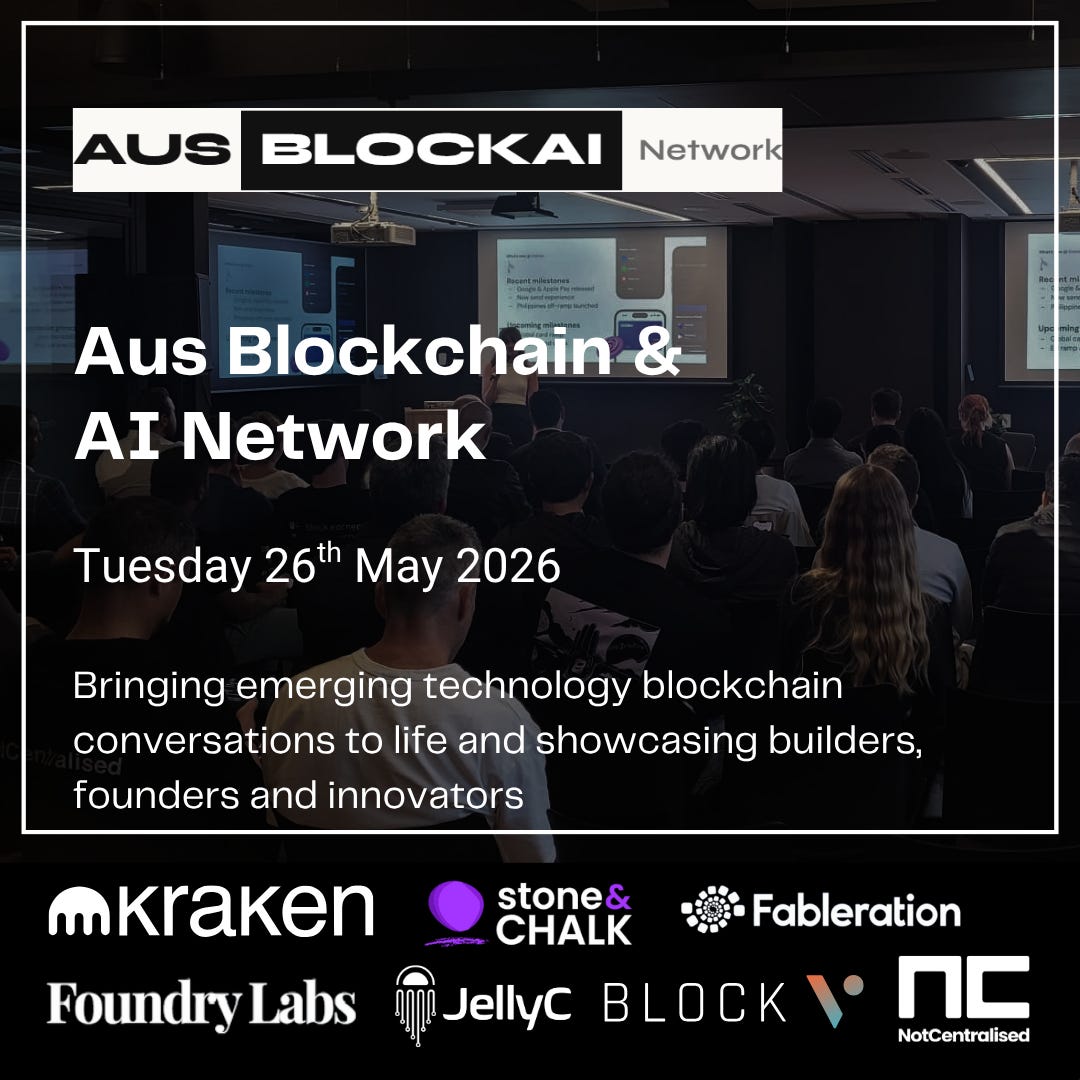
Before we get started, remember to sign up and join us next Tuesday for our meetup at Stone & Chalk - sign up here: https://luma.com/gqqnfgil
This week’s blockchain developments reinforced a trend that has been building quietly for some time: digital assets are increasingly being treated less like an alternative financial system and more like an extension of existing financial infrastructure.
What matters now is not simply whether blockchain works technically. The focus has shifted toward whether these systems can satisfy the operational, regulatory, and risk requirements expected by institutions, governments, and large-scale markets.
That shift is changing the entire conversation.
Link: https://cointelegraph.com/news/jpmorgan-files-second-tokenized-money-market-fund-ethereum
JPMorgan filed to launch a tokenised money market fund on Ethereum, designed specifically for stablecoin issuers to hold reserve assets in a regulated, cash-like product while still earning interest.
This is a very important signal.
Stablecoins are not just being treated as crypto payment tokens anymore. They are increasingly being connected to the same instruments, custody expectations, and reserve frameworks that underpin traditional finance.
The more interesting point is not that a money market fund is being tokenised. It is that the tokenised product is being positioned as part of the operating layer for stablecoin issuers.
That is where institutional finance and digital asset infrastructure start to properly overlap.
Link: https://www.reuters.com/legal/transactional/what-is-us-senates-landmark-crypto-bill-2026-05-12/
The US Senate’s Clarity Act set out a broader framework for crypto regulation, including rules around stablecoin rewards, AML obligations, DeFi, fundraising exemptions, and tokenised securities.
The direction is clear: the US is trying to define where crypto fits within the existing financial system, rather than leaving everything to enforcement and interpretation.
One of the more important provisions is the treatment of tokenised securities. The bill makes clear that putting a security on-chain does not magically remove it from securities law.
That sounds obvious, but it matters.
Tokenisation is becoming more mainstream precisely because regulators and institutions are beginning to define the boundaries. The technology may be new, but the underlying financial rights still need legal clarity.
Link: https://cointelegraph.com/news/kraken-joins-layerzero-exodus-switching-chainlink-ccip
Kraken announced it is moving from LayerZero to Chainlink CCIP as its exclusive cross-chain infrastructure for kBTC and future wrapped tokens, following the Kelp DAO exploit.
This is the kind of story that looks technical on the surface but is actually about trust.
As more real value moves across chains, interoperability cannot be treated as experimental middleware. It becomes critical financial infrastructure.
The lesson is simple: bridges, messaging layers, and wrapped assets are no longer niche crypto plumbing. They are part of the risk perimeter.
Link: https://rubiconlaw.com.au/the-2026-crypto-reset-part-2-dealing-in-digital-assets-and-the-afsl-cliff/
Australian digital asset businesses are now facing a sharper compliance reality. Recent commentary on the 2026 reforms highlights the shift from focusing only on whether a token is a financial product, to whether the platform or service itself creates financial services obligations.
That is a major change.
The practical trigger is increasingly the platform, not just the asset. If a business holds, manages, records, or facilitates digital asset interests for users, it may be operating within the financial services framework.
For Australia, this is where the market starts maturing. The compliance burden increases, but so does the ability for more serious institutions to participate.
The Bank of Japan called for a more holistic approach to the future monetary system, noting that the answer is not simply CBDCs versus stablecoins. Tokenised bank deposits and blockchain-based central bank reserves are also part of the design space.
This is probably the most important framing.
The future of money is unlikely to be one rail. It will be a mix of central bank money, commercial bank money, stablecoins, tokenised deposits, and blockchain-based settlement infrastructure.
The countries that understand that early will be better placed to shape the next phase of financial architecture.
Link:
A fascinating Bankless discussion this week unpacked the increasingly chaotic secondary markets forming around private AI companies like Anthropic and OpenAI.
The key takeaway was simple: these firms are staying private for so long, and reaching such large valuations, that entire unofficial capital markets are forming around them through SPVs, employee forwards, synthetic exposure, and private brokers.
The comparison to crypto’s low-float, high-FDV era was hard to ignore. Limited supply combined with massive demand is creating opaque pricing, layered intermediaries, and growing market complexity before these companies even reach public exchanges.
This week’s AI developments showed that the market is rapidly evolving beyond standalone tools and into operational systems that integrate directly into organisations, workflows, and infrastructure.
The conversation is no longer centred on whether AI can generate impressive outputs. Businesses are now asking much harder questions around deployment, governance, productivity, workforce impact, and operational trust.
That shift is forcing the industry to mature quickly.
Link: https://openai.com/index/openai-launches-the-deployment-company/
OpenAI launched the OpenAI Deployment Company, backed by more than $4 billion of initial investment, to help organisations build and deploy AI systems into real operational workflows.
This is a big signal.
The frontier model companies are no longer just shipping models and waiting for customers to work out what to do with them. They are moving into implementation.
That tells us something important about the market: the bottleneck is not just model capability. It is deployment, workflow redesign, change management, and operational trust.
In other words, the hard part is not asking AI a question. The hard part is rebuilding work around it.
Link: https://www.anthropic.com/news/claude-for-small-business
Anthropic launched Claude for Small Business, connecting Claude into tools like QuickBooks, PayPal, HubSpot, Canva, DocuSign, Google Workspace, and Microsoft 365.
This is where AI starts to feel less like a product category and more like a work layer.
The value is not just in generating text. It is in helping businesses chase invoices, plan payroll, manage campaigns, and handle the operational work that normally piles up around the edges.
For small businesses, that matters because they often do not have the internal teams, systems, or time that larger organisations take for granted.
Link: https://www.anthropic.com/news/gates-foundation-partnership
Anthropic and the Gates Foundation announced a $200 million partnership across global health, life sciences, education, and economic mobility.
This is a useful reminder that AI’s most important applications may not always be the flashiest.
Better disease forecasting. Improved health intelligence. Support for frontline workers. More accessible modelling tools.
These are not consumer gimmicks. They are examples of AI being pointed at complex public-interest problems where better decision support can have real-world consequences.
Meta offered rival AI chatbots free access to WhatsApp’s business API for one month as it tries to resolve EU antitrust concerns.
This is more than a competition law story.
As AI assistants become more embedded into messaging, work tools, and customer interfaces, access to distribution becomes a strategic issue. The question is not just who has the best model. It is who controls the channels where AI agents interact with users.
That will become one of the defining tensions in the AI market.
Link:
One of the more insightful AI breakdowns this week focused less on model launches and more on the operational shift happening underneath them.
The key takeaway was that agents are increasingly moving beyond chat interfaces and into real workflows inside businesses. Notion launched deeper agent tooling for workspaces, AWS introduced managed desktop environments for agents, and Anthropic’s ongoing compute challenges showed just how aggressively agentic usage is growing.
The broader message was important: the future AI battleground is no longer just model quality. It is workflow integration, operational reliability, governance, and whether AI systems can function safely inside the messy reality of enterprise software and human processes.
The signal this week is that both AI and blockchain are moving into the operational layer. Blockchain is being pulled into regulated finance, payments, custody, settlement, and market structure. AI is being pushed into business workflows, public health, enterprise deployment, and software ecosystems.
The shared theme is trust.
Can the system be governed? Can it be audited? Can it be deployed safely? Can institutions rely on it? Can users understand what is happening?
That is where the real work now sits which means a lot less noise and a lot more systems and increasingly, those systems are being built now.
Till next week!
The Australian Blockchain & AI Network (ABAI Network) is a non-profit community organisation dedicated to increasing education and awareness of blockchain technology, specifically blockchain and AI-based projects. Their goal is to empower the Australian community with the knowledge and tools to participate in the digital economy, and to promote the adoption and growth of emerging technology in Australia and beyond.
This newsletter is brought to you by the following sponsors:
No posts
Comments
Nothing yet. Say the first thing.
Sign in to join the conversation.