
George Monbiot’s latest piece in The Guardian is a call loud enough to wake the dead. Or should be. He’s not arguing that a fertilizer supply crunch, such as we’re witnessing now, or harvest failures caused by climate breakdown can cause the entire global food system to collapse. He’s arguing that the entire global food system is so precariously poised on the tip of an unstable equilibrium that a far weaker push will suffice to bring it crashing down. My sole contribution to his article, which is reproduced below, is that I have converted its many weblinks to footnotes and added original abstracts (where available) or TL;DRs of the source texts.
By George Monbiot, The Guardian, Wed 25 Mar 2026
The fragility of the global food system fills me with dread—and the war with Iran has exposed just how close to collapse it is
The fate of environmentalists is to spend their lives trying not to be proved right. Vindication is what we dread. But there’s one threat that haunts me more than any other: the collapse of the global food system. We cannot predict what the immediate trigger might be. But the war with Iran is just the right kind of event.
Drawing on years of scientific data,1,2,3 I’ve been arguing for some time that this risk exists—and that governments are completely unprepared for it. In 2023, I made a submission4 to a parliamentary inquiry into environmental change and food security,5 with a vast list of references. Called as a witness, I spent much of the time explaining6 that the issue was much wider than the inquiry’s scope.
While some MPs got it, governments as a whole simply don’t seem to understand what we’re facing. It’s this: the global food system is systemically fragile in the same way that the global financial system was before the 2008 crash.
It’s easy to see potential vulnerabilities, such as a fertiliser supply crunch7 caused by the closure of the strait of Hormuz, or harvest failures8 caused by climate breakdown. But these are not the thing itself. They are disruptions of the kind that might trigger the thing. The thing itself is the entire system sliding off a cliff. The same factors that would have brought down the financial system, were it not for a bailout amounting to trillions of dollars, now threaten to bring down the food system.
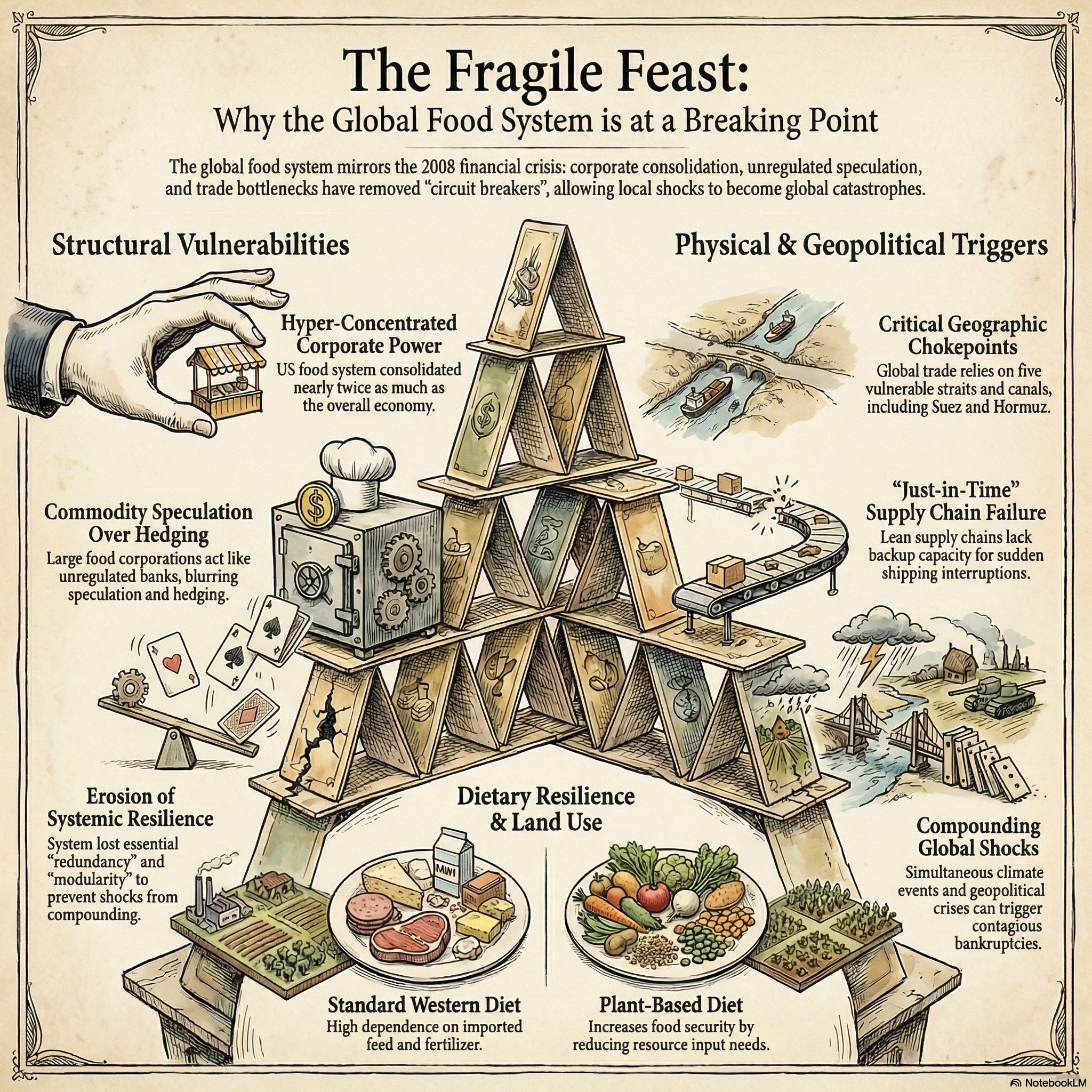
Recent data suggests that every part of this system is now highly concentrated9 in the hands of a few corporations, which have been consolidating10 both vertically and horizontally. One recent study found that11 the US food system has “consolidated nearly twice as much as the overall economic system”. Some of these corporations, diversifying into financial products, now look more like banks12 than commodity traders, but without the same level of regulation. They might claim that financialisation helps them hedge against risk, but as one paper remarks,13 “it is nearly impossible to differentiate between hedging and speculating.” We don’t know how exposed to risk they might be, but it doesn’t look great.14 Partly through their influence, the world has shifted towards a “global standard diet”, supplied by the global standard farm.
These vulnerabilities are exacerbated by the use of just-in-time supply chains and the funnelling of much of the world’s trade through a number of chokepoints. Some people15 have long warned16 that the strait of Hormuz, alongside the Suez canal, Turkish straits, Panama canal and straits of Malacca, are critical chokepoints, whose obstruction would threaten the flow of food, fertiliser, fuel and other crucial agricultural commodities. A year ago, I listed17 “military attacks on … straits and canals” as a major interruption risk exacerbated by Donald Trump’s antics. The thought that Houthi rebels in Yemen, backed by the Iranian government, might simultaneously resume their attacks on Red Sea shipping keeps me awake at night.
What all this means is a reduction in the key elements of systemic resilience: diversity, redundancy (a system’s spare capacity), modularity (its degree of compartmentalisation), backup (other ways of providing food), asynchronicity (which prevents shocks suddenly compounding) and circuit breakers (mostly in the form of effective regulation). A loss of any one of these properties should be a flashing red light. But the whole dashboard is now lit up.
When a system has lost its resilience, it’s hard to predict just how and when it could go down. The collapse of one corporation? The simultaneous closure of two or more chokepoints? A major IT outage? A severe climate event coinciding with a geopolitical crisis? The next step could be contagious bankruptcy and cascading failure18 across sectors. Then … well, it’s beyond imagination. The chain between seller and buyer – as fundamental to our food supply as the production of food itself – could suddenly snap. Shelves would clear as people panic-bought. Crops would rot in fields, silos or ports. Rebooting a system whose financial architecture has imploded might prove impossible on the timescale required to prevent mass starvation. As complex societies, we’re looking at a potential termination event.
We know what needs to happen: break up the big corporations; bring the system under proper regulatory control; diversify our diets19 and their means of production20; reduce our dependence on a handful of major exporting countries; build strategic food reserves, accessible to people everywhere. But there’s a problem, and it’s not just Trump. Almost all governments are beholden to corporate and financial power. The measures required to avoid catastrophe are those they are least prepared to implement. The chances of a global agreement on this global problem are approximately zero.
The best we can hope for is that braver politicians in our own countries seek to insulate us from the worst impacts. A crucial step is to encourage a shift to a plant-based diet. People struggle to see the relevance, but it’s simple. A plant-based diet requires far fewer resources, including just a quarter of the land21 a standard western diet requires and much less fertiliser and other inputs. Just as we make ourselves more energy-secure by switching from fossil fuels22 to renewables, we make ourselves more food-secure by switching from animals to plants. Don’t take my word for it: it’s a key message in the national security assessment23, which the government sought to withhold24 from public view – probably because it would upset too many powerful interests. Chinese researchers have come to the same conclusion25 about their own country: its food resilience is now dangerously compromised by the rising consumption of animal products.
But policy in the UK is nothing short of moronic. In response to warnings about our food vulnerability, our environment secretary, the former financial lobbyist Emma Reynolds, remarked that she wanted to boost domestic poultry production26. Given that this sector largely depends on imported feed (such as soya from Brazil and maize from the US), her plan would make us more vulnerable. But she proposes scarcely anything else: no strategic reserves, no alternative supply chains, no useful defensive measures of any kind.
Policy here and across most of the world appears to consist of allowing “the market” (namely a few huge global corporations) to decide what happens next. There’s another way of putting it. Our governments are leaving a group of ruthless speculators to play dice with our lives.
Michael J Puma et al, Assessing the evolving fragility of the global food system 2015 Environ. Res. Lett. 10 024007. TL;DR: The 2008 global food crisis revealed a dangerous irony: as our global trade networks for wheat and rice became more interconnected and "efficient" between 1992 and 2009, they actually became more fragile. While trade connections doubled and food flows surged, this complexity created a system where 85% of countries now rely on imports they cannot produce themselves. When we simulated major crop failures in regions like Europe or Asia, we found that this modern, highly connected network actually suffers deeper losses than the simpler systems of the past because exporting nations tend to shut their borders during shortages. This systemic vulnerability hits the world's least developed countries the hardest, with their potential food supply losses jumping from roughly 8% in the nineties to as high as 14% in the late 2000s. Ultimately, we must stop prioritizing trade efficiency at all costs and instead focus on strengthening local farming and diversifying where we get our food to ensure the world can withstand the next major shock.
Samir Suweis et al, Resilience and reactivity of global food security 2015 PNAS 112 (22) 6902-6907. TL;DR: Over the last 25 years, the globalization of food trade has created a paradox: while it connects the world, it simultaneously erodes systemic stability. By analyzing the interplay between demographic growth and resource scarcity, our framework demonstrates that the global food system has become increasingly sensitive to environmental and policy shocks. As nations trade self-sufficiency for import dependency, the coupled food–population nexus is losing its resilience, leaving the planet more vulnerable to sudden, widespread food crises.
Cottrell, R.S., Nash, K.L., Halpern, B.S. et al. Food production shocks across land and sea. 2019 Nat Sustain 2, 130–137. Abstract: Sudden losses to food production (that is, shocks) and their consequences across land and sea pose cumulative threats to global sustainability. We conducted an integrated assessment of global production data from crop, livestock, aquaculture and fisheries sectors over 53 years to understand how shocks occurring in one food sector can create diverse and linked challenges among others. We show that some regions are shock hotspots, exposed frequently to shocks across multiple sectors. Critically, shock frequency has increased through time on land and sea at a global scale. Geopolitical and extreme-weather events were the main shock drivers identified, but with considerable differences across sectors. We illustrate how social and ecological drivers, influenced by the dynamics of the food system, can spill over multiple food sectors and create synchronous challenges or trade-offs among terrestrial and aquatic systems. In a more shock-prone and interconnected world, bold food policy and social protection mechanisms that help people anticipate, cope with and recover from losses will be central to sustainability.
House of Commons, Environmental Audit Committee, Oral evidence: Environmental change and food security, HC 880.
Chris Krebs (former director of the US Cybersecurity and Infrastructure Security Agency), Hormuz fertiliser block will upend world’s food production, Financial Times, Mar 24, 2026. TL;DR: The current geopolitical crisis in the Strait of Hormuz transcends energy security, as the waterway facilitates the transit of 49% of globally traded urea and 30% of ammonia, essential for high-yield agriculture. With the closure occurring during a critical four-week window for nitrogen application in the Northern Hemisphere, farmers are already shifting crop estimates, locking in yield losses. This disruption exacerbates a global food system already strained by the prolonged conflict in Ukraine, pushing import-dependent regions like the Horn of Africa toward imminent famine. The "agricultural clock" is measured in weeks, meaning that if fertilizer shipments do not resume within a month, the crisis will transition from a manageable supply disruption to a widespread humanitarian and security emergency.
T. Hasegawa, H. Wakatsuki, and G.C. Nelson, Evidence for and projection of multi-breadbasket failure caused by climate change, 2022, Current Opinion in Environmental Sustainability 58 101217. Abstract: Simultaneous crop failures in multiple major producing regions (breadbaskets) threaten both local and global food security. Evidence of their frequency and impact has recently become more available. We conducted a systematic literature search and identified 30 articles published between 2019 and 2022. Historically, synchronized crop-production losses have led to a global production deficit of as much as 20% and have often been associated with large-scale sea-surface temperature oscillations. Increasingly strong evidence suggests that the frequency of these impacts will increase with global warming. Simultaneous breadbasket failures increase local and global food prices and undermine food security, particularly in import-dependent low-income regions. Closely monitoring exposure to hazards, vulnerability, and impacts on food availability, access, and utilization in exporters and importers at regional and global levels will help identify vulnerable regions and processes. Seasonal forecasting of yield anomalies based on climate indices can provide a means of early warning.
FOODBARONS 2022: Crisis Profiteering, Digitalization and Shifting Power, Research by ETC Group, September 2022 (143 pages). TL;DR: The report highlights that critical agrifood sectors, ranging from seeds and agrochemicals to food delivery, are now controlled by as few as four to six dominant firms. These corporations leveraged the global disruptions of 2020, including the pandemic and climate shocks, to tighten their market grip and expand their influence over agricultural policy. This concentration is further accelerated by three major trends: the rapid digitalization of the food chain, the rising power of Asian corporations, and horizontal integration driven by massive asset management firms that create a semblance of competition while actually diminishing it.¶ In contrast to the resource-heavy industrial model, the "Peasant Food Web" continues to feed approximately 70% of the world's population using less than 30% of available land and water resources. The industrial system is criticized for exploiting labor, reducing biodiversity, and disproportionately impacting Indigenous communities and people of color through extractive practices. To counter this, the report advocates for a strategic divestment from the industrial food chain similar to movements against tobacco and fossil fuels. It calls for new regulatory mechanisms to restrict the power of data giants and private equity while supporting grassroots initiatives like the Nyéléni Process to return control to small-scale producers.
E. Paulus, M. Obersteiner, and N. Ranger, Getting into the doughnut: A framework for assessing systemic resilience in the global food system, One Earth, 2025; 8. Abstract: The global food system’s recent disruptions reveal its vulnerability to cascading failures, highlighting the urgent need to strengthen its systemic resilience, a vital precondition for global food security. Though modeling is key to comprehending its complex behavior and informing policy and decisions, the conceptualization, assessment, and modeling of systemic resilience are still in their infancy, raising questions about the suitability of existing models for evaluating resilience-building solutions. Utilizing insights from complexity theory and systems thinking, this paper proposes a holistic framework of seven criteria to evaluate modeling approaches and policies for systemic resilience. An assessment of five existing modeling approaches and associated examples of existing models reveals important gaps in current methodologies, especially regarding the transmission and amplification of impacts on the macro scale. Hence, we call for enhancing the analytical preparedness capability through the development of new models and clear communication of current shortfalls to stakeholders for improved governance.
C. Brinkley, J. Ulimwengu, and S. Raj, Real and simulated shocks to the food system: a nested food-economic system model for assessing resilience using a networked input–output approach 2025 Front. Sustain. Food Syst. 9:1608981. TL;DR: This study introduces a new way to look at how our food and money systems are tied together, treating them as one big, connected web. By looking at the U.S. economy during the 2008 financial crisis, the researchers found that food-related businesses actually became even more essential to the overall economy as it recovered. The research shows that when key parts of this network are hit by a shock, the damage can ripple through the entire system, potentially causing a total breakdown. Interestingly, it highlights that investing in scientific research is a huge "bang for your buck," as it requires little funding but significantly boosts productivity across the food industry. Ultimately, the study warns that we can't truly understand or protect our food supply if we study it in a vacuum; we have to look at the whole economic picture to keep our shelves stocked and our economy stable.
Ties Gijzel, Why the world’s food system is more fragile than you think. “This article in one minute”: Over the last 10 years, giant food trading companies have started acting like banks by increasingly engaging in financing activities. This, in combination with a lack of transparency, makes the global food system unsustainable, a top U.N. trade expert warned, arguing that a next food crisis could come soon. This is in line with other experts, who warn that the global food system has become too dependent on the traders. If these companies were to go bankrupt, global food security could go down with them. A handful of food traders dominates the global food trade. They dominate the entire supply chain for some essential products, including soya, rice, and grain, because they buy, store, transport and sell food. If just one of them fails and goes bankrupt, food prices could shoot up around the world and even lead to global hunger, experts warn. The problem is that food traders aren’t as strongly regulated as banks, which opens the door for dangerous levels of financial speculation. Follow the Money interviewed a range of food experts, read scientific studies and reports and reached out to major food traders.
Jennifer Clapp, ABCD and beyond: From grain merchants to agricultural value chain managers 2015 CFS/RCÉA –2 (2) 126‒135. Abstract: The world of agricultural commodity trading firms has changed over the years, although corporate concentration has long been a defining feature of this sector. The four dominant agricultural trading firms—the ABCDs (ADM, Bunge, Cargill and Louis-Dreyfus)—have a long history dating back to the 1800s and early 1900s. First established as private, family-owned grain merchant companies with specific geographical specialties, these firms have since evolved to be quite complex companies. They buy and sell grain as well as a host of other agricultural and non-agricultural commodities, while they also undertake a range of activities from finance to production to processing and distribution. New entrants into this space have also taken on complex structures and activities in a bid to stay competitive.
Michael Nelson, Investors warned the food industry is unprepared for future supply chain volatility: Sub-scale risk mitigation strategies are giving investors false confidence PA Future 3 Apr 2025. TL;DR: The memo, published by the anonymous collective "Inside Track x Food," asserts that major food production and retail entities are providing investors with a false sense of security. Despite escalating threats from soil degradation, water scarcity, and extreme weather, current risk mitigation strategies are characterized as "sub-scale" or "wishful" and are often validated by audit firms despite being insufficient. The insiders attribute this lack of preparedness to a combination of ill-equipped corporate boards, a competitive culture that discourages transparency, and a persistent bias toward pleasing shareholders rather than addressing long-term existential risks to the food supply chain.¶ To protect portfolios and the public's access to food, investors are urged to move beyond passive observation and drive urgent corporate action. Financial experts and stewardship directors emphasize that the ability to produce food sustainably is in jeopardy, as productivity shocks become more frequent. Investors are encouraged to challenge existing sourcing practices and disaster preparedness levels, as the current reliance on finding alternative regions or unproven food sources is deemed inadequate to withstand a potential collapse of soil and food systems.
L. Wellesley et al, Chokepoints in global food trade: Assessing the risk, Research in Transportation Business & Management 25, December 2017, 15‒28. TL;DR: Modern food systems are more connected than ever, but their "just-in-time" delivery models leave us vulnerable to sudden price spikes and supply shortages. While we’ve long studied how shipping bottlenecks affect the energy market, we haven’t paid enough attention to how they impact our dinner tables. To fix this, we developed the Chatham House Maritime Analysis Tool (CH-MAT), which tracks the flow and value of essential crops through the world’s most critical shipping lanes. By mapping trade data from 2000 to 2015, we can better understand how climate change, conflict, or infrastructure failure might disrupt global food security. Our goal is to provide a clear roadmap for governments and businesses to manage these risks and build a more resilient global food supply.
R. Walton, J.O. Miller and L. Champagne, Simulating Maritime Chokepoint Disruption in the Global Food Supply, 2019 Winter Simulation Conference (WSC), National Harbor, MD, USA, 1708‒1718. Abstract: The crops of wheat, maize, and rice make up almost two-thirds of the world's dietary needs. Additionally, soybeans account for three-quarters of global livestock feed. Considering over half of the world's exported supply of these commodities is exported via maritime means, the free flow of marine traffic becomes paramount. Current optimization models found in a number of studies involving food commodities lack the ability to capture the inherent variance in maritime transport. To capture this variance, a discrete-event simulation was built to understand how disruptions in this system impact those who rely on its unhindered functionality. Monthly export data are used, and the maritime chokepoints of the Panama Canal, the Suez Canal, and the Strait of Gibraltar are modeled for disruption. Results indicate significant food shortages for all importers studied. Marine traffic through the Strait of Malacca was also significantly impacted when any of the three chokepoints studied were closed.
George Monbiot, Britain’s food supply is precarious—and Trump’s chaos is spreading. I have a plan. Do you? The Guardian 16 Mar 2025. TL;DR: The global food system currently exhibits structural vulnerabilities reminiscent of the financial system prior to the 2008 collapse, characterized by a dangerous lack of redundancy and a high concentration of production among a few dominant nations. This fragility is exacerbated by potential triggers such as geopolitical instability, climate-driven weather whiplash, and technological failures. While individual stockpiling may offer a marginal pro-social benefit by reducing immediate demand during a crisis, it cannot replace the necessity for robust state-level resilience and strategic planning.¶ A significant critique is directed toward the UK government's reliance on just-in-time logistics and its lack of transparent, state-managed grain reserves, a sharp contrast to the strategic stockpiling seen in nations like China and Switzerland. To bolster long-term security, the text advocates for systemic shifts, including the relaxation of cosmetic food standards and a drastic reduction in livestock dependency to free up land for human consumption. Ultimately, achieving true food security requires breaking corporate monopolies, improving soil science to reduce fertilizer imports, and implementing collective, transparent government contingencies to ensure all citizens are fed during periods of systemic shock.
R. Burkholz and F. Schweitzer, International crop trade networks: the impact of shocks and cascades 2019 Environ. Res. Lett. 14 114013. Abstract: Analyzing available FAO data from 176 countries over 21 years, we observe an increase of complexity in the international trade of maize, rice, soy, and wheat. A larger number of countries play a role as producers or intermediaries, either for trade or food processing. In consequence, we find that the trade networks become more prone to failure cascades caused by exogenous shocks. In our model, countries compensate for demand deficits by imposing export restrictions. To capture these, we construct higher-order trade dependency networks for the different crops and years. These networks reveal hidden dependencies between countries and provide an estimate of necessary stock reserves to protect countries from cascading export restrictions. They differ substantially from first-order networks that do not take cascading effects into account. We find rice trade most prone to cascading export restrictions. A great number of Asian and African countries are most exposed to cascades. Noticeably, the main suppliers are similar for most of the crops: USA, Canada, Argentina, Brazil, and India. While shocks in the USA mainly affect South America and several Asian countries, the south of Africa is primarily dependent on American and Asian exporters. The north of Africa depends strongly on Europe, in particular via wheat imports.
N.S. Nirmani et al Exploring the potential of underutilized starch sources as nutritive alternatives to refined wheat flour: a review, 2026, Journal of Future Foods 6 (3) 361–373. TL;DR: As developing nations lean more heavily on refined wheat flour, health concerns are rising, sparking a search for better, more nutritious alternatives. This review explores a variety of unconventional starches—from water lily and jackfruit seeds to coconut and finger millet—that offer much more than standard white flour. Most of these alternatives are packed with dietary fiber, while water lily and jackfruit seeds provide high-quality plant proteins that wheat simply lacks. Additionally, options like jaggery palm flour bring essential minerals and gut-friendly resistant starch to the table. By highlighting these diverse nutritional profiles, this study calls for more research into how we can turn these underutilized plants into everyday staples for a healthier diet.
George Monbiot, Embrace what may be the most important green technology ever. It could save us all, The Guardian 24 Nov 2022. TL;DR: The failure of nearly three decades of traditional climate diplomacy suggests that meaningful environmental progress now requires a combination of mass social movements and a radical overhaul of global systems. A primary catalyst for this transformation is precision fermentation, a technology that utilizes renewable energy, water, and carbon dioxide to cultivate high-protein microbes. This process offers a sustainable alternative to conventional agriculture by producing food with significantly fewer resources. By drastically reducing the land requirements compared to soy and beef production, this technology enables large-scale rewilding and ecosystem restoration, which serves as a critical strategy for reversing biodiversity loss and sequestering atmospheric carbon.¶ Beyond environmental benefits, the transition to fermented proteins enhances global food security by allowing nations with limited arable land to achieve self-sufficiency, thereby reducing reliance on vulnerable international supply chains. While concerns regarding ultra-processed foods and corporate monopolies persist, these challenges are often inherent to the existing industrial food system rather than unique to new technology. Addressing the systemic risks of corporate capture through policy and overcoming the cultural resistance to dietary shifts are essential steps. Embracing this technological evolution represents a necessary and viable path toward stabilizing the global climate and ensuring long-term ecological and economic resilience.
J. Poore and T. Nemecek, Reducing food’s environmental impacts through producers and consumers 2018 Science 360 (6392) 987‒992. Abstract: Food’s environmental impacts are created by millions of diverse producers. To identify solutions that are effective under this heterogeneity, we consolidated data covering five environmental indicators; 38,700 farms; and 1600 processors, packaging types, and retailers. Impact can vary 50-fold among producers of the same product, creating substantial mitigation opportunities. However, mitigation is complicated by trade-offs, multiple ways for producers to achieve low impacts, and interactions throughout the supply chain. Producers have limits on how far they can reduce impacts. Most strikingly, impacts of the lowest-impact animal products typically exceed those of vegetable substitutes, providing new evidence for the importance of dietary change. Cumulatively, our findings support an approach where producers monitor their own impacts, flexibly meet environmental targets by choosing from multiple practices, and communicate their impacts to consumers.
George Monbiot, UK energy prices are soaring—and propagandists want to sell you a false reason why, The Guardian 13 Mar 2026. TL;DR: The high cost of electricity in the UK is primarily driven by the "marginal cost pricing" system, which ties the price of all electricity to the most expensive source, currently fossil gas. Despite the fact that renewables now account for nearly half of the UK's electricity generation and are significantly cheaper to produce, the market structure ensures that soaring international gas prices—exacerbated by geopolitical conflicts—dictate consumer bills. The author refutes claims that North Sea oil and gas expansion would lower costs, noting that these resources are sold at international market rates and that the UK's remaining reserves are insufficient to influence global pricing.¶ The narrative further suggests that political and media pressure to abandon net-zero policies in favor of fossil fuels serves the financial interests of the wealthy elite rather than the public. By comparing the UK to countries like Norway, which utilizes hydroelectric power to maintain lower domestic costs despite being a major gas exporter, the text highlights a systemic failure to decouple electricity prices from volatile gas markets. The author concludes that the transition to renewables and improved energy storage is the only viable path to long-term energy security and affordability, asserting that the current reliance on fossil fuels is a result of a deliberate preference for high-profit, concentrated energy sources over more competitive, ubiquitous alternatives like wind and solar.
Global biodiversity loss, ecosystem collapse and national security: A national security assessment. Key judgements: ●Global ecosystem degradation and collapse threaten UK national security and prosperity. The world is already experiencing impacts including crop failures, intensified natural disasters and infectious disease outbreaks. Threats will increase with degradation and intensify with collapse. Without major intervention to reverse the current trend, this is highly likely to continue to 2050 and beyond. (Analytical Confidence Rating: High) ●Cascading risks of ecosystem degradation are likely to include geopolitical instability, economic insecurity, conflict, migration and increased inter-state competition for resources. (Analytical Confidence Rating: Moderate) ●Critical ecosystems that support major global food production areas and impact global climate, water and weather cycles are the most important for UK national security. Severe degradation or collapse of these would highly likely result in water insecurity, severely reduced crop yields, a global reduction in arable land, fisheries collapse, changes to global weather patterns, release of trapped carbon exacerbating climate change, novel zoonotic diseases and loss of pharmaceutical resources. The Amazon rainforest, Congo rainforest, boreal forests, the Himalayas and South East Asia’s coral reefs and mangroves are particularly significant for the UK. (Analytical Confidence Rating: High) ●Ecosystem degradation is occurring across all regions. Every critical ecosystem is on a pathway to collapse (irreversible loss of function beyond repair). (Analytical Confidence Rating: High) ●All countries are exposed to the risks of ecosystem collapse within and beyond their borders. Some will be exposed sooner than others and are likely to act to secure their interests, particularly water and food security. (Analytical Confidence Rating: Moderate)
George Monbiot, The UK government didn’t want you to see this report on ecosystem collapse. I’m not surprised. The Guardian 27 Jan 2026. TL;DR: The recently disclosed UK national security assessment highlights a critical and immediate threat to national stability caused by global biodiversity loss and the impending collapse of essential ecosystems. This document, which surfaced only following a Freedom of Information request, asserts that every major ecosystem is currently on a trajectory toward irreversible failure, a process that is already triggering crop failures and the spread of infectious diseases. The intelligence community concludes that such environmental degradation is not merely an ecological concern but a primary driver of geopolitical instability, as nations begin to compete aggressively for dwindling food and water resources.¶ The report provides a formal validation of long-standing environmental warnings, specifically identifying intensive animal farming and current land-use patterns as fundamentally unsustainable. It suggests that the United Kingdom cannot maintain its food security without a wholesale transformation of consumer diets and land management. Furthermore, the assessment warns of a direct link between ecological decline and military escalation, including the potential for nuclear tensions in regions like the Himalayas where water scarcity is becoming acute. This internal intelligence contradicts the current political narrative that often frames environmental protection as a secondary concern or an obstacle to economic prosperity.¶ Despite these stark warnings from the joint intelligence committee, the government is criticized for suppressing the findings and retreating from established conservation commitments. While the assessment identifies the protection of 30% of land and sea by 2030 as a vital security measure, current policy appears to be moving away from these targets and reducing international climate finance. This disconnect between documented security risks and executive action suggests a prioritizing of short-term political optics over the long-term biological and systemic foundations required for national survival and global peace.
Xiaohua Zhu et al, Multidimensional deconstruction and workable solutions for addressing China's food security issues: From the perspective of sustainable diets, 2025, Land Use Policy 148 107401. TL;DR: China’s food security is a major pillar of global stability, but its challenges are shifting from a simple lack of grain to a mismatch between what is grown and what is eaten. While the country has secured its supply of basic staples, the modern Chinese diet—which has evolved significantly since 1987—now requires twice as much grain for livestock feed as it does for direct human consumption. This shift has pushed the land required to support the national diet to nearly 160 million hectares, a figure that already exceeds China’s available farmland. If these consumption trends persist, the country won't be able to feed itself by 2035; however, there is a silver lining. By transitioning toward more sustainable, culturally appropriate, and affordable eating habits, China could actually achieve total food self-sufficiency within the next decade. Ultimately, the key to long-term security lies in balancing production with these new consumption patterns through land protection and dietary awareness, ensuring the nation can reliably feed its own people while contributing to a more stable world.
Helena Horton, UK must stockpile food in readiness for climate shocks or war, expert warns, The Guardian 7 Mar 2026.TL;DR: The United Kingdom is currently facing a significant food security crisis characterized by a dangerous lack of self-sufficiency compared to its European neighbors. While countries like France and Spain produce 75% to 100% of their own food, the UK is only about 54% self-sufficient and lacks the emergency stockpiles maintained by nations such as Switzerland. This vulnerability is compounded by a "just-in-time" logistics system that prioritizes corporate efficiency over national resilience, leaving the population dependent on a fragile network of imports that are increasingly threatened by climate-driven crop failures in Southern Europe and North Africa.¶ Professor Tim Lang highlights a critical structural weakness in the British retail landscape, where only nine companies control nearly 95% of the food market. This extreme concentration means that the nation’s entire food supply relies on just 131 distribution centers, making them "sitting ducks" for cyber-attacks or drone warfare. For instance, Tesco alone provides nearly a third of the country's food through only 20 hubs. The current lack of binding UK laws to ensure the population is fed during a crisis, combined with post-Brexit import declines and a lack of government production targets, has created a "tinderbox" environment susceptible to social unrest and food riots.¶ To mitigate these risks, experts advocate for a fundamental shift in food policy, specifically the introduction of a "Food Security and Resilience Act" that would mandate government responsibility for food supplies. This legislative change would move the UK away from its current reliance on a three-day household cupboard supply toward a robust national stockpiling strategy. Furthermore, there is an urgent need to reinvest in domestic horticulture and poultry production to utilize the UK’s natural resources more effectively. By building flexibility into the system rather than focusing solely on profit-driven efficiency, the government can better protect the public from the inevitable shocks of the 21st century.¶ The reality of climate change and shifting global trade patterns means that the UK can no longer assume that other countries will always be able to feed its population. With projections suggesting that by 2050 the supply of essential fruits and vegetables will fall short of dietary recommendations due to overseas climate vulnerability, the need for immediate action is paramount. Transitioning toward a more localized, resilient food infrastructure is not a matter of nationalism but a practical necessity for national security. Without a strategic increase in domestic production and a move away from concentrated distribution choke points, the UK remains uniquely exposed to systemic collapse during times of war or environmental disaster.
No posts
Comments
Nothing yet. Say the first thing.
Sign in to join the conversation.