
Claire Berlinski is an American journalist and author living in Paris. She edits The Cosmopolitan Globalist, a publication “for everyone who’s worried about the new Caesarism, the survival of liberal democracy, and the gathering storm of global war.” In a recent post she wrote:
We’re now hearing from almost every quarter that Iran posed no threat to us, that Israel is overreacting, that diplomacy was working. These are dangerous misunderstandings. The [Iranian] regime has said, with great consistency and considerable precision, what it believes and what it intends. But our policy makers and news media have failed, over 47 years of news coverage, adequately to explain what this means. This is not a trivial failure.
Our journalistic incentive structure is part of the problem. Editors want sources who speak English fluently and can be quoted on deadline. Scholars who can actually read the primary Persian material are few, often academic and not mediagenic, and not always available. The think-tank analysts who are available have been trained in the rational-actor tradition and translate everything into it. Western foreign policy analysis is so thoroughly marinated in realist IR [International Relations] theory—states pursue interests, interests are material, material interests are negotiable—that ideological frameworks which genuinely mean what they say are systematically discounted. It’s almost a reflex: When a regime says something that sounds irrational, Western analysts translate it into something rational. [Iran’s] eliminationist rhetoric about Israel becomes “a bargaining position.” It isn’t dishonesty so much as trained incapacity, a paradigm so dominant it makes certain things literally difficult to see.
I would go further: literally impossible to see. So, what does the Iranian regime believe and what does it intend? Let’s listen to three voices that are qualified to competently speak of these matters. Berlinski first:
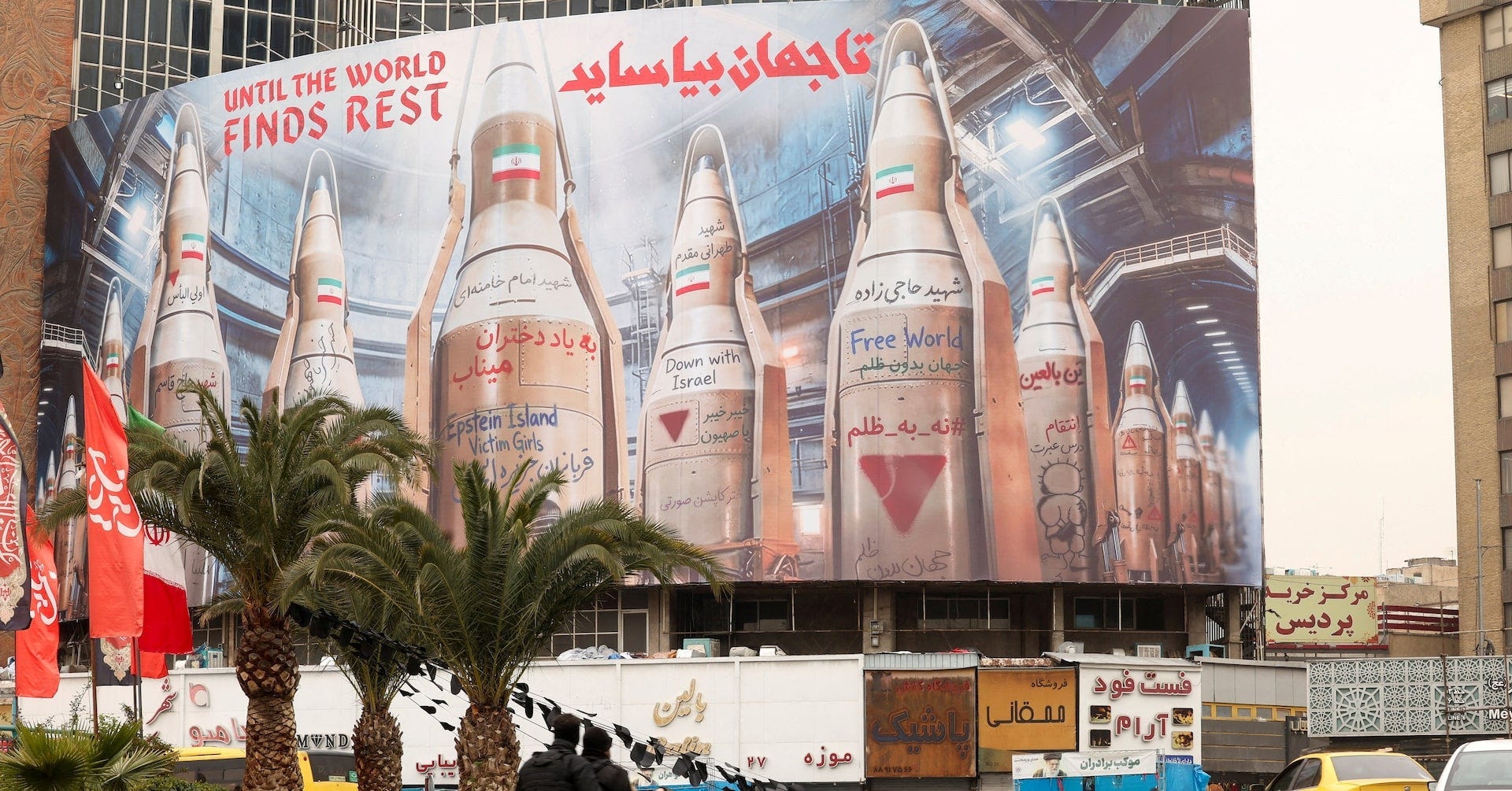
Have a look at the photo above, a billboard recently spotted in Tehran. The red slogan in the center, :ﺗﺎ ﺟﮭﺎن ﺑﯾﺎﺳﺎﯾد , is the Persian translation of the English words, “Until the world finds rest.” The missiles say:
· شهید امام خامنهای — “Martyr Imam Khamenei”
· به یاد دختران میناب — “In memory of the girls of Minab”
· شهید طهرانی مقدم — “Martyr Tehrani Moghaddam”
· شهید حاجیزاده — “Martyr Hajizadeh”
· شهید قاسم — “Martyr Qasem”
· جهان بدون ظلم — “A world without oppression/injustice”
· #نه_به_ظلم — “#No to oppression/injustice”
· انتقام — “Revenge”
· درس عبرت — “A lesson.” (Or “an object lesson” or “a warning”)
“UNTIL THE WORLD FINDS REST” are the most important words on the billboard, and they’re doing enormous theological work. They’re ominous enough on the face of it, but far more so in the context of revolutionary Shia eschatology. The world is restless because injustice reigns, and injustice reigns because the enemies of God and righteousness prevail. The world will only find rest when the Mahdi—the “Rightly Guided One”—returns at the end of history, vanquishing evil and ushering in Islamic rule. The billboard is, therefore, an exhortation to struggle in a conflict that is both cosmically necessary and inevitable. The current war, it suggests, belongs to a struggle that ends only with the eschatological consummation.
“A world without oppression/injustice” is another significant phrase. The Persian-Arabic word ظﻠم (zulm) is richer than the English word “oppression.” It denotes the state of the world under illegitimate rule, which it has been, or so Shiites believe, since the battle of Karbala in 680 CE.... The word zulm connotes tyranny, moral disorder, usurpation, things where they don’t belong.... Within this symbolic world, resistance to zulm is a sacred duty. The Islamic Republic uses this word to describe Israel, the United States, hostile Arab states, and internal dissidents. We are embodiments of zulm.
“Down with Israel” has a specific theological significance. For Khomeneists, Israel’s destruction is an eschatological goal, not just a geopolitical one, because Israel’s destruction is the precondition for the Mahdi’s return. Similarly, اﻧﺗﻘﺎم (revenge) refers to the cosmic settling of accounts that will precede the restoration....
For Shia, martyrs aren’t dead. They testify. Their blood speaks. The blood of the girls of Minab speaks, as Husayn’s blood is said to do. Dead children are testimony against ظﻠم, confirming the righteousness of the cause. The juxtaposition of the Minab girls with the “Epstein Island Victim Girls” is quite theologically precise: For Khomeneists, America isn’t merely the great usurper, it’s also the great corruptor, the emblem of sexual licence and moral subversion. The Epstein saga is proof of this. There is an implicit argument here: “They exploit their girls. We avenge ours.” Similarly, naming weapons for martyrs connects the military project directly to the drama of Karbala. The missiles continue the martyrs’ testimony, proving that the shahids didn’t die for nothing....
“Free World,” of course, is a term from the West’s Cold War vocabulary.... In Khomeneist eyes, this term is one of the most successful pieces of Satanic propaganda ever devised: a slave order that calls itself freedom, a corrupting power that calls itself liberation....
The inverted red triangle is a Hamas symbol: It indicates something marked for destruction. The hashtag before #ﻧﮫ_ﺑﮫ_ظﻠم (“#No to oppression/injustice”) is a sardonic allusion to Western social media culture and the digital vocabulary of liberal activism (#BringBackOurGirls, #StandWithUkraine). The implication is that the Great Satan has seduced the world into thinking that by typing a phrase into a phone, it can rectify injustice. Our اﻧﺗﻘﺎم, this says, is rather more concrete.
The authors of the text on the billboard obviously have a sense of their Western audience. They imagine that they’re speaking to us directly, in our own idiom. We’re meant to understand it. But of course, we don’t. No one in the West pays this kind of thing the slightest bit of attention, and this the strangest aspect of our long conflict with the Islamic Republic. For 47 years, it has made its beliefs and its goals unambiguous. What’s more, the behavior of the regime has been consistent with what it claims to believe. But the West just refuses to take any of this seriously. In all of the reporting you’ve seen on this war, have you seen even one article discussing the Mahdi? I haven’t.
It’s as if, during the Cold War, we simply refused to believe that our adversaries were communists, refused to read a word of Marx, and never once considered that Soviet leaders might be serious about building a socioeconomic order based on the common ownership of the means of production, distribution, and exchange. Imagine trying to figure out what Stalin was doing without understanding the concepts of historical materialism, class war, the dictatorship of the proletariat, the vanguard party, or the laws of revolutionary development. Imagine insisting that Bolshevism was just a decorative vocabulary draped over ordinary Russian nationalism, or a kind of theatrical language no one was meant to take literally.
We never talked ourselves into such stupidity....
Khomeinism instructs Iran’s elites, particularly the [Islamic Revolutionary Guard Corps, IRGC], in the meaning of history. It teaches them that the longed-for redemption of history will emerge, and can only emerge, through struggle, catastrophe, and blood. To ignore all of this isn’t sophistication. It’s just smug illiteracy....
The Islamic Revolutionary Guard Corps is constitutionally and self-consciously the guardian of the revolution’s ideological purity. Khomenei distrusted the regular Iranian army, Artesh; he created the IRGC in 1979 as an explicitly ideological force.... The IRGC has its own seminaries, publishing houses, and theological training programs. Its officers are expected to be ideologically formed, not just militarily trained....
The IRGC’s paramilitary volunteer force, the Basij, is where the ideological formation reaches its most intense expression. The cult of martyrdom that the Basij cultivates goes back to the Iran-Iraq War, when teenage boys were sent across minefields wearing what were said to be the keys to paradise around their necks. This was one of the most important ways Khomeini transformed the Shia theology of martyrdom into a military doctrine. Shahadat (martyrdom) should be sought, not merely borne, because it guarantees the martyr’s place in paradise and advances the revolutionary project simultaneously. This has direct implications for how the IRGC calculates acceptable losses....
Why would a regime facing existential military pressure not seek de-escalation? The rational-actor model predicts accommodation. But for the ideological core of this regime, the current moment may look less like catastrophe than like confirmation, even fulfillment. The chaos, the fires, the confrontation with “Global Arrogance”—within this eschatology, that’s not a mistake.
The second voice that merits attention belongs to Fatima Abo Alasrar, a non-resident fellow at the Arab Gulf States Institute in Washington, DC. She is the founder of The Ideology Machine, a publication on authoritarian information systems. She specializes in Yemen’s conflict dynamics, the Houthi movement, Iranian-aligned networks, and Gulf security. In a recent post she makes the point that “to understand what is happening now, you have to understand the sequence of decisions that made February 28 almost inevitable, because no single one of them was irrational, and yet taken together they produced an outcome that nobody planned and nobody can control.”
For a decade, Tehran armed, funded, and directed networks that hollowed out sovereign states from the inside, and it did so with a patience and discipline that nobody in Washington fully appreciated because Washington only ever looked at Iran through one lens, which was Israel. The impact on Yemen, on Iraq, on Lebanon, on Syria, the slow strangulation of countries that were trying to build something that was never urgent enough to drive American policy. It was background noise.
And behind all of it, there was a larger architecture that is only now becoming visible. Iran was not operating alone. It was operating within a set of relationships with Russia and China that were collectively working to undermine the American-led order, to weaken NATO, to demonstrate that sovereignty was negotiable and that the rules-based system was a fiction maintained by a power that no longer had the will to enforce it. The bitter irony is that the United States is now doing some of that work itself, fraying its own alliances, alienating its own partners, calling NATO allies cowards for refusing to join a war it started without consulting them. The order is being dismantled from both ends, and the people caught in the middle, the Gulf states, the Yemenis, the Iraqis, the Lebanese, are left trying to navigate a world where neither the architects of destruction nor the supposed guarantors of stability can be relied upon....
The IRGC is not the Islamic Republic. It is something older, deeper, and harder to kill.... The assumption in Washington was that decapitation would trigger collapse, or at minimum that it would create an opening for the protest movement to fill. That assumption misunderstands how the Islamic Republic is structured. This is not a regime that depends on a single leader the way a personalist dictatorship does. It is an institutional system with redundancy built into its design. The Supreme Leader matters, but the IRGC, the Guardian Council, the Assembly of Experts, the Basij, the judiciary, the Friday prayer network, these are independent power centers that can operate without central direction for extended periods. The system was designed, consciously and explicitly, to survive decapitation. It was born in a revolution that understood how its predecessor died, and it made sure it would not die the same way.
And here is where the conversation in the West goes wrong, and dangerously so. There is a narrative, amplified by parts of the Iranian diaspora and embraced by many in Washington, that the Islamic Republic is an alien imposition on a society that is fundamentally secular, Western-oriented, and waiting to be freed. I understand why that narrative is appealing. There are millions of Iranians who want the regime gone, and their courage, particularly in the January protests, was extraordinary. But that narrative flattens eighty-eight million people into a single story, and the parts it leaves out are the parts that will determine whether this war produces a transition or a catastrophe.
The IRGC is not a foreign army. It is a domestic institution that employs, directly and indirectly, millions of Iranians. It runs construction companies that build roads and housing. It operates telecommunications networks. It controls significant portions of Iran’s import-export trade. It manages pension funds and charitable foundations. For a large segment of the Iranian population, the IRGC is the employer, the landlord, the social safety net....
The theory was that if you hit the regime hard enough, the people would do the rest, and the regime has been hit, and the Supreme Leader is dead, and the air defenses are gone, and the regime is still there, because it was never just a man or a building, it was a system, and systems do not fall the way buildings do. I have no illusions about the IRGC, because I watch its smaller version in Yemen every day. The Houthis built theirs in ten years and it is already too deep to pull out by the roots, and the IRGC has had forty. If the system cannot be destroyed from the air, and it cannot, then the question of what comes after requires a coherent answer. It has been asked. It has been answered differently every week....
There is a painful irony that Gulf analysts are noting quietly: the Gulf states had spent years working toward de-escalation with Tehran, including the 2023 Saudi-Iran rapprochement brokered by Beijing, and all of that diplomatic investment has been destroyed not by anything the Gulf did, but by a war launched by their own security partner without their consultation....
[Abbas] Araghchi’s formulation, that the Strait of Hormuz is “open, but closed to our enemies,” is not a casual statement. It is a strategic instrument. It tells the Gulf: your problem is not Iran. Your problem is your association with the United States. Distance yourself and the pain stops. That is the most dangerous proposition in this entire conflict, not because the Gulf will accept it, but because the logic behind it will become more attractive with every day that the American commitment looks fragile and the European commitment looks nonexistent....
Everything I have described converges at the Strait of Hormuz, because the strait is where the military conflict, the energy crisis, and the political sustainability of this war all meet. Before this war, twenty million barrels of oil passed through Hormuz every day. Twenty percent of global LNG. Six hundred billion dollars in annual energy trade. The strait was governed by the UN Convention on the Law of the Sea, which guarantees the right of transit passage through international straits. That legal framework, and the American naval presence that enforced it, was the invisible foundation of the global energy market. It was so stable that the world stopped pricing the risk. The most load-bearing assumptions in any international order are the ones that nobody examines until they fail....
But here is something that other analysts have noted and that is important because it could easily be missed in the coverage of daily strikes and price movements. The strait did not close because of a naval blockade. It closed because of insurance.... Insurance, a mechanism that exists entirely outside the traditional military balance, became the instrument that shut down twenty percent of global oil trade. That is a form of power that is new, and we do not yet have a framework for managing it.
According to Lloyd’s List and the Financial Times, the IRGC has established what it describes as a safe maritime corridor through Iranian territorial waters. Vessels that submit to IRGC vetting, registration, and approval can transit. The reported price is up to two million dollars per vessel, paid in cash, cryptocurrency, or barter. Between March 1 and 15, roughly ninety ships cleared the strait under IRGC clearance. The payments are being made. The commercial precedent is established. The IRGC verifies clearances over VHF radio. Multiple governments, including India, Pakistan, Iraq, Malaysia, and China, are negotiating transit arrangements directly with Tehran.
I want to be precise about what this represents, because it is easy to dismiss as extortion and miss the logic behind it.... Iran is simultaneously attacking ships that transit without permission and charging ships that ask for it. It has effectively turned a waterway governed by international law into a toll road. And the dilemma this creates is one that no capital has solved. Sanctioning the operators who pay the IRGC toll means shutting down the only active oil supply channel through the strait. The extortion is also the lifeline....
The problem is that the American system evaluates threats on short timelines and authoritarians plan on long ones, and that mismatch is how you end up surprised by things that were visible for a decade....
Iran’s theory of victory was never military. It was always political. Tehran cannot defeat the United States Air Force. It can make the war expensive enough, long enough, that American domestic politics does the work. Every day the strait stays closed, gas prices climb. Every day gas prices climb, the political coalition behind the war erodes. Every day the coalition erodes, the probability that Washington will seek an exit increases. And every day that passes without an exit, the IRGC’s toll regime on Hormuz becomes more entrenched, more normalized, and harder to reverse. The question is not who has more firepower. It is whose political tolerance for pain runs out first. This is a contest of endurance disguised as a military conflict, and the outcome will be shaped less by what happens over Iranian airspace than by what happens in American living rooms, European energy markets, and Gulf foreign ministries....
The people absorbing that damage are also the people who still control the guns, the institutions, and the economic networks that make the IRGC indispensable to millions of Iranians. They have everything to lose, and that makes them more dangerous, not less. The Iranian public has not been able to rise at this moment, and until they can, the IRGC will be left standing, weaker and more paranoid but standing.... That is the paradox of successful decapitation in the absence of strategy, and we are not learning from it.
The third voice to which we ought to lend an ear is that of Wajeeh Lion, a Saudi-American, Minneapolis-based human rights activist, journalist, and international geopolitical analyst. In a recent post he explains the working of the military apparatus of Iran.
The military apparatus of the Islamic Republic of Iran—most notably the Islamic Revolutionary Guard Corps (IRGC) and its paramilitary branches—operates on a foundation vastly different from conventional Western militaries. Instead of relying solely on material superiority or secular nationalism, the Iranian armed forces weave together Twelver Shia theology, pre-Islamic Persian martial traditions, and modern revolutionary symbolism. This unique blend forges an unyielding psychological readiness for battle.
By transforming the kinetic battlefield into a sacred space, Iran effectively immunizes its combatants against the psychological friction of war. Physical death is reframed: it is no longer seen as a tragic loss, but as a victorious, eschatological transition to a divine state.
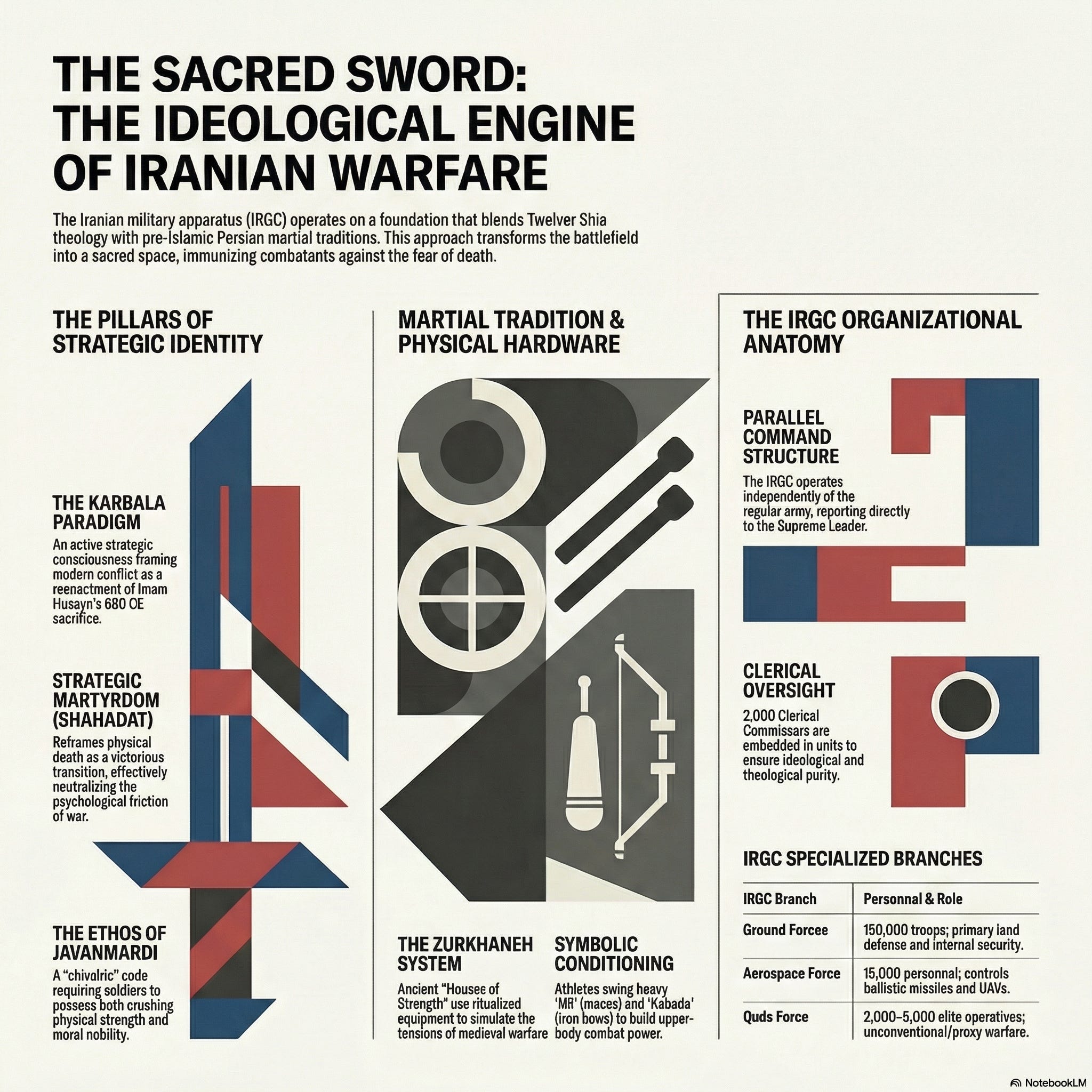
At the heart of this mobilization is the seamless blending of Islamic martyrdom culture with ancient Persian heroic traditions. Through orchestrated communal prayers, rhythmic eulogies, and grueling physical rituals, the Iranian state bridges the gap between the seventh century and today’s geopolitical conflicts. Martyrdom (Shahadat) becomes a proactive, strategic tool that drives unit cohesion and ideological loyalty, presenting a military force where religious purpose and operational doctrine are indistinguishable.
To understand the psychological endurance of Iranian forces, one must look to the “Karbala paradigm,” the absolute epicenter of Shia political and military identity. This paradigm is anchored in the events of 680 CE, when Imam Husayn (the grandson of the Prophet Muhammad) and seventy-two companions were surrounded and slaughtered by the superior forces of the Umayyad Caliph Yazid in the desert of Karbala. Denied water and food for days, Husayn refused to pledge allegiance to a tyrant. On the tenth day of the month of Muharram, known as Ashura, he and his followers were killed in a brutal final stand.
In the Iranian strategic consciousness, Karbala is not a static historical tragedy; it is an active, ongoing reality. During the 1979 Islamic Revolution, figures like Ayatollah Ruhollah Khomeini and sociologist Ali Shariati weaponized this memory. Shariati redefined martyrdom from a passive tragedy into an active “involvement”—a conscious choice and a divine medal of honor.
During the devastating Iran-Iraq War (1980–1988), dubbed the “Sacred Defense,” this paradigm was mobilized on a massive scale. Ayatollah Khomeini framed the conflict as a cosmic reenactment of Karbala. Iraqi President Saddam Hussein was cast as the modern-day Yazid, while young Iranian volunteers were positioned as the righteous followers of Imam Husayn. Frontline trenches were officially called “Husayn’s front,” bullets were “ambassadors of monotheism,” and state propaganda depicted ancient martyrs carrying fallen soldiers to paradise. This visual and ideological saturation completely dissolved the human fear of death....
While Shia theology provides the spiritual software, Iran’s physical and moral hardware is deeply rooted in ancient Persian martial traditions. The institution of the Zurkhaneh (“House of Strength”) and the practice of Varzesh-e Bastani (Ancient Sport) are heavily integrated into the IRGC’s physical education and combat training programs.... The physical conditioning uses equipment deliberately designed to mimic ancient warfare. Athletes swing the Mil, massive, club-like wooden weights that build immense upper body strength, symbolizing the devastating striking power of the ancient Persian heavy cavalry mace. They also use the Kabada, a heavy iron chain connecting a rigid metal bow structure; rattling and shifting this overhead simulates the extreme tension required to draw a war bow. To build the strength needed to fend off battlefield blows, athletes lie in a supine position and press the Sang—enormous wooden panels weighing up to 80 kilograms that act as a surrogate for heavy shields.
These exercises are dictated by the rhythm of a master (morshed) who beats a drum and chants epic poetry from Ferdowsi’s Shahnameh, intertwined with religious verses praising Imam Ali. This creates a hypnotic, moving meditation. The paramount virtue cultivated here is Javanmardi (chivalry or spiritual nobility). A true champion (pahlevan) must possess crushing physical strength to fight enemies, alongside moral fortitude to defend the weak and support the community. By immersing soldiers in this environment, the Iranian military psychologically armors them with a dual legacy: they are simultaneously mythological Persian warriors and righteous Shia soldiers.
The translation of these rituals into effective military statecraft is managed by the highly sophisticated command structure of the IRGC. Founded in 1979 to protect the revolution, the IRGC operates parallel to, but completely separate from, the conventional Iranian army (the Artesh), ensuring ideological purity.
The IRGC commands an estimated 190,000 active personnel distributed across five highly specialized branches. The Ground Forces, comprising roughly 150,000 active troops, serve as the primary land army responsible for territorial defense and internal security. The Aerospace Force, with about 15,000 personnel, controls Iran’s strategic arsenal of ballistic missiles, UAVs, and air defense systems. In the Persian Gulf and the Strait of Hormuz, the Navy (NEDSA) utilizes its 20,000 personnel (including Marines) to execute asymmetric, fast-attack warfare. Domestically, the Basij paramilitary force maintains 40,000 active members—with hundreds of thousands more mobilizable—to manage internal security, morality policing, and wartime mobilization. Finally, the elite Quds Force, consisting of 2,000 to 5,000 operatives, handles extraterritorial unconventional warfare, proxy training, and foreign intelligence.
What makes the IRGC distinctly effective is its unique “by-pass” oversight mechanism. IRGC commanders bypass the standard military chain of command and report directly to the Supreme Leader. Furthermore, an extensive network of approximately 2,000 Clerical Commissars is embedded within every unit and base. Operating under the Supreme Leader’s direct supervision, these commissars ensure that the recitation of prayers, the organization of mourning gatherings, and the Karbala paradigm remain the primary drivers of all tactical decision-making.
Because the Iranian state is fundamentally driven by the IRGC’s revolutionary ambitions, its international behavior relies heavily on theological mechanisms to manage escalation and confuse adversaries.... This doctrinal flexibility allows the IRGC to balance the uncompromising rhetoric of martyrdom with highly calculated asymmetric deterrence. The goal is not necessarily to win a conventional war against a technologically superior adversary, but to deter aggression by presenting the threat of a maximum retaliatory price. A force immunized against the fear of death, physically hardened by ancient traditions, and prepared to inflict catastrophic damage via proxy networks cannot be easily coerced by the mere threat of kinetic force.
The exhaustive integration of Shia mourning rituals, liturgical recitation, and ancient Persian athletic traditions yields a profound strategic advantage for Iran. By weaponizing historical grief, the state continuously replenishes its ideological reserves. By incorporating ancient athletic rituals, it ensures that soldiers’ physical conditioning perfectly mirrors their ideological conditioning. And by mapping contemporary adversaries onto the ancient archetypes of Karbala, the IRGC insulates its proxy wars from domestic fatigue.
The battle readiness and strategic endurance of the Iranian Shia soldier cannot be quantified simply by counting ballistic missiles or troop numbers. To understand or deter the military maneuvers of the Islamic Republic, one must first understand the psychological and theological engine that drives it: the recitation of the Ziyarat Ashura, the cadence of the eulogist, the legacy of Karbala, and the chivalric ethos of the Zurkhaneh.
Since this article went online, Waajeh Lion has published a string of posts that provide more valuable insights. Together with Malcolm Nance and Jacob Kaarsbo he publishes a highly informative—and I dare say entertaining— daily US-Iran war cast, which is now also available as a podcast.
No posts
Comments
Nothing yet. Say the first thing.
Sign in to join the conversation.