
The traditions of the past are very great in their own place—in the past; but I do not see why we should merely repeat them and not go farther. In the spiritual development of the consciousness upon earth the great past ought to be followed by a greater future. — Sri Aurobindo, Letters on Yoga—II, p. 480.
In reply to a comment to my last piece by AI (his initials, not an alien intelligence), I posted passages from Chapter VIII of Book 1 of Sri Aurobindo’s The Life Divine, titled “The Methods of Vedantic Knowledge.” Re-reading the chapter and AI’s reply, I was struck again by Sri Aurobindo’s use of the wisdom of ancient scripture (notably the Rig Veda, the Upanishads, and the Bhagavad Gita), a wisdom which had lain buried under layers of increasingly shallow partisan readings, and which Sri Aurobindo did more than anybody else to uncover and make intelligible to the oh so enlightened modern mind. To him these scriptures were steppingstones, which he treated with the deep respect that one owes to steppingstones. His purpose was to build something new, and not just a wider knowledge for knowledge’s sake but a vaster vision for a greater being. As he wrote in the Arya (issue of November 1918),
Knowledge does not end with knowing, nor is it pursued and found for the sake of knowing alone. It has its full value only when it leads to some greater gain than itself, some gain of being.... A greater knowledge opens the possibility and, if really possessed, brings the actuality of a greater being. [Kena and Other Upanishads, p. 154.]
Moreover, and conversely, the value of a knowledge systems depends on the purpose it serves. In describing the system of supraphysical worlds, for example, Sri Aurobindo stated explicitly that he followed “consistently the Vedic and Vedantic arrangement of which we find the great lines in the Upanishads, first because it seems to me at once the simplest and most philosophical and more especially because it was from the beginning envisaged from the point of view of the utility of these various planes to the supreme object of our liberation” [The Synthesis of Yoga, p. 448].
What follows are excerpts from “The Methods of Vedantic Knowledge.” These should be required reading for those advocates of spirituality who, seeing our contemporary knowledge—our knowing more and more about less and less—as a loss, plead for a return to a supposedly wiser past.
In reality, all experience is in its secret nature knowledge by identity; but its true character is hidden from us because we have separated ourselves from the rest of the world by exclusion, by the distinction of ourself as subject and everything else as object, and we are compelled to develop processes and organs by which we may again enter into communion with all that we have excluded. We have to replace direct knowledge through conscious identity by an indirect knowledge which appears to be caused by physical contact and mental sympathy. This limitation is a fundamental creation of the ego and an instance of the manner in which it has proceeded throughout, starting from an original falsehood and covering over the true truth of things by contingent falsehoods which become for us practical truths of relation.
From this nature of mental and sense knowledge as it is at present organised in us, it follows that there is no inevitable necessity in our existing limitations. They are the result of an evolution in which mind has accustomed itself to depend upon certain physiological functionings and their reactions as its normal means of entering into relation with the material universe. Therefore, although it is the rule that when we seek to become aware of the external world, we have to do so indirectly through the sense-organs and can experience only so much of the truth about things and men as the senses convey to us, yet this rule is merely the regularity of a dominant habit. It is possible for the mind—and it would be natural for it, if it could be persuaded to liberate itself from its consent to the domination of matter—to take direct cognisance of the objects of sense without the aid of the sense-organs.... Because our waking consciousness is determined and limited by the balance between mind and matter worked out by life in its evolution, this direct cognisance is usually impossible in our ordinary waking state and has therefore to be brought about by throwing the waking mind into a state of sleep which liberates the true or subliminal mind. Mind is then able to assert its true character as the one and all-sufficient sense and free to apply to the objects of sense its pure and sovereign instead of its mixed and dependent action. Nor is this extension of faculty really impossible but only more difficult in our waking state—as is known to all who have been able to go far enough in certain paths of psychological experiment....
If then we can extend our faculty of mental self-awareness to awareness of the Self beyond and outside us, Atman or Brahman of the Upanishads, we may become possessors in experience of the truths which form the contents of the Atman or Brahman in the universe. It is on this possibility that Indian Vedanta has based itself. It has sought through knowledge of the Self the knowledge of the universe.
But always mental experience and the concepts of the reason have been held by it to be even at their highest a reflection in mental identifications and not the supreme self-existent identity. We have to go beyond the mind and the reason. The reason active in our waking consciousness is only a mediator between the subconscient All that we come from in our evolution upwards and the superconscient All towards which we are impelled by that evolution. The subconscient and the superconscient are two different formulations of the same All. The master-word of the subconscient is Life, the master-word of the superconscient is Light. In the subconscient knowledge or consciousness is involved in action, for action is the essence of Life. In the superconscient action re-enters into Light and no longer contains involved knowledge but is itself contained in a supreme consciousness. Intuitional knowledge is that which is common between them and the foundation of intuitional knowledge is conscious or effective identity between that which knows and that which is known; it is that state of common self-existence in which the knower and the known are one through knowledge. But in the subconscient the intuition manifests itself in the action, in effectivity, and the knowledge or conscious identity is either entirely or more or less concealed in the action. In the superconscient, on the contrary, Light being the law and the principle, the intuition manifests itself in its true nature as knowledge emerging out of conscious identity, and effectivity of action is rather the accompaniment or necessary consequent and no longer masks as the primary fact. Between these two states reason and mind act as intermediaries which enable the being to liberate knowledge out of its imprisonment in the act and prepare it to resume its essential primacy. When the self-awareness in the mind applied both to continent and content, to own-self and other-self, exalts itself into the luminous self-manifest identity, the reason also converts itself into the form of the self-luminous intuitional1 knowledge. This is the highest possible state of our knowledge when mind fulfils itself in the supramental.
Such is the scheme of the human understanding upon which the conclusions of the most ancient Vedanta were built.
To develop the results arrived at on this foundation by the ancient sages is not my object, but it is necessary to pass briefly in review some of their principal conclusions so far as they affect the problem of the divine Life with which alone we are at present concerned. For it is in those ideas that we shall find the best previous foundation of that which we seek now to rebuild and although, as with all knowledge, old expression has to be replaced to a certain extent by new expression suited to a later mentality and old light has to merge itself into new light as dawn succeeds dawn, yet it is with the old treasure as our initial capital or so much of it as we can recover that we shall most advantageously proceed to accumulate the largest gains in our new commerce with the ever-changeless and ever-changing Infinite.
Sad Brahman, Existence pure, indefinable, infinite, absolute, is the last concept at which Vedantic analysis arrives in its view of the universe, the fundamental Reality which Vedantic experience discovers behind all the movement and formation which constitute the apparent reality. It is obvious that when we posit this conception, we go entirely beyond what our ordinary consciousness, our normal experience contains or warrants. The senses and sense-mind know nothing whatever about any pure or absolute existence.... At the most in the phenomenon of self-awareness or behind it, we get sometimes a glimpse of something immovable and immutable, something that we vaguely perceive or imagine that we are beyond all life and death, beyond all change and formation and action. Here is the one door in us that sometimes swings open upon the splendour of a truth beyond and, before it shuts again, allows a ray to touch us—a luminous intimation which, if we have the strength and firmness, we may hold to in our faith and make a starting-point for another play of consciousness than that of the sense-mind, for the play of Intuition.
For if we examine carefully, we shall find that Intuition is our first teacher. Intuition always stands veiled behind our mental operations. Intuition brings to man those brilliant messages from the Unknown which are the beginning of his higher knowledge. Reason only comes in afterwards to see what profit it can have of the shining harvest. Intuition gives us that idea of something behind and beyond all that we know and seem to be which pursues man always in contradiction of his lower reason and all his normal experience and impels him to formulate that formless perception in the more positive ideas of God, Immortality, Heaven and the rest by which we strive to express it to the mind. For Intuition is as strong as Nature herself from whose very soul it has sprung and cares nothing for the contradictions of reason or the denials of experience. It knows what is because it is, because itself it is of that and has come from that, and will not yield it to the judgment of what merely becomes and appears. What the Intuition tells us of, is not so much Existence as the Existent, for it proceeds from that one point of light in us which gives it its advantage, that sometimes opened door in our own self-awareness. Ancient Vedanta seized this message of the Intuition and formulated it in the three great declarations of the Upanishads, “I am He”, “Thou art That, O Swetaketu”, “All this is the Brahman; this Self is the Brahman”.
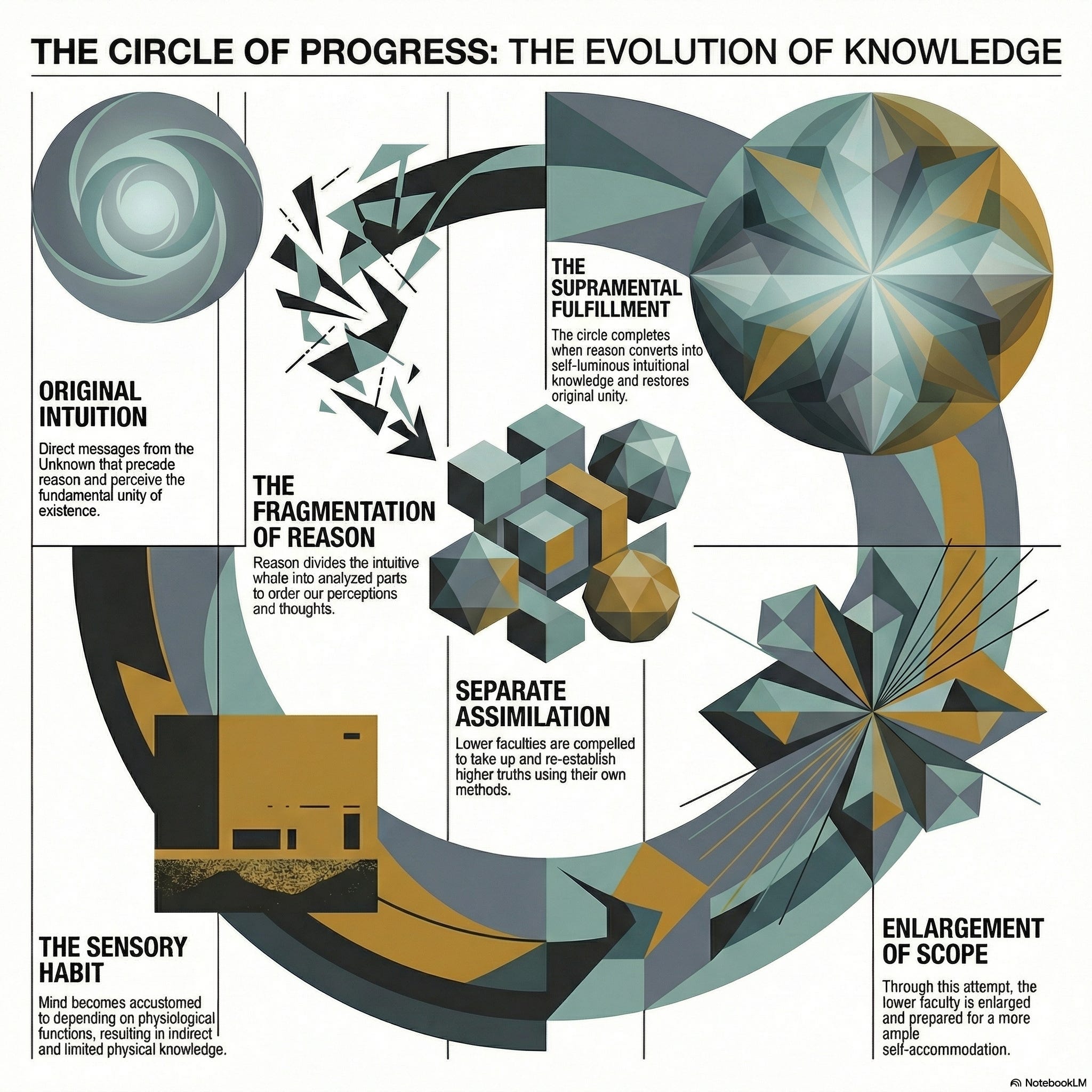
But Intuition by the very nature of its action in man, working as it does from behind the veil, active principally in his more unenlightened, less articulate parts, served in front of the veil, in the narrow light which is our waking conscience, only by instruments that are unable fully to assimilate its messages—Intuition is unable to give us the truth in that ordered and articulated form which our nature demands. Before it could effect any such completeness of direct knowledge in us, it would have to organise itself in our surface being and take possession there of the leading part. But in our surface being it is not the Intuition, it is the Reason which is organised and helps us to order our perceptions, thoughts and actions. Therefore the age of intuitive knowledge, represented by the early Vedantic thinking of the Upanishads, had to give place to the age of rational knowledge; inspired Scripture made room for metaphysical philosophy, even as afterwards metaphysical philosophy had to give place to experimental Science. Intuitive thought which is a messenger from the superconscient and therefore our highest faculty, was supplanted by the pure reason which is only a sort of deputy and belongs to the middle heights of our being; pure reason in its turn was supplanted for a time by the mixed action of the reason which lives on our plains and lower elevations and does not in its view exceed the horizon of the experience that the physical mind and senses or such aids as we can invent for them can bring to us.
And this process which seems to be a descent, is really a circle of progress. For in each case the lower faculty is compelled to take up as much as it can assimilate of what the higher had already given and to attempt to re-establish it by its own methods. By the attempt it is itself enlarged in its scope and arrives eventually at a more supple and a more ample self-accommodation to the higher faculties. Without this succession and attempt at separate assimilation we should be obliged to remain under the exclusive domination of a part of our nature while the rest remained either depressed and unduly subjected or separate in its field and therefore poor in its development. With this succession and separate attempt the balance is righted; a more complete harmony of our parts of knowledge is prepared.
We see this succession in the Upanishads and the subsequent Indian philosophies. We see this succession in the Upanishads and the subsequent Indian philosophies. The sages of the Veda and Vedanta relied entirely upon intuition and spiritual experience. It is by an error that scholars sometimes speak of great debates or discussions in the Upanishad. Wherever there is the appearance of a controversy, it is not by discussion, by dialectics or the use of logical reasoning that it proceeds, but by a comparison of intuitions and experiences in which the less luminous gives place to the more luminous, the narrower, faultier or less essential to the more comprehensive, more perfect, more essential. The question asked by one sage of another is “What dost thou know?”, not “What dost thou think?” nor “To what conclusion has thy reasoning arrived?” Nowhere in the Upanishads do we find any trace of logical reasoning urged in support of the truths of Vedanta. Intuition, the sages seem to have held, must be corrected by a more perfect intuition; logical reasoning cannot be its judge.
And yet the human reason demands its own method of satisfaction. Therefore when the age of rationalistic speculation began, Indian philosophers, respectful of the heritage of the past, adopted a double attitude towards the Truth they sought. They recognised in the Sruti, the earlier results of Intuition or, as they preferred to call it, of inspired Revelation, an authority superior to Reason. But at the same time they started from Reason and tested the results it gave them, holding only those conclusions to be valid which were supported by the supreme authority. In this way they avoided to a certain extent the besetting sin of metaphysics, the tendency to battle in the clouds because it deals with words as if they were imperative facts instead of symbols which have always to be carefully scrutinised and brought back constantly to the sense of that which they represent. Their speculations tended at first to keep near at the centre to the highest and profoundest experience and proceeded with the united consent of the two great authorities, Reason and Intuition. Nevertheless, the natural trend of Reason to assert its own supremacy triumphed in effect over the theory of its subordination. Hence the rise of conflicting schools each of which founded itself in theory on the Veda and used its texts as a weapon against the others. For the highest intuitive Knowledge sees things in the whole, in the large and details only as sides of the indivisible whole; its tendency is towards immediate synthesis and the unity of knowledge. Reason, on the contrary, proceeds by analysis and division and assembles its facts to form a whole; but in the assemblage so formed there are opposites, anomalies, logical incompatibilities, and the natural tendency of Reason is to affirm some and to negate others which conflict with its chosen conclusions so that it may form a flawlessly logical system. The unity of the first intuitional knowledge was thus broken up and the ingenuity of the logicians was always able to discover devices, methods of interpretation, standards of varying value by which inconvenient texts of the Scripture could be practically annulled and an entire freedom acquired for their metaphysical speculation.
Nevertheless, the main conceptions of the earlier Vedanta remained in parts in the various philosophical systems and efforts were made from time to time to recombine them into some image of the old catholicity and unity of intuitional thought. And behind the thought of all, variously presented, survived as the fundamental conception, Purusha, Atman or Sad Brahman, the pure Existent of the Upanishads, often rationalised into an idea or psychological state, but still carrying something of its old burden of inexpressible reality. What may be the relation of the movement of becoming which is what we call the world to this absolute Unity and how the ego, whether generated by the movement or cause of the movement, can return to that true Self, Divinity or Reality declared by the Vedanta, these were the questions speculative and practical which have always occupied the thought of India.
I use the word “intuition” for want of a better. In truth, it is a makeshift and inadequate to the connotation demanded of it. The same has to be said of the word “consciousness” and many others which our poverty compels us to extend illegitimately in their significance.
No posts
Comments
Nothing yet. Say the first thing.
Sign in to join the conversation.