
Mr Global about himself: I have spent my life in the oil and gas industry and became a formally appointed industry expert in 2019. I have now dedicated my time to educating the public about oil and gas and all other forms of energy, but most importantly, telling people the truth about what is happening. The politicians and the media keep you in the dark and lie to you daily about all things energy. This is what inspired me to do what I do now full-time. As you might imagine, my efforts to tell the truth about oil and gas have not been received well by many in my industry. Due to the litigious nature of our business, we have operated under a great deal of secrecy for decades. As such, I have had to sacrifice a great deal to continue doing this. That’s okay. Everything I have said about oil and gas is easily verifiable. While some in my industry are super supportive, many are not, and this has cost me an untold number of opportunities. That’s okay, too. I would never change my decision for a second.
Below are two reports. The first was created by NotebookLM on the basis of the transcript of this video. The second was created by NotebookLM on the basis of this transcript plus the transcripts of the following two videos:
Watching people wave flags and cheer as massive energy tankers line up in U.S. ports is, quite frankly, frightening. To the casual observer, these ships represent a visual signal of American strength and energy abundance—a sign that relief is on the way to lower the prices that are strangling your household budget. We’ve been conditioned to view a busy port as a win for the home team. But there is a staggering curiosity gap between that patriotic imagery and the cold, hard market reality. While the crowds are celebrating, they are missing a detail that is as clear as day to anyone who actually understands the supply chain: those ships aren’t here to fill our tanks. They are here to empty our reserves. This is a staggering display of economic illiteracy. What you’re actually cheering for is the sound of your own financial security being shipped to the highest bidder overseas.
When a tanker docks, the average person assumes it’s bringing crude oil in to bolster our domestic supply. The reality is the exact opposite, and it’s a punch to the gut of the American consumer. While there’s some crude moving, these ships are primarily here to load up on finished products: diesel, jet fuel, and gasoline. These are the exact refined fuels where global shortages are most acute. It is deeply counter-intuitive for the average citizen to realize that a bustling port actually signifies a drain on domestic availability, but that is the “insider” truth. We are watching the lifeblood of our economy being siphoned off and sent away, yet we treat the spectacle like a victory parade.
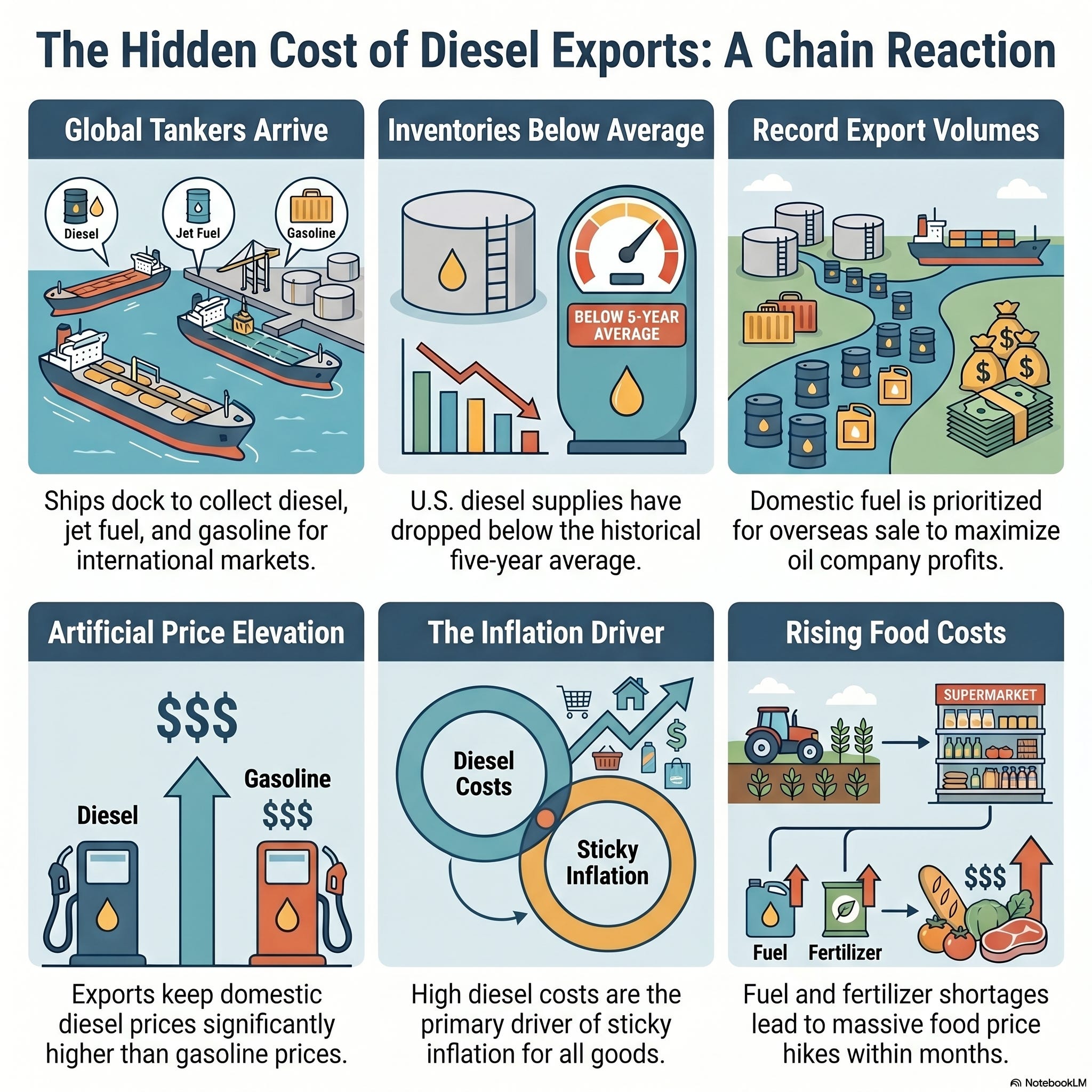
There is a direct, undeniable link between this export obsession and the “sticky” inflation that keeps your grocery and utility bills at record highs. The United States has a chronic, systemic problem with exporting excessive amounts of diesel. By prioritizing the global market over domestic stability, we are intentionally keeping our own prices artificially high. This is why inflation feels impossible to beat. Diesel is the primary engine of the global supply chain; when it stays expensive, every single thing it touches—from the field to the shelf—stays expensive. We aren’t just “participating” in the global market; we are sacrificing the American consumer to fatten the margins of energy giants. Diesel prices are one of the largest drivers of inflation, food inflation, just normal goods. And we keep it artificially elevated in the United States to enrich oil companies who sell diesel overseas. By facilitating these record-breaking export levels, our policy-makers are effectively choosing to enrich oil companies at the direct expense of your purchasing power.
The most alarming part of this export surge is the sheer recklessness of the timing. Currently, U.S. diesel inventories are sitting well below the 5-year average. We aren’t exporting from a position of abundance or surplus; we are exporting from a position of depletion. The irony here is almost too much to bear. While the public obsesses over headlines about Iranian oil—a country we don’t even import from—they are cheering for the very ships that are siphoning away the fuel that keeps our own economy afloat. Do you want to know why diesel is currently $1.50 a gallon more than gasoline? Look at the docks. We are intentionally draining our reserves to hit record export numbers while our own domestic supply is in the red. This isn’t just a market trend; it’s a policy that ensures you pay a premium for every good transported across this country.
This crisis doesn’t exist in a vacuum. It is converging with a disaster in the agricultural sector to create a “double whammy” that is going to hit your kitchen table with a vengeance. At the same time we are draining our diesel supply, fertilizer prices have hit prohibitive levels and shortages are becoming widespread. This combination—sky-high fuel costs to run farms and transport goods, paired with scarce, expensive fertilizer—is a ticking time bomb. We are looking at a 3-to-4-month window before these factors converge. When they do, the “celebration” at the ports is going to look like a bitter joke. Celebrating the fact that you’re going broke and you don’t even know it.
In a few months, when the costs are reflected on every receipt and you’re wondering where your paycheck went, you’ll look back at these tankers and see them for what they really are. By then, the ships will be long gone, and the American consumer will be left picking up the tab. I’m telling you what’s coming before it hits the headlines; when it finally does, you’ll realize this was the warning you should have heeded. And for the thousandth time you will say, “Holy ###, he was right.”
1. The Disconnect Between Political Rhetoric and Operational Reality
In the high-stakes theater of global energy, trust is the fundamental currency upon which stable markets and supply chains are constructed. When a widening chasm emerges between diplomatic pronouncements and the physical movement of cargo, the resulting “trust deficit” destabilizes price discovery and disrupts critical supply corridors. Currently, the Strait of Hormuz—the world’s primary maritime choke point—is characterized by an acute disconnect where political signaling attempts to mask a profound breakdown in operational security. Markets do not respond to aspirations; they respond to the verifiable confidence that a vessel can transit a waterway without the risk of seizure or destruction.
The following table illustrates the divergence between official signaling and the ground truth as of May 2026:
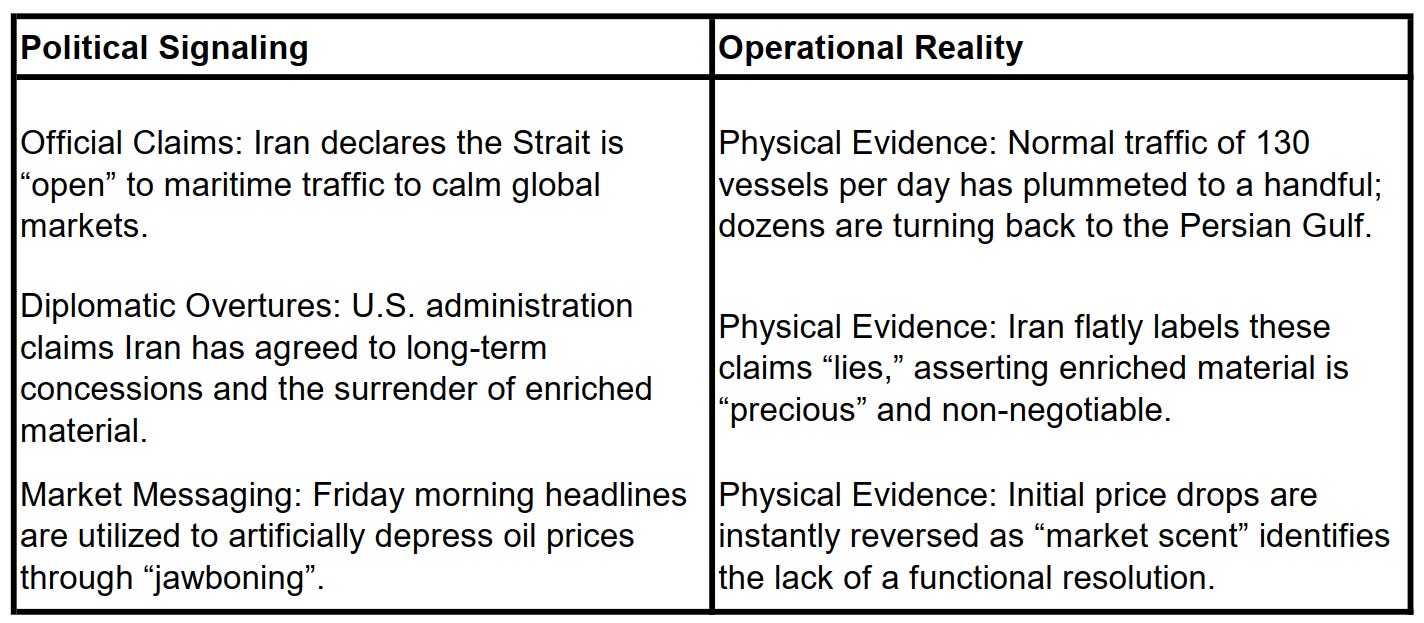
This instability is aggravated by uncoordinated “jawboning” tactics from both administrations. The U.S. administration’s penchant for claiming immediate diplomatic victories is met with Iranian assertions that the Strait is not run in “cyberspace” but in the “physical world”. This messaging friction prevents the stabilization of oil prices, as insurance markets and shipping conglomerates refuse to base multi-billion dollar risks on contradictory political theater.
2. Physical and Structural Barriers to Maritime Transit
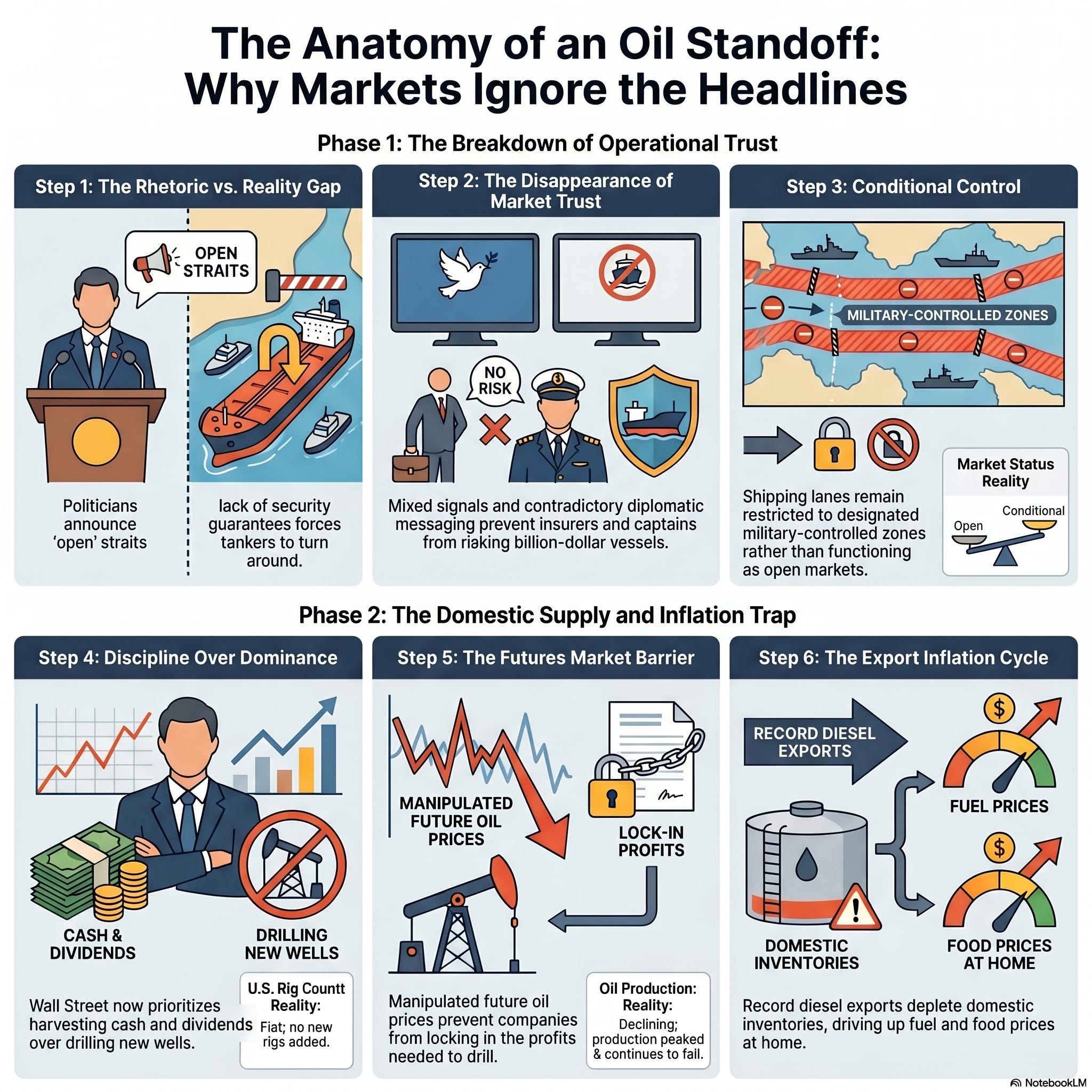
A “political opening” is functionally irrelevant in the absence of a stable military and insurance environment. Maritime control is a physical reality, and the current mechanics of transit are governed by imminent threat rather than diplomatic treaty. Every tanker captain is currently facing a “billion-dollar gamble,” forced to risk crew and cargo in a corridor where the rules of engagement are entirely opaque. The physical risks preventing the resumption of normal transit include:
● The U.S. Naval Blockade: Despite claims of an open waterway, the U.S. continues to enforce a naval blockade. Iran maintains that the Strait is operationally closed so long as this blockade remains in place.
● Revolutionary Guard Oversight: Iran has mandated that all passing vessels receive direct approval from the Revolutionary Guard and utilize designated lanes under their control, effectively turning a global waterway into a restricted military zone.
● Tactical Risks: The environment remains lethal. Hazards include the documented presence of mines, the threat of missile strikes, and the persistent risk of vessel seizure.
● The Monday Ceasefire Deadline: The current transit window is temporary. The existing ceasefire is scheduled to expire this coming Monday, meaning any perceived “opening” is a fleeting pause rather than a systemic restoration of trade.These physical risks necessitate security guarantees that cannot be provided by social media declarations or diplomatic “words” alone. Consequently, the financial markets have begun to price in a prolonged state of maritime paralysis.
3. Financial Market Volatility and the Manipulation Layer
Professional traders and sovereign risk analysts prioritize “market scent” over political headlines. While announcements may trigger short-term algorithmic price drops, the physical-political disconnect forces prices back up as the lack of operational progress becomes undeniable. This volatility is further compounded by clear indicators of market manipulation.
● The “Pump and Dump” Indicators: Data suggests a significant $750–$ 800 million oil short occurred immediately prior to recent “calming” headlines. This indicates that specific actors are capitalizing on the predictable cycle of administrative messaging to profit from manufactured price swings.
● Price Signal Inversion: A stark contradiction exists between physical oil prices and the futures market. While physical prices remain high due to scarcity and risk, the futures market has been depressed, creating a structural inhibitor to long-term investment.
● Regulatory Skepticism: While the Federal Commodities Trading Commission (CFTC) has announced an investigation into this manipulation, there is profound skepticism regarding the administration’s willingness to regulate its own messaging environment. This “high-stakes game of chicken” between the U.S. and Iran—where the U.S. attempts to apply pressure without triggering escalation—creates a noise-filled environment that obscures fundamental price discovery.
4. The U.S. Energy Sector: Discipline Over Dominance
Despite record-high price signals that would historically trigger a domestic drilling boom, the U.S. energy sector has remained unresponsive. Rig counts have not increased since the onset of the conflict, signaling a transition from “growth at all costs” to a framework of strict “financial discipline”. The structural reasons for this refusal to expand include:
The Wall Street “Leash”: Traditional “oil men” have been largely superseded by financial managers who prioritize shareholder primacy. Capital allocation frameworks now favor returning cash to shareholders via dividends and buybacks over aggressive production expansion.
The Futures Market Barrier: To initiate new drilling, companies require the ability to “hedge” production. The May 2027 futures contract (currently one year away) is trading below $65—a price point that fails to provide the guaranteed returns necessary for Wall Street to approve new rigs.
Production Decline: U.S. oil production peaked in September and has maintained a steady decline for six consecutive months. Furthermore, there is a deep-seated distrust of the administration’s energy messaging. The industry views “Energy Dominance” as a political narrative contradicted by the President’s own actions, such as requesting production increases from OPEC. This idiosyncratic political risk discourages long-term domestic expansion.
5. Downstream Consequences: Supply Chains and Inflationary Pressure
The domestic energy landscape is currently defined by an irrational systemic contradiction: the U.S. is exporting record volumes of diesel, jet fuel, and gasoline while domestic inventories remain critically low. This strategy prioritizes the enrichment of energy majors over the stability of the domestic consumer.
● Diesel Inventory Shortages: Domestic diesel levels are currently trending well below the five-year average.
● Export Strategies: Exporting diesel to capture global premiums keeps domestic prices artificially high, serving as a primary driver of “sticky” inflation in food and consumer goods.
● Infrastructure Damage and Refining Loss: Assessments indicate approximately $80 billion in damage to Middle Eastern oil and gas infrastructure, resulting in a loss of 5 million barrels per day in refining capacity.
● The Corporate Disconnect: While the middle class faces soaring costs, energy majors like Chevron have issued insulting guidance, suggesting consumers “drive less” or “take shorter showers” to manage the $1,200 electric bills and high fuel costs they helped generate. The scale of infrastructure damage ensures that even a successful political “opening” of the Strait will not facilitate an immediate return to pre-war supply levels.
6. Strategic Outlook and Conclusions
The current state of the Strait of Hormuz is a manufactured illusion of openness. In the “physical world,” the waterway is controlled, contained, and untrusted. The failure to align political rhetoric with operational security has created a systemic deadlock that cannot be resolved through performative diplomacy.
● The Strait of Hormuz is not run in cyberspace; it is run in the physical world where security guarantees and time—not words—are the only path to restoration.
● U.S. energy production is in a six-month decline as Wall Street’s leash ensures shareholder dividends take priority over the political narrative of “energy dominance.”
● The $80 billion in infrastructure damage and 5 million barrel per day refining loss ensure that this crisis will have a prolonged tail, regardless of ceasefire deadlines.
The primary risk factor to global stability remains the negotiation process itself. Characterized by administrative incompetence, ego-driven “jawboning,” and fantastical claims, the current diplomatic approach is a “cluster” that has failed to deliver the clarity required by global markets. Until a baseline of normalcy and factual integrity is restored, the maritime trust deficit will continue to drive economic volatility and systemic hardship.
Here is another favorite of mine (there aren’t that many):
No posts
Comments
Nothing yet. Say the first thing.
Sign in to join the conversation.