
Donald’s Monster Kite (WDC&S 68, May 1946) seems to lack the complexity of the previous month’s Jet Rescue, which piled on themes to no end. If anything, it reads like a throwback to the simpler stories of previous years, restricting the action mostly to a domestic competition between Donald and the kids. That’s not quite the case, though. In this story, Barks packs more versions of Donald into a single simple tale than he’d ever managed before, and he does so smoothly enough that the seams don’t show.
The story reads like a test of how mutable Donald’s personality can be without causing the story to disintegrate. As it turns out, as long as the shifts follow a coherent narrative arc, they don’t jar too badly. Many stories ago, I remarked that Donald’s face provided the unity of his character, rather than any intrinsic traits he possessed.
Donald’s Monster Kite puts that thesis to an acid test through sheer quantity. Instead of giving Donald an unorthodox personality, it shunts him through a rollercoaster of changes in quick succession and relies on narrative flow and Donald’s physical presence to smooth out the shifts.
Let’s catalog those shifts.
Donald 1: the stoic hobbyist.
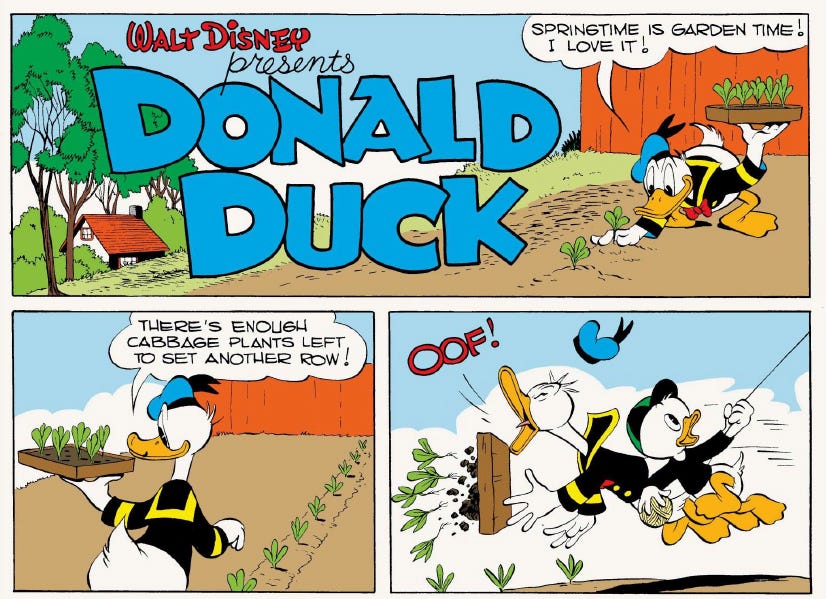
Donald initially reacts with low-key consternation, but further interference from the nephews turns him into:
Donald 2: the undeserved victim.
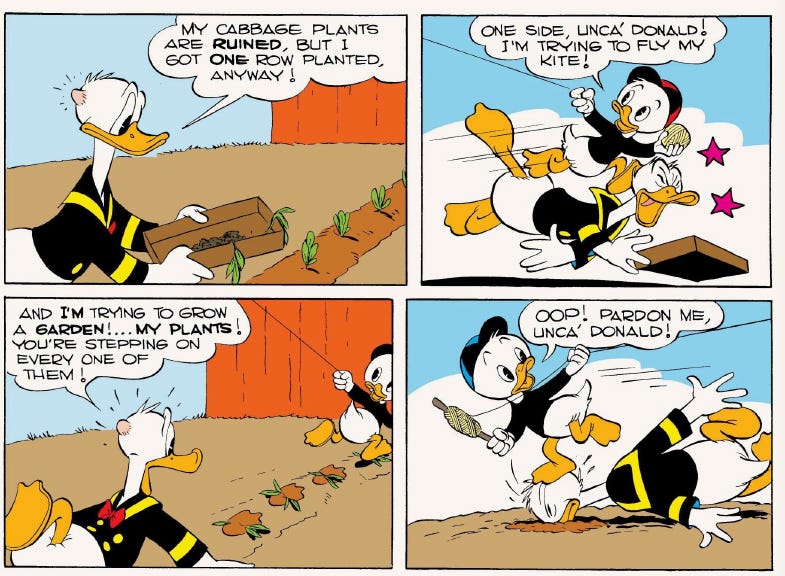
In the face of this persecution, he quickly becomes:
Donald 3: the man at his limit.
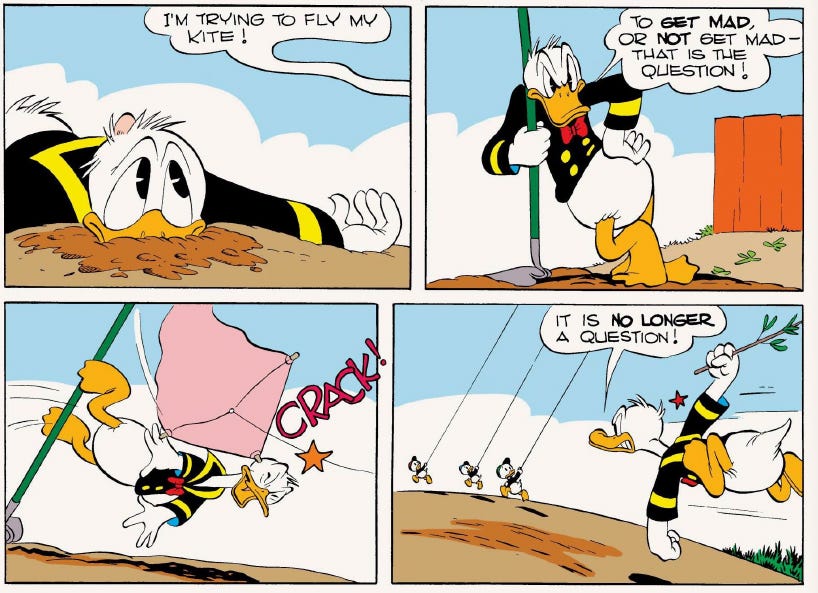
After failing to catch the nephews, Donald transitions to:
Donald 4: the righteous avenger.
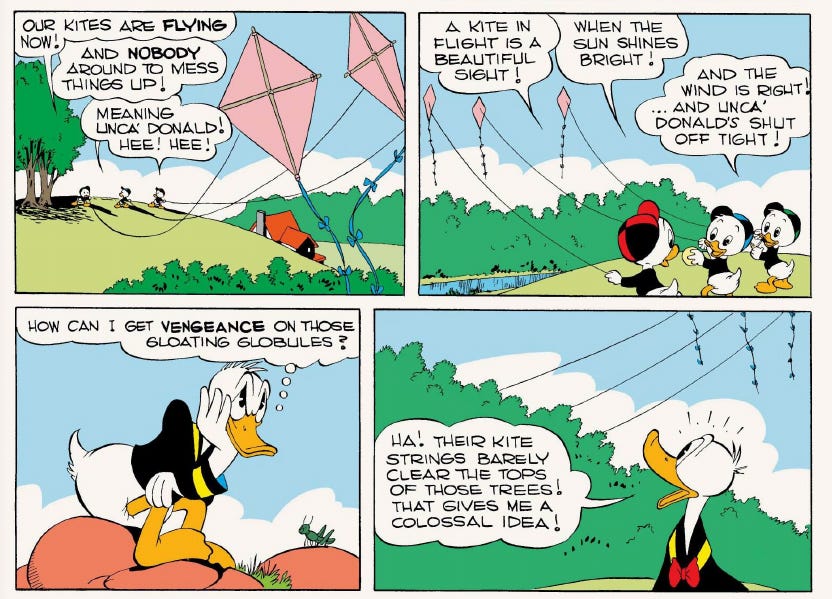
Yet Donald quickly moves from righteous revenge to mischievous trickster, abandoning any sense of proportion just to wreak havoc on the nephews. We now have:
Donald 5: gleeful demon.
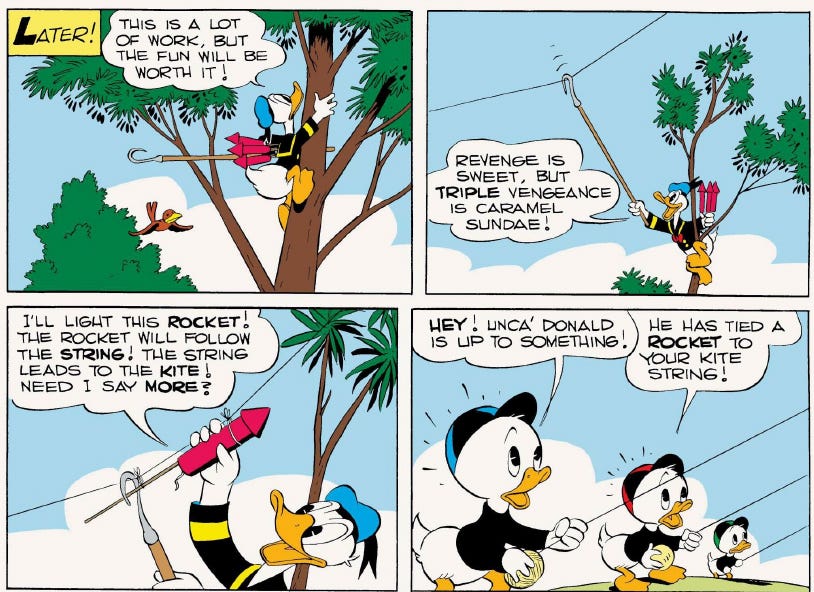
Donald’s agenda turns from “vengeance” to malevolent “fun.” The nephews turn the tables by hooking a bag of eggs to the string, leaving Donald with egg on his face (literally). Donald flies into pure rage, becoming:
Donald 6: raging violence.
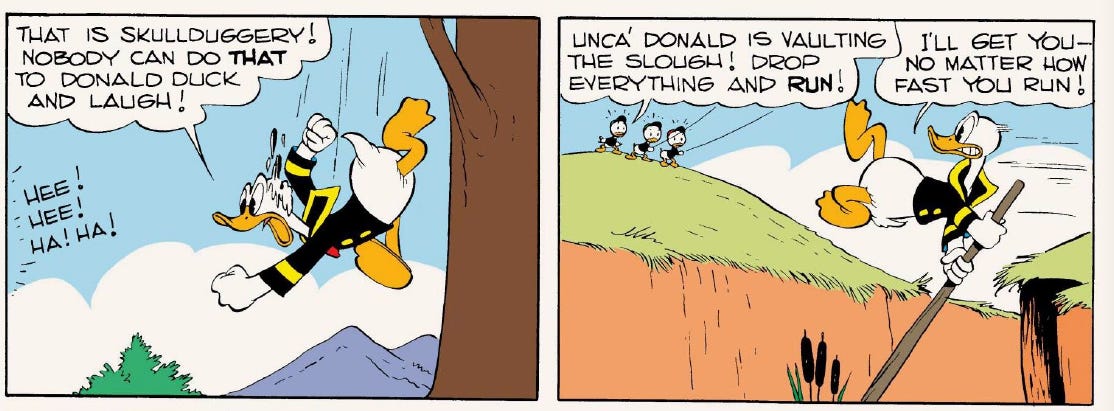
But just as Donald catches up with them, the nephews manage to trigger another shift in him by appealing to his insecurity and vanity, turning him into
Donald 7: the wounded ego.
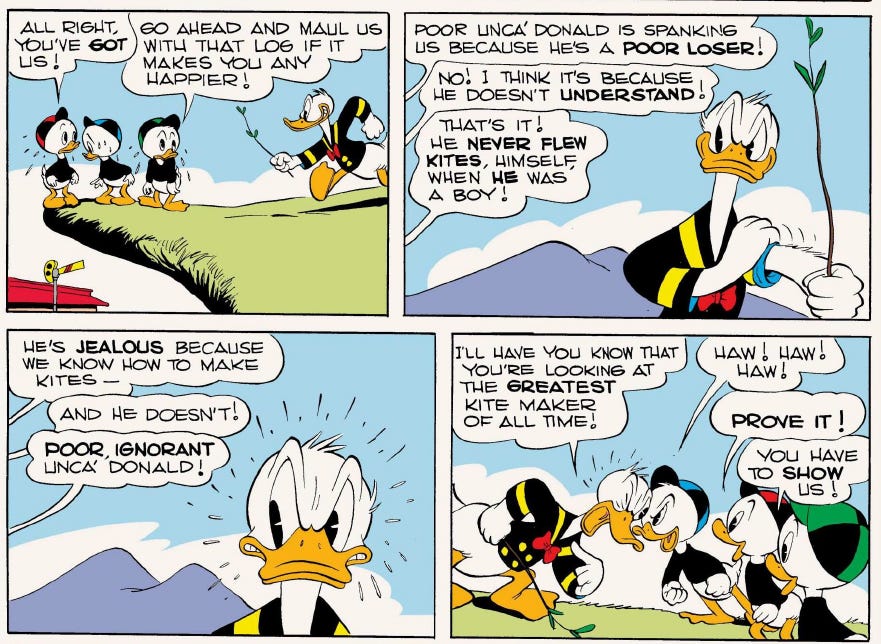
Donald immediately snaps out of his rage, moving the story to psychological warfare. This favors the nephews, and Donald becomes:
Donald 8: the braggart.
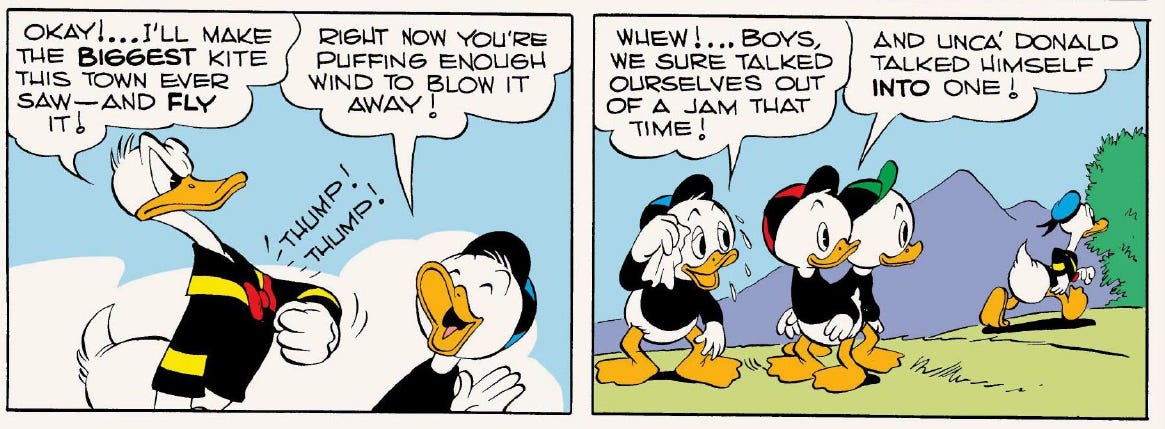
Here the story decisively turns, abandoning the rivalry and warfare between Donald and the nephews to turn to the consequences of Donald’s puffed-up arrogance. His bragging quickly inflates to:
Donald 9: absurd hubris.
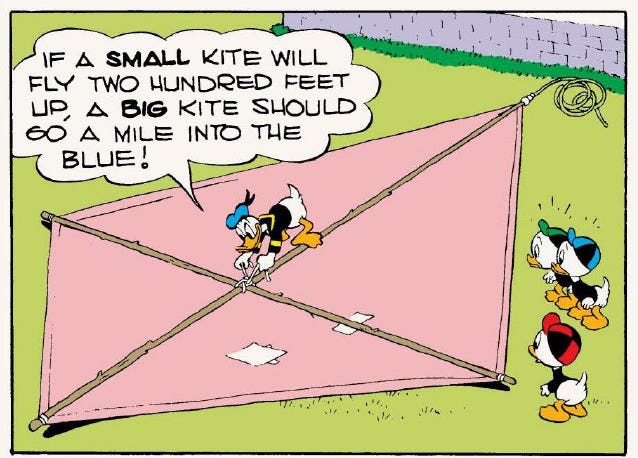
The nephews are only spectators now, as the conflict has turned to Donald’s hubris vs. reality. Donald tests his invention out by tying it to a car, becoming:
Donald 10: Icarus-on-adrenaline.
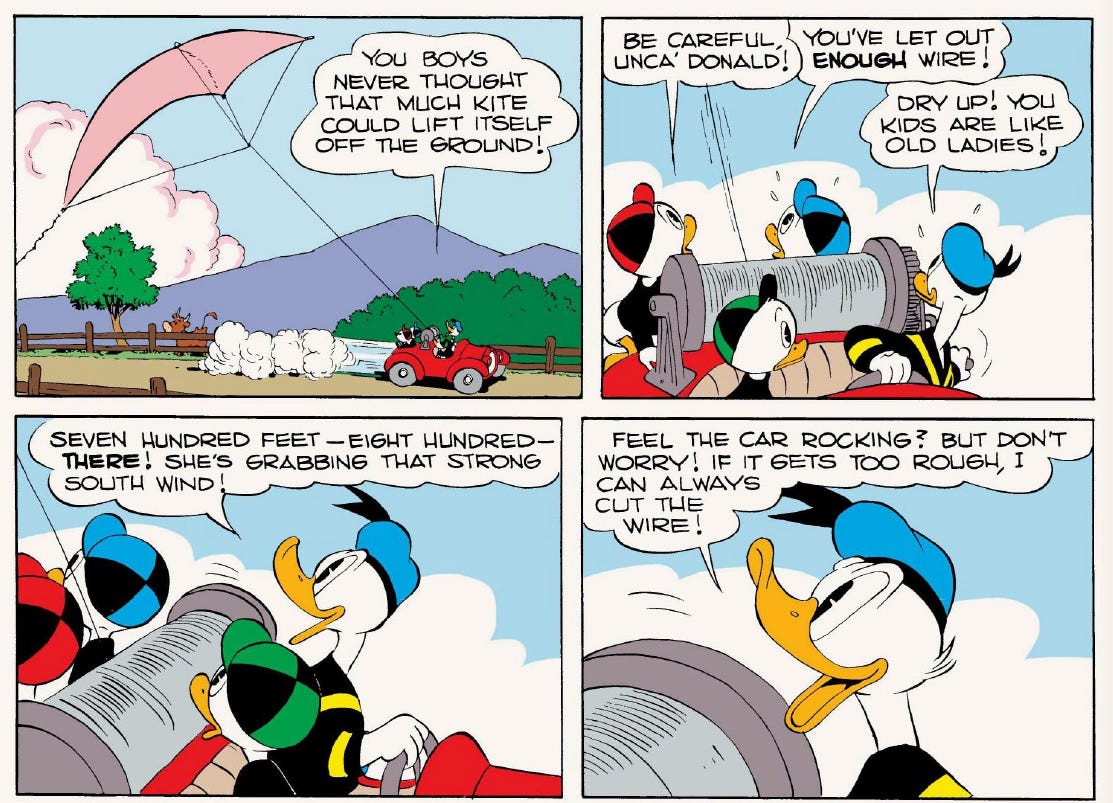
Once the car leaves the ground, the nephews bail out and Donald crashes (metaphorically) to reality through some targeted acts of God, becoming:
Donald 11: Icarus humbled and remorseful.
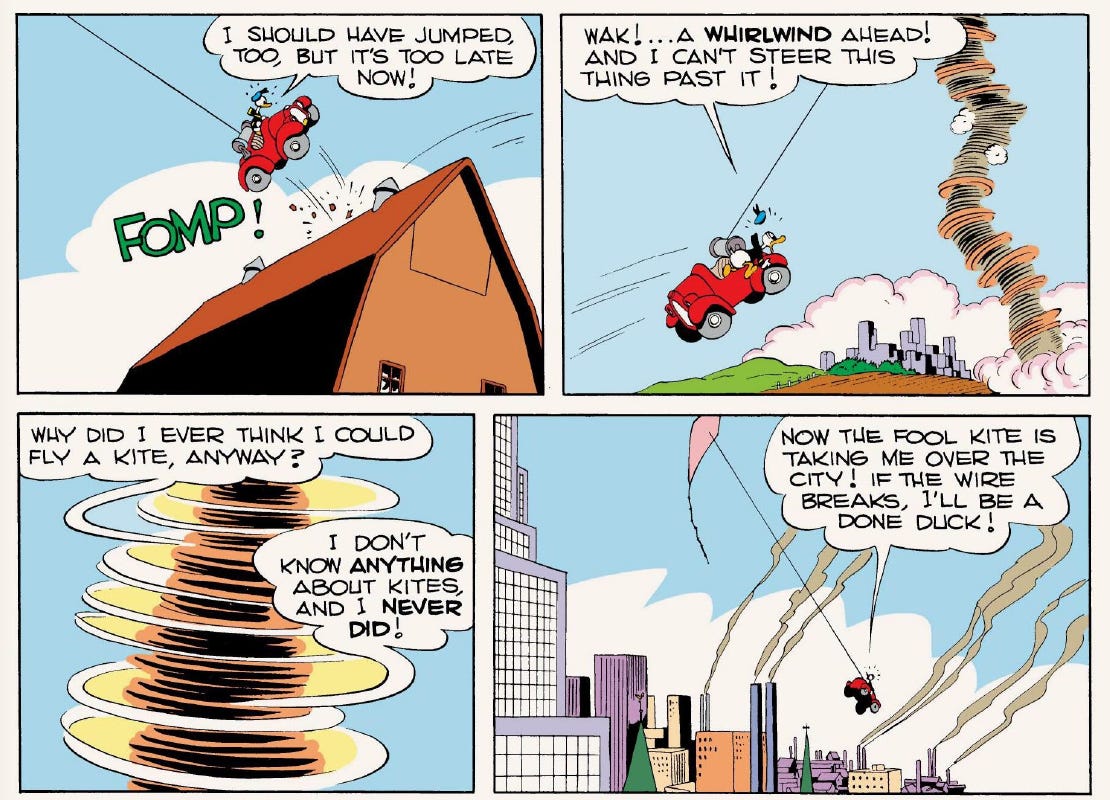
Granted, this is more the logical conclusion to the Icarus persona than it is a separate personality, but since these are only two moments of his personality out of more than a dozen and the shift occurs so quickly and abruptly, I’m counting them separately.
Rather than sticking with Donald, we abruptly shift perspective to a swanky banquet of the “World’s Greatest Men,” who just happen to see:
Donald 12: the unwitting celebrity.
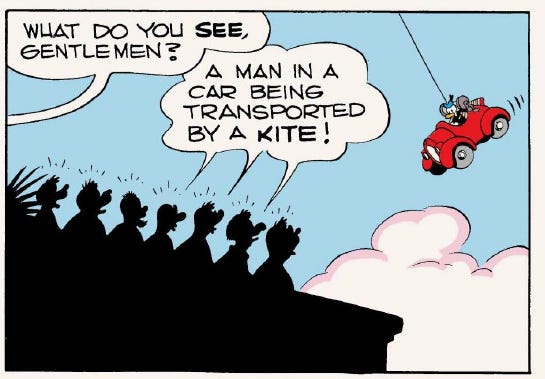
We’re removed from Donald’s perspective, suspending the hubris theme and throwing us into a wholly different context. The story so far has been Donald and the nephews alone—now we suddenly are in society. All that is enough for Donald’s personality to get reset again, turning him into:
Donald 13: the skilled crisis manager.
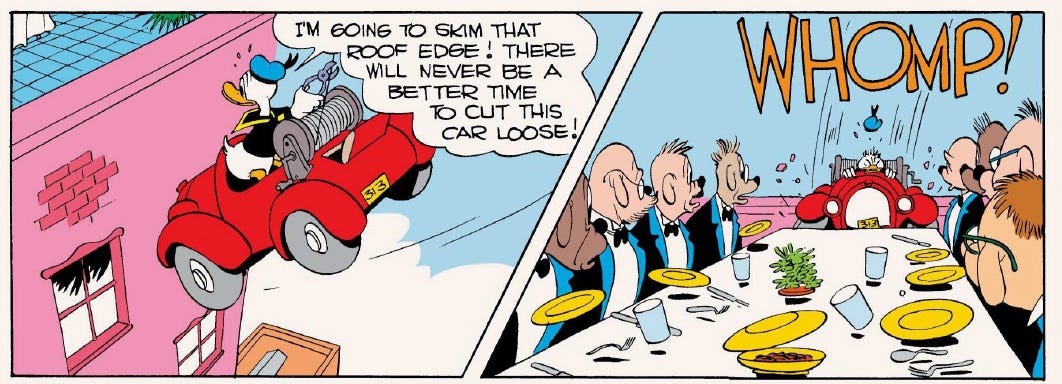
The change in context covers up the anomaly that Donald has shifted from completely helpess to comparatively calm and capable, making the right decision on a dime. The force of impact, though causes him to briefly and finally switch back to…
Donald 11: Icarus humbled and remorseful.
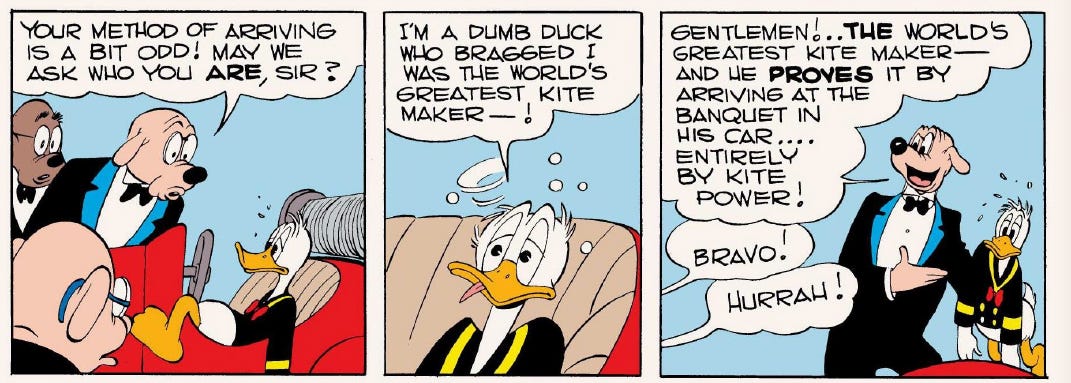
Yet here we see Donald 11 through the eyes of society, who take him to be a genius. That is the last we see of Donald—dazed, humbled, and barely aware of what’s going on. It’s left to the nephews to hear about the final version of Donald:
Donald 14: born under a lucky star.
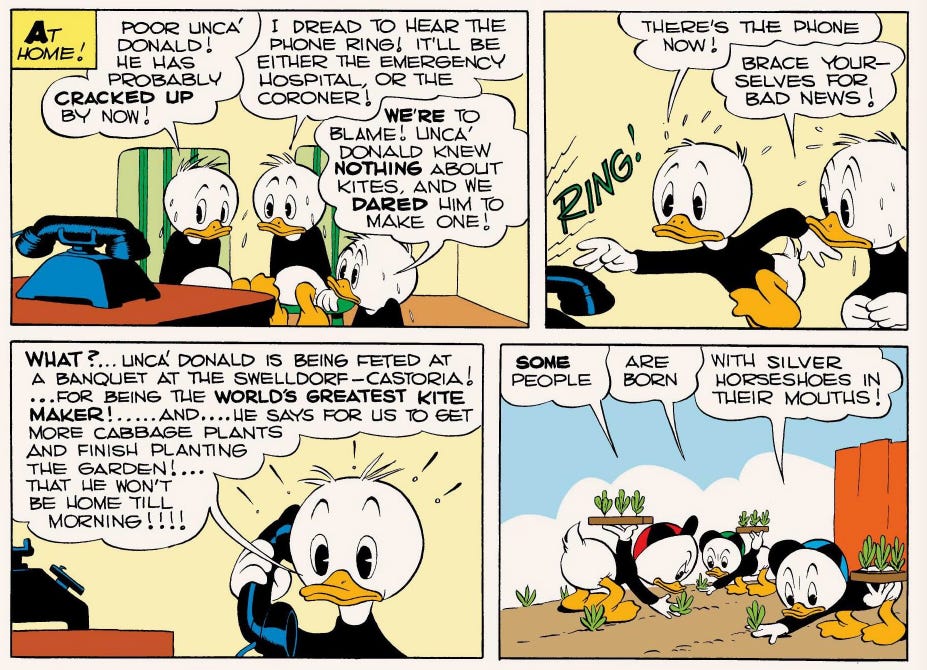
And so we end with the nephews grudgingly doing what Donald was stoically enjoying at the very beginning of the story, and the nephews resenting Donald’s absurd luck.
All that in ten pages. The most dominant thematic throughline is hubris-brought-to-earth (even if that theme is ultimately undercut), but there is no trace of that theme in the story or in Donald until page 6, halfway through the story, up to which point Donald has gone from mellow parent to malevolent trickster with no hint of pride or ego. Even in the first five pages, Donald’s initial stoicism is a complete red herring: once he snaps, he snaps hard.
When the nephews appeal to Donald’s pride and insecurity, they shift the whole direction of the story, pushing Donald’s character into a completely different realm for the last half, only for the punchline to undermine that theme. There’s been no hint of Donald’s luck until the last page; for fortune to suddenly assert itself in the most arbitrary of ways lampshades the less absurd but equally arbitrary twists earlier in the story. “You thought Donald would actually be punished for his pride? Didn’t you notice that there’s been no thematic coherence?”
Yet the story itself holds together. It’s about kites. However Donald is acting, it’s still about kites. The action starts off small and gets bigger and bigger. Donald’s appearance, his face in particular, gives him a unity through his changes. And despite how volatile Donald’s personality is, each individual transition is not so far from what immediately preceded it. There are just far too many of those transitions for there to be any unity of theme.
It’s a very Barksian quality to have such weirdness occurring underneath a seemingly coherent and unexperimental surface. By this point, Barks seems to have trusted his instincts enough to realize that as long as those surface elements remained reasonably traditional and orderly, he could push very hard on the more submerged aspects and not have the story fall apart. That, in turn, sets up some of the outright surreal stories to come, which still are never in danger of leaving recognizable reality.
Though Barks would also find that their are limits. What if Donald spent an entire story in one persona…but a wholly un-Donald-like and unacceptable one? That’s next.
Comments
Nothing yet. Say the first thing.
Sign in to join the conversation.