
Jet Rescue (WDC&S 67, April 1946) is a low-key milestone for Barks, reaching a new level of sophistication in theme and social commentary, but only by accidentally backing into it. Nature vs. culture, adults vs. children, hypocrisy vs. sincerity—it’s all here. The story is a mixed success, but its ambition and complexity are higher than anything Barks had written to this point.
The nephews are the protagonists of this story. We’ve seen this a few times before, but not with this level of sophistication. They’re finally fleshed out here. They’re still a bit rowdy, but also prototypical Junior Woodchucks with a sophisticated and intellectual interest in toy rockets. Donald thinks the rocket stuff is silly and wants them to put their money in the bank and earn interest. Yet while Donald goes to the a picnic of the vaguely Beatnik “Merry Loafers,” the nephews are thinking about patenting a helicopter and making a far bigger profit.
The recurrent moral theme, which is never quite foregrounded, is Donald (and society at large’s) embrace of shallow social convention without any deeper engagement. Donald talks about money and interest and does the math, but his thinking is entirely rote, unlike the nephews’. This is an unusually complex and abstract theme for a Barks story of this era, and the somewhat haphazard progress of the story suggests that it emerged in the creation rather than being something Barks settled on. As a ubiquitous form of human folly, it fits Donald perfectly, but it’s also not the sort of theme that one can portray through physical humor in a comic for kids. Here, Barks manages it.
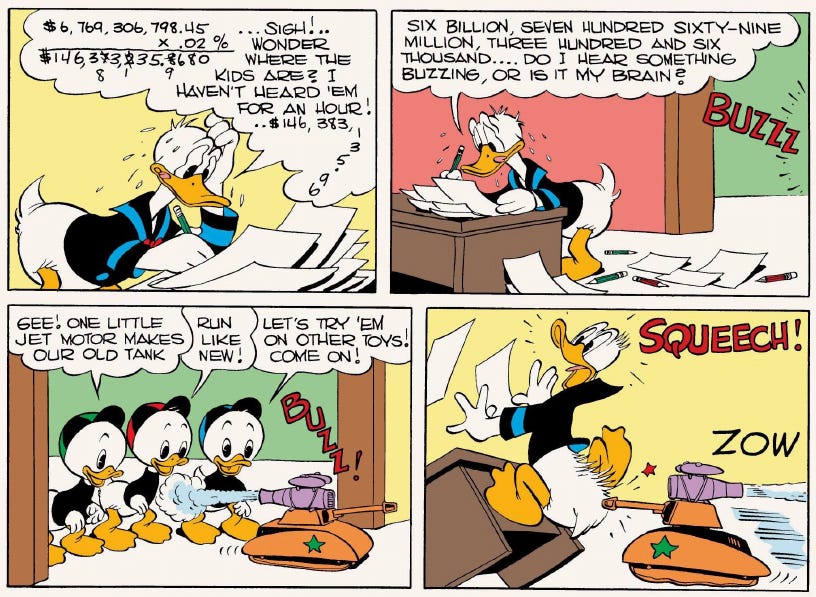
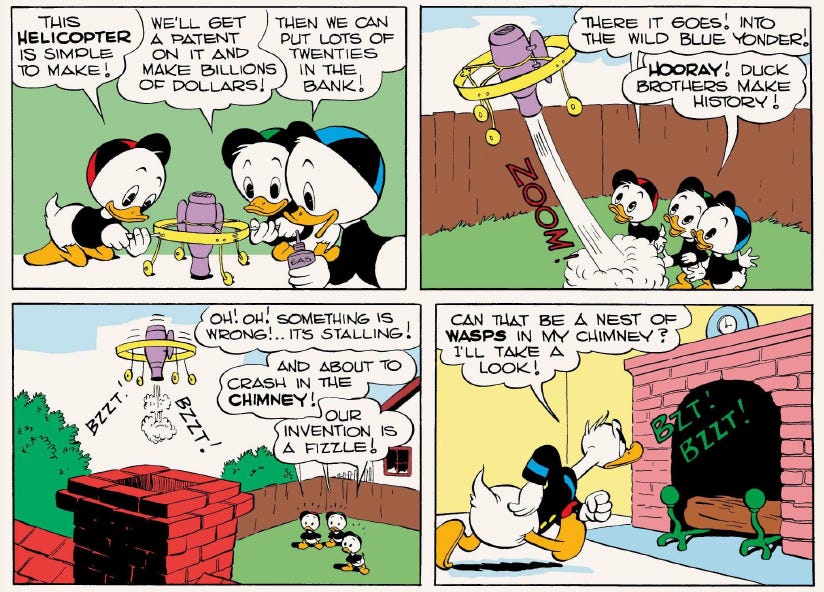
Structurally and visually, the story divides into two polarized settings: domestic and natural. The first half of the story is set in Donald’s stark and nearly-empty home, with no furniture beyond a desk and a fireplace. It highlights Donald’s interest calculations and the sight gags of Donald being assaulted by the nephews’ inventions, but it also shows a world utterly sealed off from nature—and beyond that, reality. We see very little of the outdoors, and notably, when the nephews send a rocket-propelled helicopter up a chimney, it fails the moment it reaches the outside.
Everything changes once in the wilderness. The Merry Loafers are some Eden Ahbez-ish nature boys who dance and gallivant in the woods in a poor imitation of some Dionysian rite. Initially, the environs are playful and look like something out of an early-30s Disney cartoon.
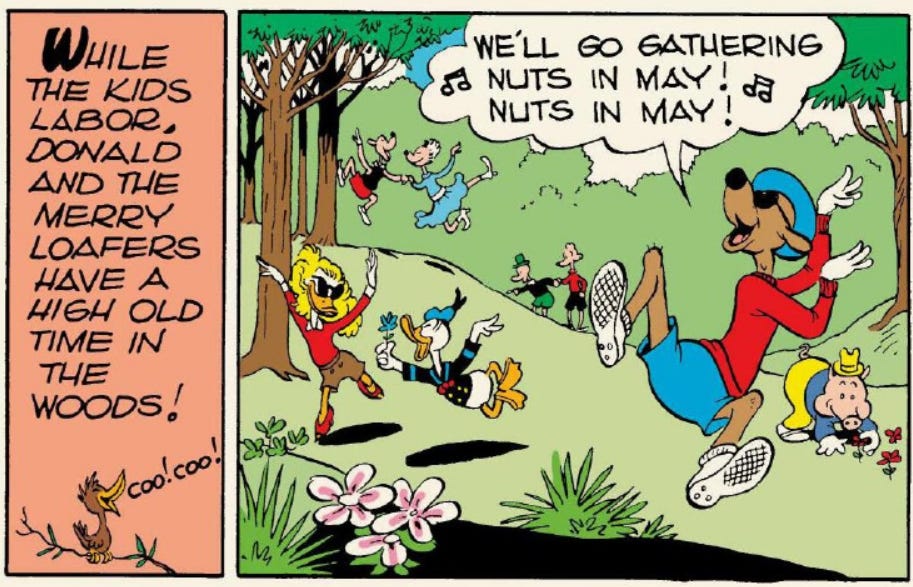
The bird’s “Coo! Coo!” offers Barks’s none-too-subtle comment on the proto-hippies. They’re living in a fantasy world. Donald’s interest is clearly more in the blonde diva than in nature itself, echoing his earlier pretense toward financially-responsible adulting. As soon as Donald climbs “Pinnacle Rock” with love interest Gloria Swansdown-Swoonsudden, real nature asserts itself: not malevolent, but indifferent and capricious, completely unsuited to loafing.
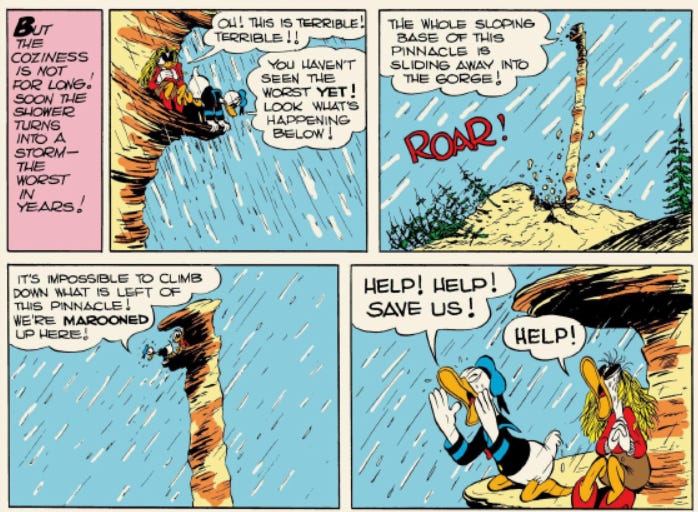
The art in the second half is a complete contrast with that of the first section: textured, deep, scenic. From his very first story, Barks always put more effort into nature scenes than required, stemming from both his rural background and, I suspect, his greater affection for “honest” (or at least unpretentious) nature over the willfully deceptive or self-delusional workings of people.
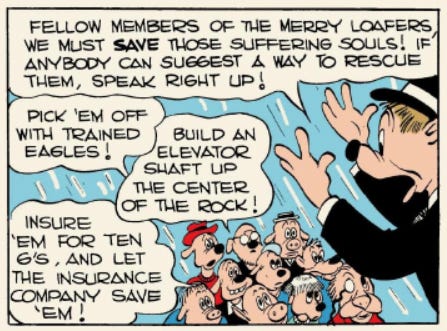
The nephews complicate matters, though. If Donald had been facing a nemesis in the first section, the contrast would make sense, but the story resolves into a different conflict: the nephews’ genuine creative ingenuity vs. adults’ general uselessness. The Merry Loafers generate ideas to save Donald and Gloria that are decidedly societal, whether through domesticated animals, technological impossibility, or economic manipulation:
More realistic attempts with climbers and helicopters fail too. Nature wins every round. Yet the nephews pull off a coup:
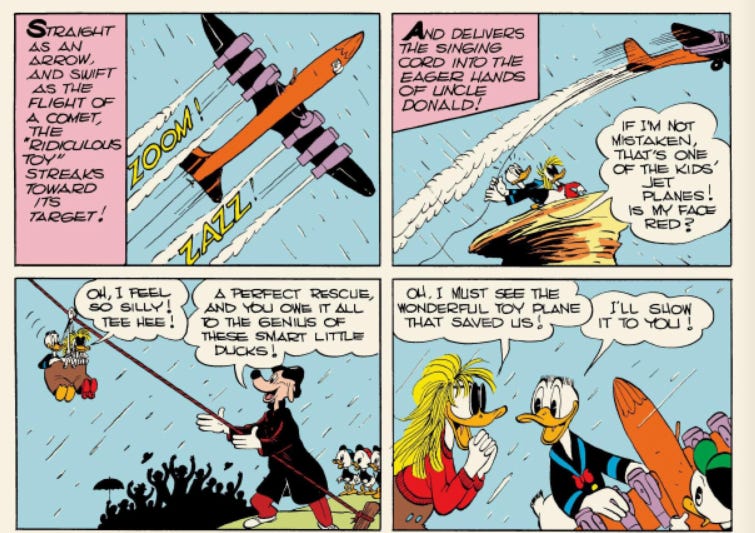
The “ridiculous toy” triumphs over all adult dreams and ingenuity. Besides being a testament to the nephews’ growing prodigiousness, what is the arc here? My interpretation is that it is Barks’s appeal to a form of innocence and earnestness that is lost by adulthood. The nephews succeed not because they are necessarily smarter than the adults, or even because they are more creative, but because their talents show through when untainted by vanity, status-jockeying, or lazy ignorance.
To underscore all that, Barks puts in the final punchline where Donald finally sees the utility of the jet engines: they impress girls. And once again, he is punished for superficial enthusiasm, now pretending to have knowledge of engineering just as he pretended to economic knowledge at the beginning of the story:
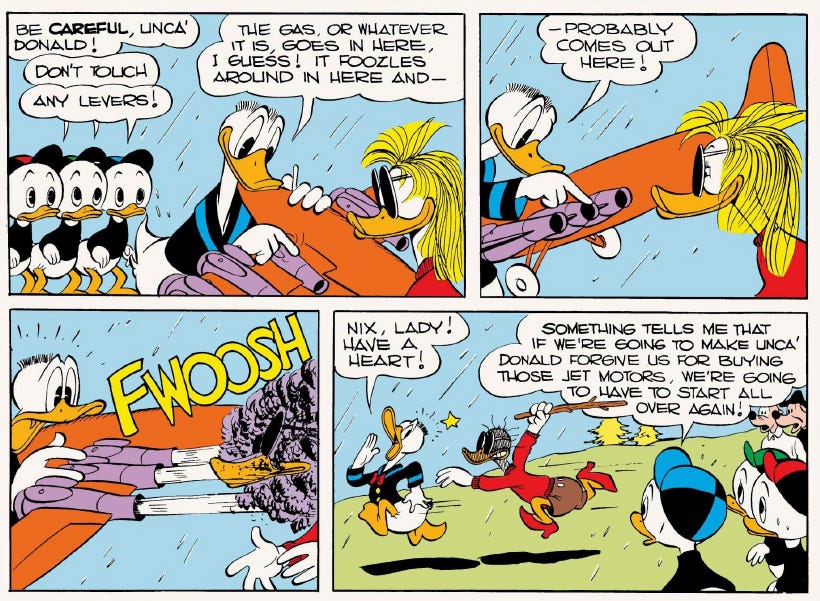
Gloria Swansdown-Swoonsudden is similarly unmasked, quite literally, having her hair disintegrated by the jet engines—her glamor being a social pretense much as Donald’s financial acumen was. Only the nephews, in their ingenuousness, get off clean, though they don’t expect any sympathy from Donald.
That appeal to innocence adds to Barks’s atypically anticapitalist note at the beginning of the story, where Donald’s insistence that the nephews save money instead of spending (investing) it in potential inventions proves to be pretentious, boring, and useless, a gesture at responsibility without any deeper understanding.
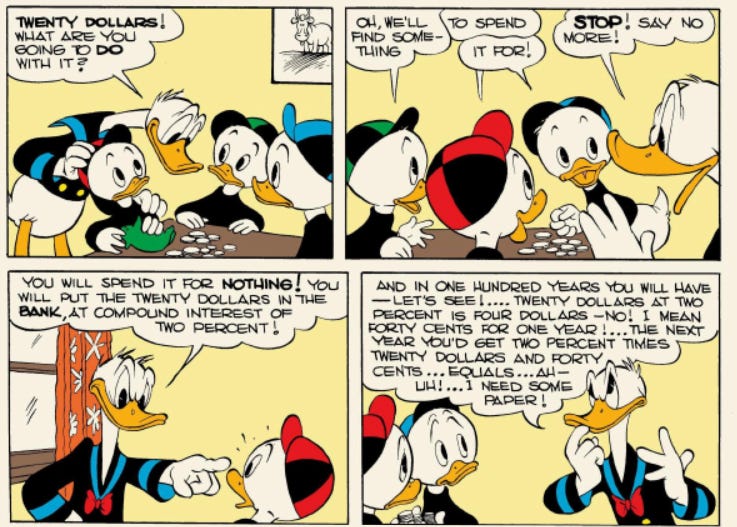
This is also a foreshadowing of Uncle Scrooge’s bizarrely anti-capitalist approach to money, where he will frequently reject two of the core tenets of money by downplaying any sort of capitalist rapaciousness and prioritizing (1) enjoyment of the specific physical instantiations of his money, and (2) protecting that physical instantiation from material loss.
Barks’s rather puritan work ethic made the rentier capitalist notion somewhat repugnant to him. He had no problem with rich people whom he perceived to have earned their money. Even loans with interest were not out of bounds for him. But the idea of money in the abstract simply raking in more money never sat well with him—even if substantively it amounted to loans with interest. It feels too much like earning money for nothing. This is the connection between Donald’s initial obsession with compound interest and his decadent partying with the Merry Loafers later on: they’re both entitled grabs at getting something for free.
Barks’s puritanical and libertarian tendencies put him firmly to the political right but also fueled his disgust with the power elite and the capitalist class—and with humanity more generally. In this story, Donald’s economic lesson comes off as a fruitless aspiration toward joining the upper classes, not as real toil. Scrooge would pose a bigger problem for Barks, since he was unavoidably one of the power elite despite himself. Barks would eventually square this circle by implying that Scrooge had enough money to effectively be a one-man central planning office, but that is a subject for later.
Against the pretenses of society, nature acts as the counterforce. Nature is all fate and fortune, never giving something for nothing, never providing a reliable rate of return. The only human force that stands a chance against it, rather than ephemeral economics or societal manipulations, is the sincere ingenuity found in the nephews. The nephews’s earnestness, in this story at least, grants them an exemption from the perils of both culture and fate, just as it did back in Barks’s first classic story, The Rabbit’s Foot.
Everything that was simply put in that story returns here, deployed in far greater complexity. This time, Barks grants the nephews far more agency and intellect, finding a way to put forward some positive human forces that aren’t purely naive and “lucky.” Donald, in turn, has gone from a simple doubting Thomas to a real adult integrated into society, with all the compromises that entails.
The result isn’t quite steady and isn’t quite elegant, but taken with The Rabbit’s Foot, Jet Rescue is one of the clearest markers of both the continuity of Barks’s concerns and his aggressive growth as a craftsman. To put it simply, it’s a marker of Barks’s work becoming more real.
Comments
Nothing yet. Say the first thing.
Sign in to join the conversation.