
The Firebug (FC 108, May 1946) is a disturbing story, maybe the most disturbing Barks had written to date. Some of the reason is obvious: Donald bumps his head and enters a fugue state of being obsessed with starting fires. But that setup wouldn’t be so creepy if not for some structural defects in the story, which leave it unnervingly unresolved.
After a radical experiment in quick-changing Donald’s personality in Donald’s Monster Kite, Barks sticks to only one persona for Donald in The Firebug, but for all Donald’s flexibility, a manic pyromaniac is genuinely out of bounds. For the whole array of emotions we’ve seen cross Donald’s face, this one is finally a bridge too far:
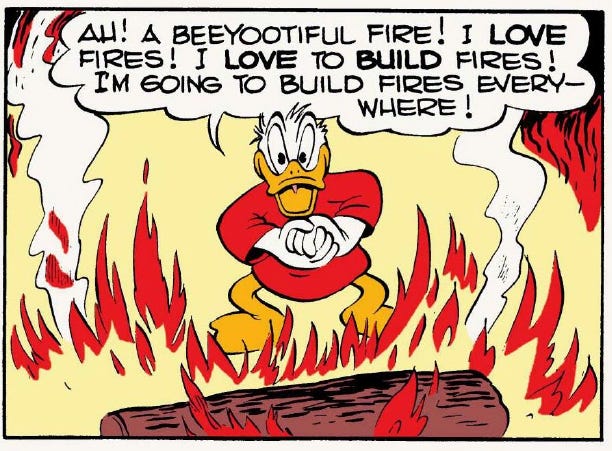
This is where Donald is at by the end of the first page, after getting a bump on the head, and it’s where he (mostly) stays for the rest of the story. He’s got the air of some kind of supervillain, and this panel neatly depicts how to him, the only thing that matters now is fire.
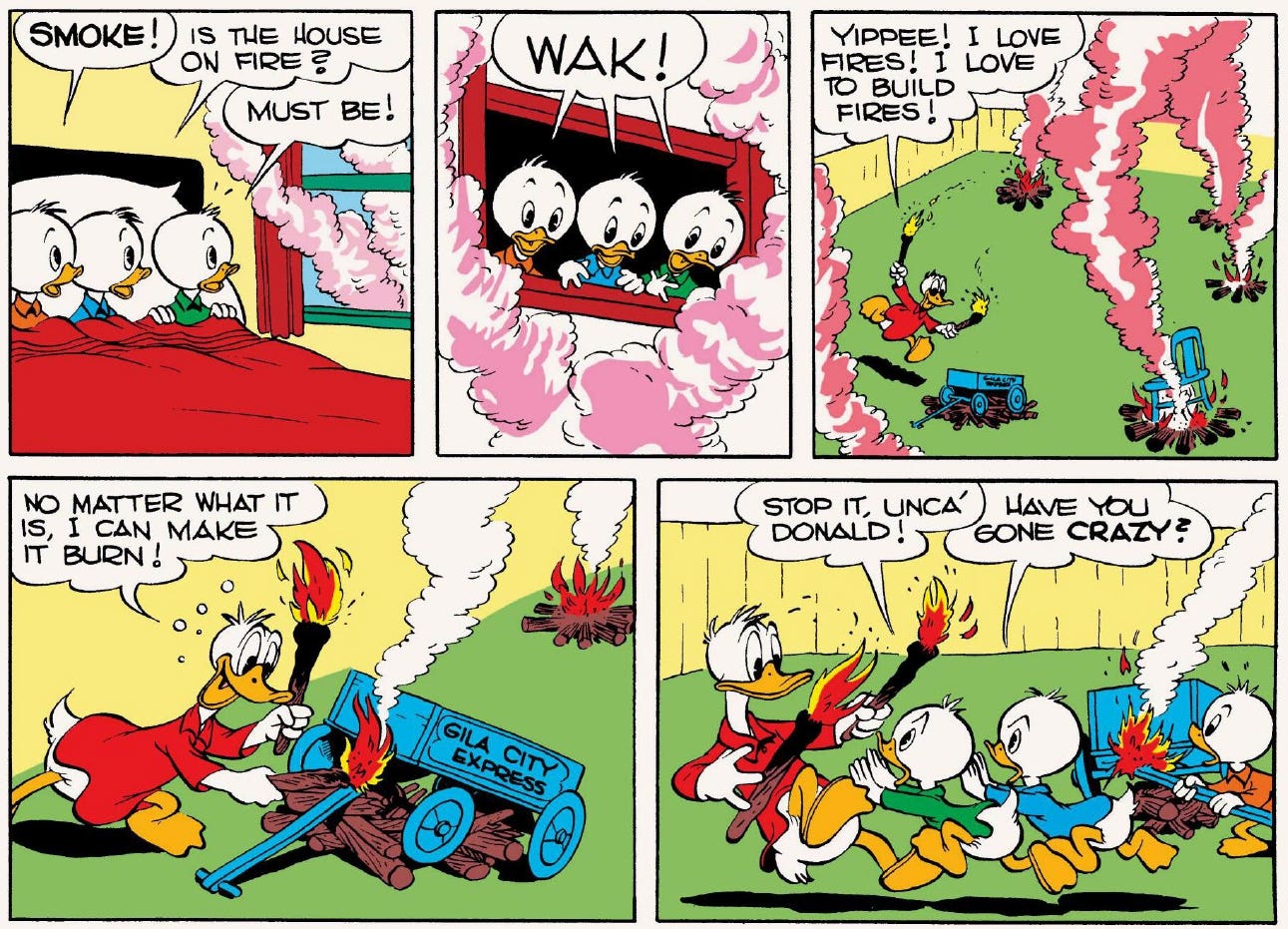
Here’s where the treatment starts to make the story more troubling than it might have been. Donald is dislocated from any recognizeable version of himself, and he never returns. Barks had Donald experience a fugue state before in The Mad Chemist, which was discomfiting in itself, but not like it is here.
In the earlier story, Donald went crazy but was only inadvertently destructive. And Donald recovered his senses by the end of the story, resulting in a typically ironic conclusion. No such luck here, where the nephews never do get their uncle back. The blithe doctor in The Mad Chemist made clear that the condition was temporary. When the nephews go see Dr. Quackfaster, he gives no such assurances and emphasizes how serious Donald’s condition is:
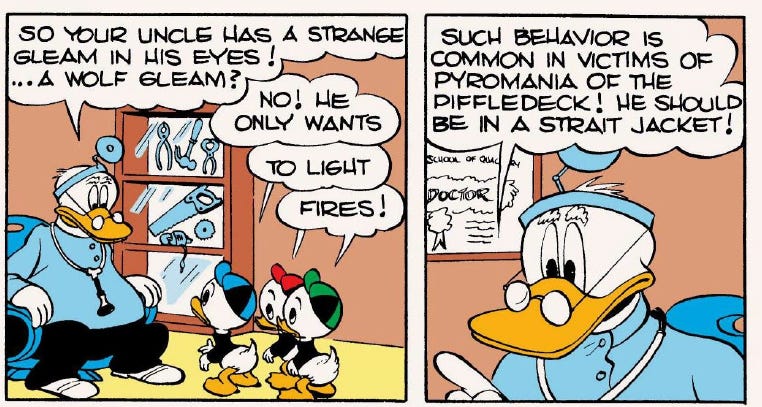
Even visually, the story is far more disconcerting. The Mad Chemist signified Donald’s fugue state by varying his eyes. This time, his eyes are normal, suggesting that Donald hasn’t merely been possessed, but fundamentally corrupted:
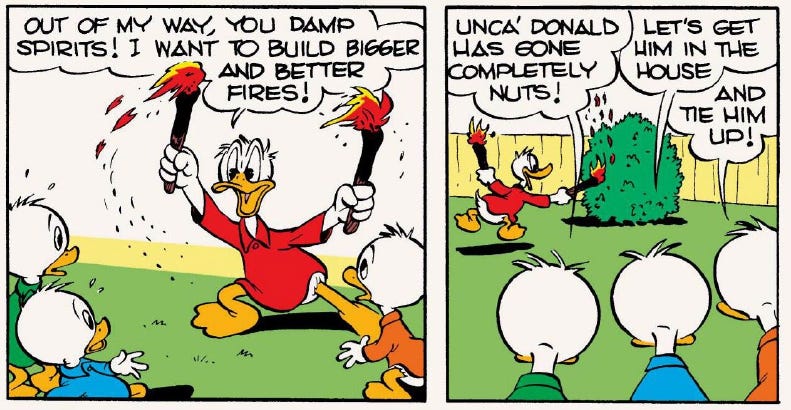
The nephews quickly realize that Donald is now a very sick person that they’re responsible for. Their reactions are muted, but these are kids who have lost their only parent.
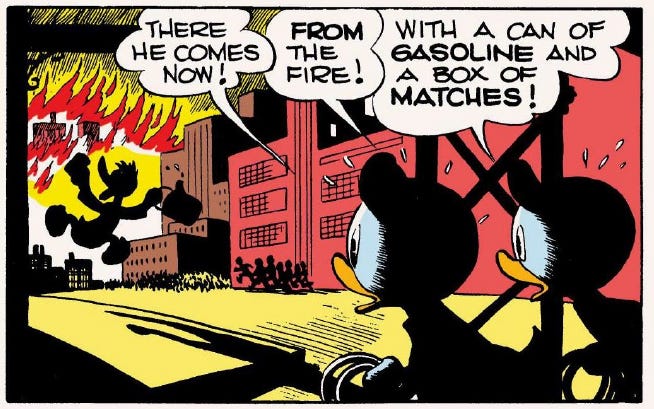
The manic silhouette in front of an enormous harbor fire shows Donald causing a level of destruction we’ve never previously seen. The nephews, here in their hyper-mature personae, deal with the problem with poise and reason, which doesn’t quite quell the unease of seeing them boarding a feral Donald up in his bedroom.
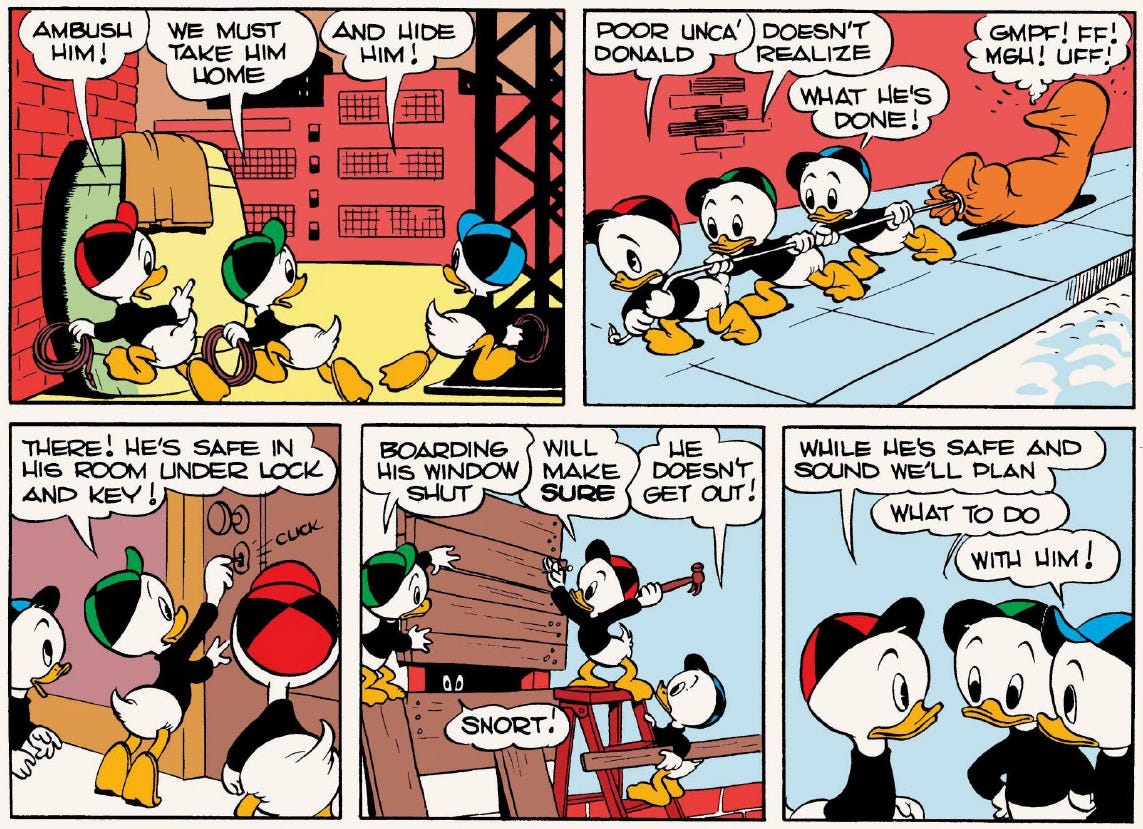
“We’ll plan what to do with him,” they say. He’s outside the bounds of reason, a snorting animal, and despite their calm, there’s no hint of what one would do in this situation. The story could have gone in the direction of comical, slapstick attempts to cure Donald by causing an aversion to fire or somesuch, but Barks didn’t go that route. In fact, it seems like Barks didn’t know what to do with this situation either, because the plot takes a huge right turn.
Donald burns his way out of the house, naturally, and gets back to setting fires:
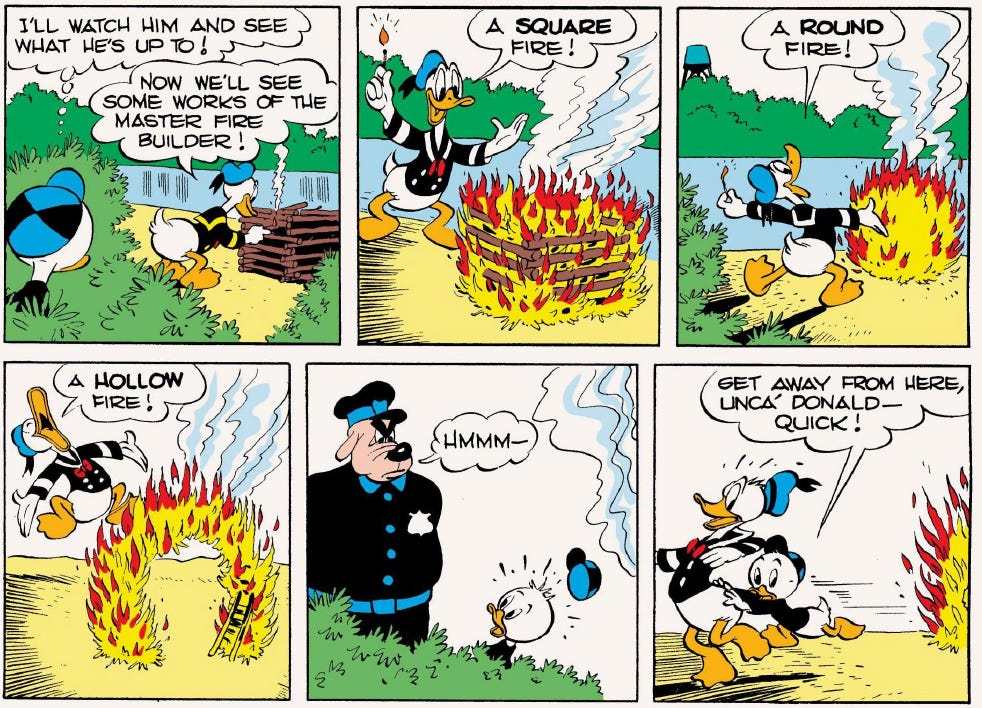
Again, what’s disturbing is that Donald isn’t so far from his normal self here, but instead of taking joy in little things or petty mischief, he’s burning up everything in sight. We now do see traces of the old Donald, but they’re all through the monomaniacal filter of pyromania, and it’s uncanny.
Without the text, he nearly looks normal in some of the panels. Soon enough, the city is in flames:
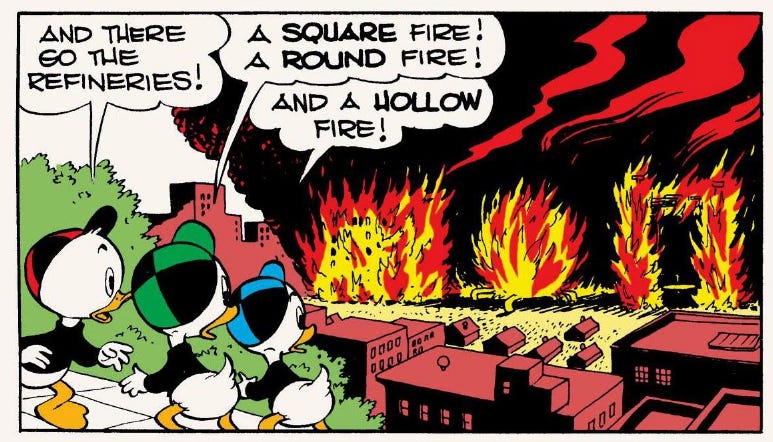
This is a huge and not especially funny level of destruction. There’s some humor to be had from the repetition of the “Square fire! Round fire! Hollow fire!” line, but the picture is drawn more to be apocalyptic than silly, with encroaching black smoke.
Having set up a nearly-unworkable premise, Barks does lose his way. The latter half of the story (an unusual 13 pager, three more than usual) is a kinetic but less startling sequence involving a big red herring. As it turns out, Donald’s pyromania is real, but he’s only set the small, comparatively harmless fires that burnt up his furniture and the nephews’ toys. The big, damaging fires have been set by a different firebug—the cop who’s been following him. Donald disdains this copycat, not for his destruction but for his plagiarism.
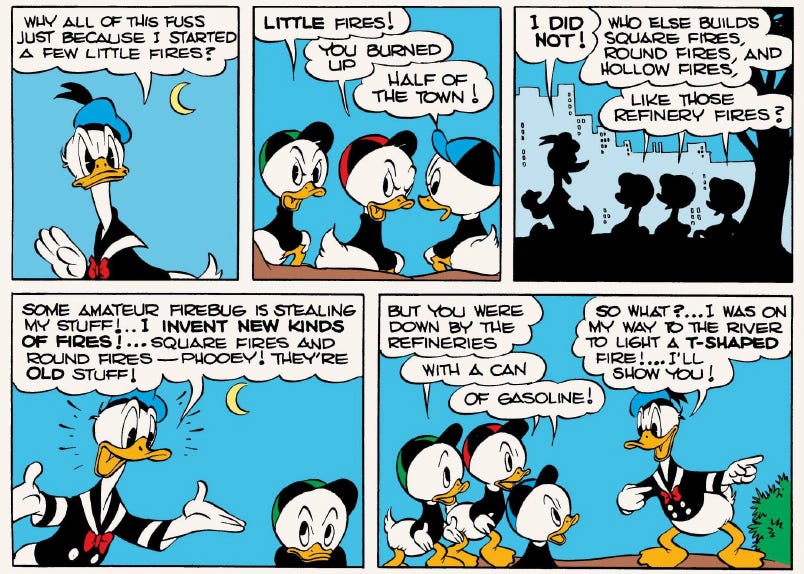
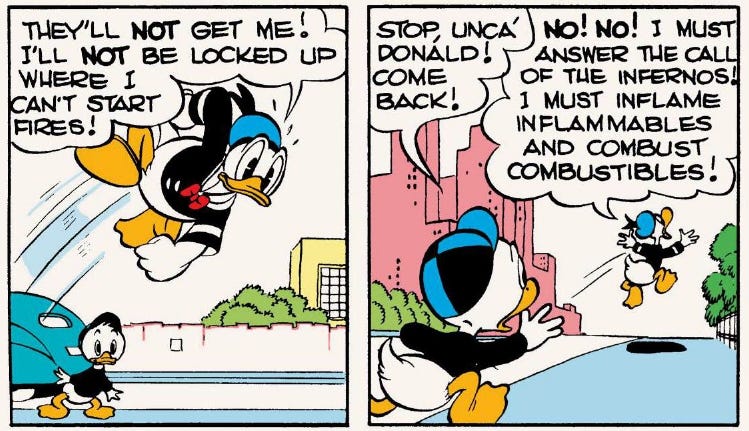
The idea of Donald as a fire auteur is pretty funny, but doesn’t gel with his sheer mania earlier. More broadly, the two storylines don’t join: it’s up to the nephews to catch the destructive firebug since Donald is too crazy to care, and the problem of Donald’s insanity loses focus when they’re chasing the cop down. Donald even seems to lose his pyromania briefly in the pursuit, as the narrative disintegrates:
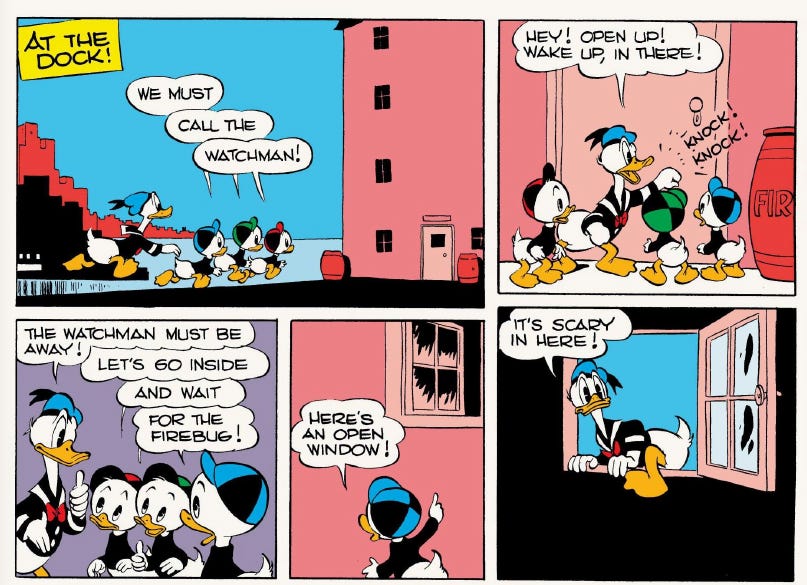
That’s a brief aberration, though; the brief return to normalcy makes his relapse into pyromania even more . Donald does in fact catch the other firebug himself, by which point his pyromania is back in force. Once more, he doesn’t care about anything but the fact that the cop has been ripping him off.
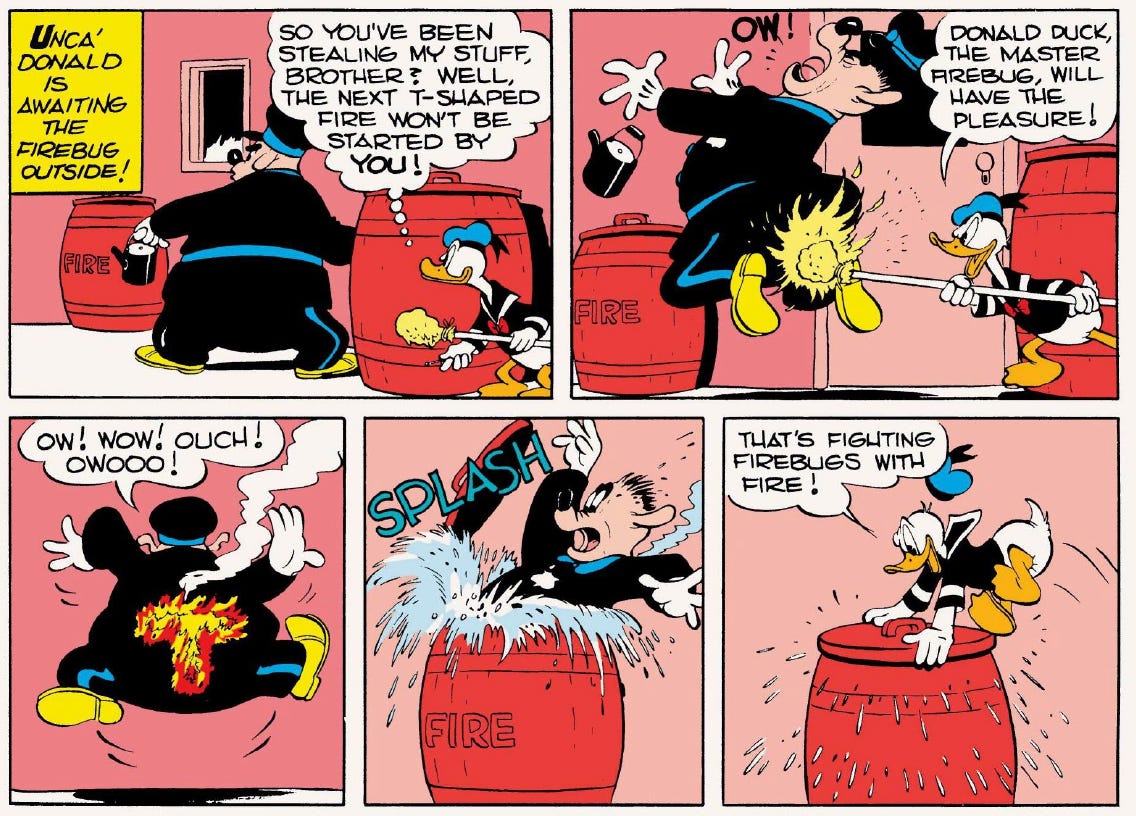
With two different stories to wrap up, Barks comes up with an ingenious (if unacceptable) solution which ties things together, sort of.
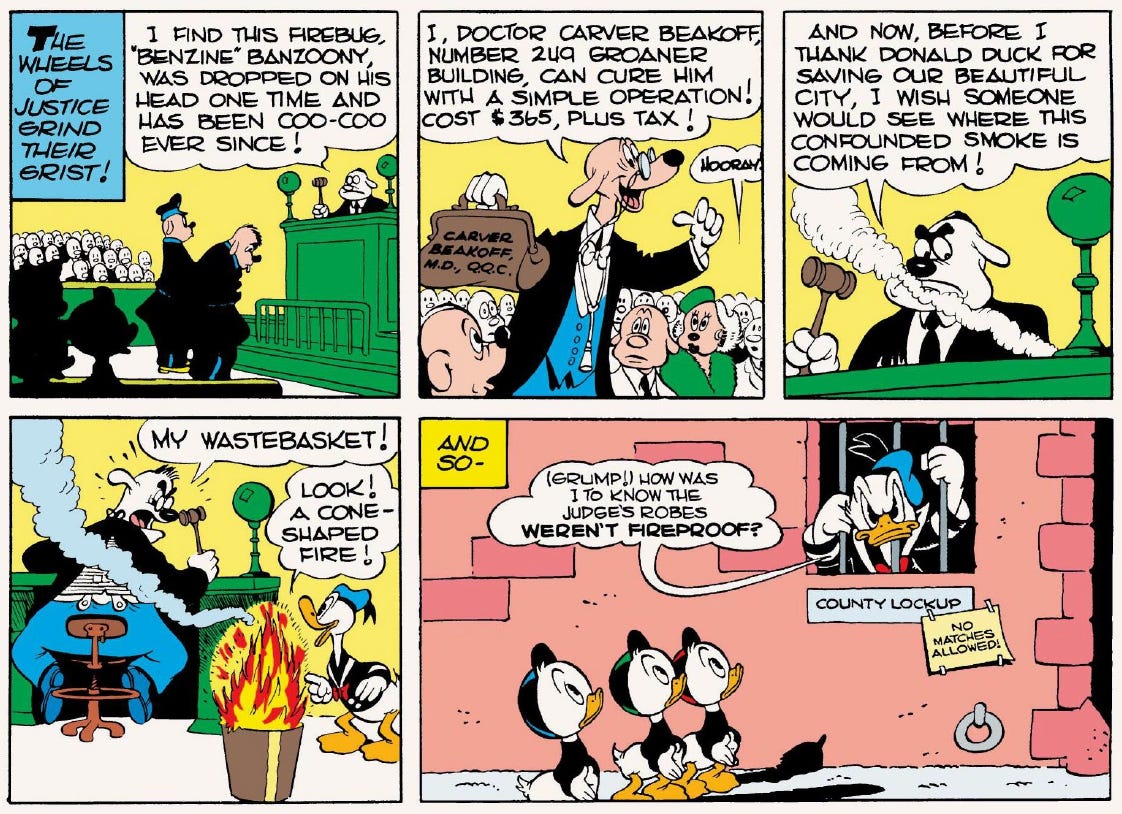
Contrary to Dr. Quackfaster’s warnings earlier, Dr. Beakoff says that curing pyromania is simple (if expensive). The cure isn’t extended to Donald, though, who ends the story in jail. His grousing last line is typical of his ending grievances from other stories—except that he’s still a pyromaniac. (Note the “No matches allowed!” sign.) Are the nephews going to have to take care of an insane Donald for the rest of his life? The lack of resolution to the already-unnerving setup adds a lot to the queasiness of the result. We’ve lost our Donald and he doesn’t come back.
That last panel was drawn by Daan Jippes, though, reconstructed from Barks’s account, because Barks’s editor changed the ending and commissioned new art from someone else (does anyone know who?). Here’s the original:
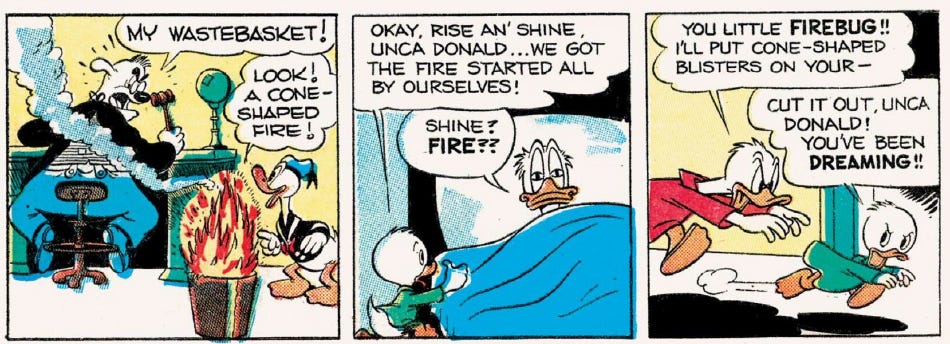
It’s a lame ending, but I’m not without sympathy for Barks’s editor. The original ending with Donald in jail isn’t a problem in itself—it’s more the cumulative impact of it coming after Donald has lost his mind and turned psychotic, with no resolution to the crisis. The dream-ex-machina ending isn’t any more satisfying, but it does at least wipe away the unpleasant image of Donald-gone-crazy.
There’s also the odd business of Donald’s pyromania being implicitly incurable compared to the other firebug’s. The story goes out of its way to suggest that there is no going back for Donald, that his “pyromania of the piffledeck” is more chronic than whatever happened to the cop, even though both became firebugs after getting bonked on the head. The larger-scope in this story is pretty incoherent: refineries burn up, there’s no protection from psychos, and the public trial at the end is equivocal at best. Fate’s actions here are beyond arbitrary into incoherent.
You could analyze the social background and what fire means in the story, but I think it has its greatest impact as a distorted fever dream intended to take us away from any acceptable version of Donald—while reminding us of what we’ve lost. As to what spurred Barks to go down this path…I don’t know, but it was something dark.
Comments
Nothing yet. Say the first thing.
Sign in to join the conversation.