
The Great Ski Race (WDC&S #62, November 1945) is a return to normal after the format changes and narrative experiments of the prior half-year. It’s ten pages, the paneling is the standard eight-panel grid, and the plot is the now-classic structure of Donald’s ambition and arrogance leading him to disaster. It’s not an exemplary version of the structure, but it’s the beginning of Barks consolidating the explorations he’d voluntarily and involuntarily performed in the previous year.
It begins with an anomaly, though, which is an actual reference to continuity, calling back to last month’s Thug Busters and the reward money the nephews got at the end:
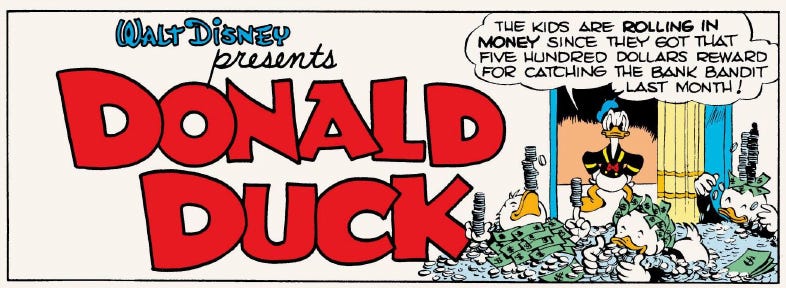
Continuity references like this are extremely rare in Barks’s works. Offhand, I can’t even think of another. Barks uses it as a very minor plot element, but by next month the nephews will be short on money again, so I don’t see much significance in it other than plot contrivance.
On the other hand, it does uncannily anticipate Uncle Scrooge’s love of money, with Louie bathing himself in coins just as Scrooge will do. (Scrooge did not take up Dewey’s habit of nearly ingesting coins, which was probably for the best.) It was an established trope in comics that rich people would show off their wealth in decorative ways, treating money as a disposable accoutrement, but Barks went further in making physical interactions with money enjoyable in themselves. For kids, this even makes sense: playing with money is like playing with a cardboard box. It feeds off imagination. Extending it to an adult, though, would make things far more strange.
Donald enters a water skiing race with a $750 prize and builds his own motorboat in short order. Too short, in fact:
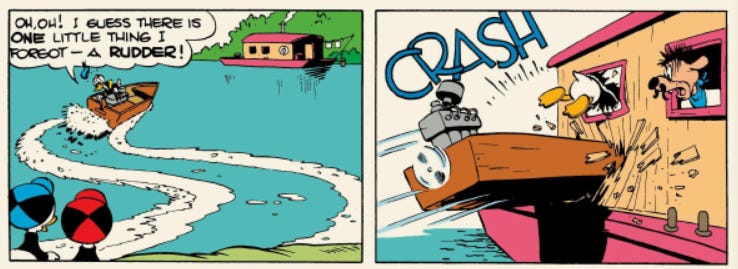
So the stage is set for the expected comedy of errors, with Donald’s ambition and carelessness adding up to disaster. The nephews don’t do much here other than be rich and loan Donald money, after failing to make an impact as protagonists in the previous story. With the nephews marginalized, we get a baffling new antagonist for Donald. He’s never named so I’ll just call him what Donald calls him, Pappy. He’s introduced first as a rival for Donald, attracing the attention of a generic beach girl and triggering Donald’s ego.
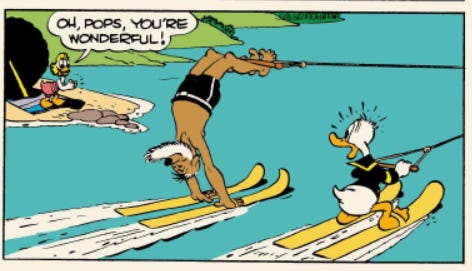
From that point on, Donald’s antics revolve around trying and failing to one-up Pappy. “If Old Pappy could take this jump, I can, too!” he says, before flipping himself upside down into the water.
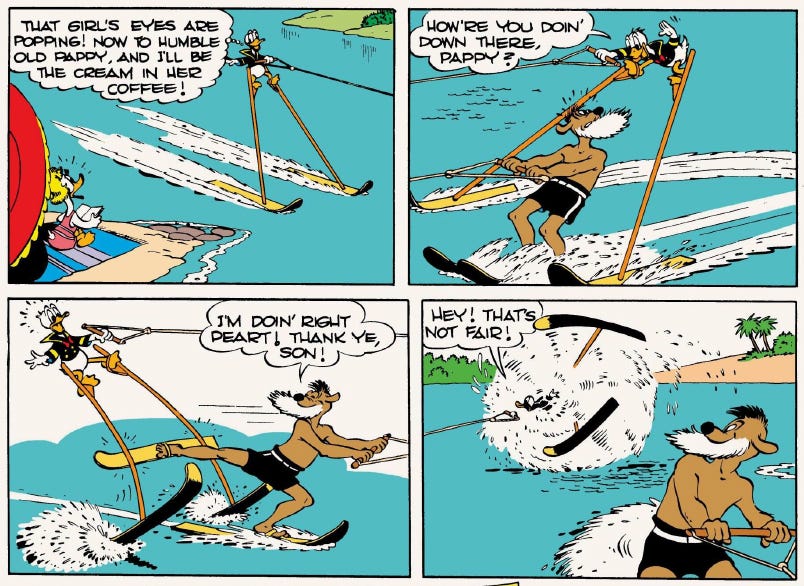
Pappy speaks with a notable Southern accent and colloquialisms (“right peart”), he’s extremely spry and even “hip,” and his thin frame and long beard make him seem even more anthropomorphic, barely a dog at all. Moreover, he blithely sabotages Donald, not even with particular malice, but more the attitude of an elder putting an upstart in his place.
Donald does seem to resent than an old-timer could be better than him, but frankly, Donald would resent pretty much anyone being better than him in this situation. The difference is that Pappy does not descend to Donald’s level but maintains an elder’s dignity, squaring the circle of how to “fight” with Donald without getting mud all over you in the process: you treat Donald as a child.
Donald’s personality here forks away from his goal: as an adult and as a parent, he needs money (especially with the nephews having come into so much of his own), but he lost sight of that purpose as soon as he saw a man getting a lady’s attention that Donald felt he deserved. In effect, he became a child.
The turnaround comes in the middle of the story, where it’s revealed just how much an elder Pappy is: he’s not just the lake commisioner, he’s also going to be judging the race.
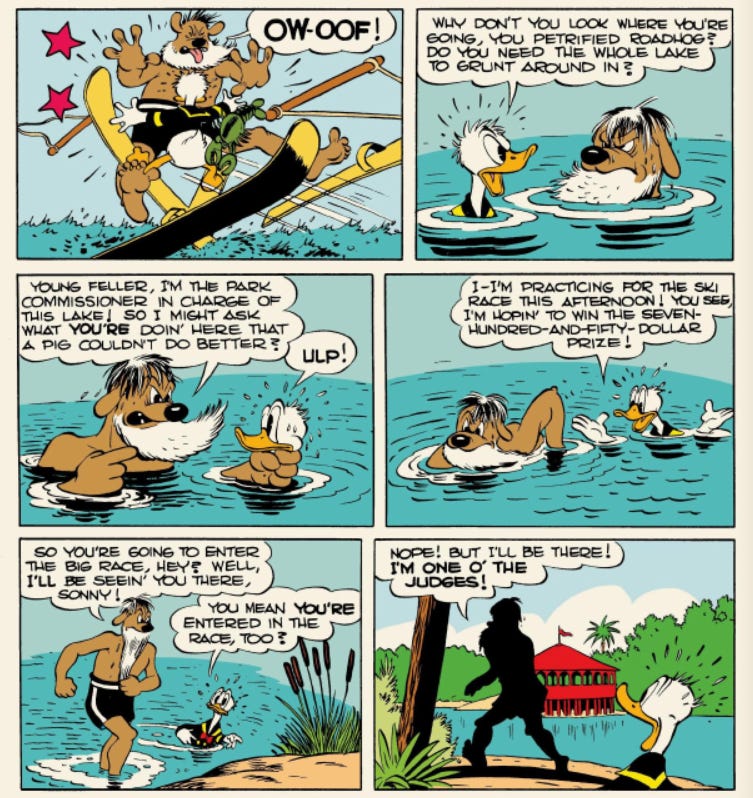
He’s Donald’s physical, generational, and social superior. On finding out that last fact, Donald immediately turns deferential, abandoning competition and going for full-on appeasement. His shock in the final panel is that of having misgauged the situation very badly and damaged his real objective: getting the $750.
Donald falling into the wrong frame—thinking he’s in a macho sandbox with Pappy instead of trying to win a race—is analogized in Donald’s misapprehension of Pappy himself: Donald thought he’d be competing against Pappy, when Pappy is actually the judge.
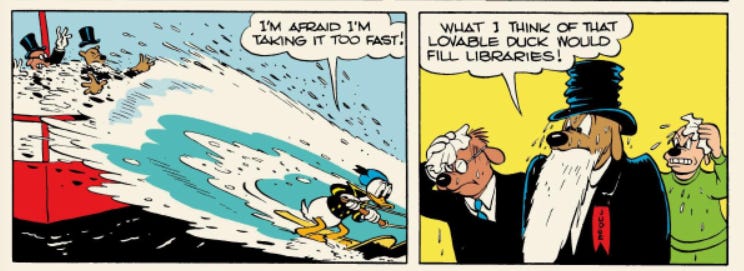
After some troubles with the nephews overdosing on soda pop and ice cream and Donald needing to engineer a remote-control mechanism to control his speedboat, the race begins and it is the expected disaster. There’s a bit of a perfunctory feel as things play out in predictable fashion, not rising to the level of Donald’s horrific attempt to cross Niagara Falls on highwire.
We do get Pappy’s reactions though, which are very paternal indeed. Donald is the prodigal son.
And eventually:
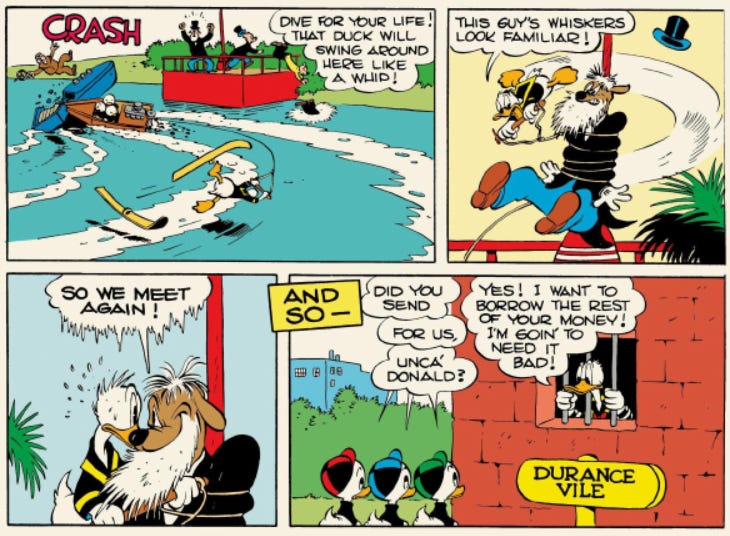
This is certainly where I learned the now-archaic expression “durance vile,” which was used in Barks’s time as a somewhat tongue-in-cheek expression for imprisonment. (I later wondered if the Residents’ Vileness Fats might have some loose link back to the phrase.) Donald’s remote-control boat flings out of control and he lassos the judge, who greets him with the iciest anger before giving him the punishment an adult doles out to a child: a time-out. The reversal of his borrowing money from the nephews caps it off. The nephews have become the adults and parents.
The story reads as a retrenchment, Barks returning to a structure and theme he knew quite well. What it adds—the presence of Pappy—isn’t huge, but it does elaborate on one problem Barks was facing, which was how to integrate Donald into larger society while preserving one or another forms of his classic personality. These experiments mostly took place in the adventure stories, where Donald had to display a certain degree of competence and coherence that the comedy stories didn’t require, but here there’s a similar experiment going on, with Donald becoming a child in the eyes of society.
The difficulty, which Barks would come to elaborate on, is that the society of adults may not be as fair or reasonable as is required for treating Donald as a child. Pappy is fair and reasonable, but Barks was far too cynical to pretend that Pappy was the least bit representative of humanity. In his best stories, he would bring out the tension between the irresponsible and troubled individual (Donald) and an irresponsible and troubled society.
Comments
Nothing yet. Say the first thing.
Sign in to join the conversation.