
Thug Busters (WDC&S #61, October 1945) puts Huey, Dewey, and Louie as the unquestioned protagonists of the story, relegating Donald not just to being an antagonist but nearly a marginal figure. It’s an equivocal step. What comes out is not just the sunniest story Barks had done to date, but also one of the dullest.
First, let’s look at where the nephews ended up. By late in Barks’s career, the nephews were three steadfastly ethical, knowledgable, brave and good-hearted kids who went on adventures and solved problems. They displayed little in the way of character faults and equally little in the way of childish behavior—very little you’d associate with anyone from age 6 to 10 or so, their supposed age range. They were dutiful Junior Woodchucks (i.e., Boy Scouts), and when Donald appeared as a foil, it was to show that the hard-working, modest attitudes of the nephews would triumph over Donald’s foolhardy arrogance and laziness.
In a word, the nephews were dull. Likable, but unconflicted and subject to only minor threats to their lives and values, and plagued by the unavoidable fact that “they” were actually one character in three bodies and so incapable of generating tension and dialogue within themselves. I took it for granted when I was young, but seeing three identical characters having identical reactions in panel after panel is surreal at a fundamental level.
Barks mellowed out to a tremendous degree over the twenty years or so he did comics (I’m inclined to isolate 1955 as the transition point, as Michael Barrier does), and the loss of the fatalistic tension that charged his early work makes much of the later work forgettable. So it’s fascinating to see so much of that later standpoint in this story. While two months earlier Days at the Lazy K had eviscerated the nephews for sanctimonious hypocrisy, here they are uncomplicatedly dutiful and superior, with Donald’s attempts to sabotage them seeming more petty than anything else.
Donald sets up a false case for them and revels in their humiliation:
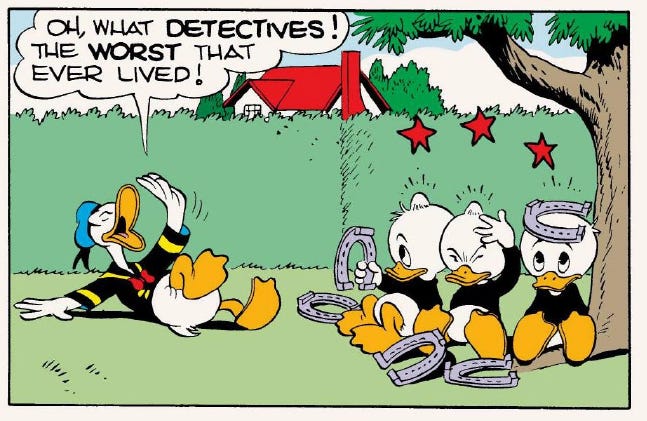
But the nephews’ response is just a bit too pure and tepid. They don’t even want revenge, they just want to learn the lesson from the experience.
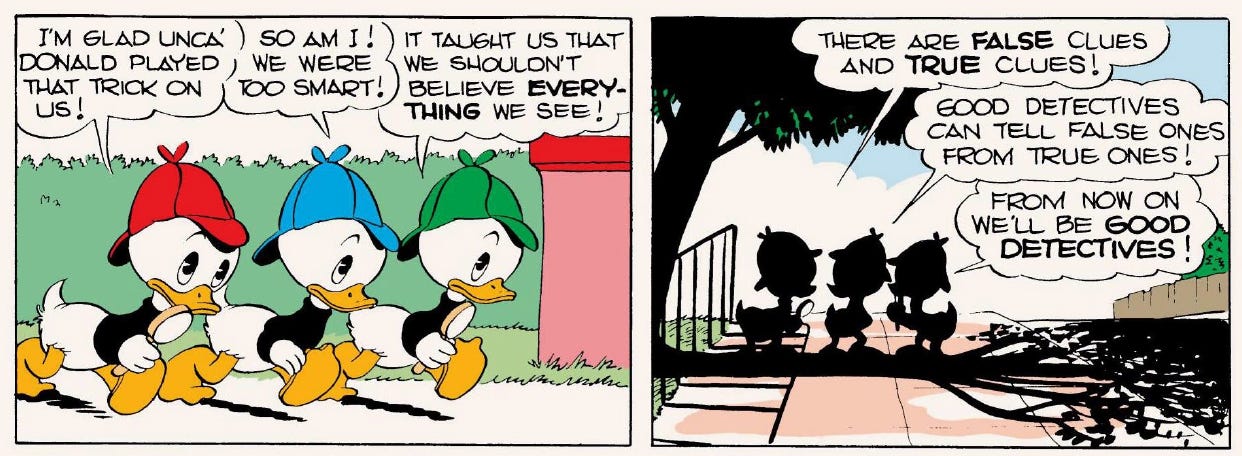
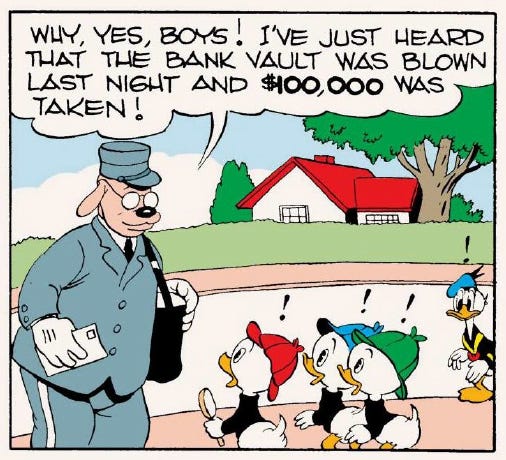
The nephews get pulled into the greater world when they hear that $100,000 was stolen from a bank and they decide to take the case.
Donald goes out of his way to torment the nephews, renting a load of costumes to throw nonsense at them.
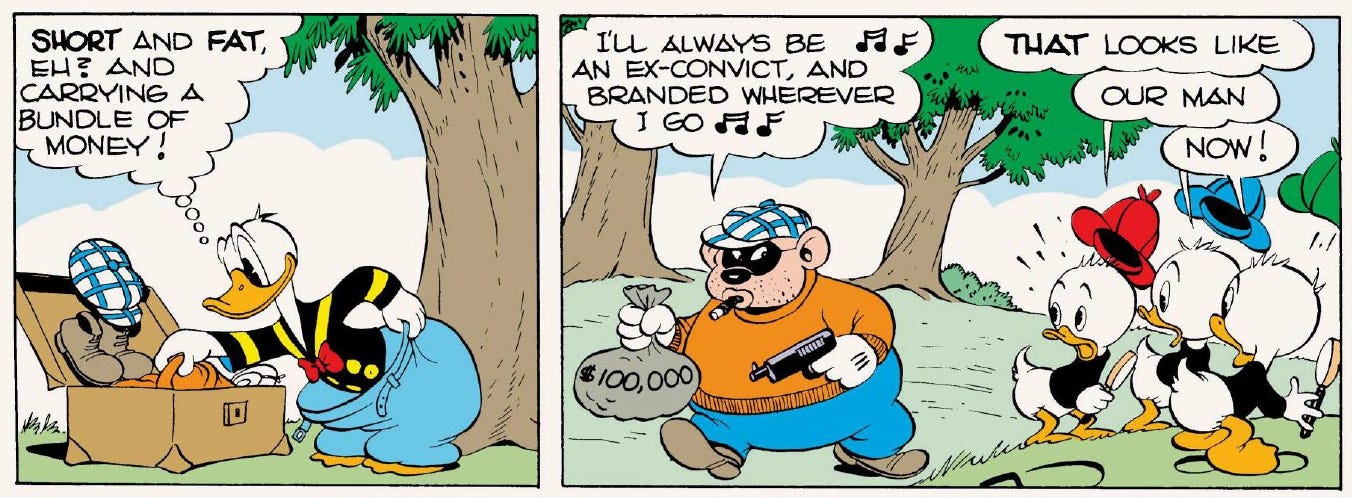
Donald’s antics go on for too long, since they don’t actually add up to anything but confusing the nephews further and further. At the last moment, though, Barks throws in the twist:
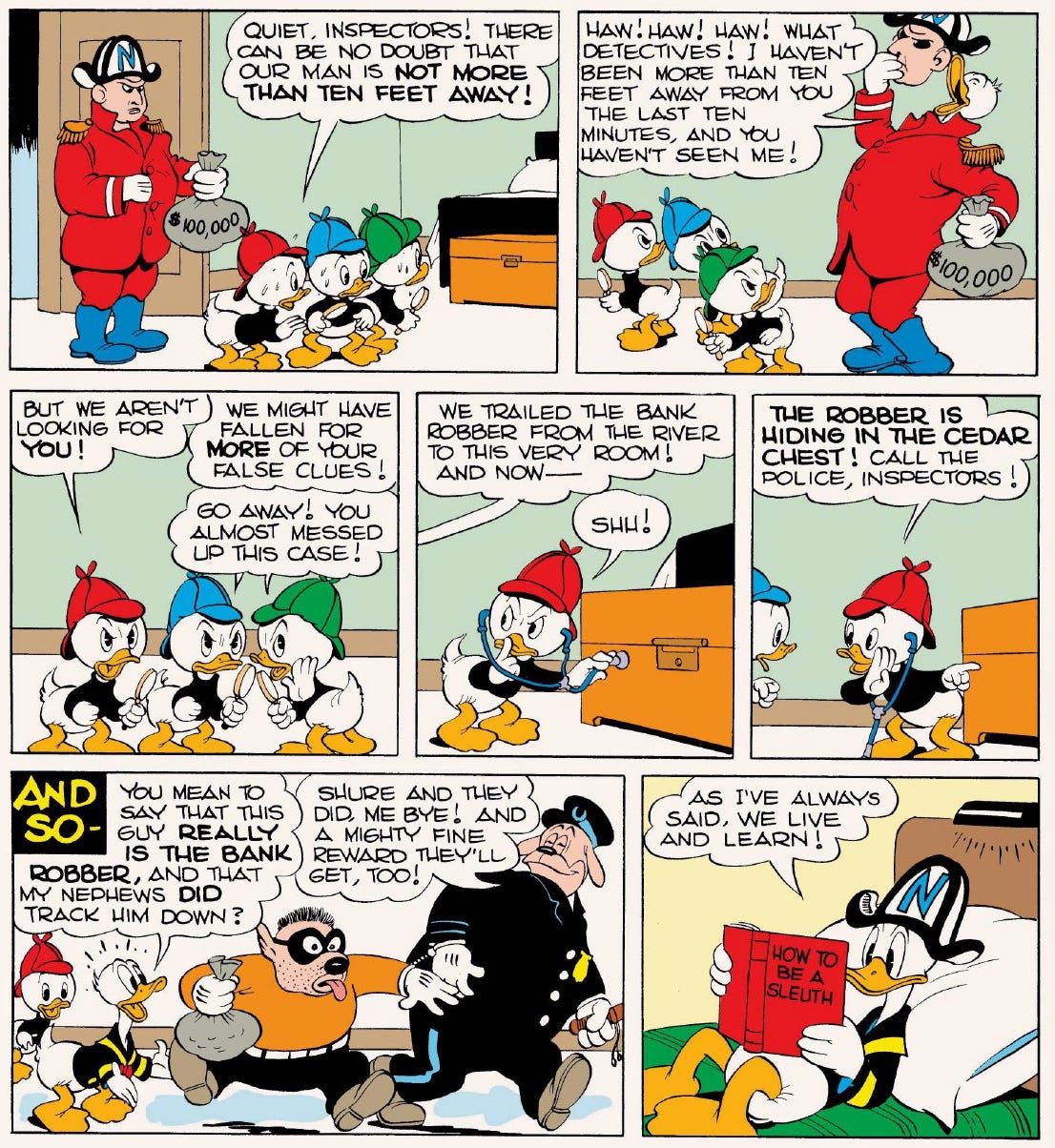
Fairly late in the game, the nephews did figure out that Donald was tricking them, and unbeknownst to the readers, they were finding real clues that indicated the real bank robber (who looks just like Donald in disguise) just happened to end up hiding in their chest.
Barks has had contrivances of catastrophe before, but this is the reverse: circumstances orient themselves so that the nephews are actually able to solve this case, right down to the robber ending up trapped in a trunk in their own house. The nephews worked hard, but fate gave them a major assist—seemingly at the cost of any personality. The shift to the greater context at the end makes Donald’s antics, which took up most of the story, look like just a trivial distraction, while we missed out on most of the build-up to the actual payoff—whatever real detective work the nephews were doing, we saw very little of it.
More significantly, it’s the first time Barks has portrayed a perfect world where everything works, from law and order down to kids’ games. The bank is robbed, teh criminal is apprehended, effort is recognized, and Donald is the sole fly in the ointment, a cancer to be expunged. It is wholly incompatible with the world Barks had portrayed in every other story he had written to date, and worse, it’s a far less interesting world. It cements that Donald, or something about him, had to remain at the heart of the story for darkness and complexity to inhabit Barks’s work, lest it turn into a clockwork Potemkin village of kids’ story tropes.
Why did it emerge now, though, amid a sea of fatalistic and gloomy stories? The idyllic world of this story always seemed within Barks, but why it popped up briefly at this moment I can’t say. My best guess is that it emerged naturally from putting the nephews at the center of the story and marginalizing Donald, and Barks quickly decided himself the result was too tepid and moved on. Because things would get much, much darker from here.
Comments
Nothing yet. Say the first thing.
Sign in to join the conversation.