
Ten-Dollar Dither (WDC&S #63, December 1945) finally makes good on Barks’s attempts to spin moral tales. It’s the story where he finally manages to figure out (imperfectly) how to integrate ethical values with his utter cynicism while portraying the message in the greater context of a whole society.
What’s new? For one, Donald is a moral paragon in this tale of trying to return a lost $10 bill to its rightful owner. Interrupted from his reading of War and Peace (!) by the nephews fighting, this month’s Donald is an upright paternal figure who inspires the nephews to do good.
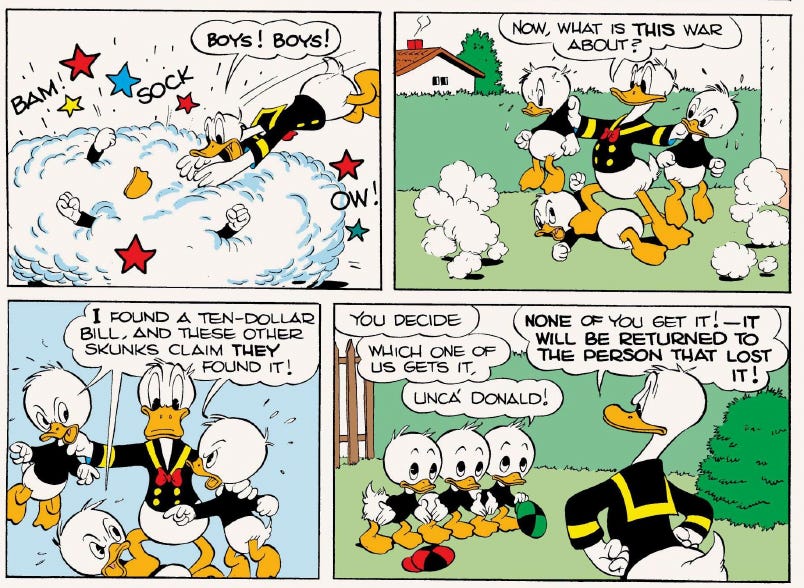
This would be boring if Donald’s tactics for doing good didn’t turn out to be almost entirely disastrous.
Some months ago, we saw a single dime cause havoc for Donald when he lost it, eventually sending him into a nervous breakdown. Donald retains his sanity here through the strength of his moral mission, but his inability to carry it out leaves him battered several times over.
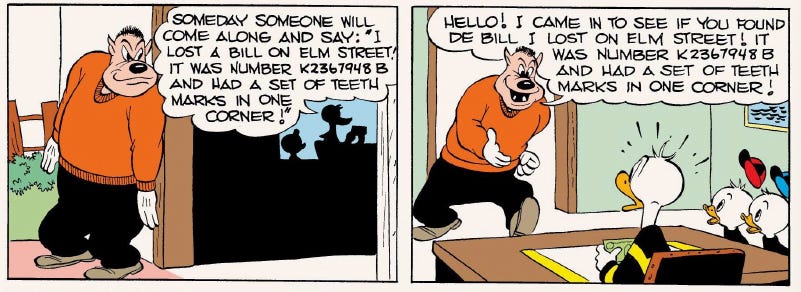
Donald starts by asking his neighbor Jones (a more generic version than the Jones we’ve seen before) to prove it’s his bill by saying where he lost it and what the serial number is:
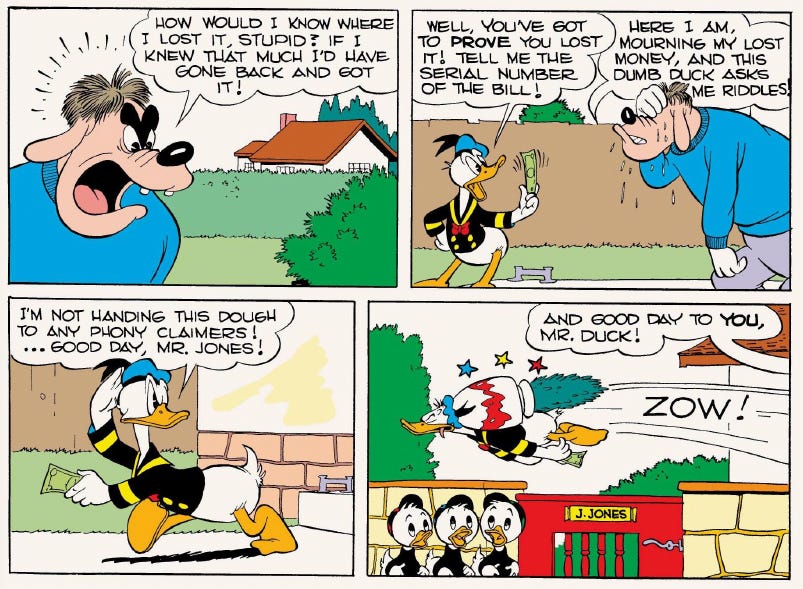
Jones is obviously lying, but Donald’s little quiz isn’t exactly valid. Who on earth would know the serial number of every bill they’re carrying? Donald sticks to his program despite its obvious absurdity. (Even as a kid, I thought this was ridiculous.)
He tries Old Maid Moosey next, and Donald’s suffering only increases.
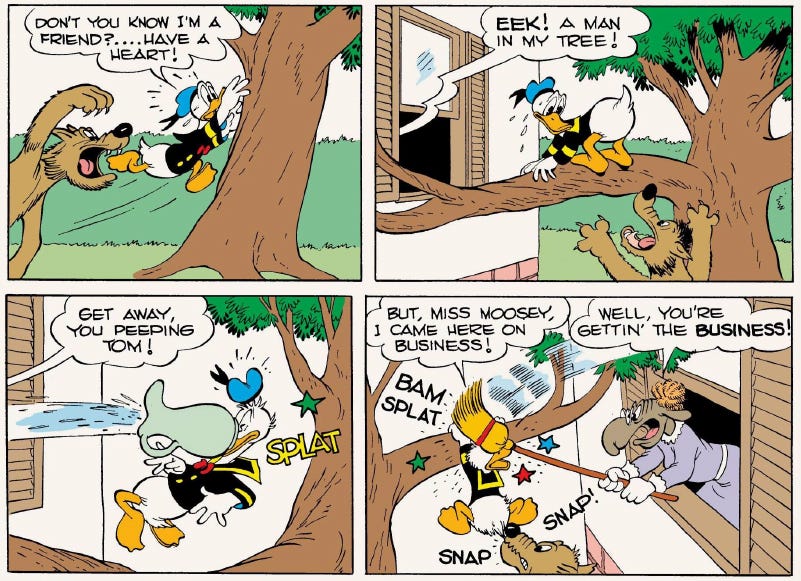
When he won’t give up the bill, she sends her parrot Esmeralda (“Men! I hate ‘em!”) after Donald.
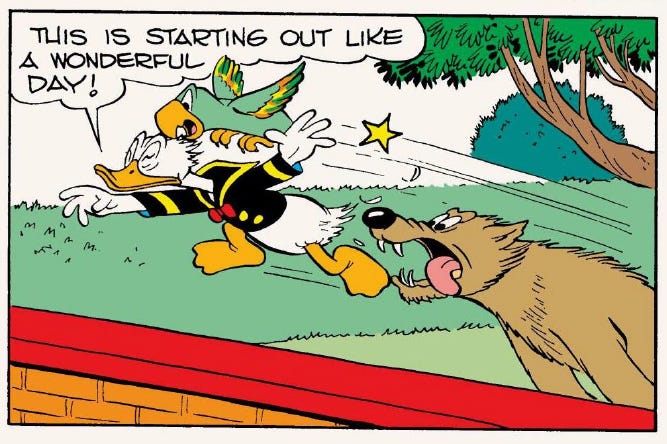
So far, Donald has gotten nowhere except to be assaulted several times over. The nephews suggest he place an ad in the paper asking for claimants to come to his house. This yields a mob:
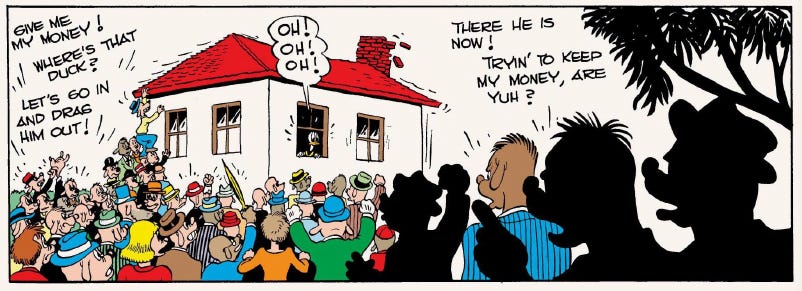
The arc of the story is for Donald’s moral naivete come up against human nature and terrible reality. His lack of strategy causes havoc and suffering, mostly to him. By this point, the question is whether any strategies to find the rightful owner of the bill would work.
Donald literally armors himself against the mob, only to get trounced anyway and find that the mob have taken over his house.
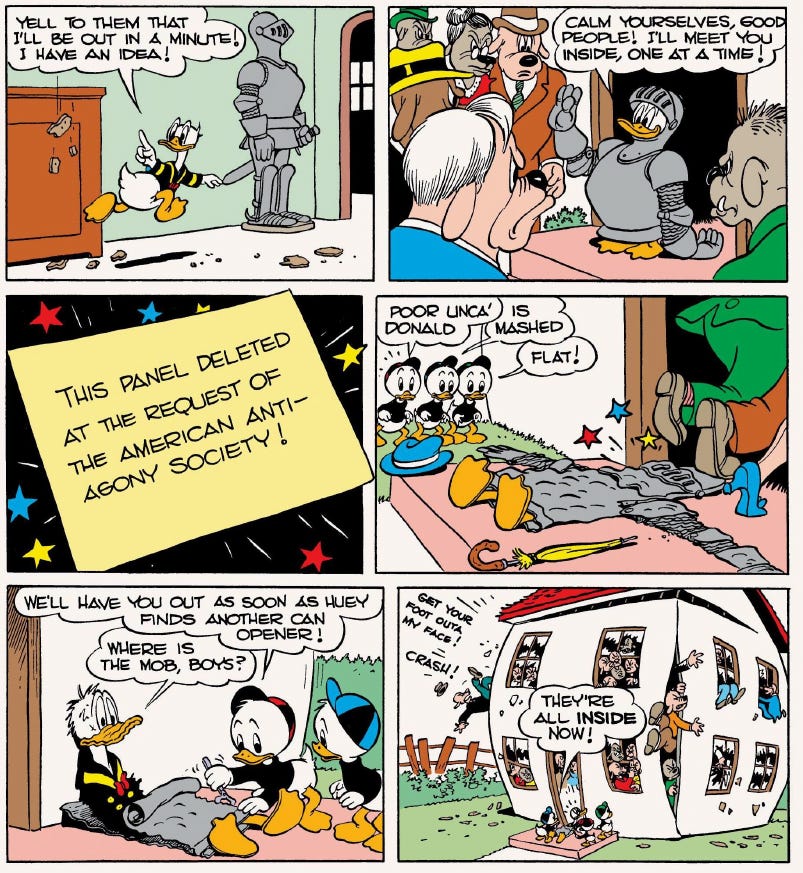
The “deleted panel” is a subtle poke at hypocrisy, invoking the forces of society to cover up what society is truly like. The people surrounding him aren’t atypical; they’re just average greedy Joes.
Yet the final destruction of Donald’s strategy comes when someone does show up with the right information.
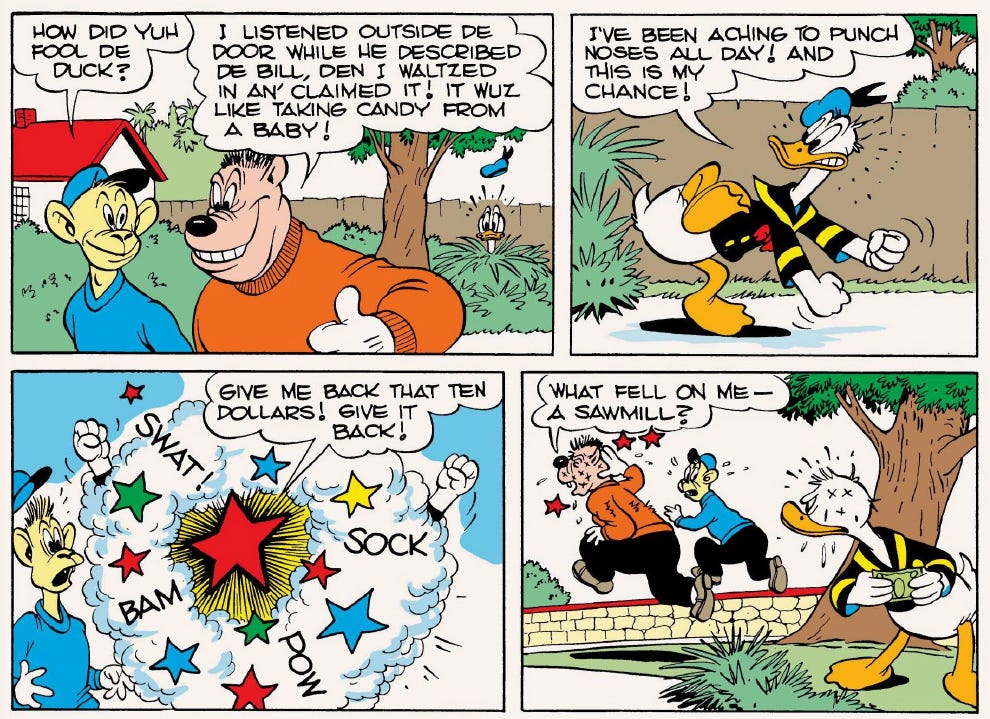
The guy is a thug so ridiculously evil he plans to use the bill to buy a gun and rob an orphanage.
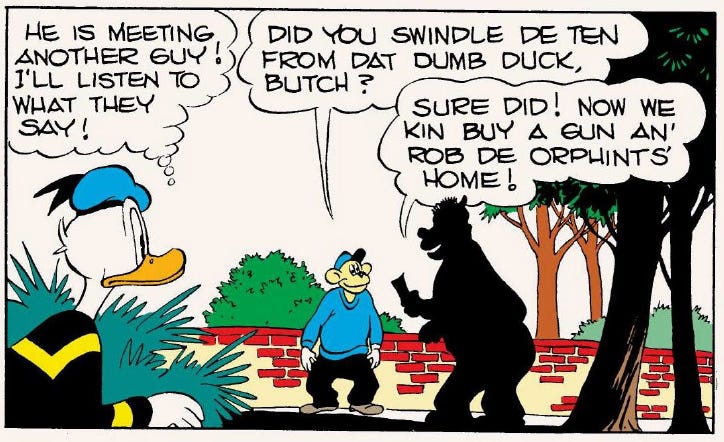
The turnaround is so comically contrived and the thug so over-the-top that the humor is at Donald’s expense. All that trouble, and his strategy only led him to give the bill to the worst possible person he could have.
Donald changes tactics: he finally releases his long-suppressed frustration and beats the crap ut of the thug.
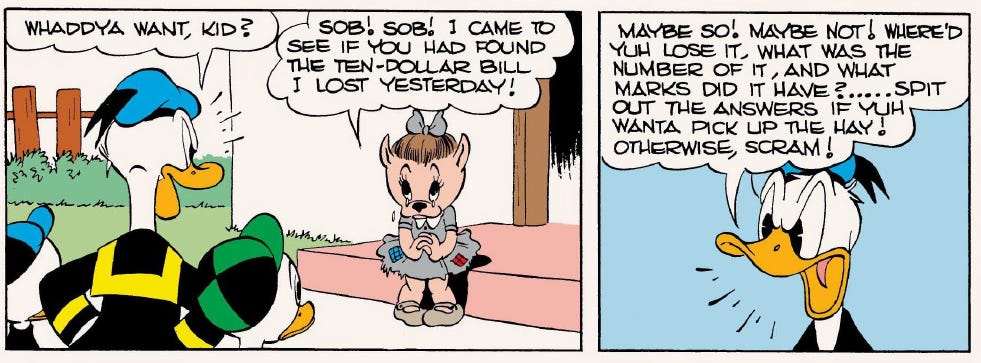
At this point Donald topples over into cynicism, rejecting a stereotypically poor girl who so obviously is the rightful owner, abruptly falling into some Noo Yawkese dialect just to emphasize how jaded he’s ecome.
Her teeth line up with the marks on the bill, providing the confirmation, but also underlining the absurdity that Donald had to fight his way through half the neighborhood to get here.
In the face of the evidence, Donald softens and slides back into his virtuous pose, but it feels a little off:
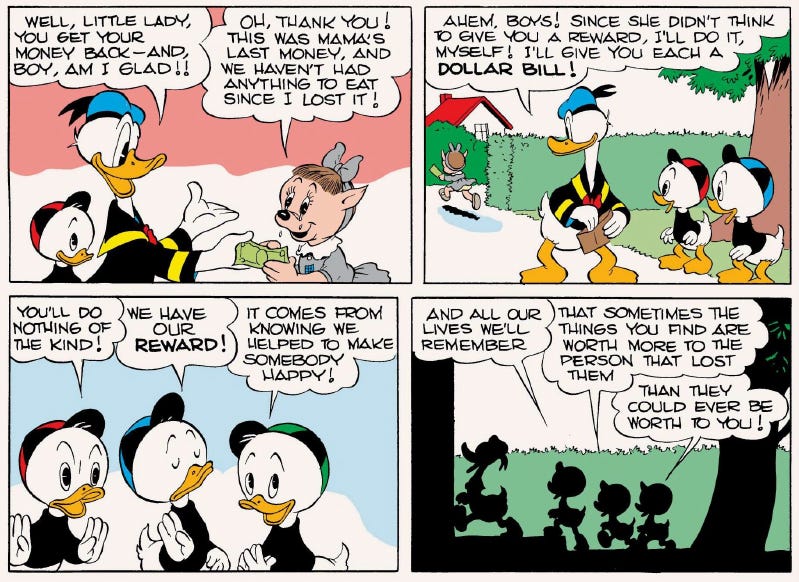
The girl is just as comically sympathetic (“Mama’s last money!”) as the thug was evil, so the whole plot feels a bit fishy. Not that anything fishy is going on in it, but how seriously are we supposed to take it? Donald and the nephews all end up on the right side of virtue, but they’ve been taught that there’s a heavy price to pay for it and very little reward outside of one’s inner satisfaction. Worse, the world will fight them at every turn.
Well, I think the answer is that Barks himself was torn. He had the moral instinct, but he couldn’t take it fully seriously—at least not at this stage of his career—so any presentation of a straightforward message tends to get undercut subtly and structurally. In Thug Busters, he played the morality so straight the result was boring (and perhaps that was the subversion), but moreover, it no longer felt true, and the result was one of his dullest stories to date.
Barks surely realized that. Ten-Dollar Dither is Barks discovering an acceptable formula for a moral story: hell to pay for virtue. But also, the ability for virtue to eventually triumph even in the face of folly and laughably poor judgment, albeit with significant collateral damage along the way. Donald could get his moral victory and still be humiliated and brutalized in the process. And even the moral victory wouldn’t be assured.
Comments
Nothing yet. Say the first thing.
Sign in to join the conversation.