
The Icebox Robber (WDC&S #56, May 1945) throws a new theme into the mix: sleep. For a writer focused on fate and chaos, what role does unconsciousness play for Barks? Sleep carries a potent and unnerving charge in Barks’s stories, which culminates in the genuinely disturbing Donald’s Worst Nightmare in 1949. Sleep is not a threat here, it seems—or is it?
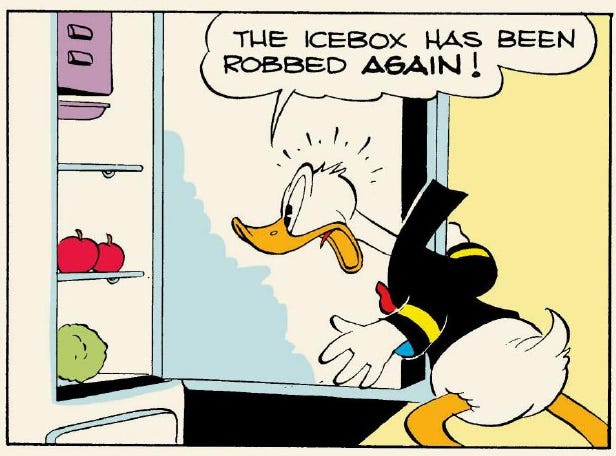
Donald is back to being a parent in this story. His authority and seniority are assumed and uncontested, even with a taste for corporal punishment that now seems fairly unpleasant. Donald draws the conclusion that the nephews must be lying when they say they didn’t steal from the icebox at night, and he switches them several times throughout the story.
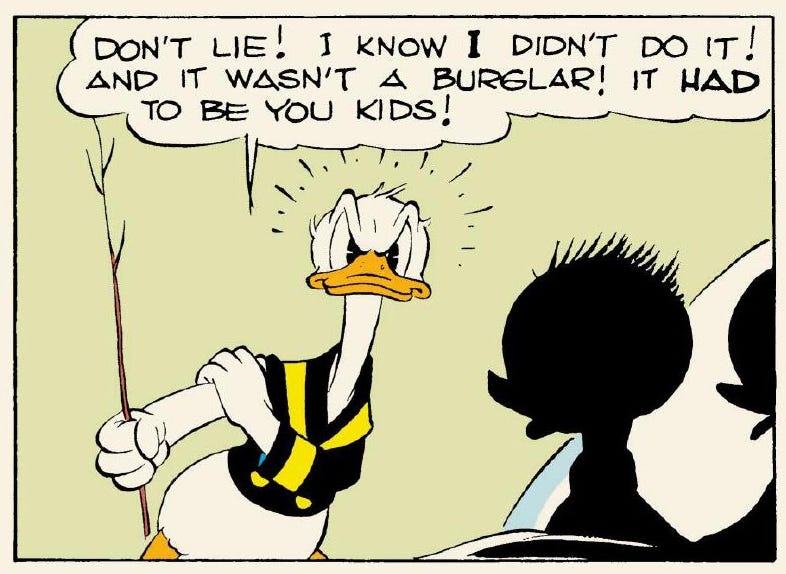
It’s not played for laughs, but it isn’t played as a monstrosity either. Unlike the earlier ten-pagers where he competed with the nephews or tormented them, this story gives us a new Donald, exercising authority unreasonably but with the full standing of a parent.
The nephews take on a detective role. They’re more or less impeccable in this story, but that impeccability isn’t quite set opposite Donald because of the uneven playing field. They will eventually outsmart him by leveraging his own authority against him—not by going up against him directly.
It turns out that Donald is sleepwalking, thinking he’s having steak at “Hogan’s Inn.” Sleepwalking becomes the central device of the whole story, as Barks strips down his plotting and scope to a fine point.
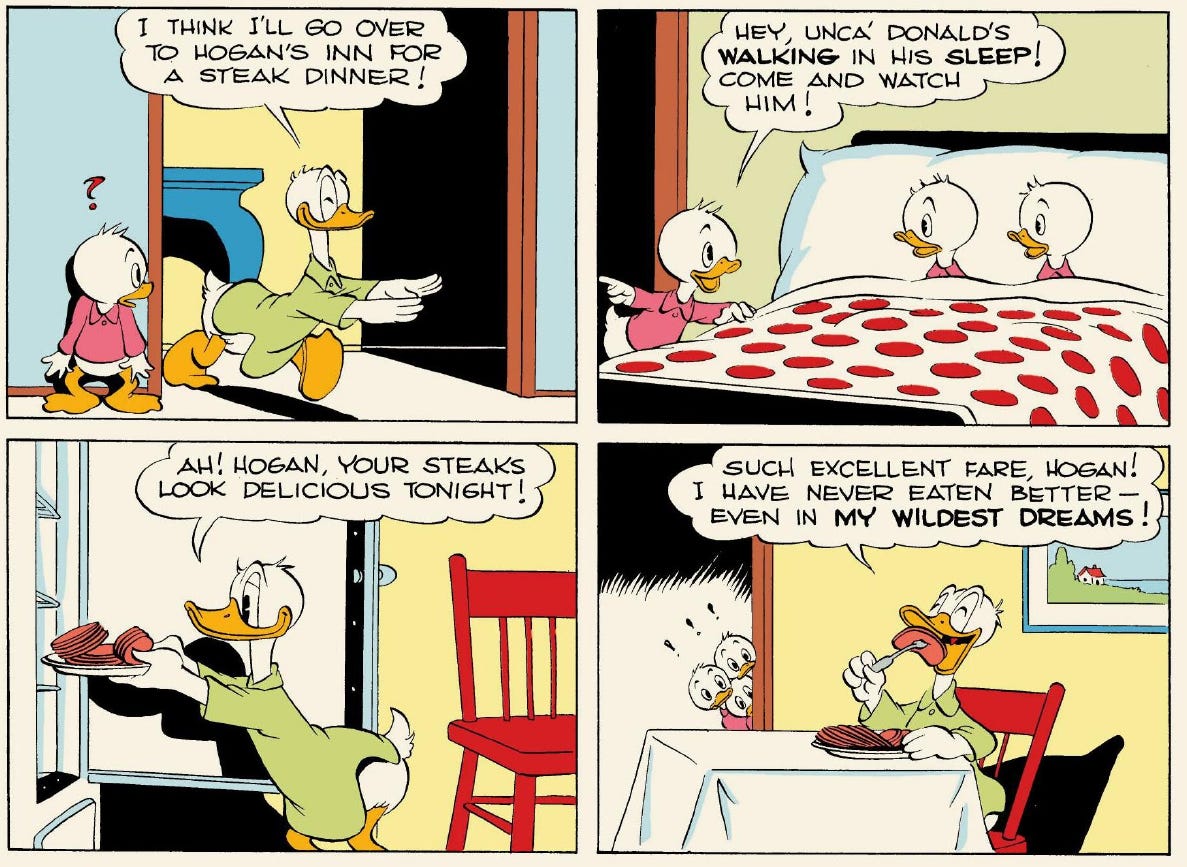
In this fugue state, Donald is transformed. His body language is softer, he’s less terse, and he is constantly smiling. Instead of the harsh and preoccupied Donald, we get an alternate Donald who is affable, easy-going, and untroubled. Donald, in other words, freed of responsibilities, parental and otherwise.
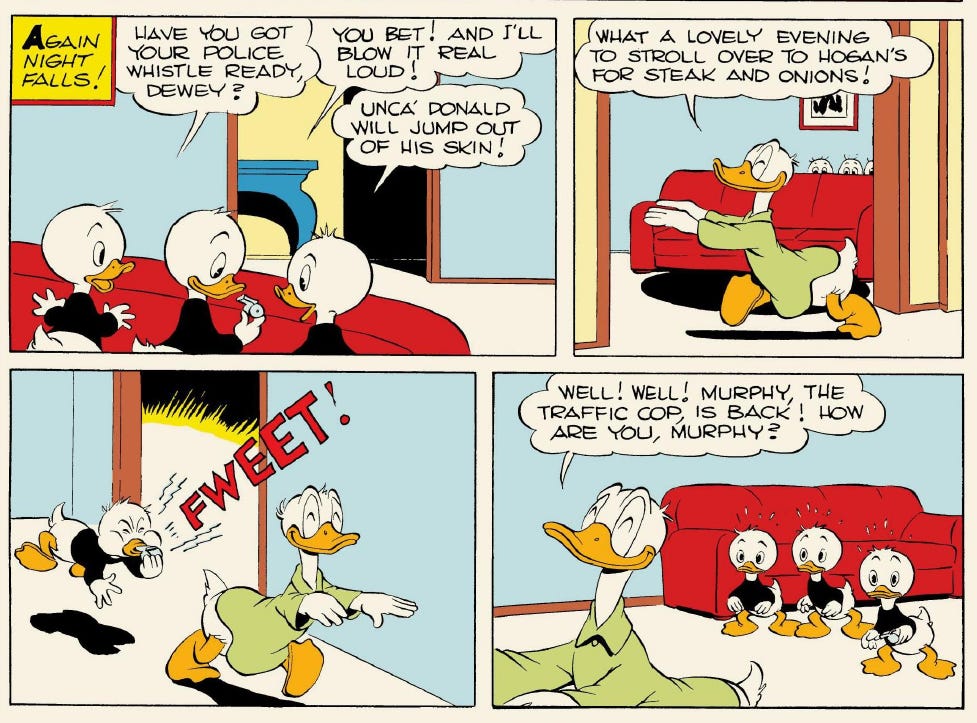
He is dedicated to his dream life and unfailingly blissful in it. Who would want to be awakened from this reverie? The very first panel takes on greater weight after we realize that being woken forces Donald out of his happy dream self into his irascible daytime self.
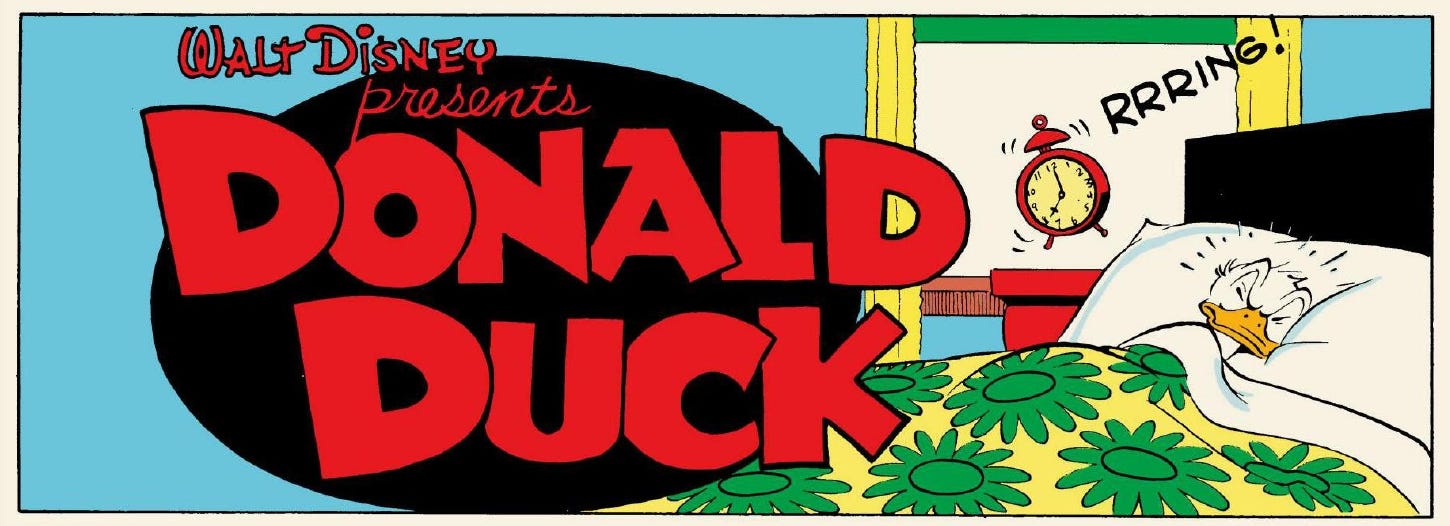
Awake, he immediately reverts to being rageful and impetuous:
When he rejects the nephews’ suggestion that he was sleepwalking, he’s implicitly rejecting the idea that he is robbing Peter to pay Paul—giving pleasure to his sleep self at the cost of causing stress on him and the nephews.
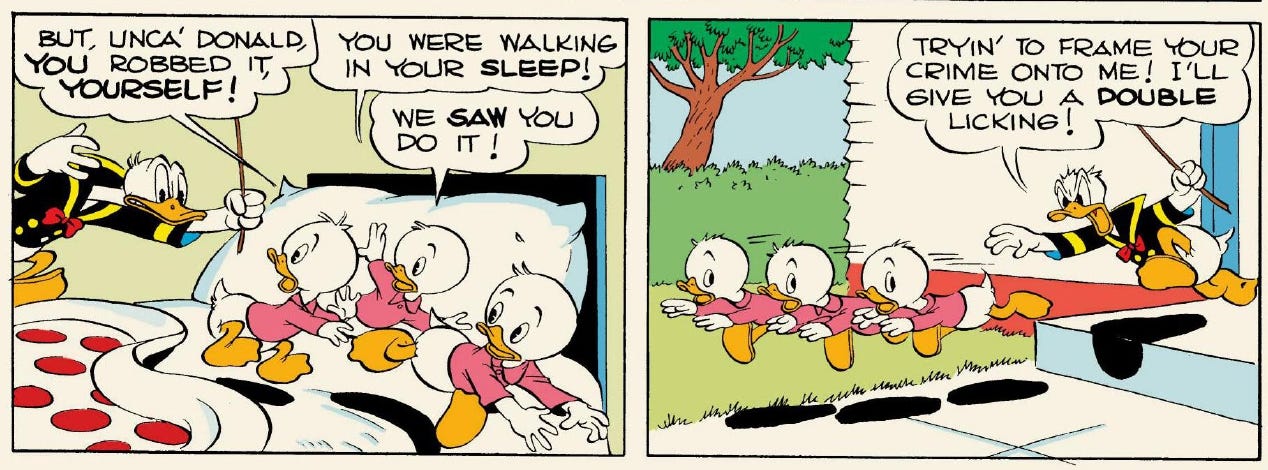
He rejects the truth with such vehemence that it goes beyond simple pig-headedness. He’s denying the possibility of that happy sleep self. Even when the nephews fire a slingshot at him in a failed attempt to wake up, his response is uncharacteristically muted compared to his rage when awake:
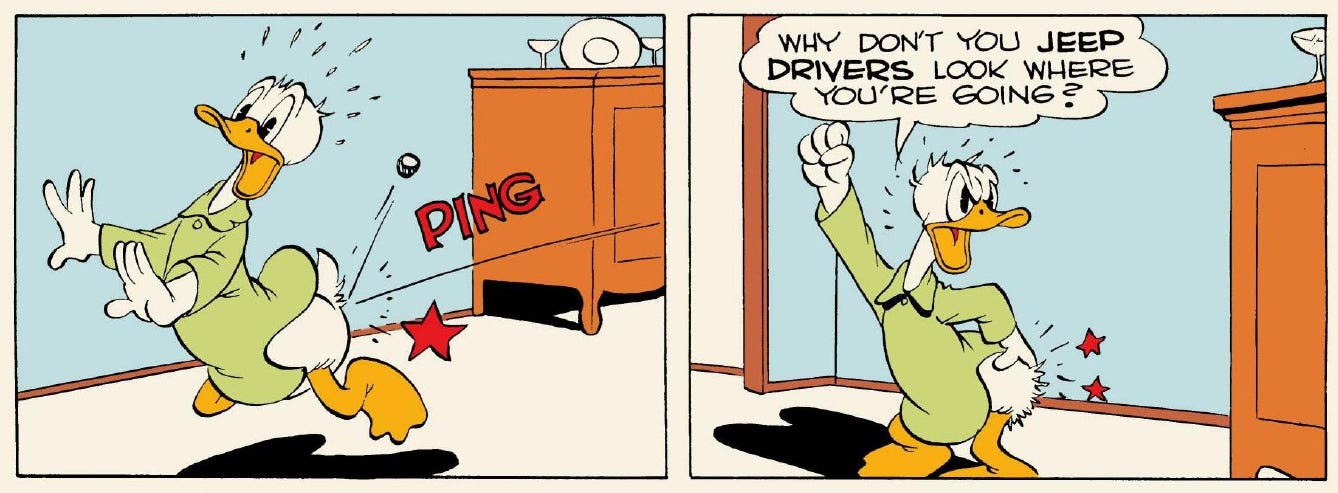
He’s annoyed, but there is none of the white-hot fury he possesses when awake. So here’s a question: is this even Donald? He doesn’t act like Donald (this story’s Donald, that is), he doesn’t talk like Donald (“Such excellent fare, Hogan!”), and there’s nothing in his sleep life that resembles anything in his real life.
When the nephews try some tiny fireworks to wake Donald up, we see yet another variation, Donald as soldier:
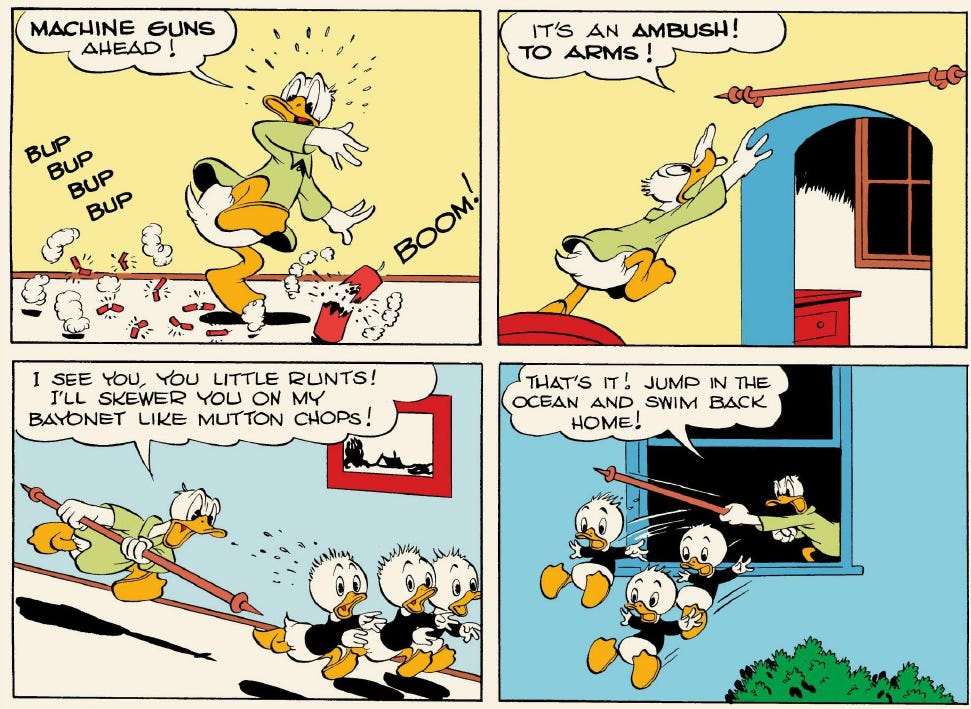
There’s a suggestion that Donald’s dream self is taking on personae from movies, whether cultured sophisticates eating at steak joints or patriotic soldiers. He’s able to repurpose props (firecrackers and a curtain rod) from his house as devices in his dream narrative and loses all traces of his real-life identity—and its troubles.
In the face of this invulnerable dream identity, the nephews engineer a way to pit his real-life identity against it. The kind-faced Doctor J. Quackwak immediatly believes the nephews and suggests a plot to expose Donald to himself.
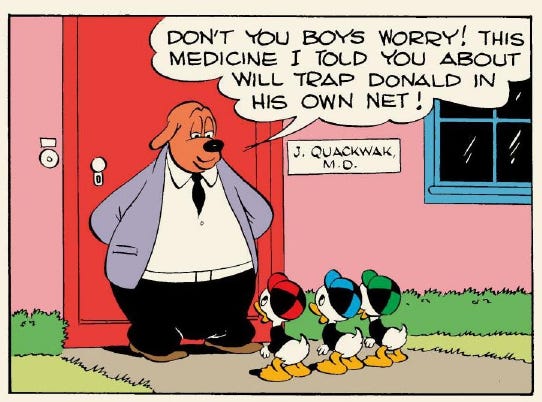
Quackwak gives them a food additive that will turn the face of the culprit green. Donald eagerly uses it, ready to trap the nephews, and gets a hell of a shock..
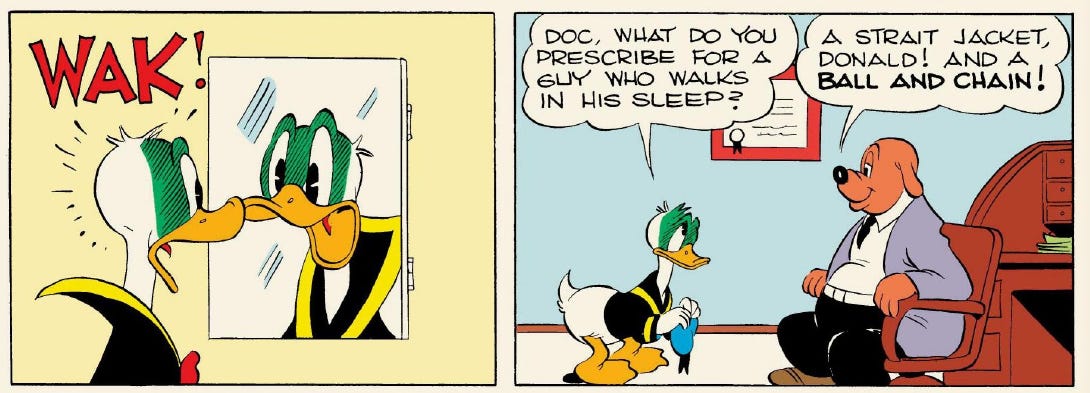
The mirror scene is Donald confronting his dream-self—or rather, being faced with the reality that the two selves are one, forcing them to reintegrate and reject the fantasy. The doctor’s draconian recommendations represent the subjugation and restriction of whatever dream self he may have, forcing him to resign himself to reality.
What’s the significance of sleep here? It offers an escape, but it’s also the source of loss of control and a fragmenting of the self. That’s how we get from Donald’s steak-eating sophisticate to this, four years later:
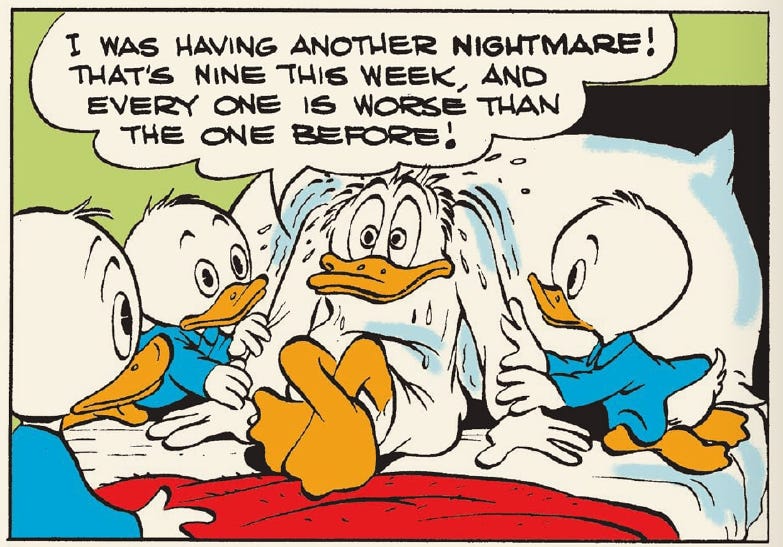
Sleep can be an idyllic retreat mocking the misery of reality. It can also reflect and amplify reality into madness. It’s a tool of fate.
Comments
Nothing yet. Say the first thing.
Sign in to join the conversation.