
By this point Barks had a fairly extensive toolbox of ideas, and some stories are a clear result of recombining former ideas. Pecking Order (WDC&S #57, June 1945) combines the hellish bird of Farragut the Falcon with the yellow journalism theme of Camera Crazy. Here, the gimmick is that if Donald or the nephews can photograph the rarest woodpecker in the world, they’ll get an unfathomable thousand dollars ($18,000 today!). Without introducing new ideas, the charge of the story, when it has one, is in the strangely anomalous combination of story themes and Donald’s previous personae.
Without the theme of photographing human chaos and misery, the story loses a lot of its direct punch. Most of the story is technically impressive but primarily an excuse for physical gags as Donald is endlessly foiled. Donald is nominally in competition with the nephews, but they fade into the background as his accomplices rather than playing an integral ongoing role.
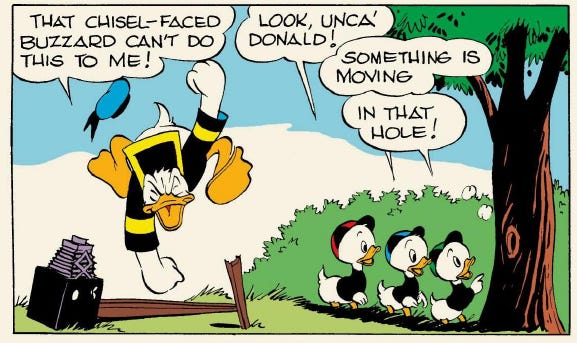
Donald experiences frustration:
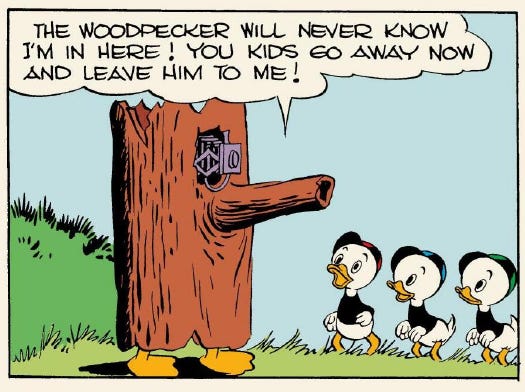
He tries out amusing disguises:
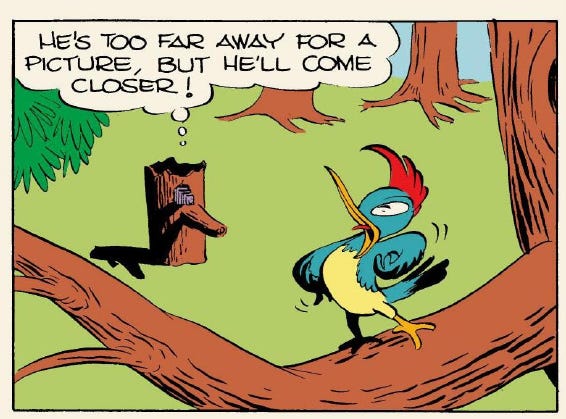
And he finds his nemesis, who is oddly reflective of him: proud, irascible, and defiant for the sake of being defiant:
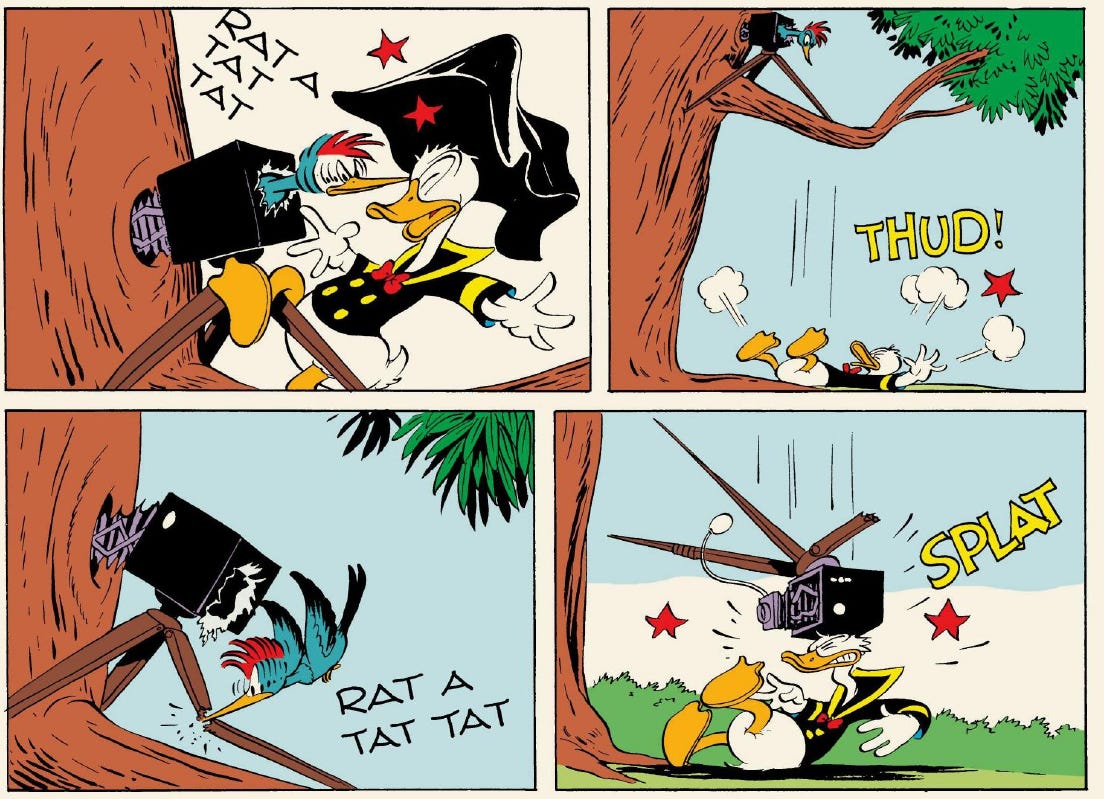
Barks kineticism in the portrayal of the gags continues to improve. There’s a momentum to the action that he didn’t have a year before, and Barks cuts quickly
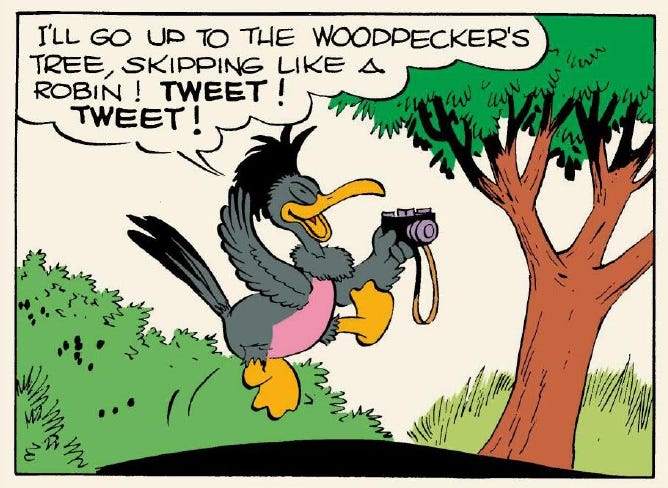
There are some anthropomorphic hijinx when Donald Duck dresses up as a bird to fool the woodpecker. (It doesn’t work.)
It’s not until the ending that deeper themes emerge, when the nephews think that Donald is picking on the woodpecker and shoot him with a BB gun, causing the woodpecker to get tangled in the camera strap and giving the nephews the opportunity to win the prize.
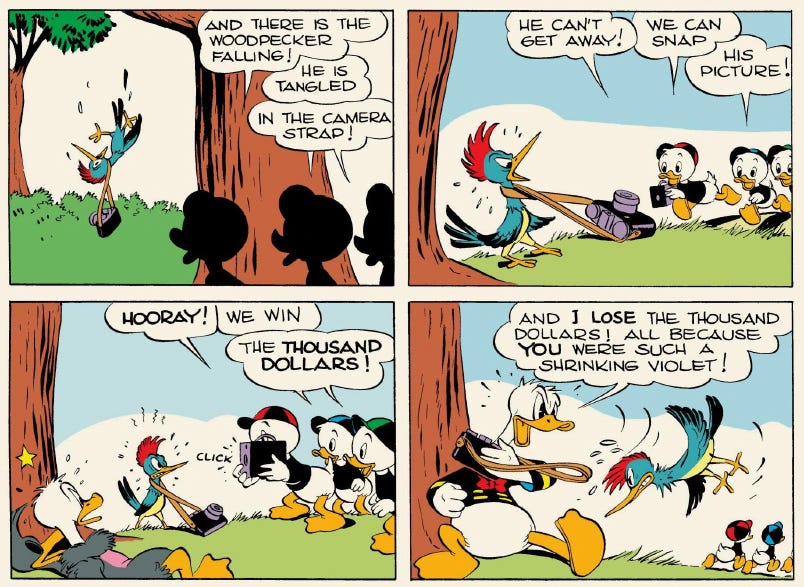
This is where we get a touch of Barks’s absurd logic, where the nephews profit handsomely from a chain of unlikely events that couldn’t have occurred without Donald’s folly and several fated misunderstandings that weren’t under anyone’s control. There’s even a suggestion that the woodpecker’s relentless tormenting of Donald did him in as well, putting Donald and the animals on the same level for once. These themes aren’t developed, but they are further manifestations of Barks leaning towards a near-nihilistic view of human efficacy in the face of fate.
That nihilism comes out in the tentative ending, where the woodpecker continues to torment Donald:
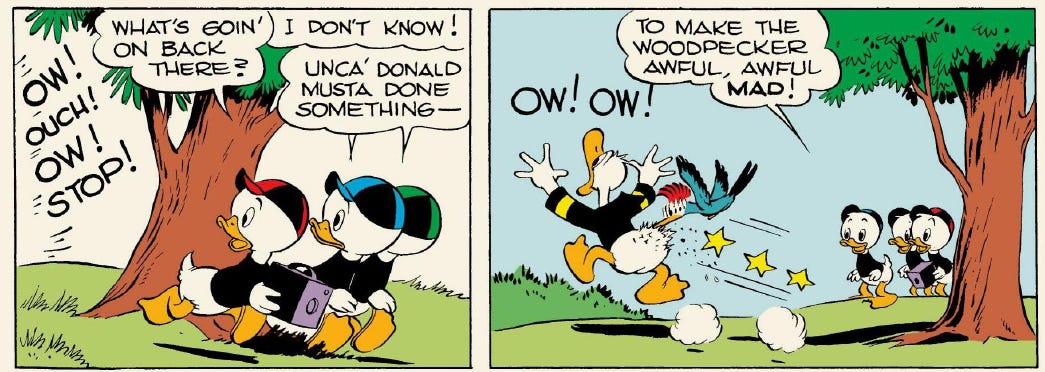
Oddly, Donald was fairly well-behaved in the story. His worst crime was daring to try to take a picture of the woodpecker, and his methods were far less malicious than they often have been. At worst, he was annoying. Stranger still, the nephews knew exactly what Donald got up to. If they are wondering why Donald made the woodpecker so angry, it’s not because they’re missing part of the story—it’s because they themselves can’t understand why Donald is being so tormented.
The presentation is ambiguous. It’s easy to think, “Oh, the nephews don’t realize how Donald tormented the woodpecker,” and with different versions of Donald, this could easily be true. Here, though, it’s a deception, and the truth is that there isn’t some secret. Donald, who started off seemingly arrogant and selfish, doesn’t get his comeuppance so much as he metamorphosizes into a different version of himself: the cosmically persecuted man doomed to failure. It’s the emergence of Barks’s meta-fatalism, where even one’s momentary role can be shifted by the universe on a whim.
Comments
Nothing yet. Say the first thing.
Sign in to join the conversation.