
At first glance, Webfooted Wrangler (WDC&S #55, April 1945) is structurally identical to its immediate predecessor, The Long Race to Pumpkinburg. Donald starts off in a devilish mood tormenting the nephews, which turns into a contest of Donald’s competence in an unfamiliar area. Then it was ice skating; here it’s being a cowboy. Here, though, the contest takes a back seat to Donald’s endless humiliation.
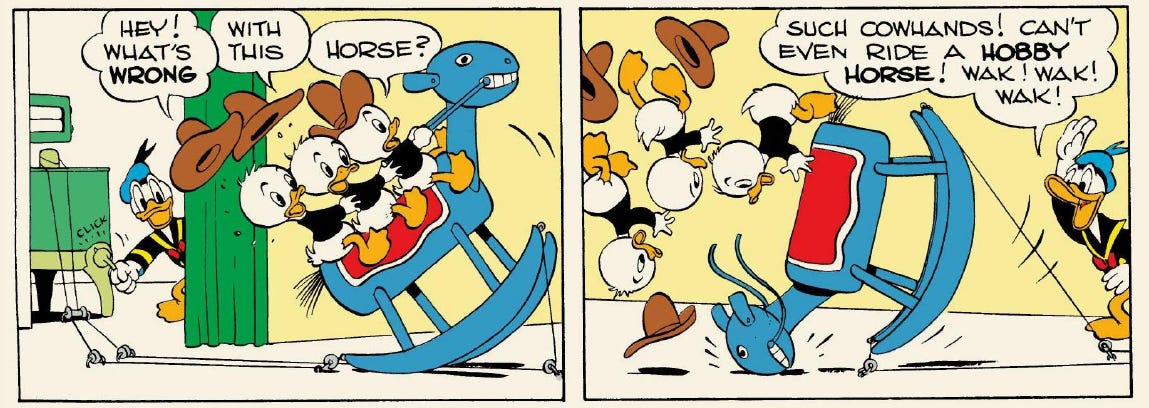
This is made somewhat more excusable by Donald not being in much of an authority position. In Pumpkinburg, he was trying to get the kids to do the chores. Here, he’s more the neighborhood bully, and the nephews show him no deference.
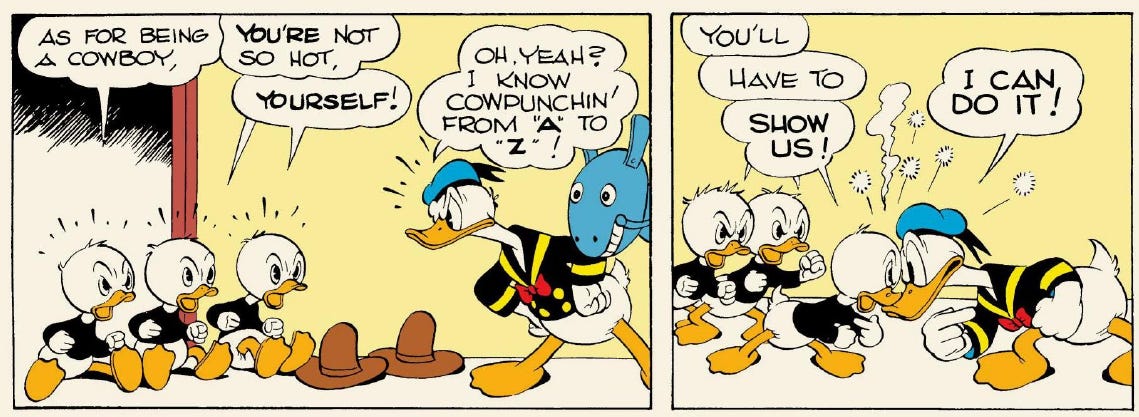
Once they get to “Cuthbert Coot’s Cattle Ranch,” though, the story dissolves into a series of sight gags involving Donald enduring the most punishment he’s had for months.
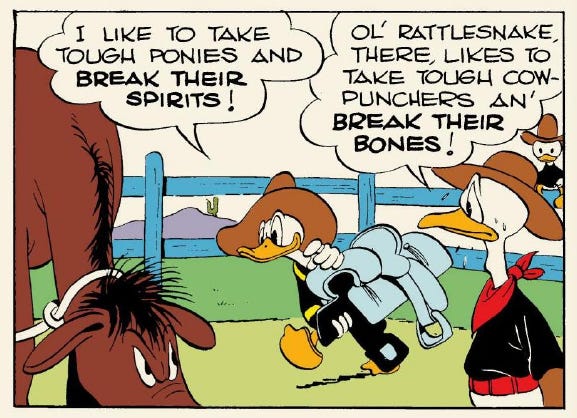
The nephews and Cuthbert become spectators to Donald’s torment at the hands of the most ornery horse around.
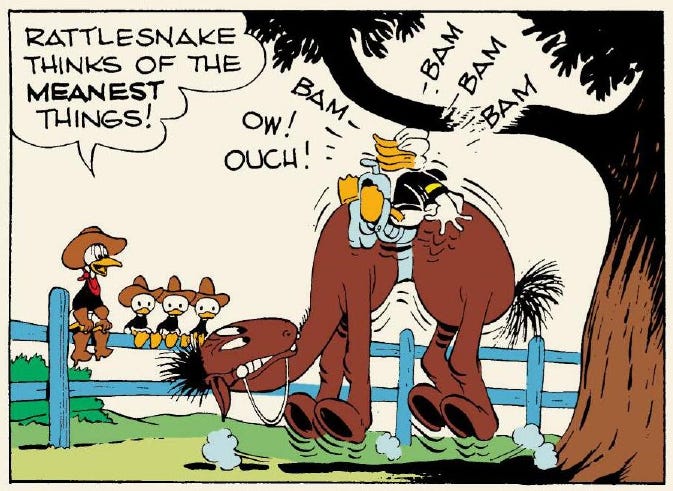
Rattlesnake may seem as vicious as Farragut the falcon, but there Donald was a complete victim to the intrusion of the demon falcon, while here there’s every bit of moral logic for him to suffer. Farragut was an exercise in random calamity; here the moral arc of the universe is swift and clear.
Barks goes awfully hard on Donald though. Even after Donald gives up on Rattlesnake and sets his sights on the more modest task of roping a calf, the calf turns out to be no less intransigent. This proceeds somewhat apace, though there are some dynamic and even eccentric framing choices, including possibly the first time something has escaped one of Barks’s panel frame. (I’m not positive.)
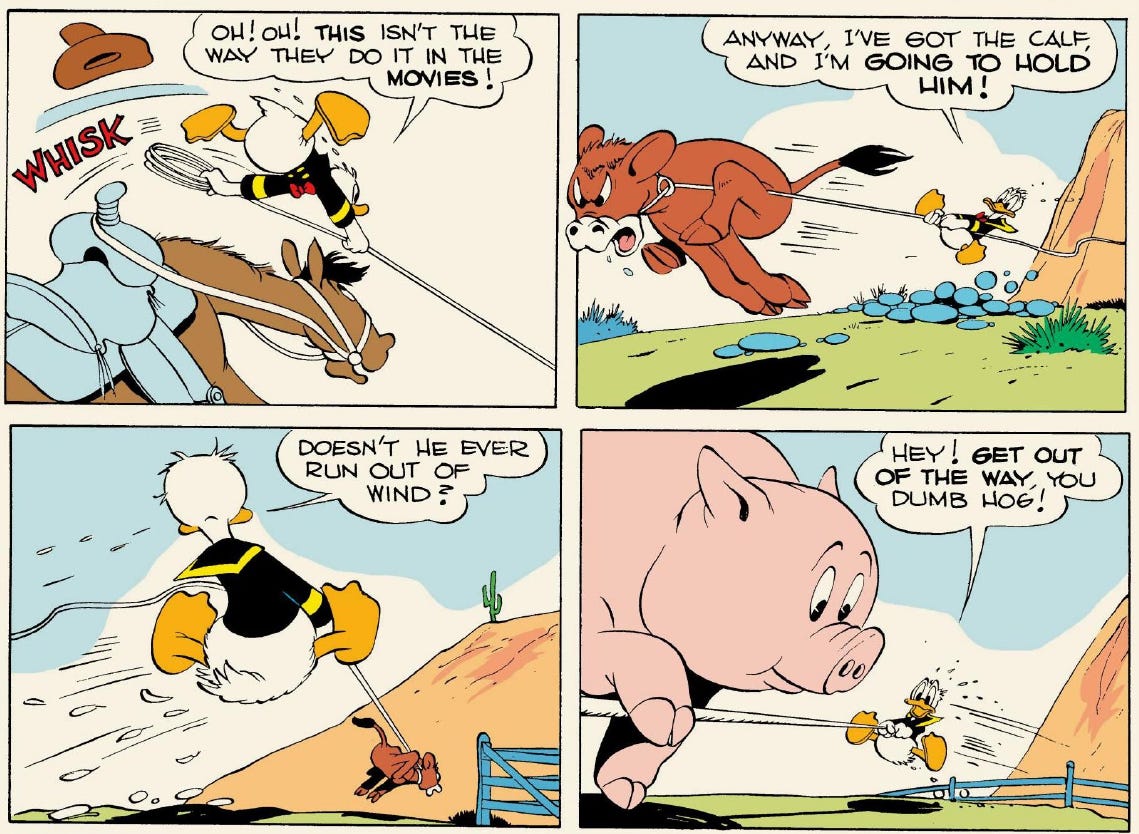
Barks’s experimentation with angles is more aggressive than in any of his other stories. To an extent, the story is an excuse for this sort of experimentation. Beyond the calf bursting out of the frame and the quick angle changes, the long-perspective shot of the pig and Donald is symbolically the heart of the story.
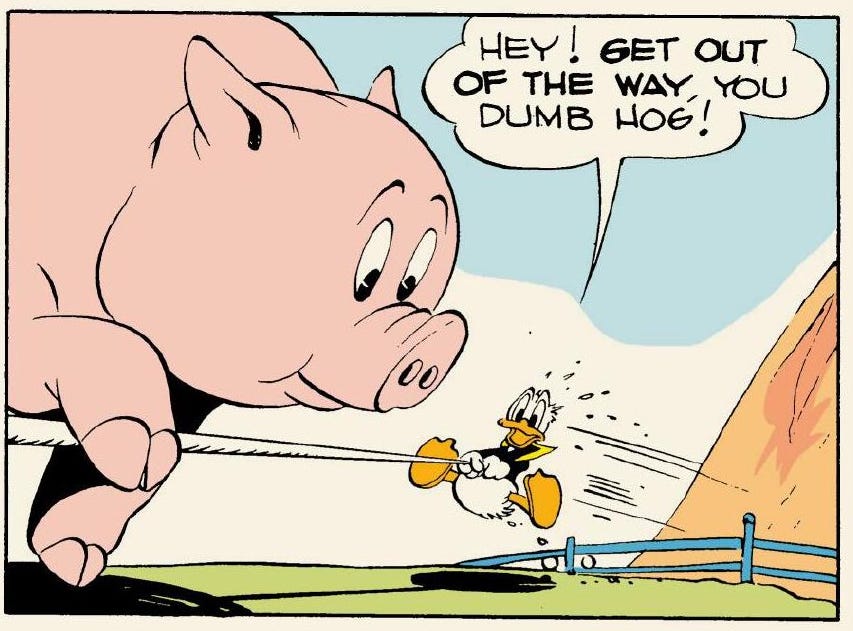
The pig’s nose is bigger than Donald’s head. The panel succinctly captures one increasingly defining feature of Barks’s worldview, which is that the reality of cause and effect is only very, very loosely correlated with humans’ perceptions and intentions of such. The oblivious, idling pig has no awareness of the story and relation to Donald at all, yet it’s the pig and not the calf that foils Donald’s attempt. If there’s a law of fate and hubris here (which there clearly seems to be), it’s meted out unfathomably by unseen universal forces, not by any individual creature.
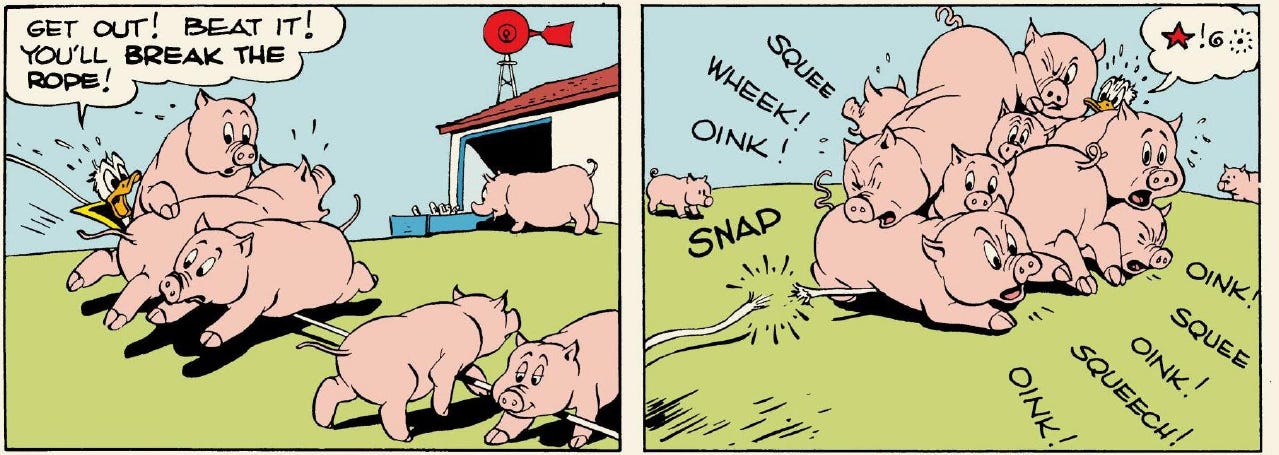
And when Donald gets pulled into a pigpile, it’s an apt visual metaphor for all human associations: chaotic, perverse, incomprehensible.
When Donald is later slingshotted into a mud puddle after accidentally lassoing a tree, he gets snooty looks from the pigs.
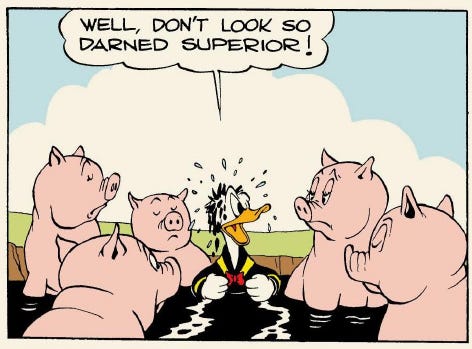
The implication is that the pigs are looking down on him for busting up their polite mud soiree, which is pretty funny but also fits with just how low Donald is being brought. By trying to excel in a human activity, he fails to reach even the standards of pig culture.
He does, however, catch the calf:
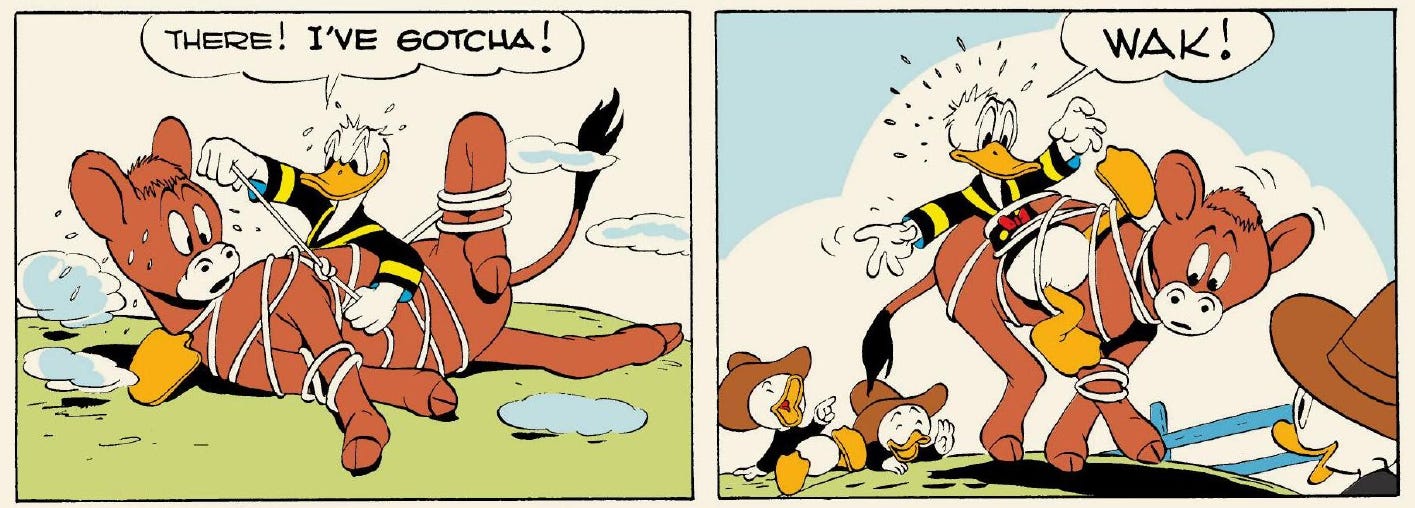
But when the nephews try to brand it, the branding goes wrong and Donald gets branded instead of the calf.
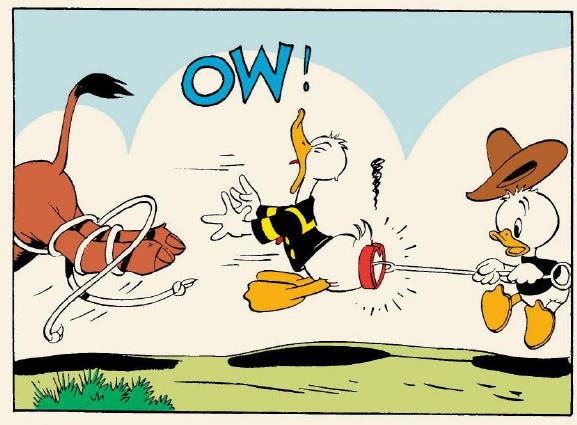
Again, he’s brought to the level of the subhuman as punishment for trying to subjugate the colt. This is all accidental on the part of the nephews. They’ve been taking pleasure in being the audience for his humiliation, but they haven’t participated in it.
The final humiliation is to reduce Donald to the level of a child (beneath the nephews), hobby horse and all:
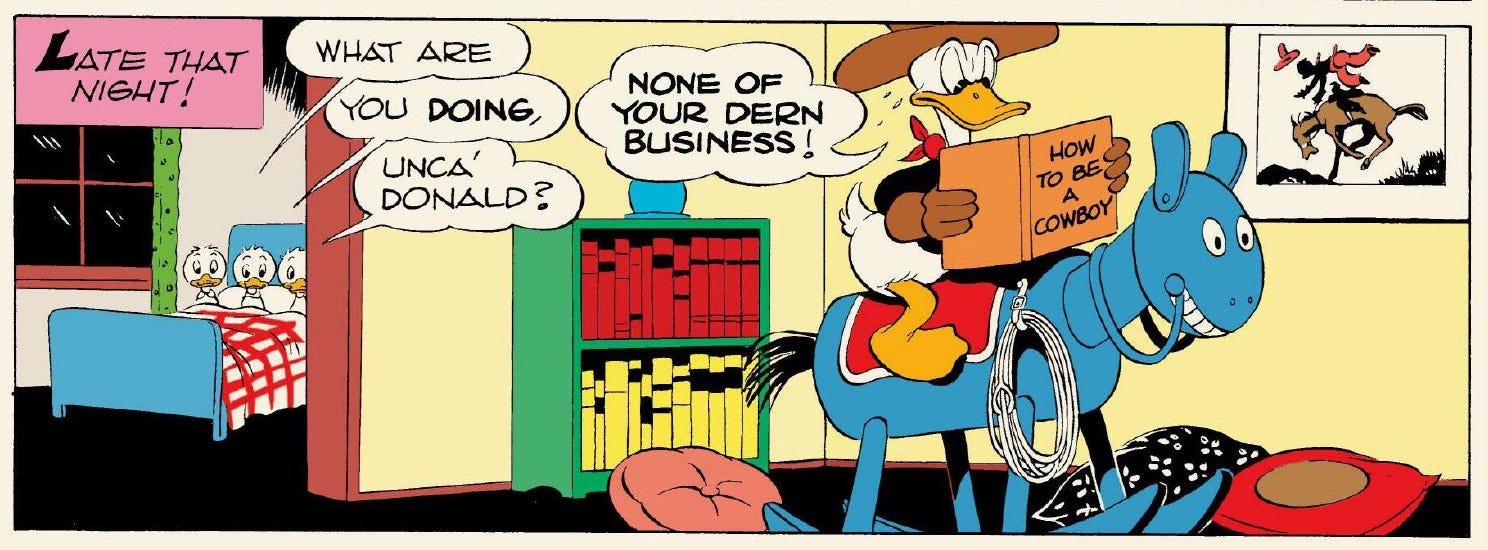
The image shows just how much of Donald’s hubris was based in a fantasy of Western cowboys (which Barks would have known, having grown up as a farmboy), as well as reinforcing the initial portrayal of him as a neighborhood bully. It’s just that it isn’t clear that there are any actual adults in the world.
The story’s moral content is so obvious—certainly by Barks’s standards—that the story can read like an echo of grand guignol-style fairy tales that used the thinnest possible pretenses to punish characters brutally for tiny flaws. That desire to entertain is here for Barks too, but in contrast to the outright unrealism of most cartoon settings, even here the banality of what we recognize to be the everyday seeps in. The contrivances of fate in those tales, for Barks, are the contrivances of our own reality.
Comments
Nothing yet. Say the first thing.
Sign in to join the conversation.