
The Long Race to Pumpkinburg (WDC&S #54, March 1945) is a return to a more typical plot after the large-scale craziness of the last few ten-pagers. Barks takes about as classic a situation as he could—Donald competes with the nephews in an ice skating race—and puts Donald in the villain position. It seems like the nephews are the good guys, but the story quietly drags them down to Donald’s level.
The closest comparison is to The Hard Loser, where Donald faced off against the nephews in an anything-goes horse race. Donald ended up being the butt of the joke because the whole world wasn’t playing fair, not just him. This story isn’t so obviously perverse, but it’s also not a simple parable, because the initial setup of Donald-bad-nephews-good doesn’t favor the nephews as much as it might look.
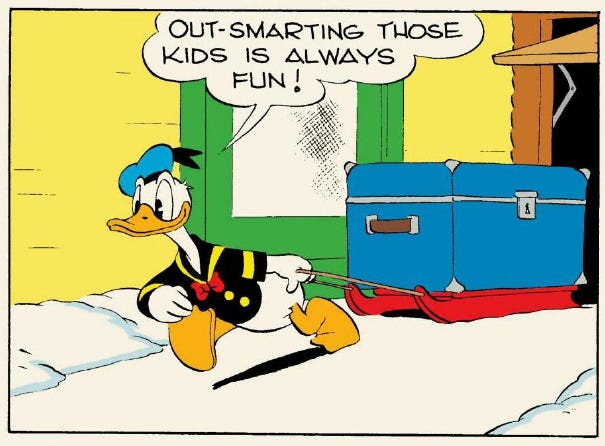
Donald captures the kids to make them have dinner and wash the dishes. Ostensibly playing the good parent, he takes a petty delight in trapping them in a trunk to drag them into the house.
The kids don’t want to do the dishes, so Donald makes them a deal that if they can beat him in a race, he’ll take over their responsibilities. So far, so reasonable, and even Donald’s ground rules seem like common sense.
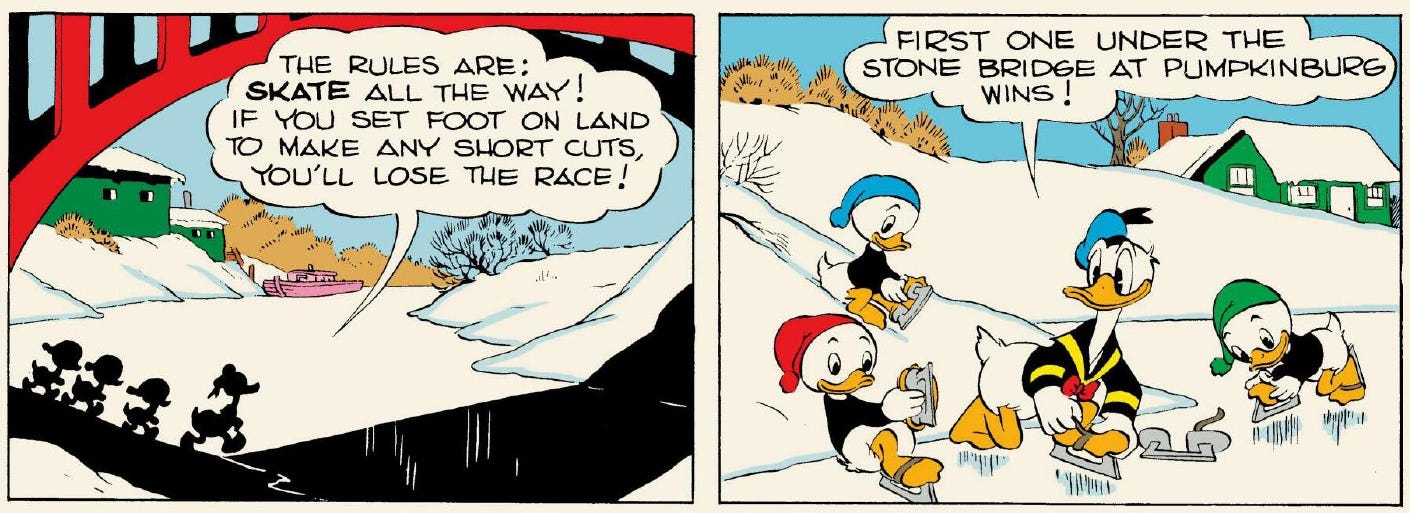
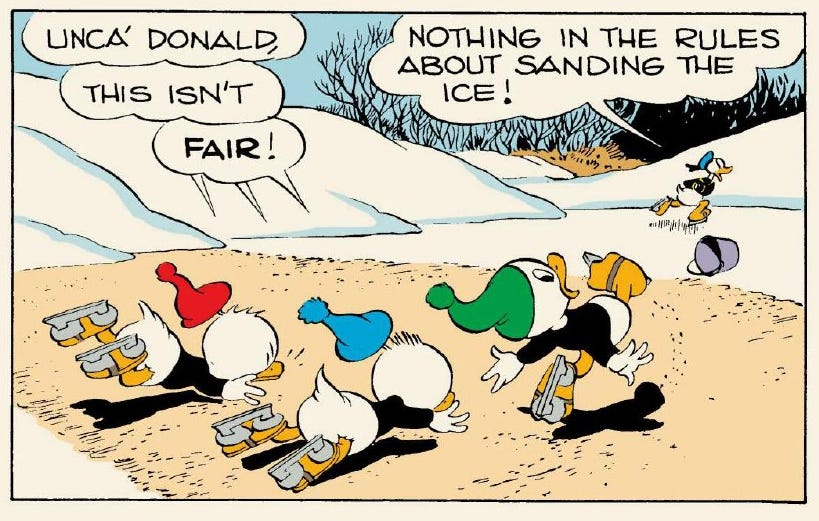
The rest of the story, however, is a legalistic dissection of those ground rules he casually reeled off. For starters, everything not explicitly banned is acceptable, whether it’s sanding the ice—
—or vaulting over snowbanks—
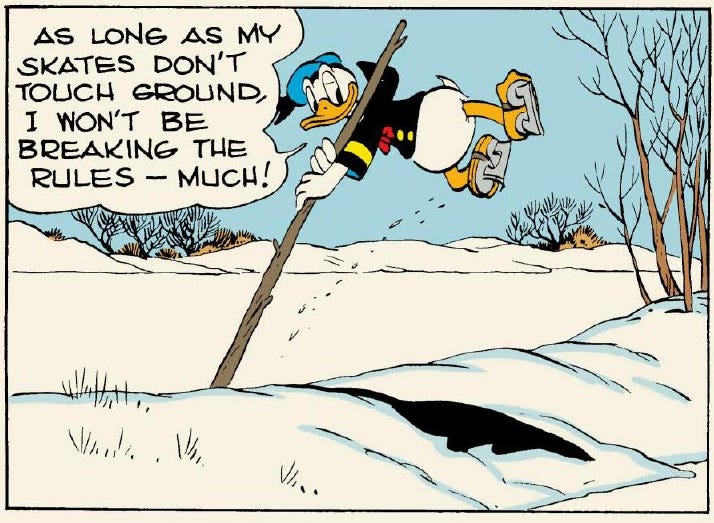
The nephews find the evidence of his vault after wondering how he could possibly have gotten so far ahead, and call it cheating.
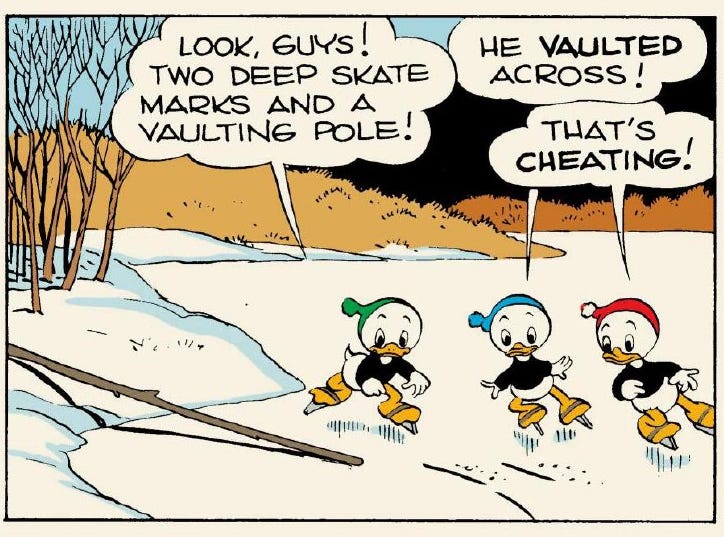
Is it cheating? It’s certainly against the spirit of the race, and the nephews swear to play fair.
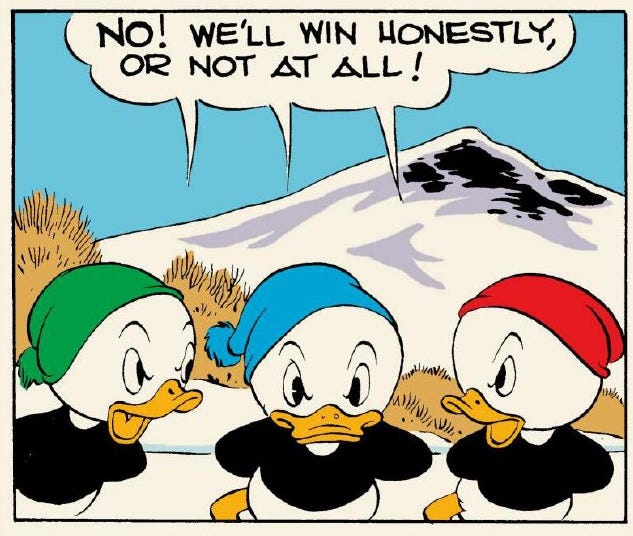
On the other hand, what is it is to play fair? Donald was the one who set the rules, so are the nephews actually hamstringing themselves by inventing rules that the actual game arbiter says don’t apply? What’s the benefit to playing fair?
Well, moral superiority for one. The nephews congratulate themselves on their honesty, finding a shortcut that doesn’t require any bending of the rules.
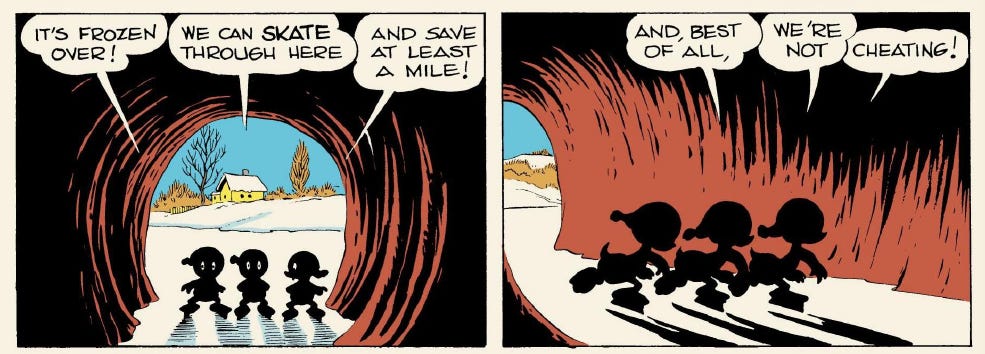
But even the silhouettes seem to suggest that this isn’t the real message of the story. The moral sanctimony is just a bit too blunt.
Donald pulls a tortoise-and-hare move and takes a break, only to find that the nephews have caught up, so in a frenzy he grabs first a windsail and then a rocket. “Nothing in the rules against using a rocket!”
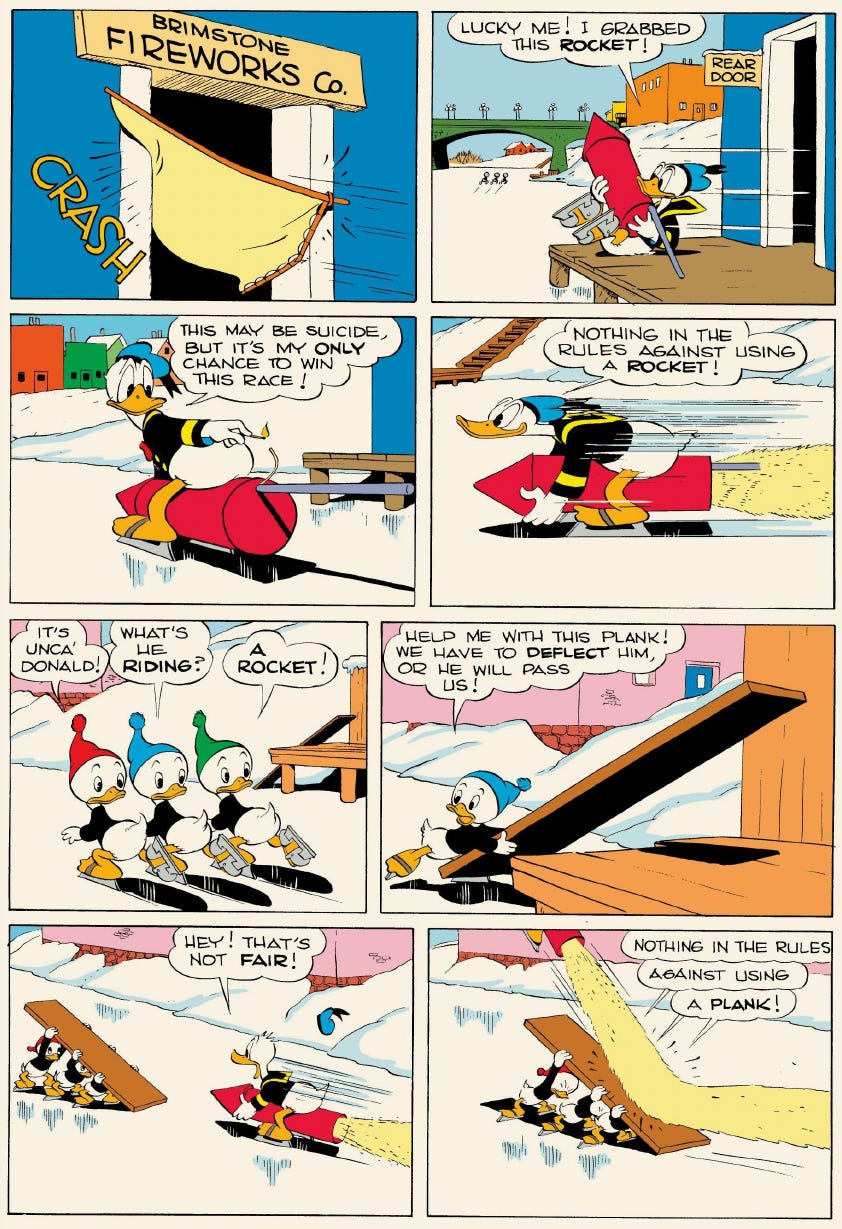
Faced with imminent loss, the nephews suddenly abandon any concerns over cheating or the spirit of the rules. Instead, it’s anything-goes, and they even embrace Donald’s legalistic formulation: “Nothing in the rules against using a plank!” Donald, hypocritical as ever, objects that it’s not fair, which is silly, but on the ethical level he actually wins the battle because he has dragged the nephews down to his level.
Donald beats the nephews to the bridge anyways, though the rocket does leave him battered.
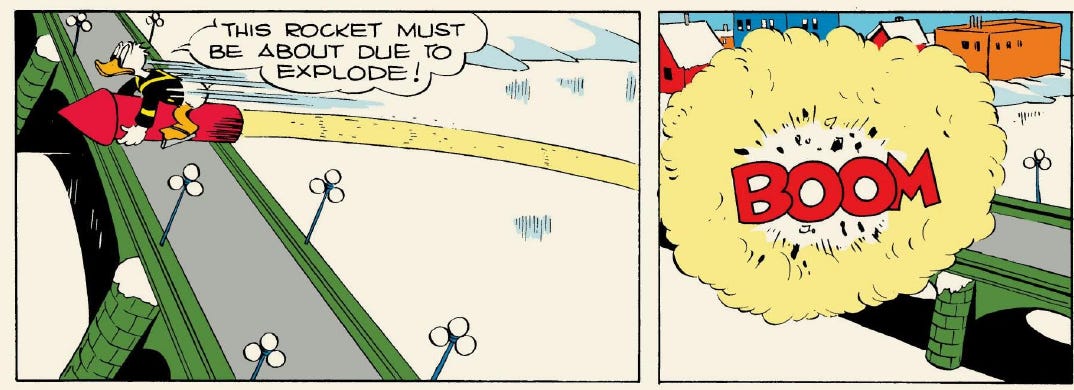
Then comes the final ironic turnaround, where the nephews outsmart Donald just as he outsmarted them on the first page of the story, beating Donald through no skill of skating but by minute parsing of the rules:
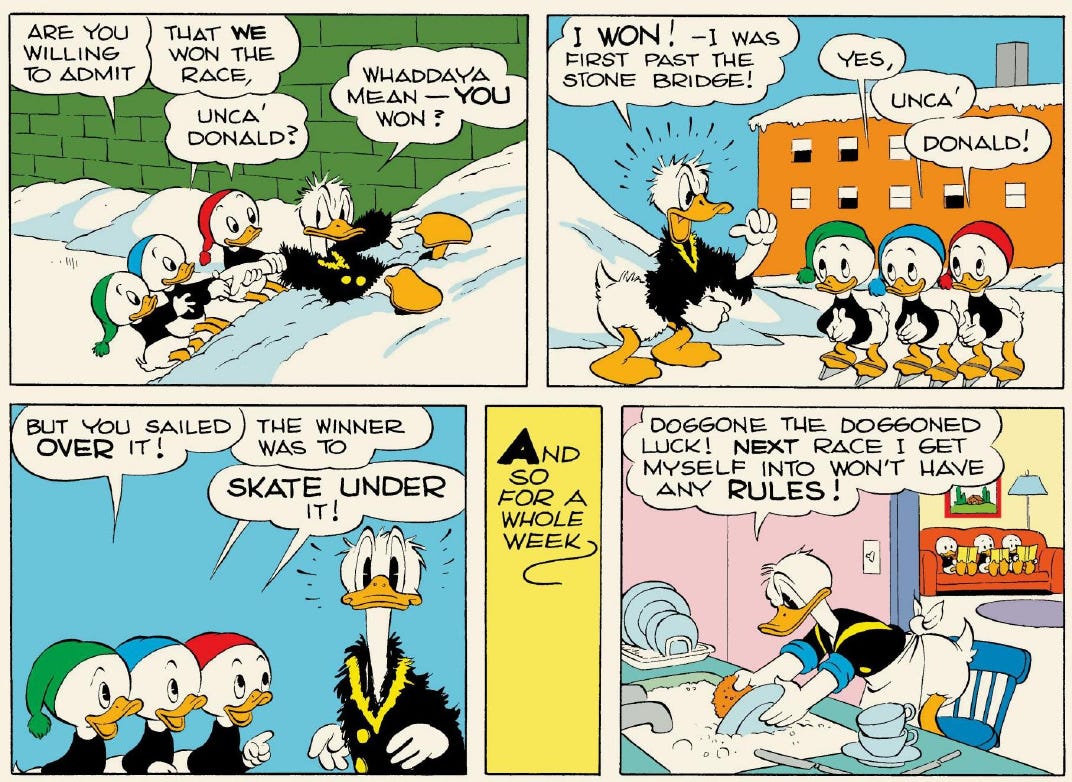
Donald did indeed require that the winner go “under” the bridge. The nephews’ argument for their win is accurate, but it’s as legalistically narrow as any of Donald’s nonsense. They didn’t win by competing honestly, but by playing Donald’s game better than he did. Ironically, it’s clear that Donald could have beaten them in a fair race with no shenanigans, but between his gimmicks and laziness, the nephews eked out a technical victory.
Donald says that next time there won’t be any rules, but we’ve already seen how that worked out for him in The Hard Loser. Really, Donald is just grousing that the nephews beat him at his own game.
Donald Duck and Fairness: The Hard Loser
·
Jan 20
The Hard Loser (FC 29, September 1943) is one of Barks’s strongest early 10-pagers, a very tight and complex tale told neatly. Considering Barks drew all the stories in the 64-page Four Color #29, his ability to produce superior work at a rapid clip was fully established.
But to beat him at his own game, the nephews had to abandon their ethical standards, however illogical they may have been. The story is really a repudiation of the supposed moral rule to always play by the rules, because (1) it doesn’t work, and (2) the rules themselves are rigged.
The thing is, Barks doesn’t draw attention to the turnaround or have the nephews acknowledge that ultimately they could only fight fire with fire. By this point, Barks was leaning toward burying the subversion in seemingly classical fable structures. It’s only when you poke at the stories that the supposed lesson—”Win honestly or not at all!”—falls apart.
Comments
Nothing yet. Say the first thing.
Sign in to join the conversation.