
The technology is good enough.
Not perfect or remotely equivalent across every vendor in every category.
But good enough that the feature gap between the market leader and the second and third options has compressed to the point where it is rarely the deciding factor in a B2B tech purchase.
Especially in cybersecurity.
Especially among the buyers who have been evaluating tools long enough to know that the demo is always better than the deployment and the product is always more capable than the problem it actually gets used to solve.
When the technology is good enough, something else becomes the deciding factor.
And the answer is completely unexpected.
I’ve extracted it in the most unguarded moments that almost no vendor is designing their marketing around - simpler and more human than any demand gen framework accounts for.
They choose the vendor that is more interesting to be around.
Call it fun, or energy, or the feeling you get when a vendor interaction leaves you in a better spot than it found you rather than depleted and more skeptical than before.
Whatever you call it, it is real, it is measurable in deal outcomes, and almost nobody in B2B tech is treating it as the strategic variable it has become.
There is a structural shift happening in how attention moves and how trust forms with buyers (not just in consumer marketing but in every market where human beings are the decision makers).
On one side, digital is accelerating.
AI is producing content at a volume and velocity that no human team can match.
The buyers you are trying to reach are being targeted by more messages, through more channels, with more apparent personalization than at any point in history.
The digital landscape is getting exponentially noisier.
And the tech brands that will thrive let alone survive in that environment are investing in digital presence at genuine scale - AEO, social distribution, retention content that compounds, with the volume and consistency that makes you discoverable when a buyer is forming an opinion before they have agreed to talk to anyone.
On the other side, something equally powerful is happening in the opposite direction.
As the digital world gets noisier, human attention is migrating toward the things that are genuinely, irreducibly real.
Live experiences. Physical presence.
The deepest, most authentic conversations that happen in a room with no ulterior motive and no pitch.
The moment that could not have been manufactured and therefore cannot be ignored.
The analog world is not dying as the digital world grows.
It is becoming more valuable precisely because the digital world is growing.
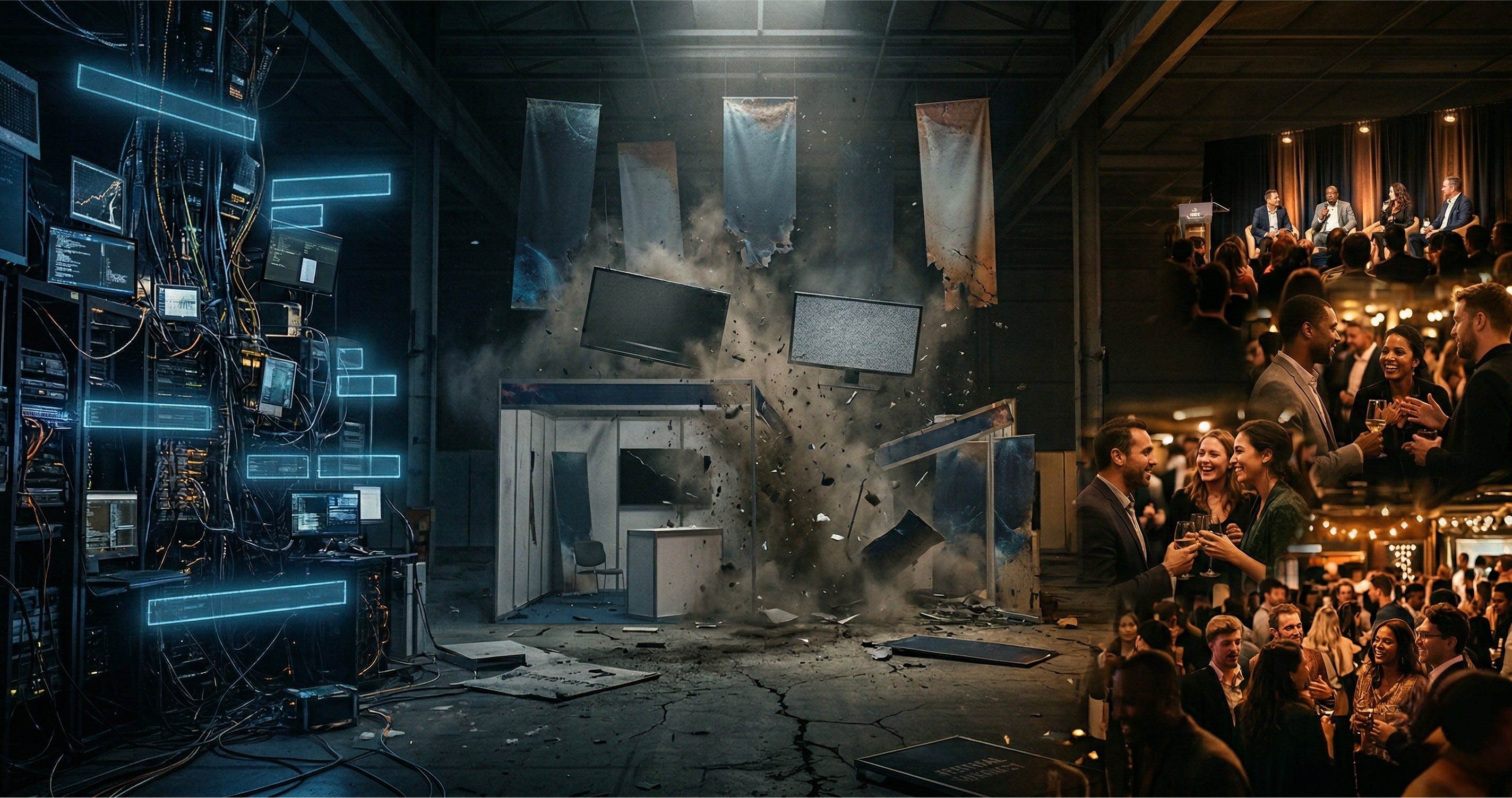
Now…the middle - the space between digital scale and genuine human experience is where most B2B tech marketing lives…
The conference booth that is neither truly experiential nor truly digital.
The webinar that is neither a real conversation nor a piece of content that will compound over time.
The branded dinner that is neither intimate enough to produce real trust nor distributed enough to produce real reach.
The sponsored panel that produces neither genuine insight nor genuine relationships.
This is the middle. And it is getting crushed from both sides.
The vendors who understand this are making two bets simultaneously.
They are going all-in on digital presence - real volume, real consistency, real investment in being findable and credible in the channels where buyers form opinions.
And they are going all-in on genuine human experience - real moments, real conversations, real specificity about who the buyer is as a person and what it feels like to be in a room with this brand.
The vendors who do not understand this are spending more money on the boring and messy middle and wondering why the returns keep declining.
The question constantly on my mind is:
Why do cybersecurity vendors keep choosing the middle when the evidence that the middle is not working has been accumulating for years?
The answer is that the middle is safe.
The middle has defensible metrics.
The middle does not require an organization to make the bet that genuine human connection, at the right moment, with the right people, will eventually show up in the pipeline.
Badge scans are countable the day of the event.
Trust shows up in revenue six months later.
The first number survives the post-event debrief.
The second number does not exist yet when the budget justification is due.
There is also the problem of what I call institutional gravity.
Every B2B marketing organization has processes, vendors, and internal stakeholders built around the middle.
The events agency.
The booth contractor.
The demand gen agency.
The SDR sequence that starts the Monday after the conference.
These systems have their own momentum.
They produce their own justifications.
They create internal constituencies for their own continuation.
Breaking out of the middle does not just require a strategic decision.
It requires dismantling infrastructure that has been built over years and replacing it with something that looks riskier because its returns are less immediately countable, even when the actual risk profile of the new model is significantly better.
The vendors who are making the move are doing it because someone in the organization - usually a CMO or founder who has spent real time with real buyers - has had enough honest conversations to know that the middle is producing the illusion of marketing while the trust gap keeps widening.
When the technology is good enough, buyers are not neutral between the vendors in their evaluation set.
They have preferences that are not fully legible in the formal criteria documented in the RFP.
Those preferences are shaped by the accumulated experience of interacting with each vendor over the course of the evaluation - and in many cases, in the months and years before the formal evaluation started.
When vendors generate genuine energy - who create interactions that feel alive rather than procedural, who show up in ways that are unexpected and specific and even, at times, genuinely enjoyable - they carry something into the evaluation that no feature comparison can measure.
It’s called limbic trust.
It is the trust that forms below the level of conscious analysis, in the part of the brain that processes emotional memory before the rational mind can intervene.
When a buyer has had enough genuinely positive human experiences with a brand, their preference for that brand becomes something closer to feeling than to logic.
They will still be able to articulate rational reasons for their choice. The real driver will be the accumulated residue of the human moments.
Fun is not frivolous in this context.
I have heard this from buyers across hundreds of conversations.
They describe the vendor they eventually chose and the description includes - almost always - some version of “I just genuinely like talking to them.” Or “their events are always something I actually want to attend.” Or “I don’t know exactly why, but when they reach out, I respond.”
None of these are formal decision criteria. All of them are decisive.
Ask ten B2B marketers to define it and you’ll get ten answers that all describe the same thing: a fancier event.
A rooftop happy hour. A chef’s table dinner. An escape room with your logo on the wall.
A golf outing with a branded tee box. A booth activation where someone spins a wheel and wins a Yeti or kicks a ball at a screen calling it gamification.
That’s not experiential marketing. That’s hospitality.
Experiential marketing is a strategy that invites people to participate in a brand experience instead of passively consuming an ad.
Rather than relying on impressions-based messaging, it creates a memorable moment through live events, interactive activations, product demos, pop-ups, or digital experiences that let audiences see, touch, try, or share something firsthand.
That last part matters more than most B2B marketers want to admit.
Firsthand.
The buyer encounters the brand directly, through something they did, felt, or walked away from changed, and that directness is precisely what makes it stick.
Done right, experiential marketing makes a brand feel real, relevant, and human in a way that deepens emotional connection and improves recall long after the experience ends.
For companies trying to stand out in crowded markets, it turns attention into engagement and engagement into a stronger relationship with the brand.
Which is exactly why the B2B version of it is almost always done wrong.
Most of what gets called experiential in B2B is still passive consumption.
The buyer is still an audience. Still being talked at. Still absorbing a message the vendor decided on in a conference room six months ago.
The format changed. The dynamic didn’t.
Real experiential marketing requires a different posture entirely.
The buyer isn’t the audience. The buyer is a participant.
There’s a meaningful difference between those two things, and buyers, especially the sophisticated, over-marketed security leaders who’ve seen every version of this, feel it immediately.
Every marketing interaction a buyer has with your brand activates one of two systems in their brain.
Understanding which one you’re activating and what each system does with the information is the most important thing a B2B marketer can know right now.
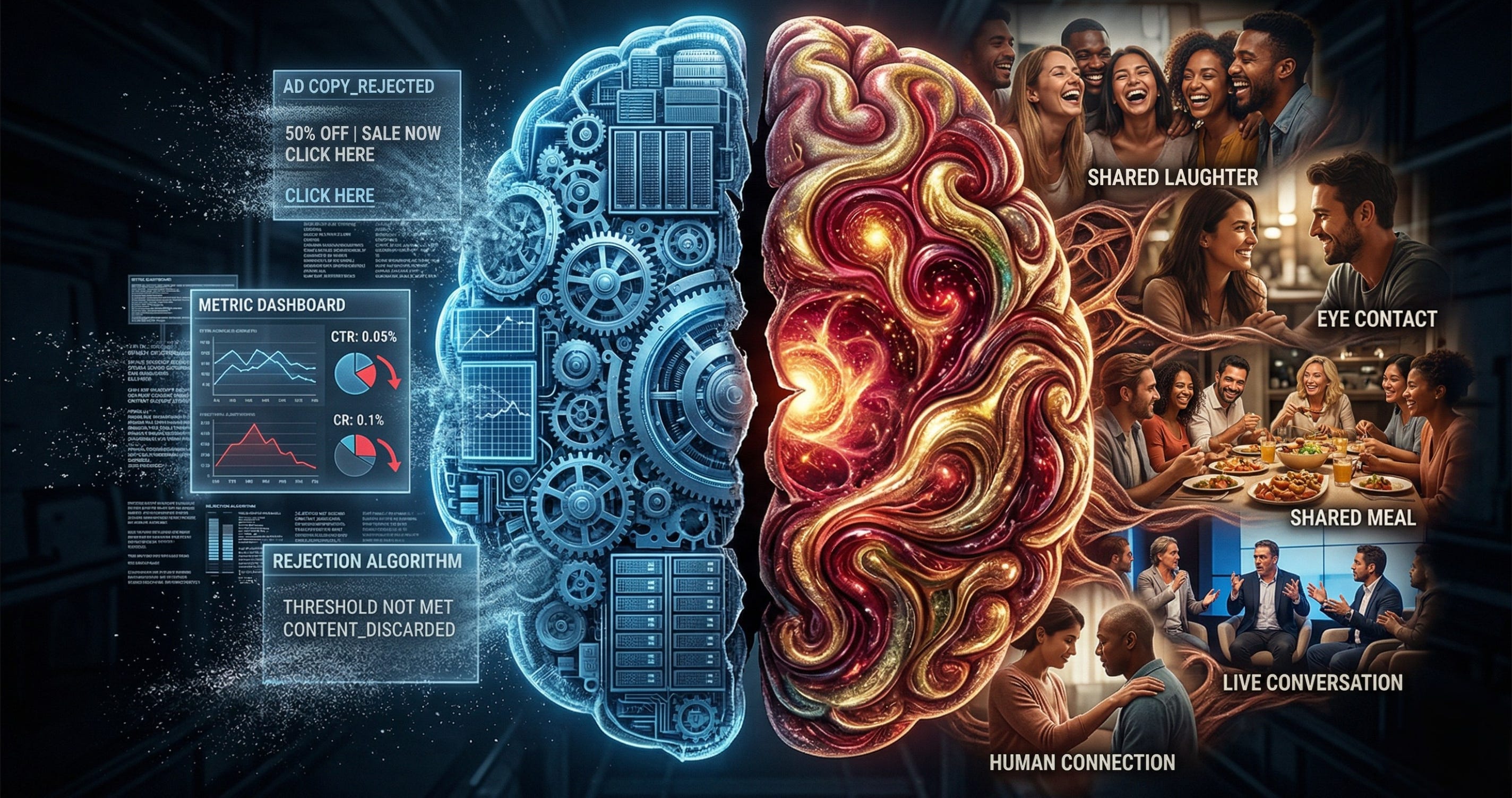
The rational, analytical, skepticism-generating part of the brain.
The part that reads your ad and immediately starts looking for the catch.
The part that has processed enough vendor messaging to know that every claim is optimistic, every case study is cherry-picked, and every “we’re different” sounds exactly like every other “we’re different.”
The prefrontal cortex is where your messaging goes to get stress-tested, discounted, and forgotten.
Research on advertising recall tells us how well that’s working: most of it is gone within hours.
The emotional, memory-forming, trust-generating part of the brain.
The part that doesn’t evaluate - it feels.
The part that registers safety or threat before the rational mind can intervene, that encodes memories through emotion rather than logic, that holds onto experiences for years precisely because they produced a feeling rather than a fact.
This is the neurological explanation for why a buyer can forget your campaign the same week it ran and still remember a conversation they had with someone from your team three years ago at a conference.
Different stimulus. Different brain. Different shelf life. Completely different outcome.
Traditional marketing is optimized for the one mode of engagement that cynical, over-marketed buyers have spent years building defenses against.
It talks at them. It engages a single sense.
It transfers information they didn’t ask for through the exact cognitive channel that is most primed to reject it.
And it does all of this in a market where the buyers are smarter, more skeptical, and more defended than almost anywhere else in B2B.
Experiential marketing bypasses the defense entirely.
A genuine human moment that engages multiple senses, invites active participation, and produces an emotional response, doesn’t enter through the skepticism filter because the skepticism filter isn’t what gets activated.
Trust isn’t argued into existence. It’s felt into existence. And what is felt is remembered.
That’s the neurological case.
They let it down in small rooms.
Not the thousand-person conference session.
The gathering of twelve where someone has clearly thought about who specifically should be in the room and why.
They let it down in formats that ask something of them.
The conversation where they are being interviewed, not pitched.
The collaborative exercise where their expertise is genuinely needed.
The experience designed around something they care about in their personal life that has nothing to do with the vendor’s product.
They let it down when the content that comes out of the experience sounds like them.
The social show where a CISO is a co-star, not a testimonial.
They let it down when the digital artifact of the human experience finds them in the trusted ecosystems where they actually spend their discretionary attention - not in the channels the vendor controls, but in the communities, the newsletters, the social feeds of the practitioners they already follow and trust.
The format is less important than the conditions it creates.
What matters is that the buyer experienced something real, that the experience was documented with enough craft to carry that realness into digital form, and that the digital form found its way into the places where buyers go to be practitioners rather than targets.
That is the full model.
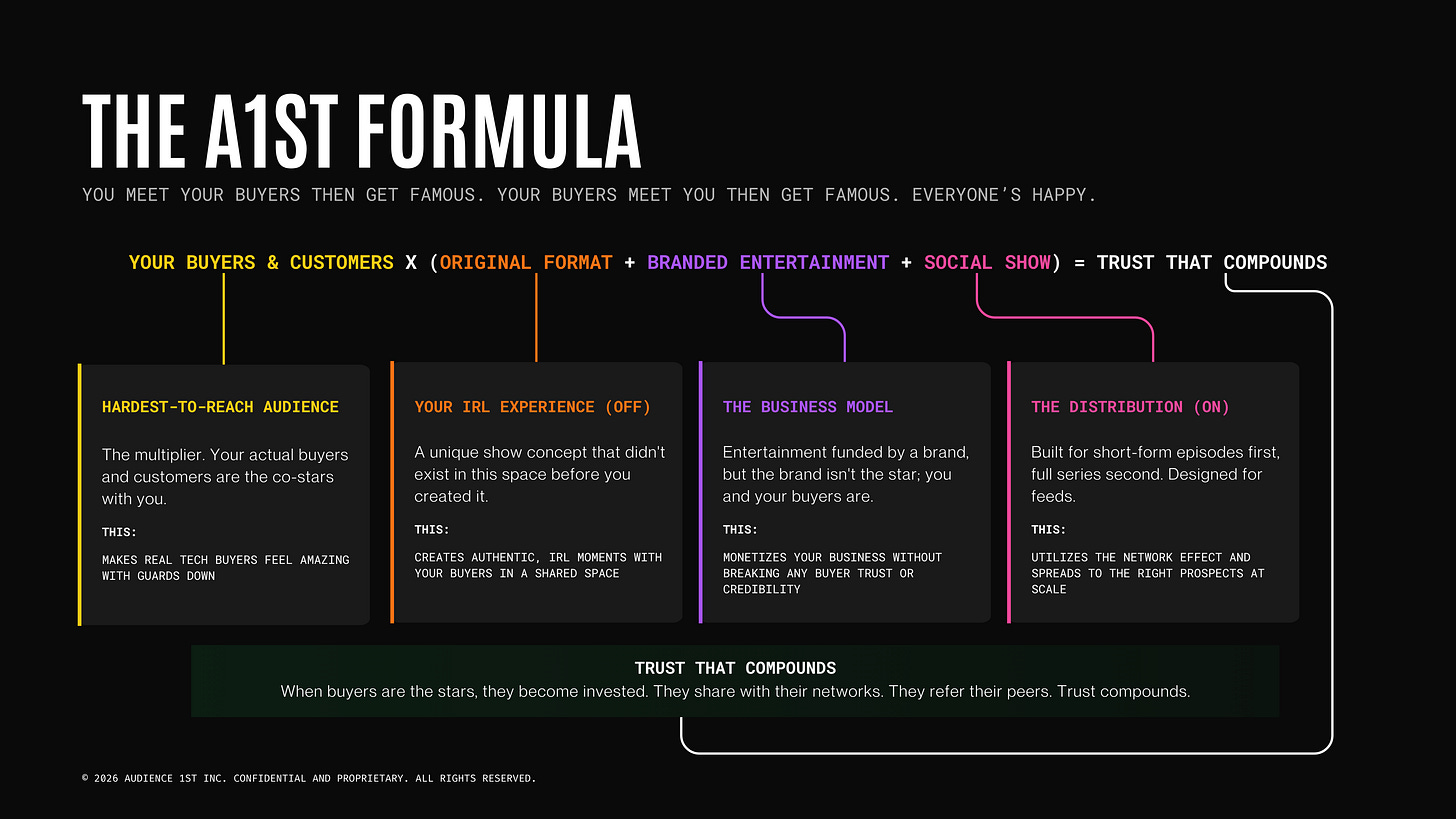
The physical experience as the production studio.
The trusted ecosystem as the distribution channel.
The peer voice as the most credible signal in the most skeptical market in B2B tech.
And this is where the pipeline math finally becomes legible in the pattern.
The CISO who attended the dinner eight months ago responds to the outreach today.
The security leader who shared the episode tells their peer to take the call.
The buyer who showed up to the event skeptical is now the one forwarding your content to their team.
None of these moments have a clean attribution path.
All of them are in the pipeline.
Some of them are in the closed-won column.
The vendors who have figured this out have stopped trying to draw a straight line from experience to revenue.
They’ve started building the conditions under which those lines draw themselves consistently and compoundingly.
The cybersecurity market is one of the most crowded, most competitive, and most noise-saturated B2B verticals in existence.
There are more vendors, more categories, more funding, and more marketing spend per buyer than almost any other technology sector.
It is also the sector where the experiential blue ocean is most dramatically wide open.
CISOs are the most studied, most targeted, and most marketed-to executive in the enterprise.
They have been the subject of more vendor personalization campaigns, more executive dinner programs, more “exclusive CISO community” invitations than any other title in the organization.
They have developed the most sophisticated filters.
They have the most finely tuned radar for the difference between genuine curiosity about their world and a vendor using the language of genuine curiosity as a lead generation tactic.
What this means in practice is that the experiential bar - the threshold at which a cybersecurity practitioner genuinely feels something rather than categorizing an interaction and moving on - is higher in cybersecurity than almost anywhere else in B2B tech.
And it means that the vendor who clears that bar is operating in territory that their competitors simply cannot access.
The brand that a CISO describes to a peer over dinner is not the brand with the biggest booth.
It is the brand that did something that actually surprised them.
That treated them like a person with a specific, interesting life rather than a title with a budget.
The crowded market created the skepticism.
The skepticism created the gap.
The gap is the blue ocean.
And because the skepticism in cybersecurity is so much higher than in other verticals, the gap in cybersecurity is proportionally wider.
No posts
Comments
Nothing yet. Say the first thing.
Sign in to join the conversation.