
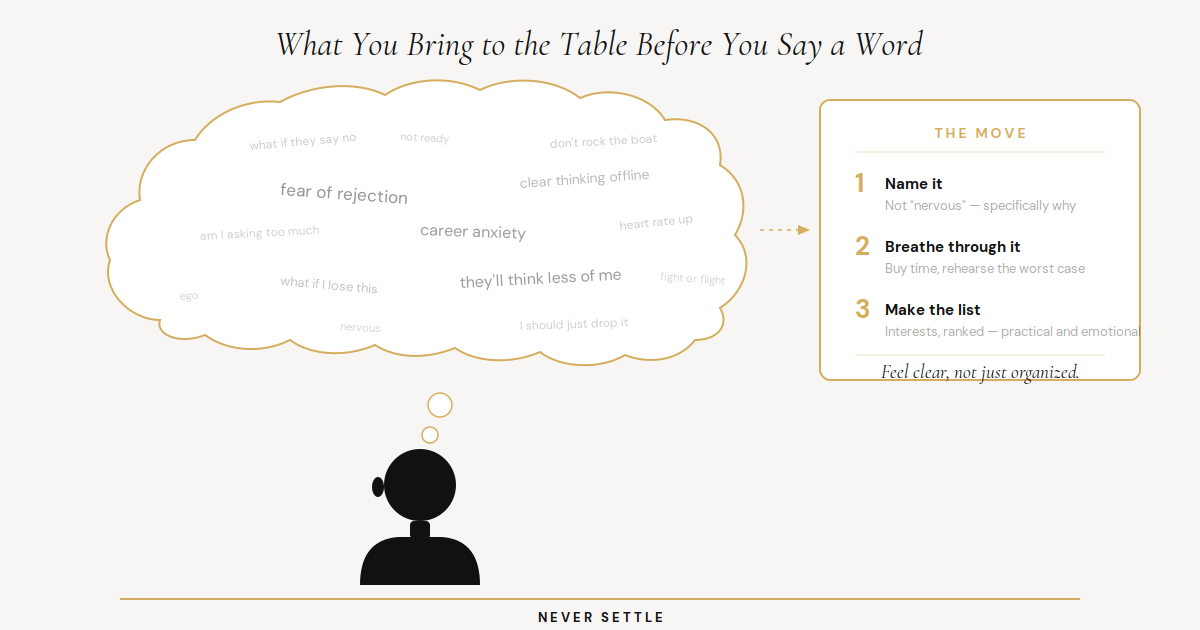
Most people prepare what they’re going to say before a negotiation. Almost nobody prepares what they’re going to feel.
And that’s where outcomes are won or lost — before the conversation even begins. Your emotions, your fears, your clarity about what you actually want: these are at the negotiation table before you are.
They shape how you ask, whether you ask, and whether you hold your ground when it gets hard.
Right now, 52% of U.S. workers are worried about AI’s impact on their futures, that emotional noise is louder than ever — and it’s impacting negotiations whether people realize it or not.
Each week I focus on one element of negotiation from my new book Never Settle — three ideas, shared Monday through Wednesday through Friday on social media, then brought together here.
This week’s focus was — what you bring to the table in negotiations in the form of emotions and self interests before you ever say a word.

Monday: Name what you’re feeling
90 to 95% of our decision making is unconscious — and most of it is emotional.²
Which means your feelings aren’t background noise. They’re driving.
Fear of hurting the relationship. Fear of rejection. Fear of losing what you have. These are the things that make people cave before they even ask. And in an environment saturated with career anxiety, they’re louder than ever.
The move: name it. As specifically as possible. Neuroscience shows that naming an emotion precisely reduces its intensity almost immediately.³
Not “nervous.” But: “I’m afraid that if I ask, they’ll think less of me”.
That specificity is where the control begins.
The exercise: before your next hard conversation — ask yourself what you’re actually feeling and why. Write it down. And if you have trouble naming your emotions specifically, download my free Emotions Wheel resource here.
Wednesday: What to do when it feels like a fight
When a negotiation gets tense, your nervous system can’t always tell the difference between a threat to your safety and a threat to your ego.
Heart rate up. Clear thinking offline.
And right now — with AI reshaping industries and career uncertainty as a backdrop — that fight or flight response is more activated than usual before anyone even sits down.
Three things help: breathe through it, buy yourself time, and rehearse the worst case before you walk in. Inoculate yourself before the conversation begins. Plan something small for right after — give yourself something on the other side.
Friday: Make the list
Your position is what you say you want. Your interests are what’s actually driving the ask — practical and emotional.
The people who navigate an AI-reshaped world best will be the ones who know their own interests clearly. What’s non-negotiable. What they’d trade. How they want to feel when it’s over.
That self-knowledge cannot be automated.
The exercise: pick one real decision. Write the outcome in one sentence. List everything that matters — practical and emotional. Rank it. Read it back. If something feels off, you’re missing an interest.
You’ll know you’ve got it when the list makes you feel clear, not just organized.
What’s coming next week
Week 3 flips the lens entirely. Instead of looking inward, we look across the table.
Understanding what the other side actually wants — not what they’re asking for, but what’s underneath it — is one of the fastest ways to get more for yourself. And it’s a skill that becomes more powerful, not less, in a world where everyone is negotiating their place in a changing economy.
Comments
Nothing yet. Say the first thing.
Sign in to join the conversation.