
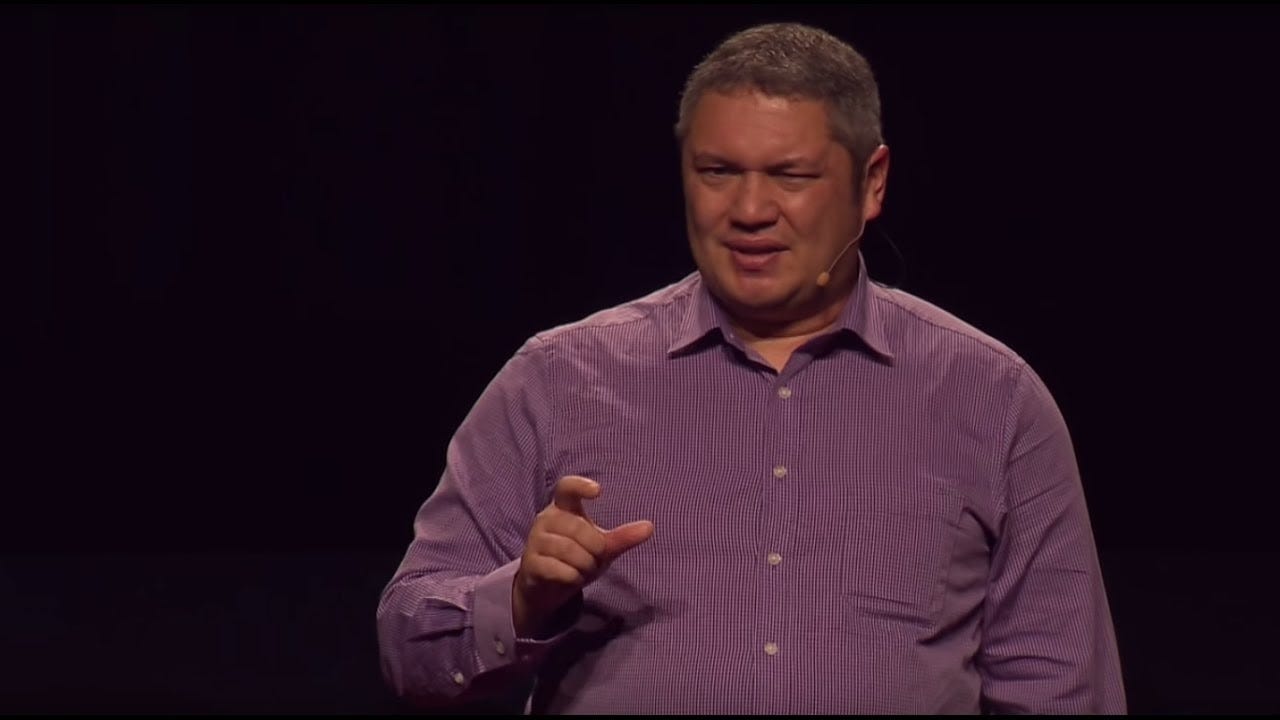
All right, part two. Let me be clear, I like Armon Tamatea. I think that he has good things to offer psychopathy as a whole, but so far, this talk is not doing him any favors. Also, I should mention that I have seen this talk in the past, but I don’t remember pretty much anything in it, so this is pretty much the same as me hearing it for the first time. I did find an article that Tamatea is tagged in as one of the authors that says this:
There are also treatment options for people with high levels of psychopathy traits who do not show antisocial behaviour that is illegal or violent. However, many more general approaches, such as working on reactive behaviour, emotion regulation, and empathy may be beneficial, with some suggesting a multimodal approach may prove more effective for this population. Possible pathways to access this are talking to a GP or a therapist who will be able to provide individual therapy.
I could do a post on this article if you are interested. Let me know, but I had to respond to this. Granted, this article lists something like four or five authors, but damn… this is so ridiculous. My Significant Other is sitting here on his phone while I am working, and I dropped that paragraph on him just to watch his eyebrows navigate into his hairline as he heard it. I’m sorry, did they just say that:
“more general approaches, such as working on reactive behaviour, emotion regulation, and empathy may be beneficial”?
Do… do they mean working with the psychopath in order to have a reaction to things that normal people would in order to blend in? Otherwise, what? What emotional reaction are you talking about? Do you have any idea what psychopathy is?
Then, because they are oh so very smart, they say, “emotional regulation”. Umm, to have issues with emotional regulations, you have to first have unregulated emotions that are strong in nature. Our emotions are muted, several are absent, and those that we have aren’t dysregulated. If they are strong enough for us to notice them, they will be a passing fancy that doesn’t affect our behavior.
And lastly, empathy. Please do not bother us with this word any longer. I have hit my saturation point with this word. When you can demonstrate to me that it is actually something of value, that perspective might shift, but at this point I do not see that happening.
Anyway, back to the talk.
One of the earliest now-modern cases of what we now recognize as a psychopath goes back some 200 years to France in the nearly 1800s and concerned a difficult man, to be fair, who was prone to quarrels and conflicts with people around him. But we also know that he was wealthy, he was financially astute, and had successfully managed an estate for many years — all of which came to a really sudden end when he threw a woman down a well because she had the audacity to disagree with him on some issue.
Yeah… none of that sounds like a psychopath. That sounds like one of those rather pesky creatures known as assholiest amungus. Psychopaths aren’t prone to quarrels. We don’t care in the first place. We are far more likely to say, Whatever, bye. Psychopaths can be wealthy, or not, neither of which has anything to do with psychopathy. Being money educated also has nothing to do with it. It has to be an interest of that psychopath. As for throwing a woman down a well, that is a strong emotional response, and one that a psychopath wouldn’t have. We also don’t care if someone disagrees with us. So what? They don’t have anything to do with us in the first place.
So the third example is also not a psychopath. That would be a total strikeout. Tsk tsk, I really do expect better of you Doctor.
So what we have is a sound, rational mind on one hand and quite destructive and self-defeating behavior on the other. And that’s the central mystery of what psychopathy is about, which led one psychiatrist to very famously describe this phenomenon as a “mask of sanity.”
Wait… nothing in the paragraph describing this dude seems like a rational person. He understands money. That doesn’t mean he is rational. It means he likes numbers, math, and probably money. There are plenty of people that fit that criteria that are emotional landmines, totally irrational, and while they may have a reasonable interest, that in no way means that they are sound of mind. Often, it’s pretty noisy in there, and it takes very little to set them off. I have known people like this. It’s always fascinating to watch, and was one of the things that taught me that neurotypicals are often reactive and irrational. They are the same type that do not handle stress well.
None of that described a “mask of sanity”. If that was the example that is supposed to demonstrate psychopathy and the mindset of a psychopath, that was a hard fail.
Now, contemporary clinical descriptions have been rather unkind to this group and not even neutral. So here’s one — this is a very well-known modern definition: “Psychopathy is a socially devastating disorder defined by a constellation of affective, interpersonal, and behavioral characteristics. Interspecies predators who use charm, manipulation, intimidation, and violence to control others and to satisfy their own selfish needs.”
…….
Sorry, my eyes were examining the back of my brain. Let me get the eye roll crew in here to get that under control. Sounds like a Hare definition to me. Let’s see if I’m right.
Ha! I knew it was Hare.
Robert D. Hare (or a close paraphrase/attribution to him).
The first part of the quote (”Psychopathy is a socially devastating disorder defined by a constellation of affective, interpersonal, and behavioral characteristics...”) is a well-known description from Hare, a leading expert on psychopathy and developer of the Hare Psychopathy Checklist-Revised (PCL-R). It appears in his writings, such as in Psychopathy: A Clinical Construct Whose Time Has Come and related works/books.
The second part (”Interspecies predators who use charm, manipulation, intimidation, and violence...”) is a common paraphrase or extension often linked to Hare’s views. He has described psychopaths as “social predators” who “charm, manipulate, and ruthlessly plow their way through life,” and sources (including educational materials and discussions of his work) sometimes use “interspecies predators” (or the similar “intraspecies predators”) to emphasize their exploitative, non-empathetic nature toward other humans.
This framing aligns with Hare’s research framing psychopathy as involving egocentricity, lack of remorse/empathy, manipulativeness, and violation of social norms—traits that make affected individuals highly destructive in social contexts. Note that slight wording variations exist across quotes, textbooks, and secondary sources. Hare’s work (e.g., Without Conscience) popularized these ideas.
It’s always Hare. Go figure. Let’s see if Dr. Tamatea debunks him.
So what this is really describing are sinister and scheming individuals whose thoughts, feelings, and behaviors are geared — engineered almost — to target, isolate, and exploit us for their own gains.
Yeah, that’s more or less the general consensus in the world. Incorrect, but generally agreed upon.
This next one is a bit more recent: “Psychopathy is an emotional disorder which puts the person at risk of repeated displays of extreme antisocial behavior.”
I love how not feeling emotions like neurotypicals is considered a “disorder”. Sorry, no. We aren’t disordered. We are just different. Also, extreme antisocial displays are usually reserved for those that have high emotional capability and are in a heightened state of emotions to enact. That would be another definition that is incorrect.
So not quite as demonizing as the previous definition, and this one is somewhat narrower in scope and does make explicit the relationship between crime and psychopathy. And to be fair, that relationship has been borne out in the research. It’s the use of the word “disorder” which I find quite interesting because it kind of frames as a type of medical condition what’s really a broad spectrum of quite complex social issues.
I don’t think I would term psychopathy as a social issue, or a medical condition. It is a neurological difference. It doesn’t need treatment-medical problem, and it exists outside social input-social issue. So… also no.
Philosophers, on the other hand, have a much simpler way of dealing with this.
Now, psychopathy is big business in the popular literature space as well. And here’s a selection of bestsellers. And what do we notice about these book covers? They kind of stare out at us, don’t they? In a kind of a weird Twilight Zone reversal moment, these books may well be reading us. And what this does, I think, is it perpetuates a malevolent stereotype of a predator lying in wait in the shadows, watching for one of us to stray from the flock before they make their move. I think what this does is that it sets up an expectation of fear and loathing in the minds of readers about what’s really quite a poorly understood group.
I can’t imagine what he could possibly mean:
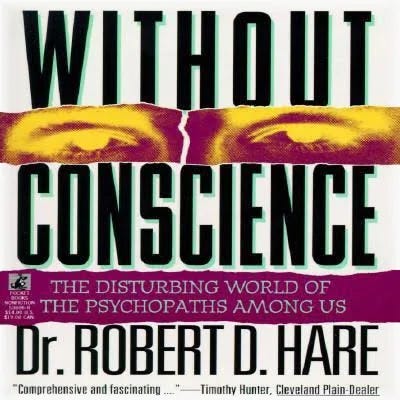
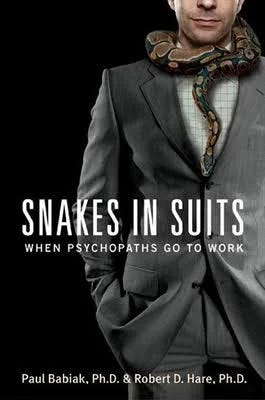
Yeah, it’s always Hare.
So given these issues of public anxieties and violence and crime and whatnot, you may well be thinking: so why do we need these people again?
Oh no… not the whatnot?!
On a serious note, yes, people like Hare use these stereotypes to their advantage. As much as I have negative things to say about Hare, most of the criticisms he earns his own damage. He says one thing, and does another.
Robert Hare: You can’t diagnose a psychopath by looking at them
Also Robert Hare: The concierge that won’t let you use the phone in the hotel is a psychopath. They like controlling things… like phones.
He states one thing with finality, and changes it to suit his needs or wants in the moment. I think, based on the context, that these things make him feel like the authority on the subject, and as the authority, he is immune from the guardrails he himself insists on being there. In other words, he’s special in his mind, and the rules do not apply. There are a ton of these examples with him, but what it comes down to is that he hates psychopaths, he feels contempt for them, and relishes in being the one that gets to define what psychopathy is in the public and research world’s perception. That is his weird little revenge against a bunch of prisoners that ran him around like the kid trying to get into the cool group in school, when he was a research student.
True story, and one he tells himself because he can’t see the larger picture. If you are unfamiliar with it, let me know and I will fill in the details in the comments section. Or I can direct you to the links where I described this situation.
Well, I’m interested in psychopathic people who are doing things well — those that don’t go on to attract legal attention. And they do exist. I want to know what they’re doing right, because the more we understand about that group, the more we can understand about this other group that have the potential to harm us in some way. I’m interested in the niches they occupy in society and the roles they have in their communities. And I’m in the process of conducting research, incidentally, on this very question — looking at the lifestyle choices and habits — and I’m looking for volunteers. And by now you should know who you are, so if you’re interested, come and see me later. Just please don’t hurt me, okay?
Ha ha, funny. However, there aren’t going to be a lot of us lining up for this research. Not the least of reasons being that you seem to be still simmering in the stew of nonsense when it comes to psychopathy. Now, granted, that may be just that you have yet to challenge what you think is fact. There is only so much time in the world, and some things we simply have to accept as reasonable things. We accept that water is wet, and that allows us to carry out a whole series of things in our lives because we have that working understanding. We can’t all become zoned out pot zombies questioning base reality. Most of us have sh*t to do.
In that I can understand having the notion of psychopathy and serial killing going hand in hand as was discussed in the last post, but that doesn’t mean that it stands up to scrutiny. When you understand what psychopathy is, and how the brain is affected, then you can also understand that people who are acting out their insecurities into the world because they didn’t have a good homelife, are not likely to be psychopathic.
The psychopathic violent individual is the person that sees violence as a tool, nothing more. It is relentless, it is remorseless, it is without passion, and it is a means to an end. You might be able to humanize yourself to a serial killer. You might find that magic button that makes them see you as a person, like Lisa McVey managed to do with Bobby Joe Long. She found that in to his psyche, and was able to get him to not only let her go, but he dropped her off at a church. He had murdered several women at that point.
Had Bobby Joe Long been a psychopath, nothing she said would have mattered. However, I don’t see a psychopath doing what he did. Interestingly, he was apparently related to Henry Lee Lucas, and also did not become a serial killer, or someone invested in paraphilias until after a motorcycle accident that caused him to land on his forehead… without a helmet.
If Dr Tamatea is actually interested in the research that he is speaking about, he is going to have a hard push of it. There isn’t a lot in the way of motivation to participate in such things. Sure, Kevin Dutton found one, Andy McNab, to write about, but that’s one dude. However, he and McNab are friends, and that friendship has given McNab access to some pretty interesting things. I can see the incentive there. What incentive is there otherwise? I really don’t see it.
Next post will be getting into the meat of the three reasons that we need psychopaths in the world. I can think of more than three, but this isn’t my talk. We will see what Dr. Tamatea has to say on the matter then.
No posts
Comments
Nothing yet. Say the first thing.
Sign in to join the conversation.