
I thought it would be fun to share a short list of the books I read, reflected on, went back to, annotated to hell, kept on my nightstand and living room ottoman within arm’s reach when making my zine last year. A zine reading list is a new installment to my newsletter, and going forward I’ll be sharing these lists for all the forthcoming At Heart zines. These are the books I’d consider influential works to Panadería.
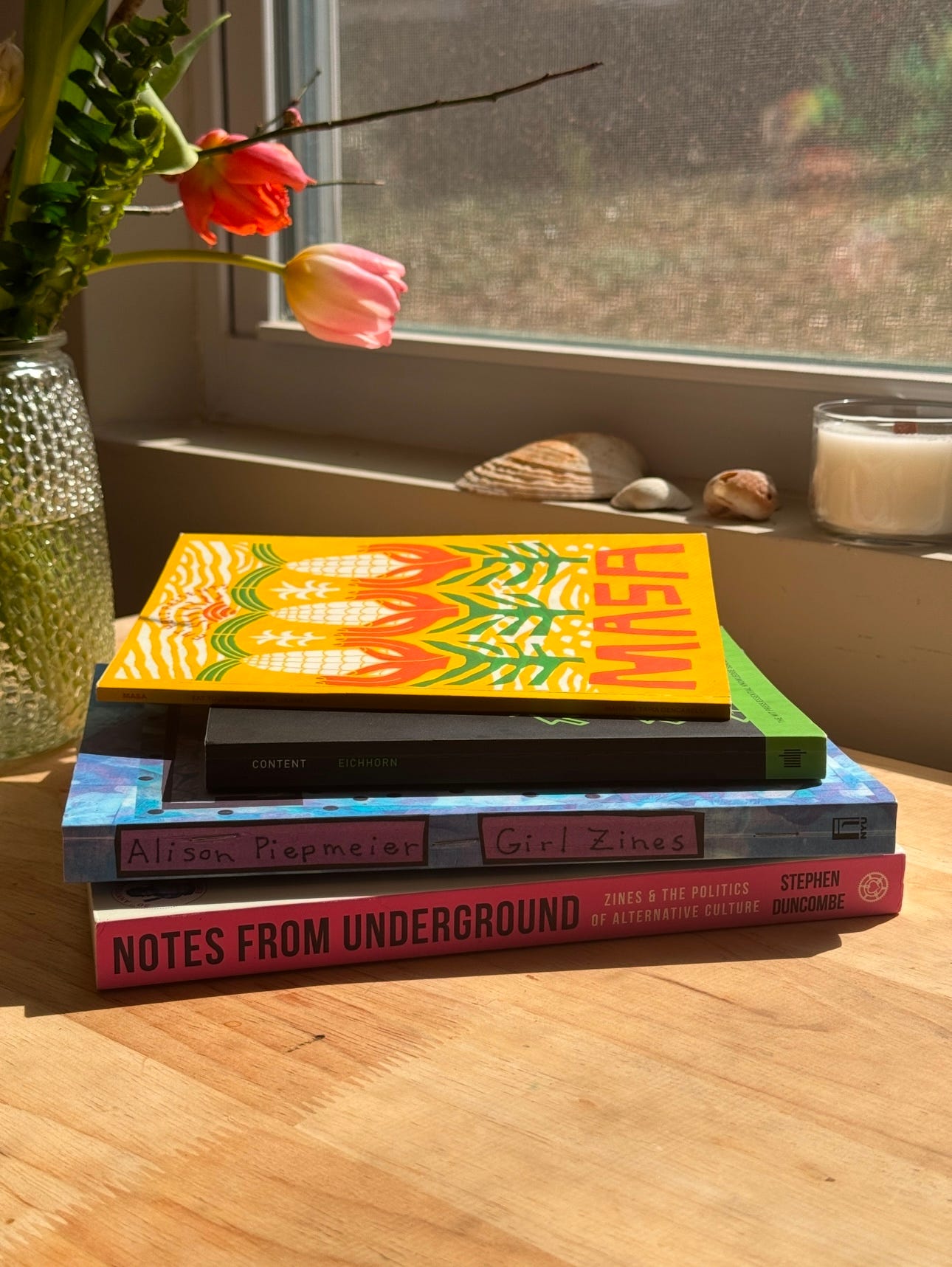
Girl Zines: Making Media, Doing Feminism, Alison Piepmeier
An account of girl and grrrl zines through a feminist and cultural optic–of course I was going to love it. I read this while my own zine went to the illustrator and after, knew how I was going to write the editor’s letter. That there would be an editor’s letter at all. I didn’t find this book until the latter part of the process, but it helped me contextualize feminist zines as a form of independent media. At the time I remember just hoping that Panadería would live up to whatever hype I felt it had, real or not. If a handful of people made the recipes I'd have been pleased. Since then my hopes and plans for this zine project have grown grander, and that sense of possibility I think was first planted by reading Girl Zines.
“Although not all grrrl zinesters identify as third wave feminists, the feminist work they are doing draws from second wave insights, the theoretical work of U.S. third world feminists, and the specificities of this late-capitalist cultural moment, synthesizing those components in ways that come to characterize the third wave. Because zines are scrappy, informal, sometimes deliberately immature and provocative, and able to be produced by almost anyone, they haven’t generally been recognized either as a meaningful part of feminist history or as sites for feminist theory production, but they are both.”
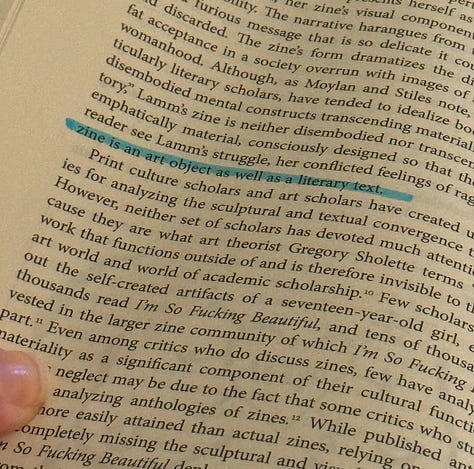

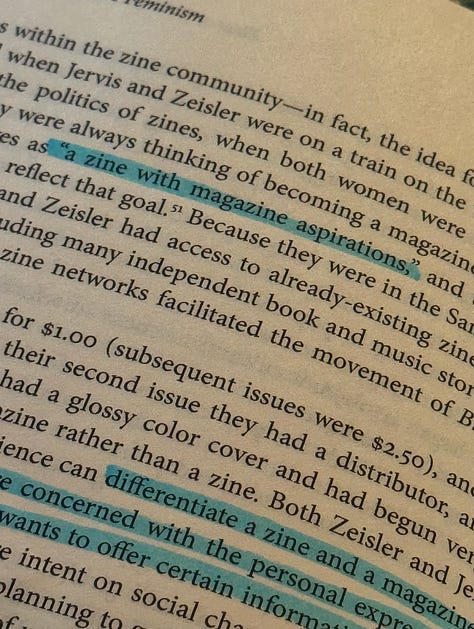
Content, Kate Eichhorn
The weariness I'd been harboring surrounding my social media use after nearly 20 years of being logged on in some way began to really grate last year. Why does it feel so gross to me to label cultural products–like zines–as “content”? How did we get to this point where content creation and “content capital” matters more than cultural capital, as Eichhorn argues? I read this book last year around the time I was realizing I needed to take a break from Instagram (lol). It was within that time when I was away that my zine began to take real shape from item on a to-do list > email chain with my designer.
“With content automation now entering a new phase, it is no longer something of interest only to computer programmers, experimental poets, and avant-garde composers. As algorithms become increasingly capable of turning out readable texts, even if they are far from perfect, and as more content circulates simply for the sake of circulation, all sorts of content – from news to television and film scripts to genre fiction – are about to be transformed. Understandably, this may sound sinister.”
Notes from Underground: Zines and the Politics of Alternative Culture, Stephen Duncombe
I read this as preparation for the piece that would kick off zine-making for me last year. Duncombe’s analysis of the politics that encompass zines was a good frame of understanding its history. The new afterword “Do Zines Still Matter” in which Duncombe writes that paper zines are “merely an exercise in nostalgia”, a fetishization of the materiality of paper in a digital age, left me wanting more on the matter because zine-making is to me more meaningful than a longing for some past when paper and print ruled. Still, this is a book I’ll always associate with the making of Panadería.
“But besides my personal convictions, there is another, and more important, reason to be concerned with the politics of zines. They ask for it. Espousing anarchism, denouncing capitalism, exhorting others to do-it-yourself, spreading the ideal of an authentic life, the vast majority of zines are critical of mainstream society and mass culture, and at least hint that there might be a different way. To interrogate underground culture as to its possible political impact is merely taking zines at their word.”
Masa Eat Yoli Zine Series Volume 2, Marissa Gencarelli
I’ve had this out of print zine produced by Kansas City, Missouri’s Yoli Tortilleria for some years. Masa wasn’t something I read while making Panadería, but upon reflecting thought it smart to include an appropriate zine that’s a part of my own personal collection. All but one recipe in Panadería utilizes masa harina, so I thought it was fitting. I like recommending one zine on a zine reading list, even if it is out of print. Masa is a dedication to the pre-colonization cooking process nixtamalization and includes recipes using both the fresh stuff and masa harina, complete with a nixtamal lesson.
“The practice of the traditional "‘pilado’ and ‘pelado’ methods to make masa was reduced to a handful of small businesses and families operating them at a medium to low scale. My generation forgot to make fresh masa and most of us actually never learned the craft.” - from the headnote for Venezuelan Empanadas with Maitake Stuffing recipe, written by Mercedes Golip

My zine designer Elizabeth and I begin work on Issue 2 of Panadería next month. This is a reminder that paid subscribers get one complimentary copy of all At Heart zines, and have the opportunity to become a paid zine recipe tester. An annual subscription to my newsletter is $30; I pay $100 for recipe testing + ingredient reimbursement, with the hope that I’ll be able to pay more down the line. Thank you for your subscription—free or paid—as your support allows me to continue making zines.
Comments
Nothing yet. Say the first thing.
Sign in to join the conversation.