

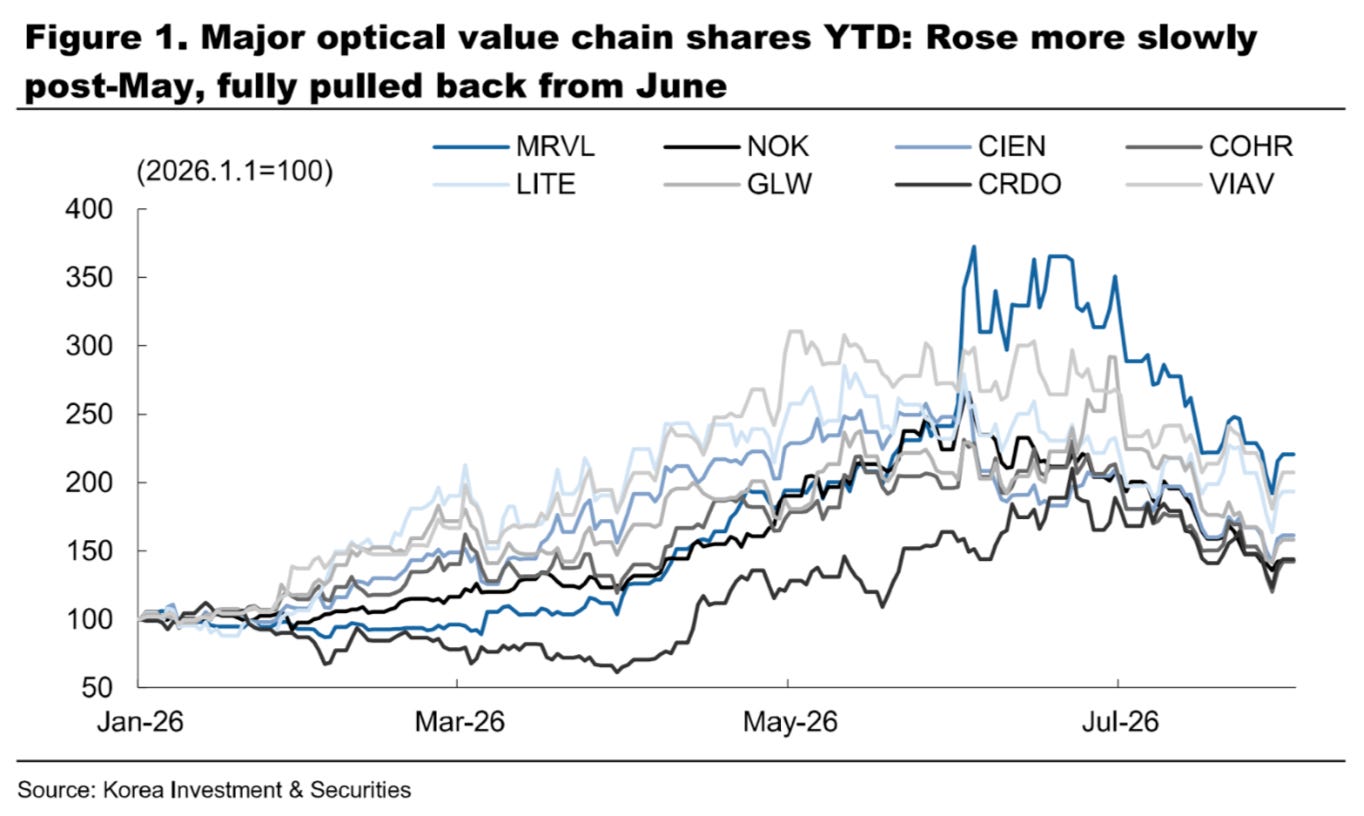
In June, we mapped the optical supply chain in our shortage report, and LITE scored at the top of the entire stack. The company grows the InP laser chips that every 800G and 1.6T transceiver depends on, and quoting their representatives:
“We can’t make enough of them.”
Demand from other layers of the chain keeps confirming it too, with AAOI telling us on Thursday’s call that the demand for their products runs 20-40% above what they can build.
This is a two-part piece.
Part one breaks down the company and why it sits where it does in the optical stack. Part two covers tonight’s earnings print.
Remember that our subscribers get access to the VIP Discord, where our analysts, as well as our co-founders (Michael and Kawz) share their trade ideas.
Here’s everything you need to know if you want to invest in LITE 0.00%↑.
Before we begin, this Substack is for informational and entertainment purposes only and does not constitute financial advice. Past performance is not indicative of future results. Never invest more than you can afford to lose. Our writers may hold positions in the securities discussed and may buy or sell them at any time without notice.
Part 1: The Company
What Does Lumentum Sell?
The Laser Position
CPO / NPO Timing
Capacity Build
China Ban
The Margin Rebuild
Part 2: The Earnings
The Print
The Guide
Key Information From Q4 Call
Capex and Capacity
Valuation
Risks
Our Take
Lumentum reports two product lines: Components and Systems.
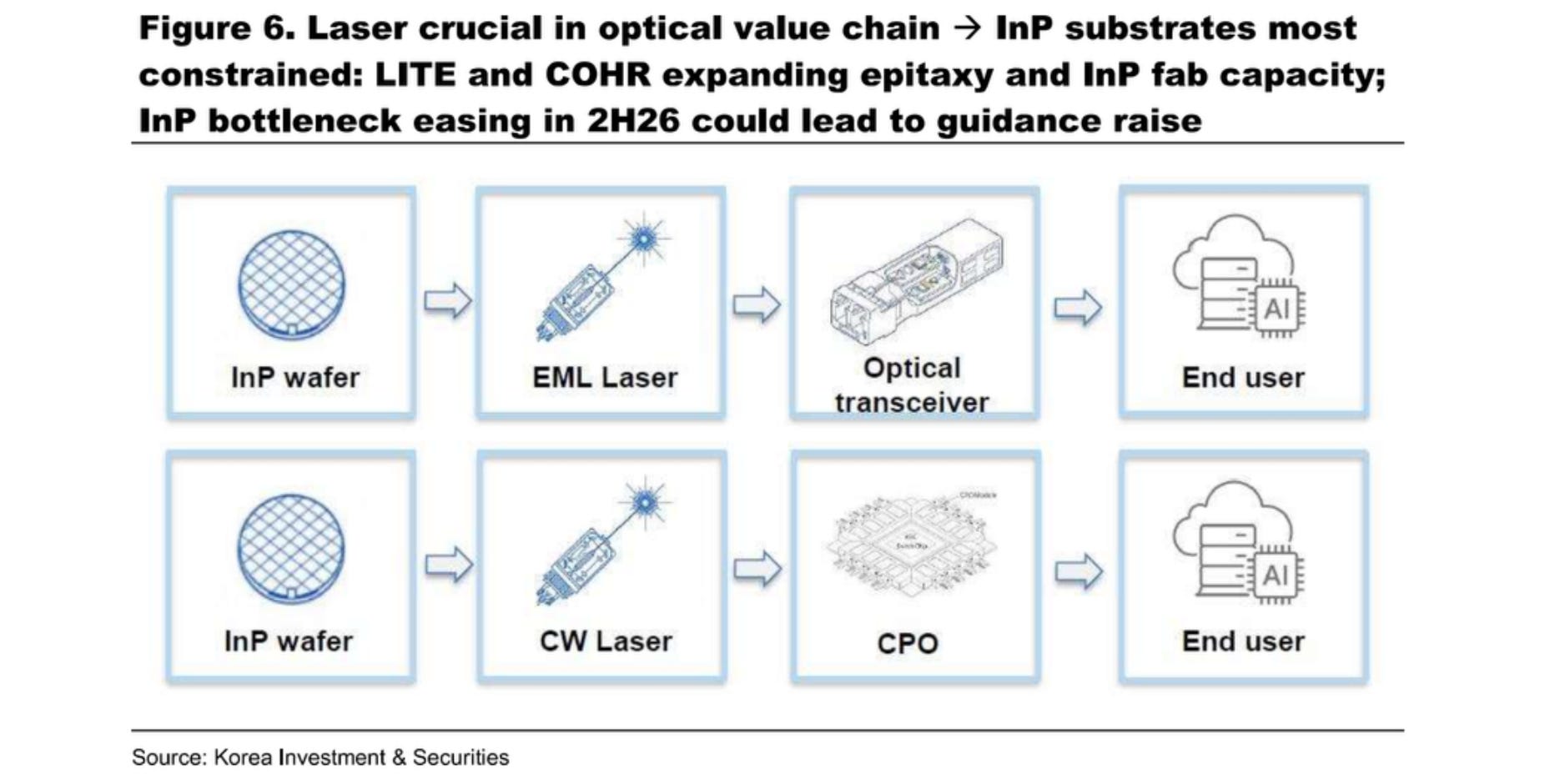
The components side is why this stock look appealing for anyone invested in optical. Lumentum makes the EML (Electro-Absorption Modulated Laser) laser chips that go into majority of 800G transceivers shipped today.
Their customer list includes the biggest names in the module industry: Innolight, Eoptolink, Fabrinet, who assembles for NVIDIA.
The conclusion here is easy = if Lumentum can’t ship enough lasers, the whole transceiver supply chain slows down.
EMLs are the volume product and driver of the company.
However, there are also pump lasers and narrow linewidth laser assemblies that both go into the scale-across links between data centers, and both lines are growing faster than EMLs right now.
→ Pump lasers grew +80% YoY last quarter
→ Narrow linewidth shipments grew +120% YoY (it grew for ninth straight quarter)
Hurlston said pump supply got tight enough that they’re now choosing which customers get allocation.
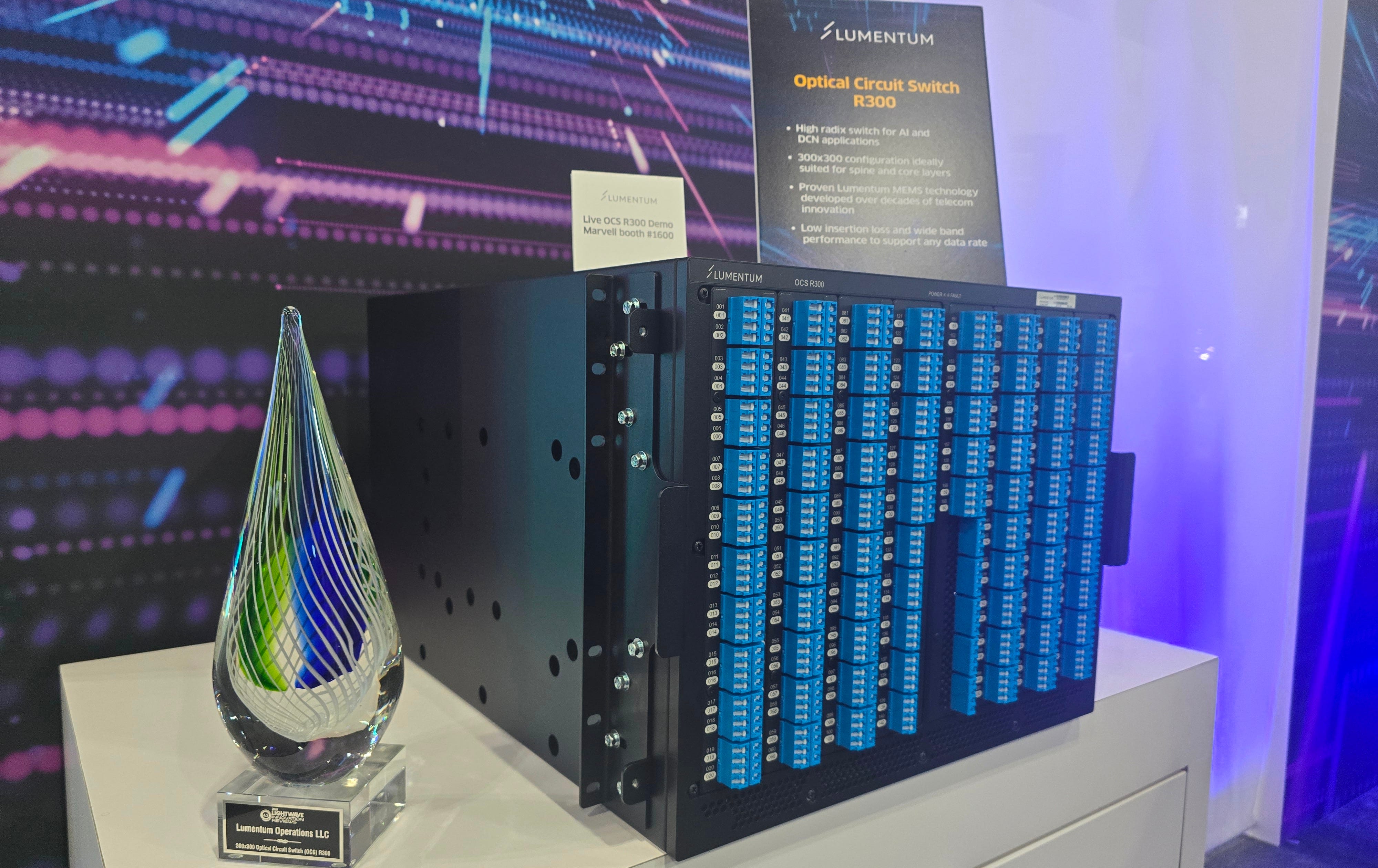
The Systems side of the business came together through the Cloud Light acquisition, which turned Lumentum into a transceiver maker shipping 800G and 1.6T modules directly to hyperscalers. Cloud transceiver shipments were supporting the growth of the company, and this part of the business grew over 40% Q/Q. Then there’s OCS (the optical circuit switches) that networks which are Google-ish use in place of electrical ones.
That product line is backed by a purchase agreement worth several billion dollars, announced at OFC in March. Hurlston called OCS:
“The biggest single tightrope that we’re walking”
He said that because the ramp depends on 2nd tier supply chain parts showing up on time. Furthermore, on the last call, Hurlston told analysts how tight overall supply is:
“We had conversations today with customers, you know, significant customers looking to really up their demand, and get output from us, and we simply can’t service that.”
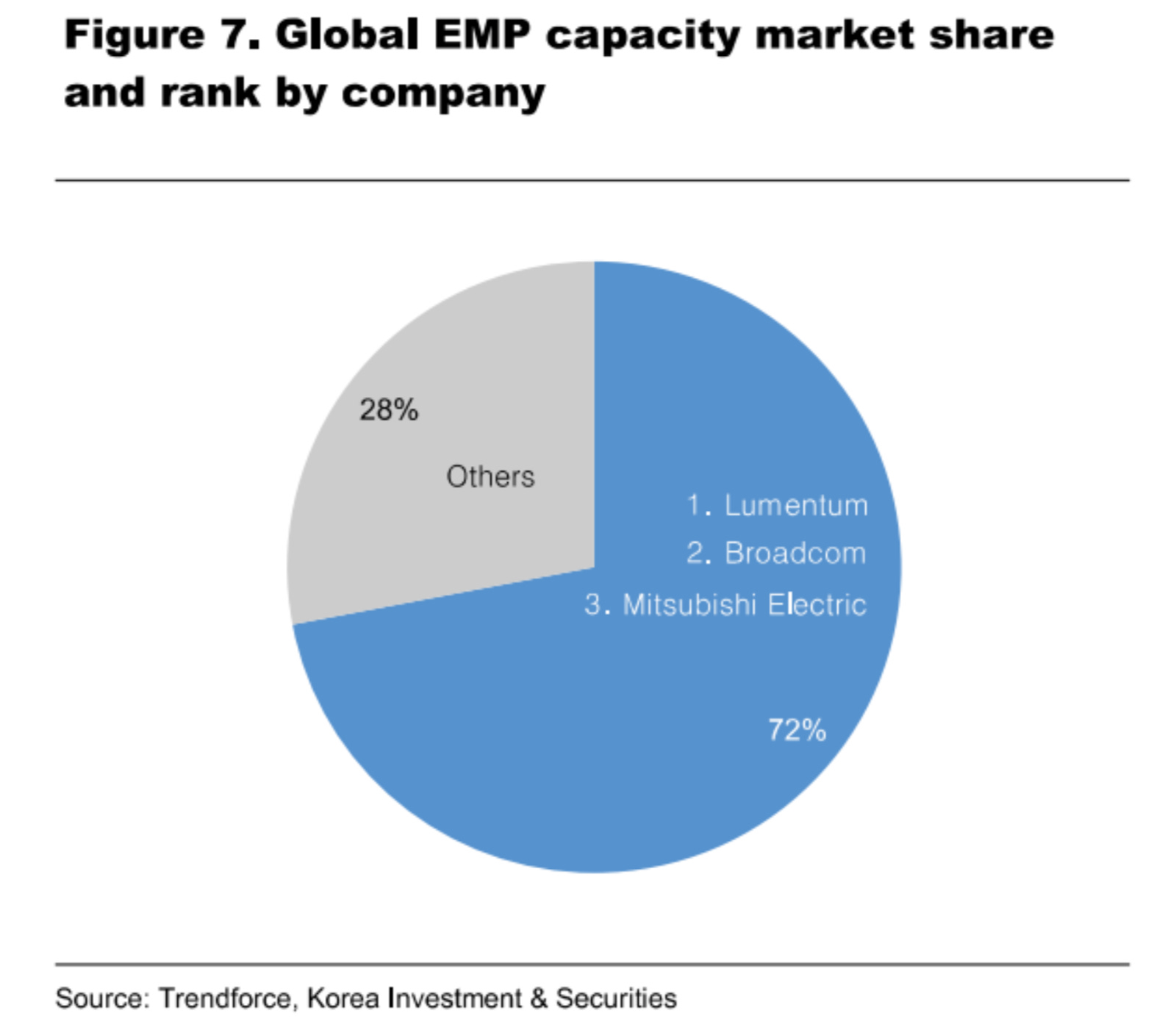
Lumentum ($LITE), Broadcom ($AVGO), and Mitsubishi Electric ($6503.T) control 72% of global EML capacity according to TrendForce, with Lumentum being first. The whole industry is more than 30% short on EML supply right now, and it will only get worse as NPO demand surges on top of existing orders.
Pricing reflects the tightness as the ASP on 200G EML is roughly twice that of a 100G EML, and the majority of Lumentum’s capacity is already locked under LTAs. Negotiations for 2028 and 2029 LTAs are underway at higher pricing. Pump laser LTA discussions are also in progress.
Furthermore, the high-power CPO laser market is a Lumentum and Broadcom duopoly, with Coherent behind by estimated 18 months (depending on the stability of their MOPA architecture), and AAOI roughly 2-3 years out (all according to Irrational Analysis). Neither of them (AOI or COHR) has publicly shown phase noise or linewidth data under real operating conditions.
That leaves LITE (out of the big three: LITE, AAOI and COHR) supplying lasers into every architecture that’s important today and every one on the roadmap.
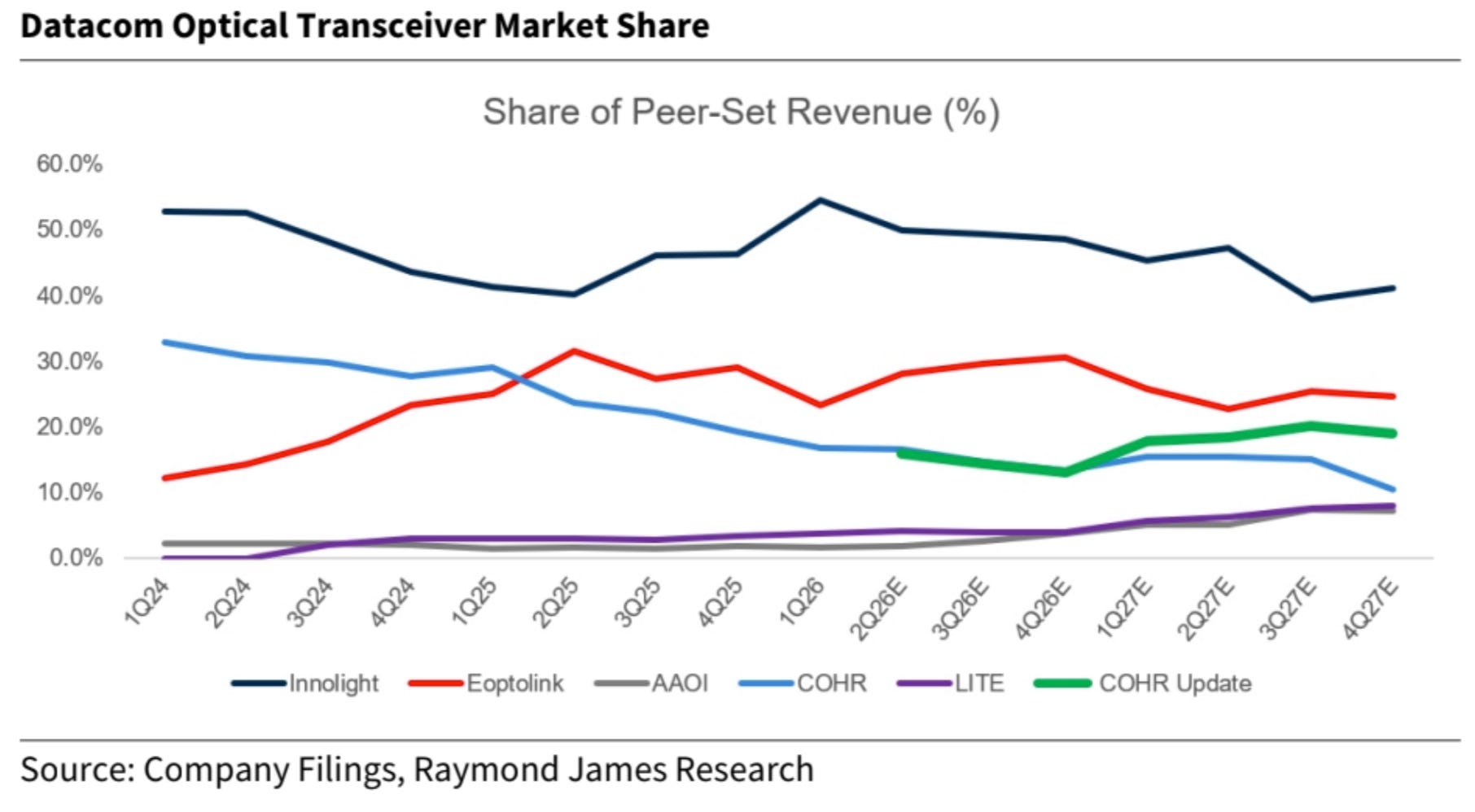
When talking about architectures, we should explain them one by one. There are three main optical architectures competing to connect AI clusters.
Pluggable transceivers are the volume product today. Every 800G module shipping right now uses a laser from Lumentum or one of the few other suppliers. Transition to 1.6T is already underway, with Lumentum ramping higher-ASP 200G EMLs and shipping 1.6T transceivers from the Cloud Light platform.
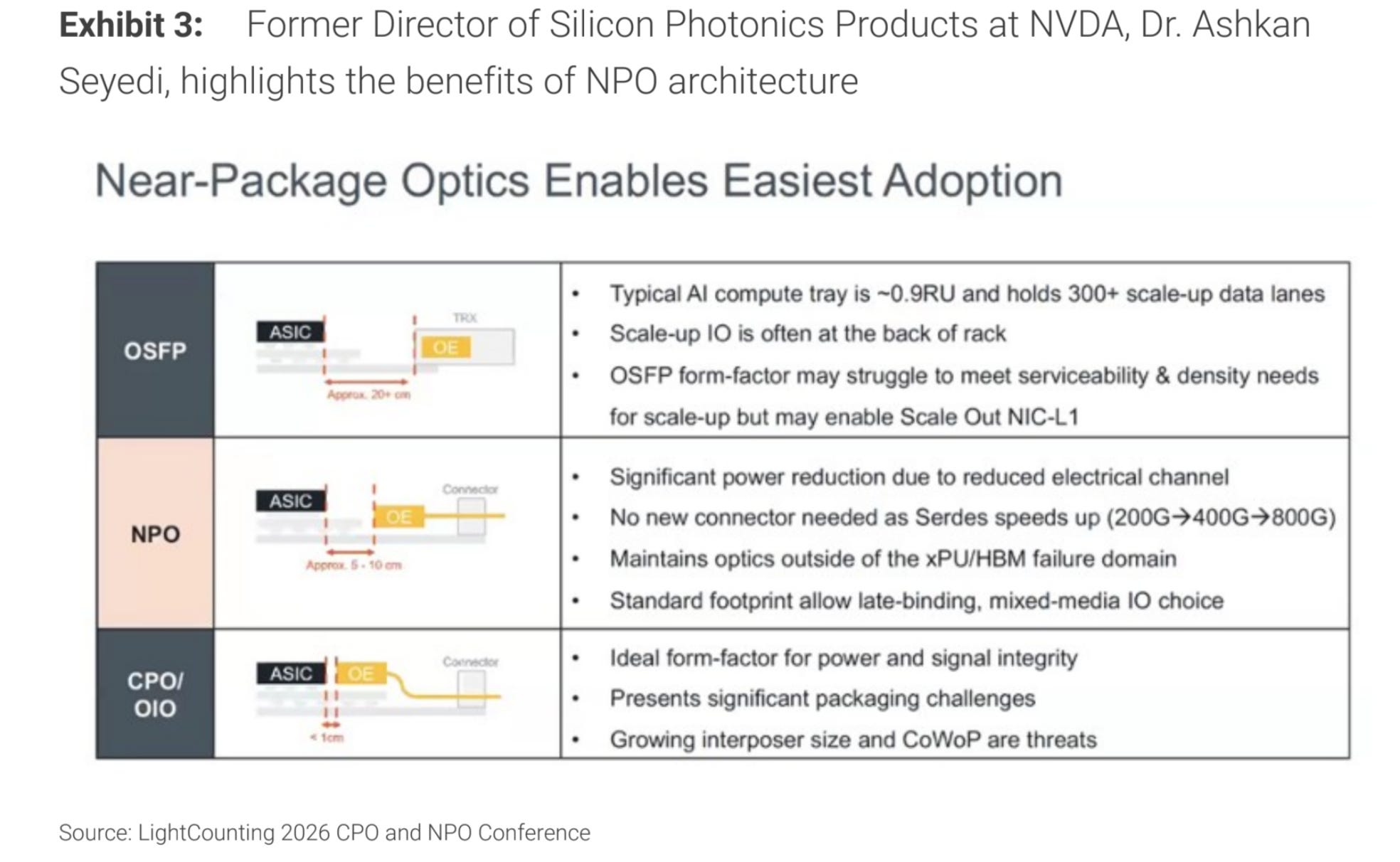
NPO is the next architecture approaching production. Lumentum has three NPO programs ranging through CY27-28, and management said their UHP (Ultra-High-Power) laser capacity is fungible between both CPO and NPO, which is beneficial on short turnoaround. Worth noting that NPO is attracting a broader customer base beyond NVIDIA, particularly platforms looking for better power efficiency without committing to CPO…
CPO carries the biggest content multiplier (and it also sits further out). A high-power CPO laser consumes 5-10x the InP die area of a 100G EML. NVIDIA remains on track for initial CPO shipments in Q3 CY26 with Q4 inflection. Volume scale-up CPO won’t arrive until the Feynman generation, but the laser orders land well before that.
So the takeaway for the InP demand is simple, each architecture transition increases laser content per system, and all architecture run through the same fabs, increasing revenue streams for LITE.
Luckily, same as AAOI, LITE is expanding at every level of the supply chain.
The current capacity add comes from completing the transition to 4-inch InP wafers and expanding the Japan fab. Together those should push laser output up roughly 50% from December 2025 to December 2026, additional capacity will be added in the UK fab layers during CY27.
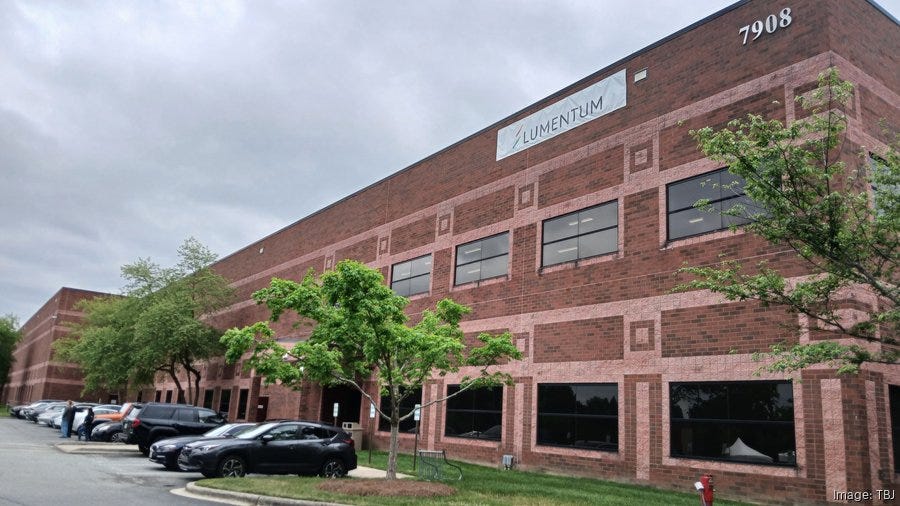
The big one is Greensboro. That fab comes online in 2028 with roughly $5B of annual revenue capacity, and half of it is already committed to NVIDIA through a LTA. Needham expects that remaining capacity to be sold out quickly.
Moreover, as most of you probably know, in March, NVIDIA took a $2B equity stake in Lumentum and Coherent combined, with a purchase commitment attached worth several billions. Preferred stock converts into common shares and adds roughly 7M to the diluted count this quarter, bringing it to about 102 million.
The dilution here is hard to ignore, so you should be aware of it when investing in the company.
In addition, the substrate bottleneck is starting to ease. AXTI is on track to 2x InP substrate capacity in 2026 and expand further in 2027. Export permits out of China are becoming more regular and the only thing that could stop it is an InP substrates export ban coming from China (we’ll talk about that in a second).
Morgan Stanley’s assessment is that internal fab capacity, is now the primary constraint on how many lasers Lumentum can ship.
Comments
Nothing yet. Say the first thing.
Sign in to join the conversation.