
SanDisk had an investor day yesterday and the stock rose 14% by the end of trading. David Goeckeler opened the conference with:
“as I stand here today, I feel like I’ve finally gotten to the starting line of where the real value creation is going to happen.”
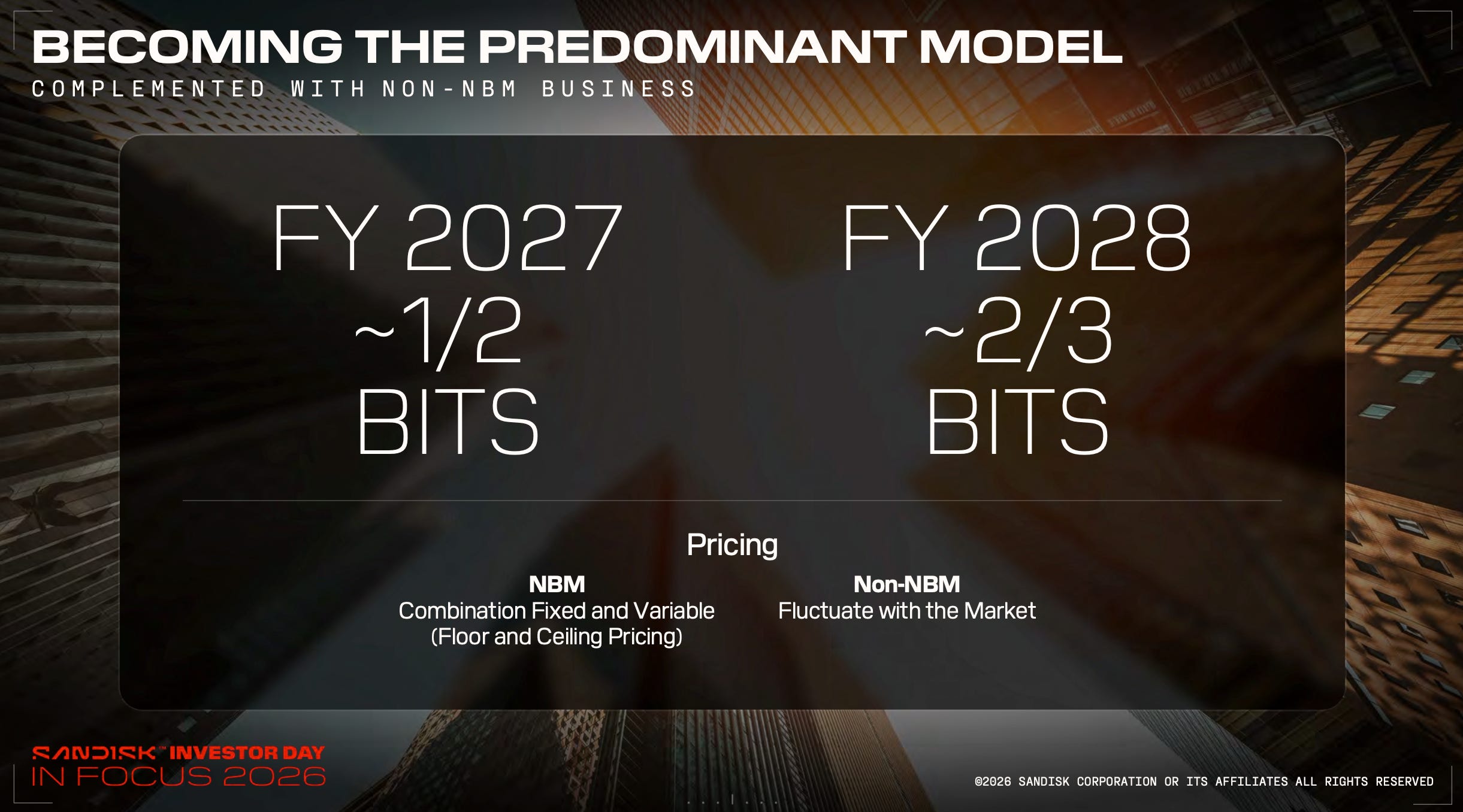
Goeckeler’s confidence comes from a contract book which secures half of fiscal 2027 and two-thirds of fiscal 2028 bits into long term contracts that include a minimum guarantee. There’s a lot to discuss regarding this event; therefore buckle your seatbelts and read about the most significant event for memory of this year.
Remember paying subscribers have access to the VIP Discord where you can see trade alerts from our analysts and authors.
Before we begin, this Substack is for informational and entertainment purposes only and does not constitute financial advice. Past performance is not indicative of future results. Never invest more than you can afford to lose. Our writers may hold positions in the securities discussed and may buy or sell them at any time without notice.
What’s Inside:
Introduction (already read)
Before Investor Day
Long Term Profitability
NBM
Leveraging Supply
HBF
Our Take
Sandisk reported their Q4 earnings nine days ago. Their headlines for this reporting period included:
→ Revenue was $8.97B, up 51% QoQ
→ Non-GAAP Gross margin was 84.6%
→ EPS was $39.25; beat the guidance of $30-$33.
All week after the report, this quarter has been a hot topic on X. Because of that, we wanted to focus your attention on one particular element; which is one specific sentence that explains this full cycle.
“...Sequential revenue growth came about one third from an increase in volume, and two thirds from an increase in price.”
Price change, relative to unit volume changes, had a significantly larger impact on the overall results. NAND supply constraints are providing pricing power for SanDisk, and therefore, the floor prices locked into their contracts will determine how much of that pricing power they can capture.
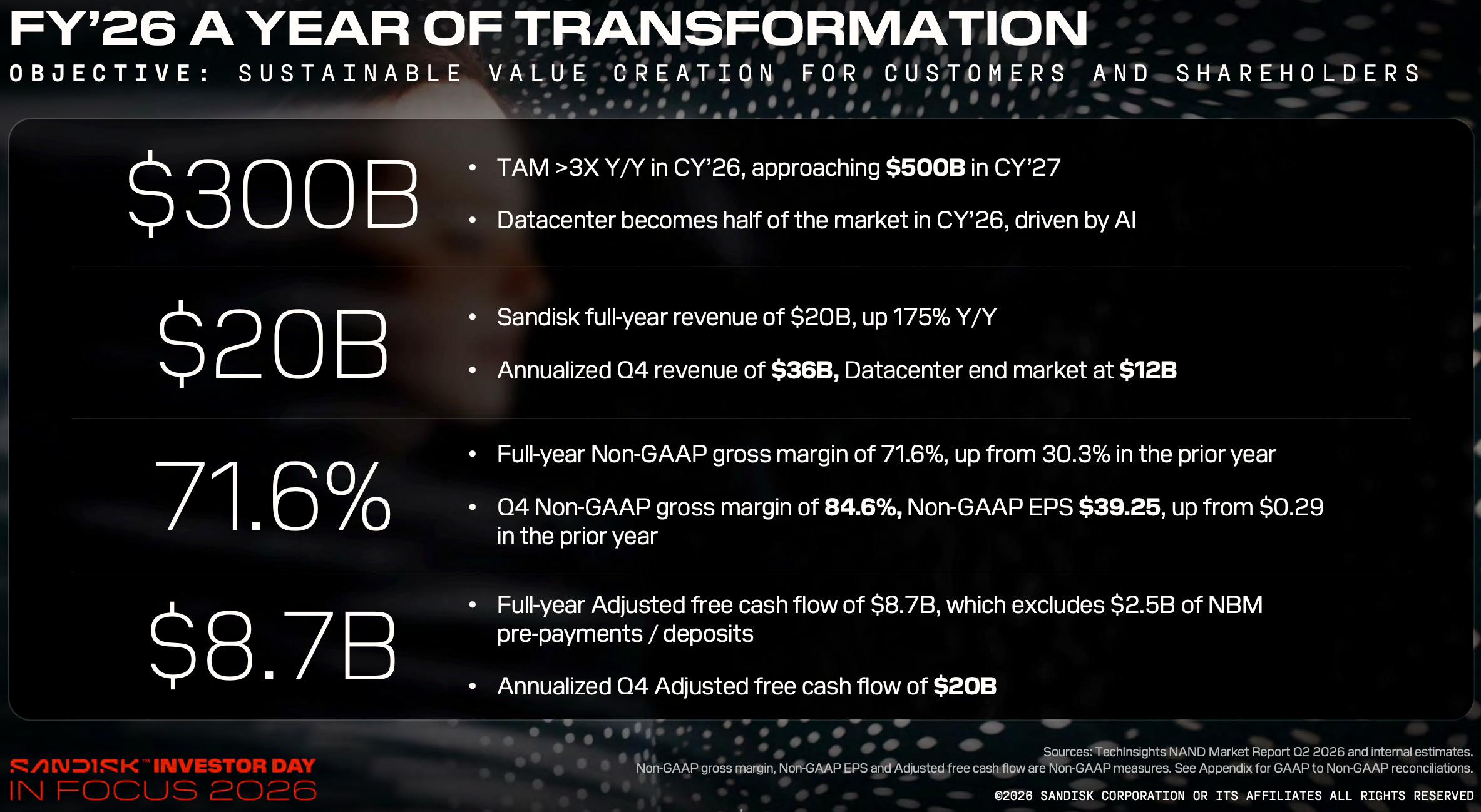
Cyclical this, cyclical that… If there is one thing you should remember from this conference, it’s this quote from Visoso himself:
“When you aggregate all of that for 2028 through 2030, we expect to grow revenue mid to high teens, consistent with [bit] growth... We expect non-GAAP gross margin to be around 80%. We expect non-GAAP operating margin to be 75%. How do we get there? We expect to spend about 5% in OpEx... And then you get to 50% adjusted FCF after paying for taxes, working capital, capital spending.”
Take a look at “grow revenue […] consistent with bit growth”. This means that if revenue and volume grow at the same rate, pricing stays roughly flat for three years, so they’re not modelling any future price hikes.
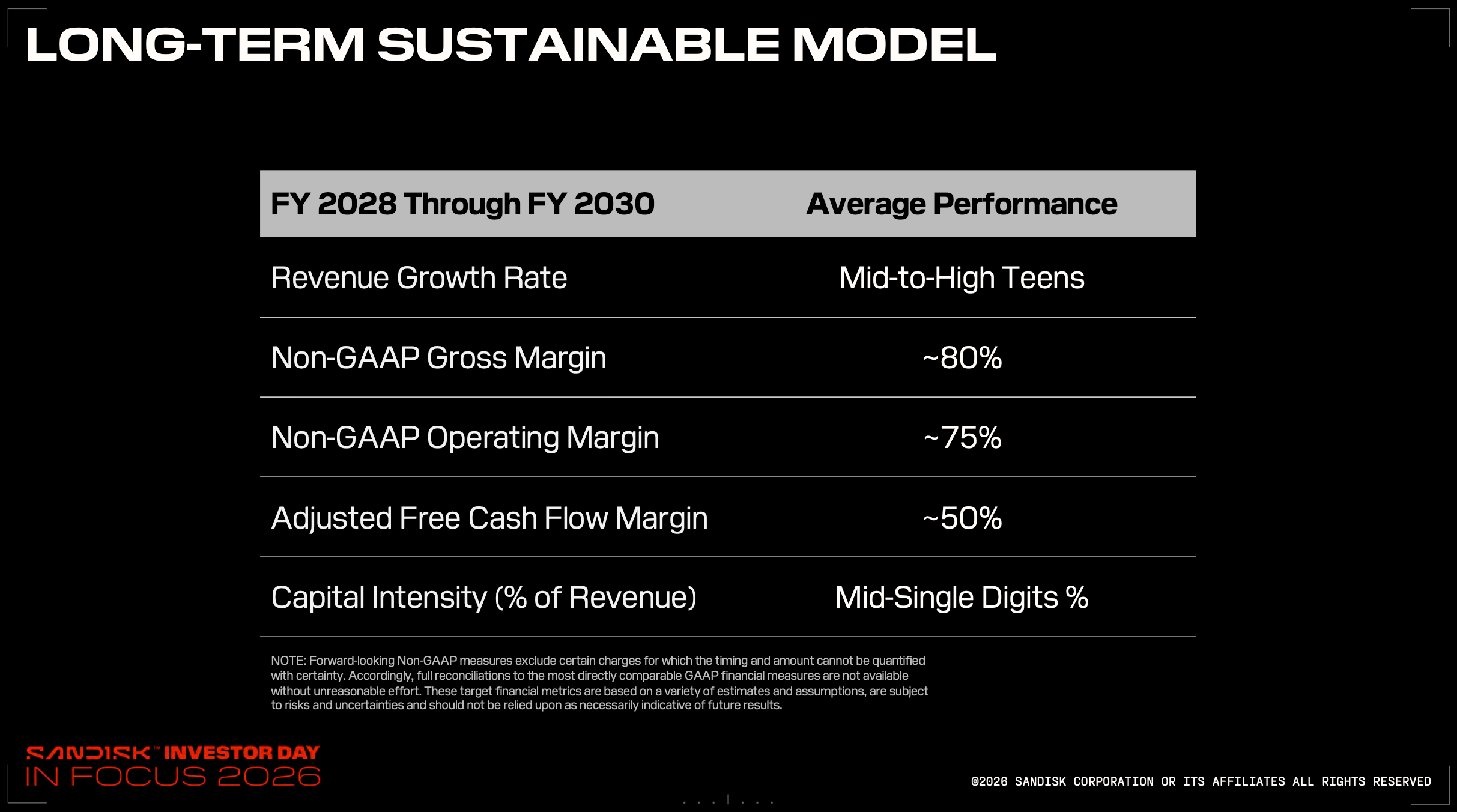
Gross margin near the 80% mark, with FCF margin of 50%. All that while running opex at around 5% of revenue is something unheard of. Not in memory, and DEFINITELY not in cyclical business.
Goeckeler (CEO) on the growth number:
“We’re committed to this kind of mid to high teens volume growth. When we look at the whole market, we think this is sustainable over long periods of time... it’s an input to a process of developing a whole fab strategy.”
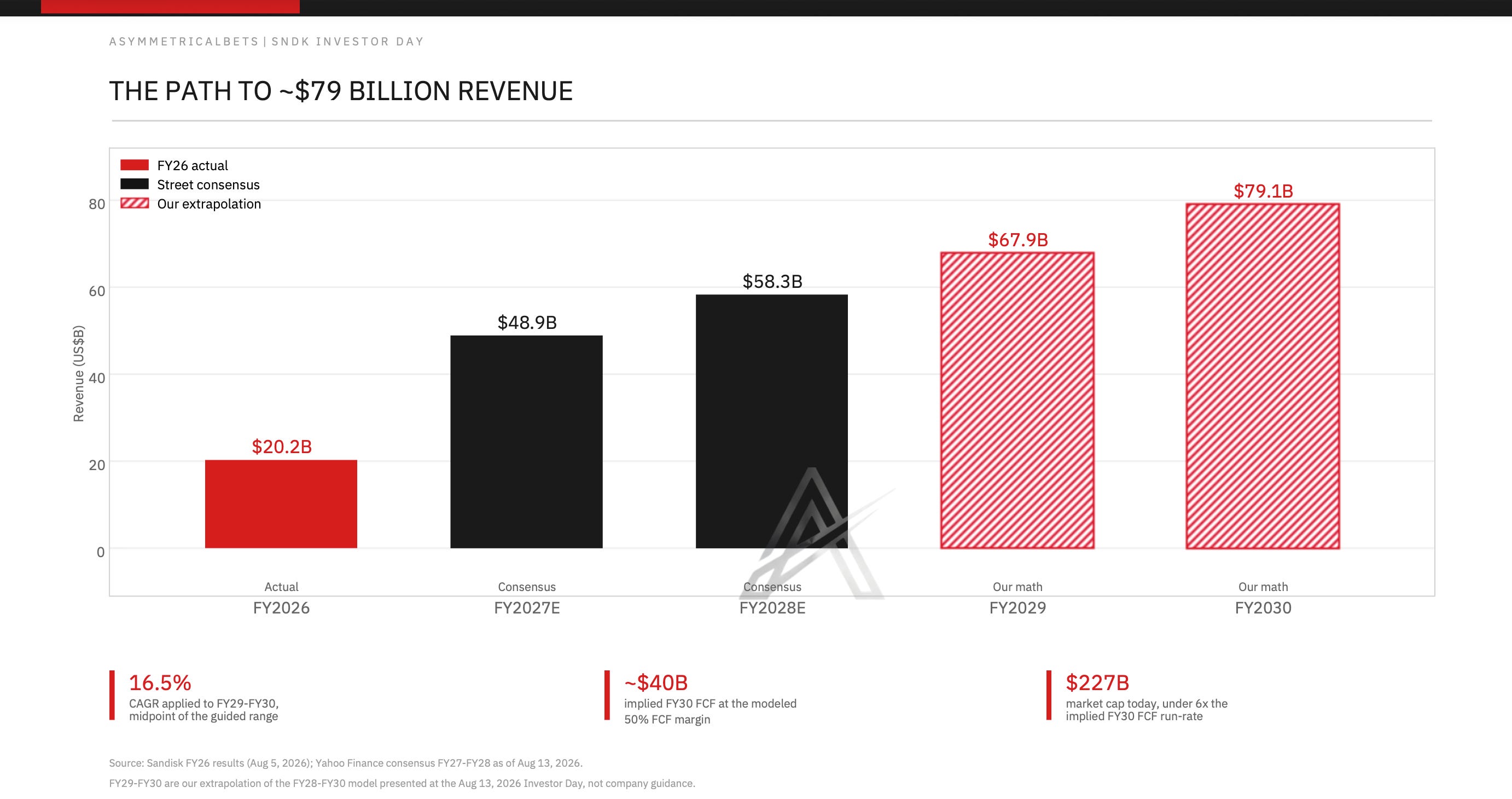
As analysts already assigned $48.9B in revenue for FY27 and $58.3B for FY28, we decided to extend management’s CAGR to FY30… and we landed at approx. $79B in revenue.
If we assume 50% FCF margin that comes up to $40B of annual FCF against a $227B market cap today, look below.
After so much FCF, the money has to go somewhere. Someone decided to ask Visoso about the same topic:
“There is no trick. It’s 100% of the cash. Excess cash will go back to shareholders. You look at last quarter, we generated $5 billion. How much did we return to you? 4.5.”
The New Business model works this way:
A hyperscaler commits to buying a fixed volume of bits (for X amount of years) → the trade is backed by financial guarantees (at prices with a floor) → the customer gets supply security → SanDisk gets revenue insurance for the downturn.
Per Visoso:
“These go to the highest level of the companies. They require board approval. We’re talking to CFOs, we’re talking to treasurers, we’re talking to CEOs.”
Their backlog right now is at 10 agreements, with 8 customers (3 of them are hyperscalers). Worth noting that the minimum revenue from these deals, at floor pricing, is $93.9B, and the average contract is around 4 years long.
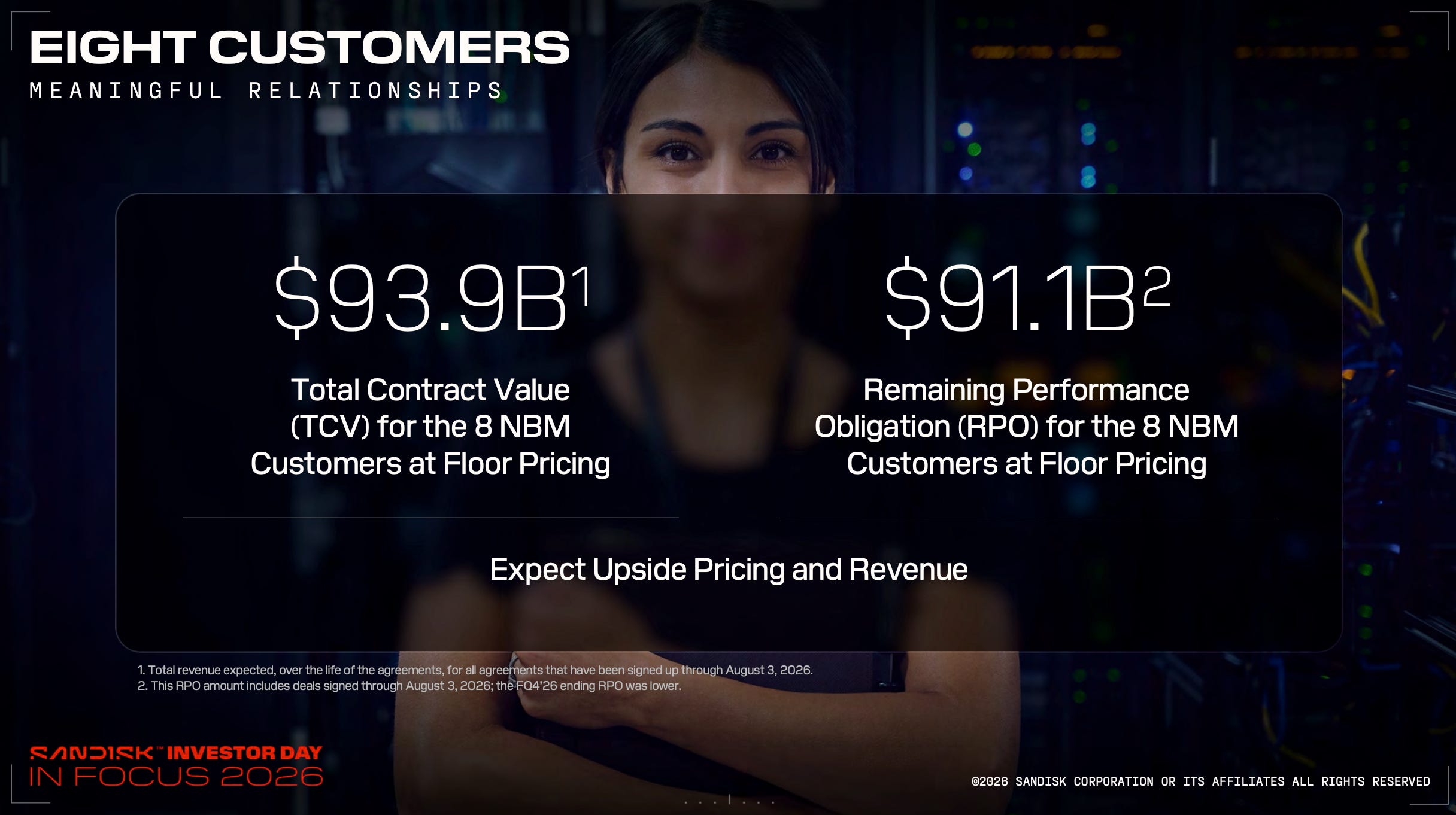
So what happens to margins if prices crash to those floors?
Visoso said:
“Even at the lowest price, at the floor pricing, at any point in time, we don’t expect these to be below 80%... every single year over the period, we should be able to be, even at floor pricing, around 80%.”
Look at it once more, the downside scenario is an 80% gross margin company.
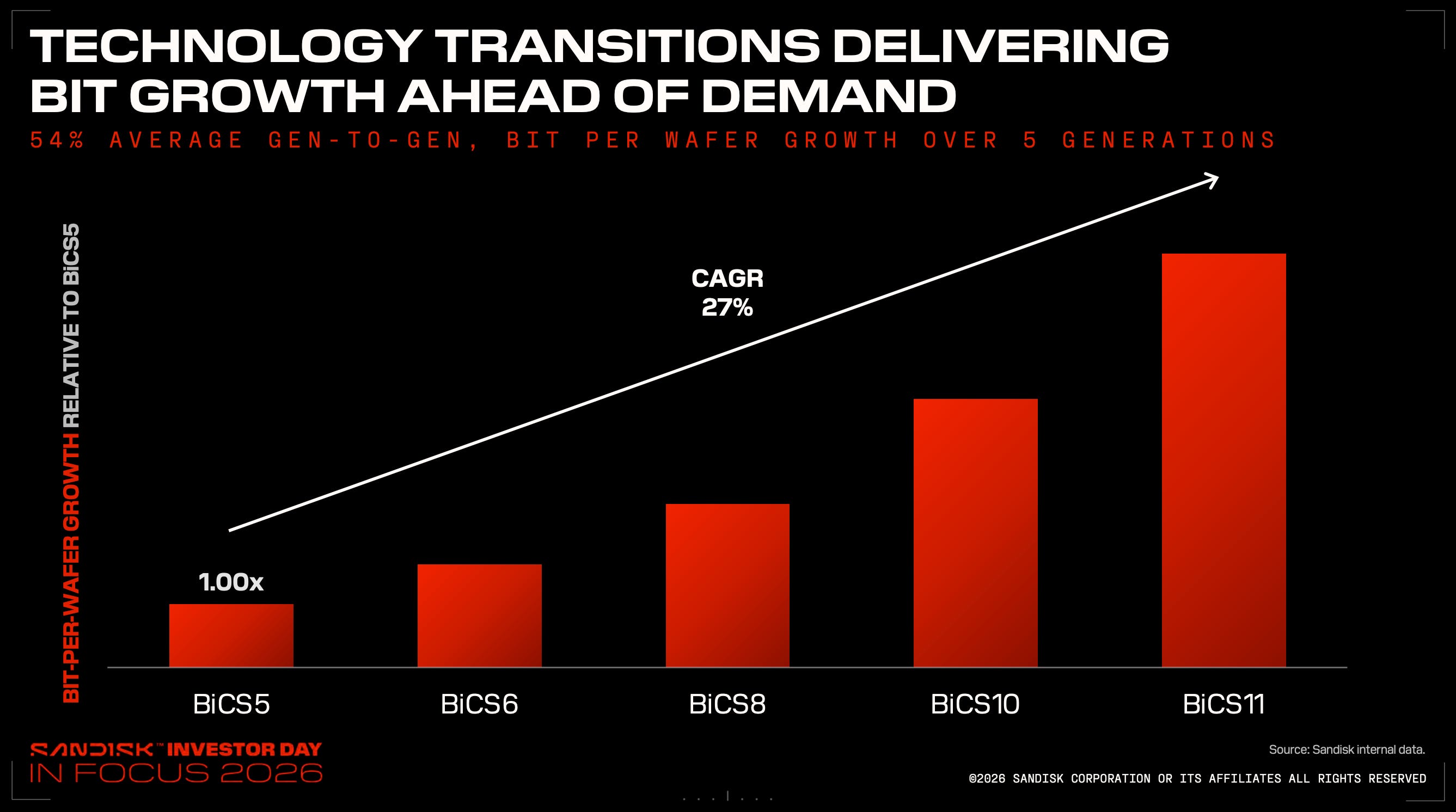
But we still wanted to know how these floors will survive, and luckily Goeckeler did the math, on stage, for us. He went through the BiCS (Bit-Cost Scalable) roadmap:
“Through the application of innovation, we can grow output per wafer at a rate of 27% a year. Which, by the way, tells you, you can’t just release nodes whenever they’re available. Otherwise you’re going to flood the market with supply and you’re going to have another 23’ situation.”
Explained in easier language: the technology COULD possibly grow output 27% a year but SNDK chooses to ship mid to high teens, which means everything in between is holding supply for pricing reasons.
That’s the sole reason why most of NAND growth through 2027 comes from upgrading existing factories, where each new process squeezes more storage out of the same wafer.
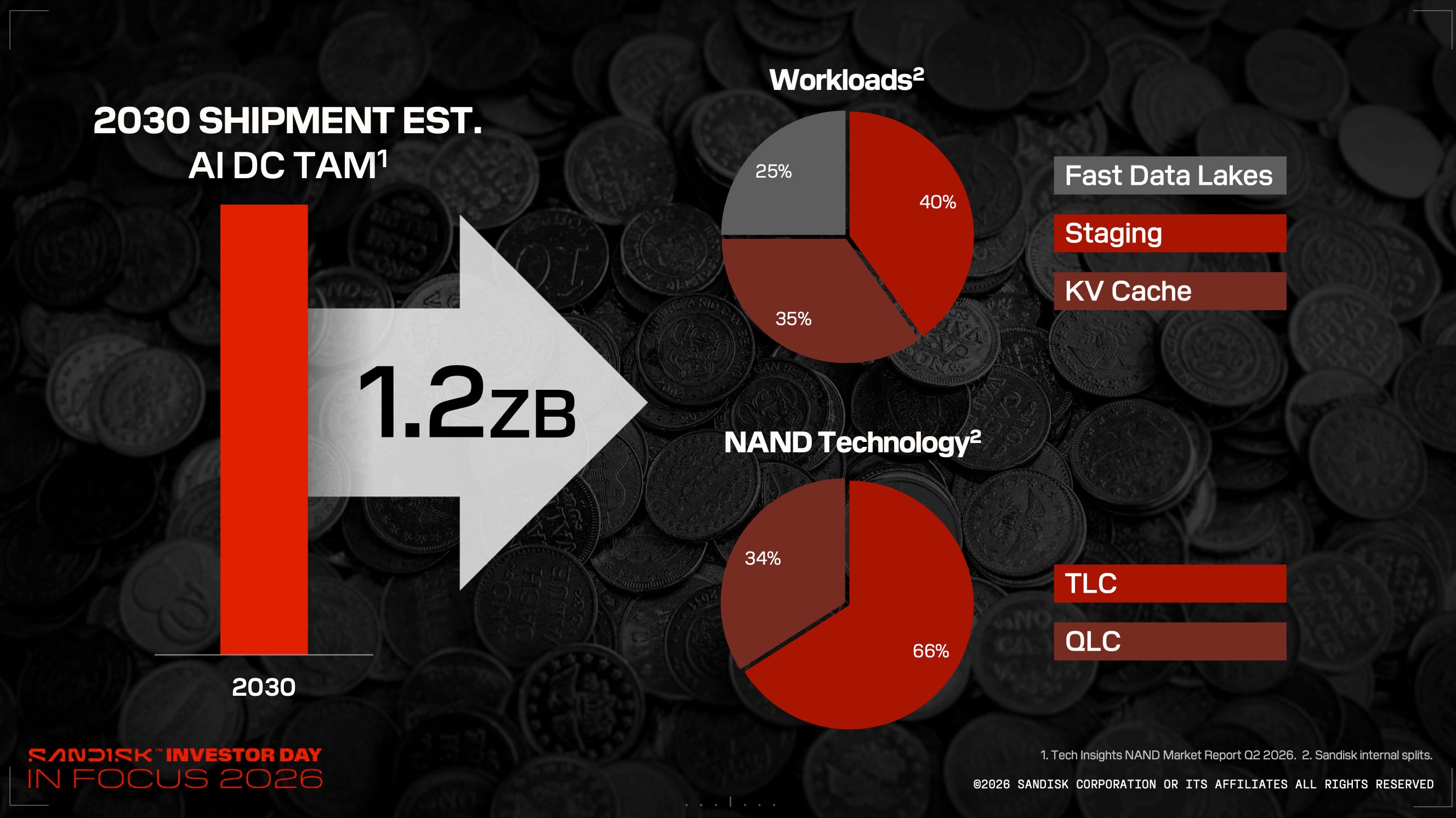
However, the fastest growing AI workload is KV cache (this is the memory that lets chatbots remember your conversation), which means that the demand is pulling another way. People using one chat longer or even models that remember who you are, all of it sums up to this one workload, and SNDK said its size is at zettabyte of storage by 2030.
What even is a zettabyte?
1,000,000,000,000 (1 trillion) gigabytes, nearly as much flash as the entire industry will ship this year (in phones, data centres, etc.).
Add this amount of demand to withheld supply and you get the pricing argument in one.
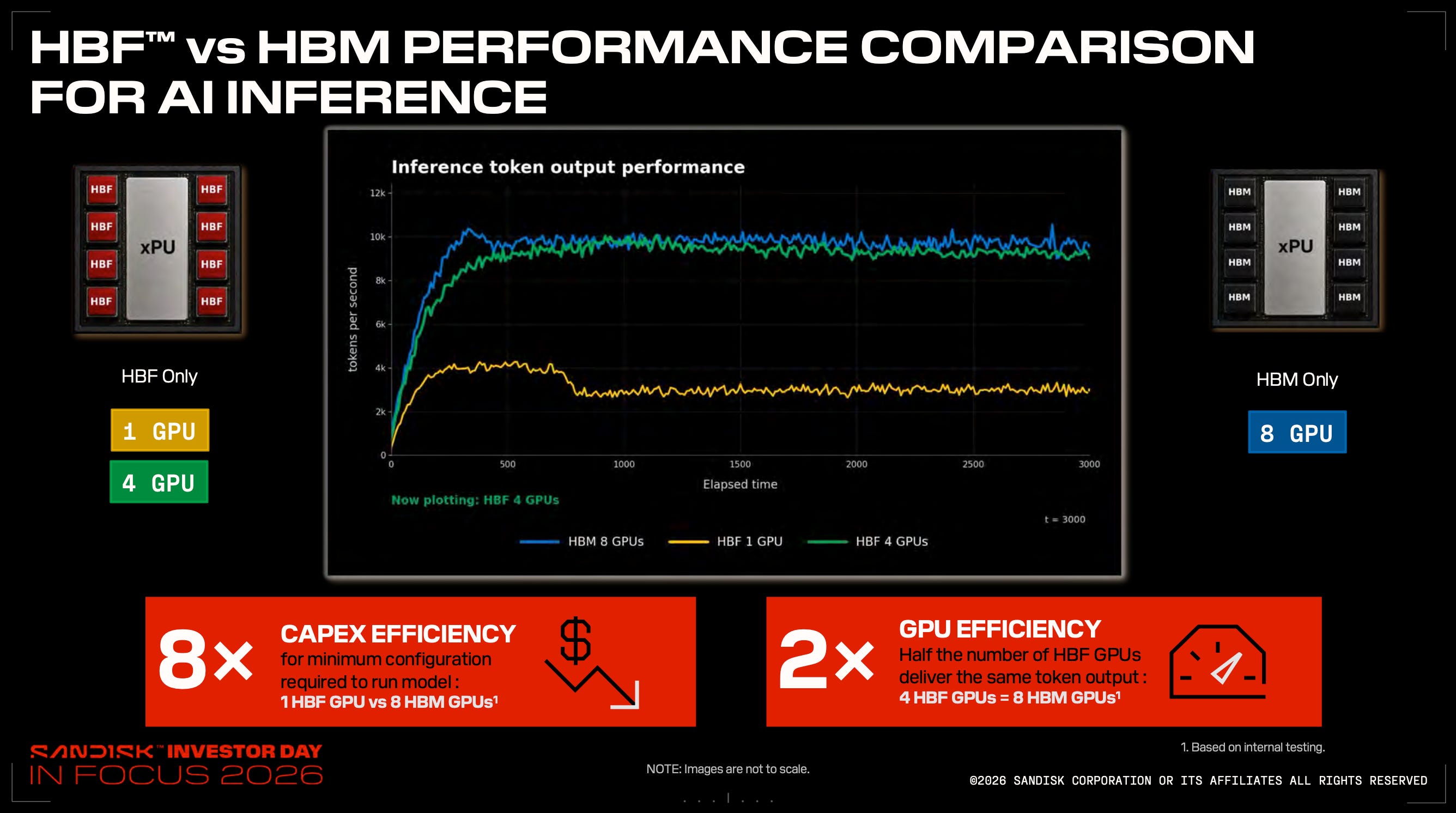
HBF is basically a HBM, but with NAND stacked on top of each other, instead of DRAM. One key difference is: 8-16x more capacity.
When first announced 1.5 yrs ago, no one knew what they were looking at, but now they do. $SKHY, $GOOG, Tencent and (updated this week) $META, are all behind it as a consortium (an alliance of two or more independent entities).
The most important thing about it was the benchmark which was pretty insane. Based on a coding agent running on a 490B parameter model, the results were a lot better on HBF in comparison to HBM.
“With four HBF GPUs we are able to match the performance of eight HBM GPUs.”
When KV cache we talked about outgrows HBM, the GPU starts to fetch from slower memory systems which results in waiting almost half the time. HBF is big enough that cache never has to leave.
When asked about timing, and when they’ll ship the product, Ilkbahar (SanDisk’s CTO) said:
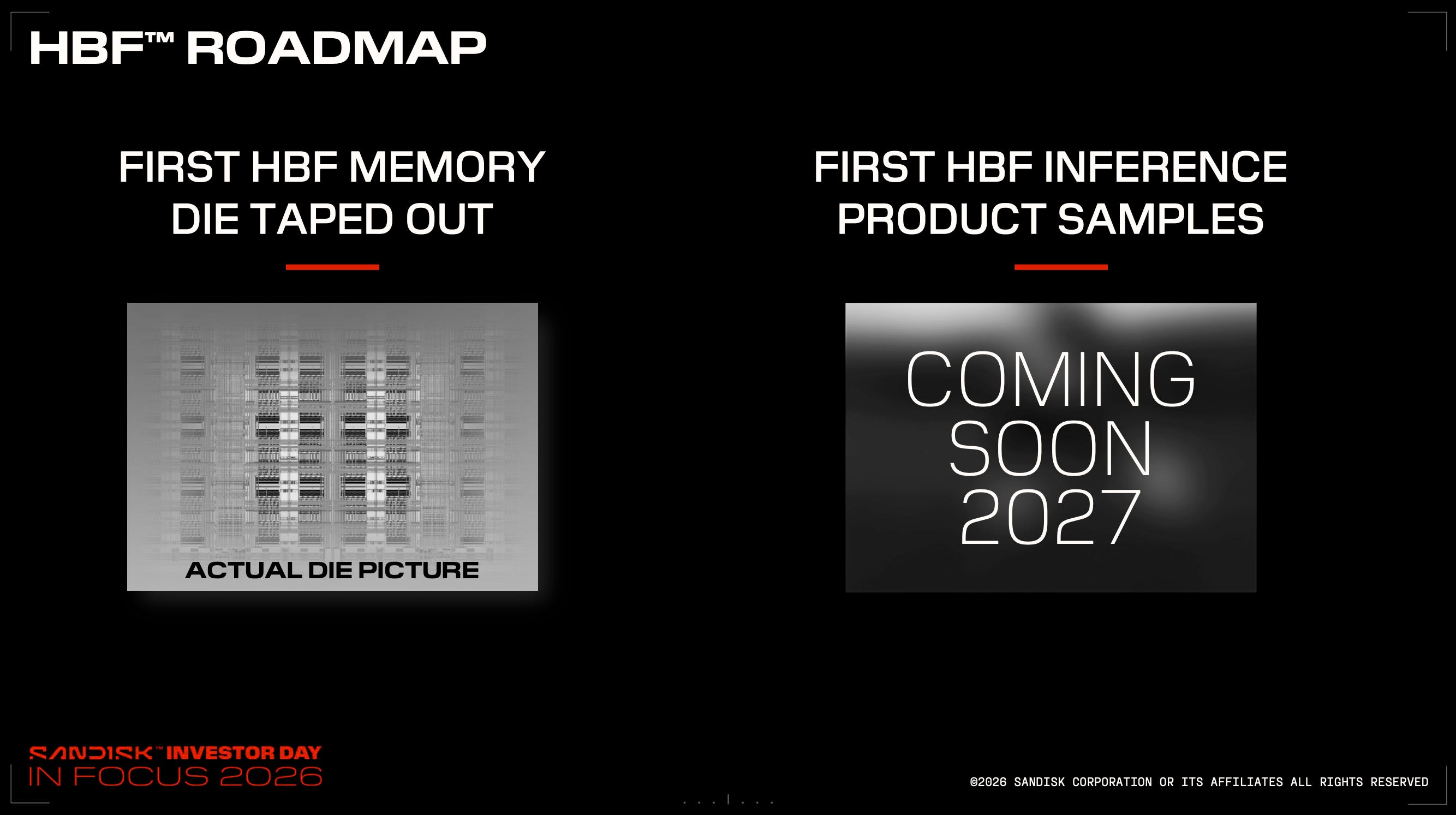
“I’m happy to share with you today that we actually taped out our first HBF memory die.”
First samples will go to customers in 2027, and surprisingly none of this sits in the FY30 model, which is what we love. HBF will be financed through opex and capex we covered, but the revenue from it is modeled at zero, so if it works, everything it earns is free upside.
As you probably know, when HBM took off, it ate DRAM production so much, that the regular DRAM got really expensive (because of how hard it was to get it). If HBF ramps the same way, people shorting NAND companies will have a hard time too.
Ben Reitzes at Melius put the valuation absurdity better than we could:
“I’ve been going to tech conferences and analyst days since about 1992, and I’ve never seen a company guide for a year three years out and be trading at less than three times that number.”
And we completely agree with that angle. SNDK 0.00%↑ is now trading at around 6x fwd P/E, essentially same as MU 0.00%↑. However, if you look at WDC 0.00%↑ or STX 0.00%↑ this multiple doesn’t make any sense, even looking at the growth itself (without touching books).
TLDR:
We remember that every time memory crashed in the past, customers found a way out of LTAs. The problem is even bigger when you account for SKHY 0.00%↑ and others adding new capacity starting in 2027 (these floors haven’t faced a test yet).
However, if the company wanted to convince people (memory investors specifically) that the old cycle of memory is gone, the proof would’ve looked exactly like this (Withheld supply, floor pricing, guarantees from banks, upgrading rather than expanding).
We’re long memory, and yesterday only reassured that.
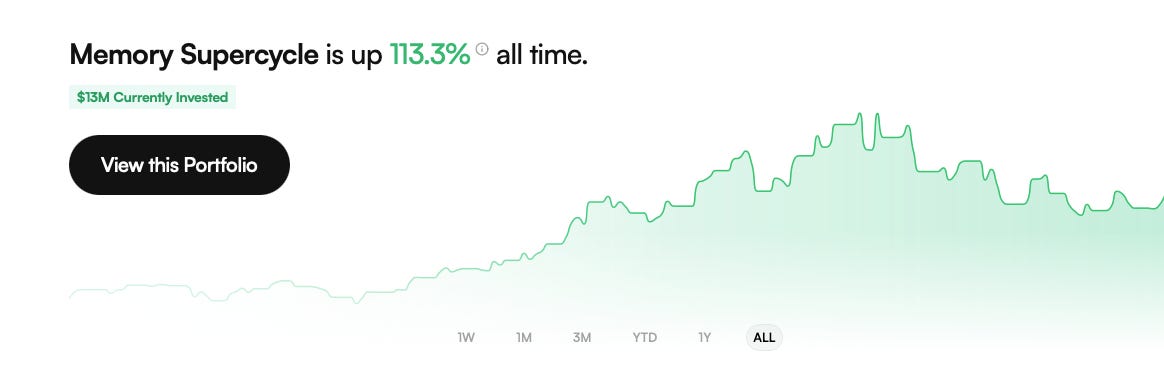
You can follow us directly on Autopilot, where our memory portfolio is up over 100% in the last 6 months.
Comments
Nothing yet. Say the first thing.
Sign in to join the conversation.