
Welcome to the latest edition of ASPI’s Fault Lines.
Each fortnight, ASPI’s Defence Strategy Program monitors the moves and countermoves shaping the regional order and Australia’s security.
This edition covers the period 15 May 2026 - 28 May 2026.
Follow the Australian Strategic Policy Institute on X, on LinkedIn, and on Bluesky.
Northeast Asia
Playing ball
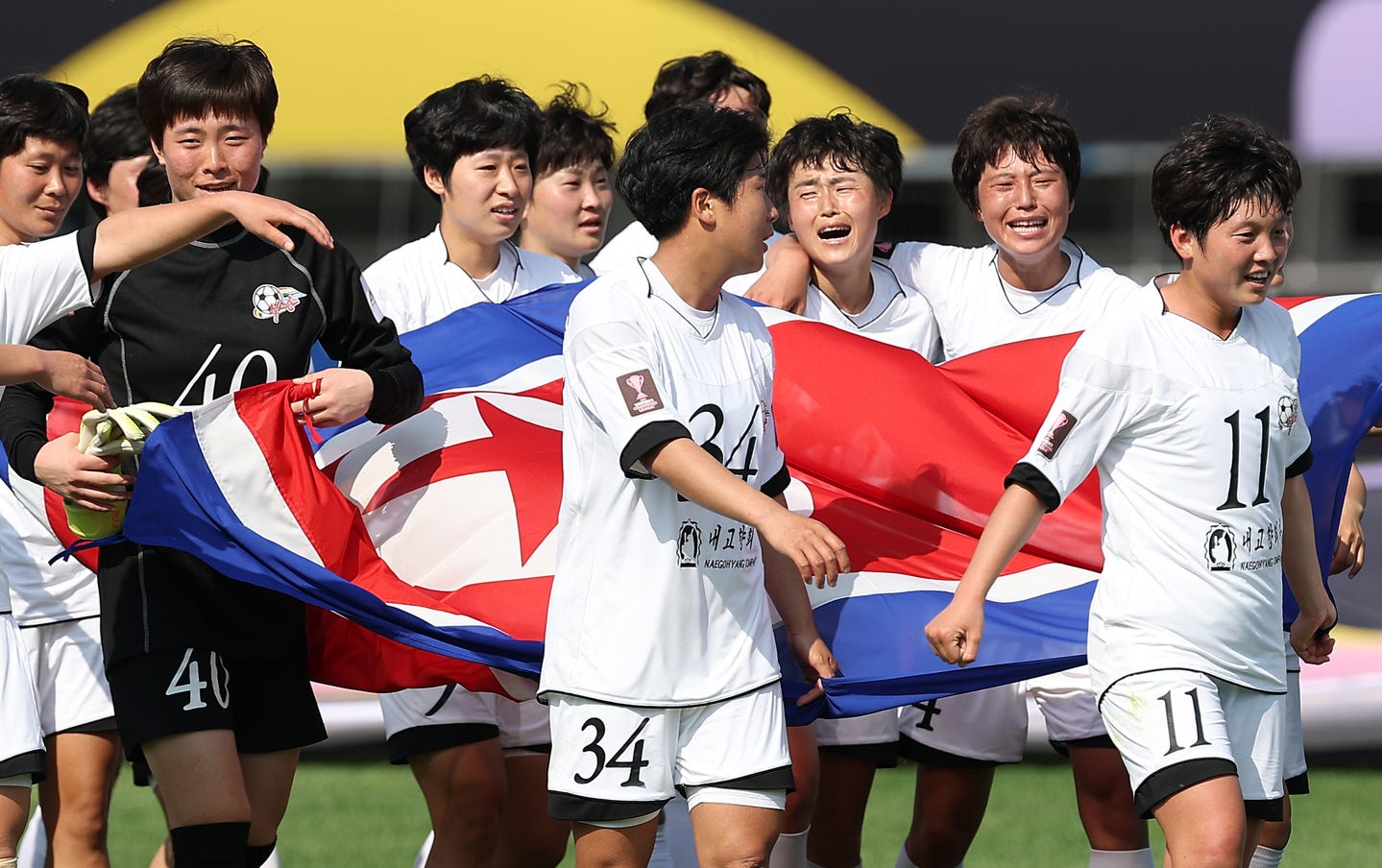
At Incheon Airport on 17 May, the members of Naegohyang Women’s Football Club—for those not yet hooked on the high-stakes world of North Korean premier league women’s soccer, that’s one of the top teams—arrived, strolled up to Immigration, and presented their passports.
No, really, this is news. North Korean athletes haven’t visited the South since December 2018—a rather more optimistic moment, during the brief thaw in relations under President Moon Jae-in. Back then, both Koreas officially entertained the view that they were each the only one, with part of their territory temporarily occupied by some non-state armed group. Visitors from one to the other weren’t considered to be arriving from a foreign country, so no passport was required.
Since late 2023, Pyongyang has changed its mind on this point, and its latest constitution seems quite convinced there are two sovereign states on the peninsula, not one. Which puts Seoul—and not least the officials at Incheon—in a tricky spot. Its constitution still holds the traditional one-Korea view, so visitors from the North need special permits issued outside the normal immigration system. Because the soccer team had those—the Unification Ministry had already spent US$200,000 toward a cheer squad for them, so it wasn’t about to turn them away at the airport—the show of passports was more of a political stunt. Refusing them would have prompted an avoidable diplomatic incident, but stamping them would have been illegal: as far as South Korean law is concerned, they’re not issued by a recognised country. In the end they were treated purely as ID documents and not otherwise acknowledged.
As an illustration of the new shape the North Korea problem has now assumed for Seoul, the passport incident couldn’t have been timed better: the Lee administration’s first Unification White Paper was released one day later. It’s a considerably more dovish document than the previous one, which was composed under former President Yoon. You’ll find much less on human rights and freedom, and much more on dialogue and peaceful coexistence. It acknowledges, for the first time in a UWP, the ‘reality that the South and North exist as de facto two states’—about as conciliatory toward the North’s new position as it’s possible to get without a constitutional amendment.
Lee’s northern policy isn’t out of character for the Korean progressive left, but it’s an odd pairing with the increasingly hard-power-centric security architecture—and the closer ties with Japan—he’s chosen to carry over from Yoon. The summit with Japanese Prime Minister Takaichi at Andong on 19 May only sharpened the contradiction: both agreed to cooperate on the North Korea issue, but Lee emphasised peaceful coexistence (and avoided mentioning the North at all in his press statements) whereas Takaichi underscored the nuclear and missile threat. Japan’s expressed interest in securing an Acquisition and Cross-Servicing Agreement (ACSA)—a treaty to facilitate cooperation on military logistics—with South Korea was rebuffed earlier this month.
News from abroad
Reportage from Kyodo on 21 May indicates the US military will deploy Typhon and HIMARS missile launchers to Kanoya Airbase in southwestern Japan later this year to support the VALIANT SHIELD and ORIENT SHIELD joint exercises between June and September.
China’s foreign ministry made the obligatory strongly worded statement in opposition, and it’s no mystery why. The main purpose of a Typhon land-based missile launcher is to shoot Tomahawk cruise missiles—you know, the ones that can range practically all of China’s eastern seaboard, and North Korea to boot, while sitting on a driveway in Kagoshima.
In the small print: the systems will stay in Japan afterwards, stored at an undisclosed US military base. First time we’ve seen an arrangement like that for Typhon. It was deployed to the US Marine Corps base at Iwakuni in September last year to support Exercise RESOLUTE DRAGON, and removed that November after criticism from Japanese civil society groups.
South Korea’s roadmap for acquiring nuclear-powered submarines was announced on 26 May. Having received Washington’s green light last year (can’t enrich uranium for use in naval nuclear power reactors without it), the plan is now to build a fleet of at least four SSNs entirely through domestic industry. The first is to be launched by the mid-2030s and enter service by the late 2030s.
Southeast Asia
The road to Mandalay
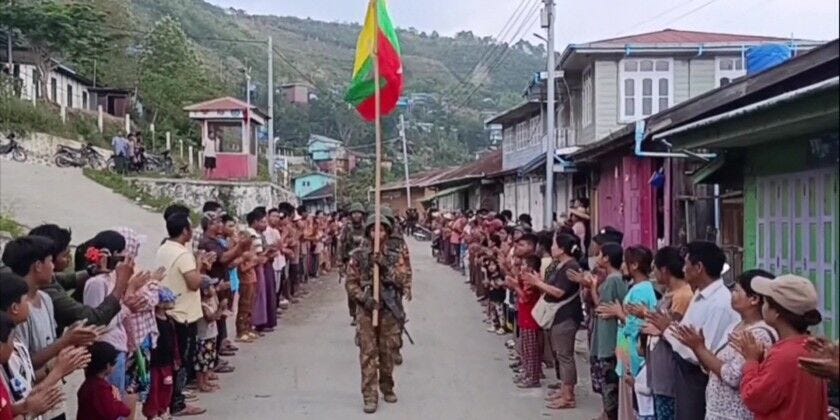
With its civilian coat of paint still drying, Myanmar’s military junta now has two big items on the to-do list. First, normalise relations with the neighbours; second, do something about the whole ‘not controlling half the country’ thing. Since April, the military’s renewed offensive in Myanmar’s border regions has tried to split the difference, and it has recently produced significant results. The towns of Mawtaung in the south near Thailand, and Tonzang, in northwestern Chin State near India, were reportedly retaken on 19 and 20 May respectively after weeks of heavy air and drone strikes.
Those towns sit on overland trade corridors, and both had been controlled by regional ethnic armed organisations for some months—Tonzang since May 2024. Refocusing military strategy on these areas isn’t simply about denying tax revenue to the anti-junta forces (though it is about that). By putting itself in a position to control the border—customs, policing, immigration, all the normal state functions—the junta gives its neighbours a strong incentive to treat it as the legitimate dialogue partner inside Myanmar. For Thailand especially, which has seen an influx of refugees, stray munitions and transnational crime out of Myanmar’s civil war, stabilising the border has been a high priority for some time—and with the anti-junta forces as fragmented as they are, the alternatives for achieving it are not especially promising.
While Thailand’s previous efforts to engage the military government got a cold reception from the rest of ASEAN—which put the junta in the diplomatic doghouse in 2021—recent months have seen the organisation shift somewhat toward Bangkok’s point of view. After discussions at the ASEAN Summit in Cebu in early May, a virtual meeting of ASEAN foreign ministers, including Myanmar’s, is now expected to occur in the ‘very near future’. It’s no consolation to the civil war’s many victims, but the logic is as cold and hard as it gets. The junta’s military position is slowly strengthening, and the existing ASEAN strategy of refusing high-level engagement until the junta progresses the 2021 peace process hasn’t delivered results. Meanwhile, China—with nothing invested in restoring democracy to Myanmar, but a great deal in the heavy rare earth elements buried in northern Kachin State—has demonstrated time and again that it can broker ceasefires and shape the civil war on the ground. So ASEAN can either engage and risk legitimising the junta, or abstain and watch Beijing play the by-no-means-impartial referee—driving the principle of ASEAN centrality into practical irrelevance.
News from the neighbourhood
On 19 May, Indonesia’s defence minister, Sjafrie Sjamsoeddin, informed lawmakers of an American offer to develop Kertajati Airport in West Java (about 150 kilometres east of Jakarta) into a regional maintenance, repair and overhaul (MRO) facility for US-made C-130 Hercules military transport aircraft.
The offer seems to have been accepted in principle, but it’s still at the conceptual stage; a definite contract and timeline are nowhere to be found.
While there are existing C-130 service centres in Malaysia and Singapore, the notion of a single Indonesian facility to centralise C-130 sustainment ‘throughout Asia’ at US expense—as Indonesian media have portrayed the Pentagon’s offer—would be a step change if realised, and a very difficult one to treat as a merely commercial proposition. The C-130 is the backbone of the US military’s tactical airlift capability; if we’re talking about shuffling high-end missile systems around the First Island Chain in a pre-conflict scenario, the C-130 is what’s doing it. What shape this MRO facility takes, if any, will test Indonesia’s traditional policy of non-alignment.
Oceania
What’s in a name?
Last week, Nauru’s cabinet issued an unusually firm directive to the effect that officials should not only refer to Taiwan strictly as ‘Taiwan Province of China’, but refrain from any formal engagement with the ‘province’. Taiwan’s trade office (read: unofficial embassy) in Suva was taken by surprise, but probably not too much. As recently as 2024, Nauru not only engaged with Taiwan but was one of the few countries to formally recognise it over the PRC.
It’s hard to call Nauru’s stance on Taiwan anything but pragmatic; the country has switched recognition back and forth before, usually (not to put too fine a point on it) following the money. You might recall that in August last year, Nauru signed up to a ‘mysterious’ investment program valued at A$1 billion—an incredible sum for a nation of only 12,000 people, around four times its annual GDP—to be delivered by a Chinese rural development company nobody seems to have heard of. Details are scant. Ostensibly a comprehensive infrastructure package implicating energy, resource extraction, agriculture and green tech, it’s just the sort of thing for which the Nauru-Australia Treaty—which wasn’t to enter into force until a month afterward, in September 2025—would have obliged prior consultation with Canberra. Australia’s Department of Foreign Affairs and Trade indicated it’d look into the matter, but so far nothing’s come to light in public; when and how the money’s even being delivered is up in the air.
It’s an awkward spot, all told. The security provisions in Australia’s treaty with Nauru are unusually strong, and amount to what’s very nearly a Canberra veto on future foreign investment in sensitive sectors. Quid pro quo, of course: Australia’s giving Nauru a lot of money (A$100 million in budget support over five years, for starters) for that privilege. But none of that is incompatible with a partner hardening its diplomatic posture in China’s favour, and a vast, vague, opaque deal slipping in just before the gate closed is a vulnerability Australia’s Pacific realpolitik has to live with. DFAT has told Parliament that treaty mechanisms will apply to any later action on that A$1 billion. But the Chinese deal still gives Beijing and Nauru a framework to build on, and leaves Canberra policing the implementation of a deal its treaty framework missed by that much. Money may buy concessions, but lasting alignment is priceless.
News from the family
The French National Assembly expanded the New Caledonian local electoral roll last week to include over 10,000 voters who were not eligible under the 1998 Noumea Accord—all of whom were born in New Caledonia.
Emmanuel Tjibaou, the largest New Caledonian independence party’s representative in the French legislature, opposed the reform and stated that the timing was inappropriate given that the campaign for the new Caledonian elections next month had already begun. Notably, this is an election that has been delayed since 2024 due to civil unrest.
In 2024, President Macron’s attempts to extend local voting rights to all 37,000 electorally disenfranchised French citizens in the territory led to months of riots and unrest. Independence advocates fear that the section of society unable to vote is largely pro-France, and their enfranchisement would tip the local balance too far in France’s favour.
Meanwhile, PNG Prime Minister James Marape was in France for an official visit last week. Prior to his departure, Marape noted that France was one of PNG’s most important global strategic partners as both a resident power in the Pacific and a leading European economy. On the agenda was trade, investment, aid, climate, aviation and the strategic situation in the Indo-Pacific.
One thing that was squarely not on the agenda was New Caledonia. Instead, after receiving a lengthy round of applause, Marape sat in the National Assembly while it engaged in debate regarding the controversial voter roll reform in New Caledonia. This continues PNG’s pragmatic approach to Melanesian separatist movements in West Papua and New Caledonia, prioritising strategic relationships with powerful partners like Indonesia and France over Melanesian solidarity.
Additionally, PNG accepted US$1 million in humanitarian assistance from China two weeks ago, continuing the trend of ongoing economic cooperation.

That’s all for this fortnight. For more timely analysis and commentary, check out The Strategist and ASPI’s Stop the World podcast—or elsewhere on Substack:


Thanks for reading! This post is public, so feel free to share it.
Comments
Nothing yet. Say the first thing.
Sign in to join the conversation.