
Welcome to the latest edition of ASPI’s Fault Lines.
Each fortnight, ASPI’s Defence Strategy Program monitors the moves and countermoves shaping the regional order and Australia’s security.
This edition covers the period 29 May 2026 - 11 June 2026.
Follow the Australian Strategic Policy Institute on X, on LinkedIn, and on Bluesky.
In water writ
A few pages deep in the readout from the Takaichi-Marcos summit on 28 May, there’s an innocuous-looking paragraph. Japan and the Philippines, so it says, will initiate formal negotiations to delimit the maritime boundaries between their exclusive economic zones and continental shelves.
You’d be forgiven for wondering where those are; if you’ve got a map with both countries on it, odds are you can’t see the islands responsible. Japan’s Hateruma and the Philippines’ Mavulis Island (total land area: four Canberra suburbs) are about 200 nautical miles apart, meaning there’s a massive overlap in the area either country could legally claim as an EEZ, and no legal definition of what they actually do claim. Trouble is, that overlap happens to include a sizeable chunk of ocean that both Chinas consider theirs.
Here’s the thing. One of the ground rules of international law is that bilateral agreements don’t prejudice the claims of third parties. Meaning—and this is the official Japanese view of the situation—whatever lines Tokyo and Manila draw can’t erase anyone else’s. In practice, it’s never that simple. A treaty can still affect facts on the ground—by changing where fishing fleets or coast guards feel entitled to go, for example—in ways which challenge another claimant’s practical control over their EEZ. Since the only major maritime disputes Japan and the Philippines have had in that area were with Taiwan, not each other, it’s safe to say Taipei understands that pretty well; hence, while its foreign ministry agrees with Japan’s reading of the law, there’s considerable public debate on how much more should be done to safeguard Taiwanese fishing rights. If the Lai government hasn’t gone further than seeking consultation with Japan, it’s mainly because there’s a bigger problem closer at hand: the China Coast Guard and the PRC Ministry of Transport, who as of the first week of June have discovered some laws they urgently need to enforce in the waters east of Taiwan.
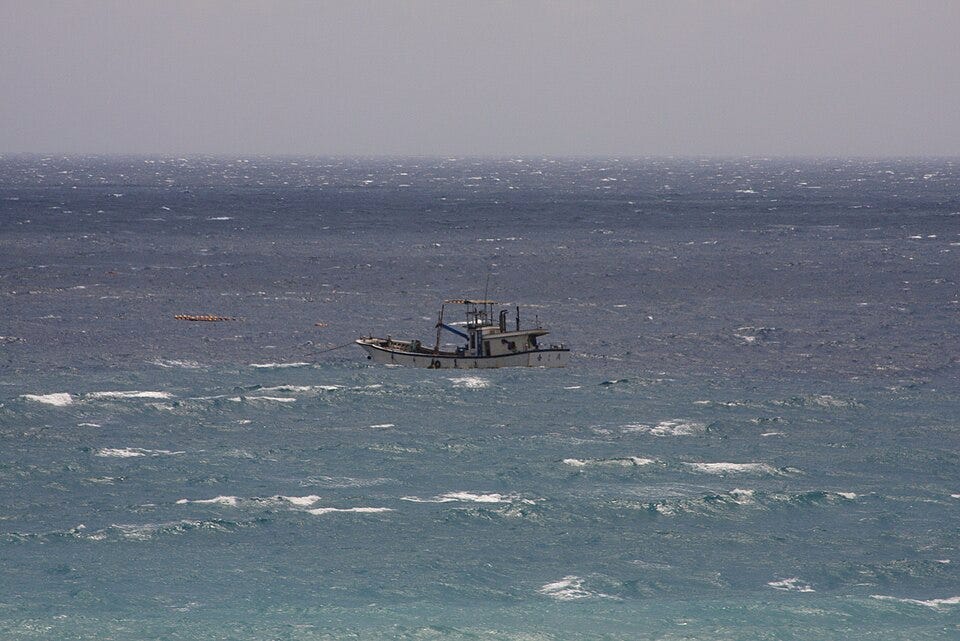
China’s left no doubt it considers the Japan-Philippines boundary talks illegal, invalid, et cetera; the tough-sounding ‘absolutely will not allow’ and ‘reap what they sow’ language is boilerplate when it comes to Taiwan-sovereignty issues, and that’s exactly what they view this as. Sending civilian vessels hundreds of kilometres beyond Taiwan on ‘special maritime traffic law enforcement operations’ is, however, a novelty. Sure, the PLA Navy’s been out there on and off for a few years (in fact, the Liaoning carrier group is still somewhere east of Luzon, not far away) and recent major exercises around Taiwan such as JOINT SWORD 2024A have started including large CCG components. But while Coast Guard and nominally civilian-led activities of this kind have become common in the South China Sea—asserting a claim by performatively doing the same maritime traffic control and policing you’d do inside your own EEZ—they hadn’t, until last week, been visible in Taiwan’s eastern approaches.
News from abroad
On 29 May, Japan’s defence ministry announced that four JSDF officers would be sent to NATO Security Assistance and Training for Ukraine (NSATU) for one year, with replacement after the tour ends. The officers, two from the ground forces and one each from the air and maritime SDF, arrived at NSATU Headquarters in Wiesbaden, Germany, the same day.
Japan’s been a major provider of financial and non-lethal aid to Ukraine since 2022, but as far as we know this is the first time Tokyo has ever put its uniformed personnel inside a NATO command (even a non-combat one like NSATU).
On 31 May, South Korea’s defence minister Ahn Gyu-back told press that ‘discussions regarding a potential ACSA [with Japan]’ had taken place on the sidelines. An Acquisition and Cross-Servicing Agreement (ACSA) would routinise military logistical support to each other—food, fuel, ammunition, maintenance services, and so on—during joint exercises and operations, replacing the messy suite of ad hoc arrangements they currently use.
You might recall Korea’s defence ministry saying back in May that an ACSA with Japan was off the table. Wouldn’t be the first time Seoul has flip-flopped on this sort of thing; if the 2016 Korea-Japan agreement on military information-sharing is any guide, even a signed treaty is no firm guarantee.
Both countries already have ACSAs with other partners, including the US and Australia, but not with each other. Getting one has been an ambition for Tokyo’s national security hawks since at least 2013, but it’s a sensitive issue over the water. Any move on Seoul’s part that raises the odds of Japanese boots on Korean ground during a crisis has a lot of ugly historical baggage to carry.
Keep the receipts
Every year the Shangri-La Dialogue briefly sends Singapore rocketing up the ‘defence ministers per capita’ leaderboard, with two main results: keynote speeches as interpretable as the Gospels, and meetings on the side for would-be artists of the deal. Sometimes, alas, of the no-deal. Norway’s defence minister, who met his Malaysian counterpart on 31 May, apologised for his government’s decision back in March to revoke the export licence for Malaysia’s purchase of Kongsberg’s Naval Strike Missile (NSM). But the decision stands.
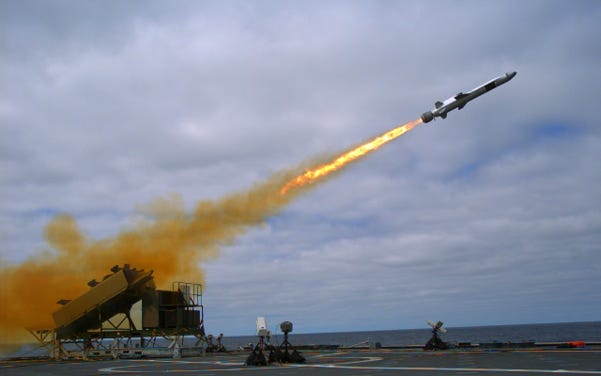
Malaysia—which had not only paid over 90% of the roughly US$150 million contract price, but was expecting delivery in a matter of days when Oslo pulled the rug—understandably wants a refund more than an apology. While EU and NATO countries have been tightening controls on defence exports for several years (witness Italy’s 2021 decision to block bombs and missiles going to Saudi Arabia), they generally don’t revoke licences for active contracts unless there’s domestic political pressure and/or a particularly bloody fight from which they could be credibly accused of profiting. Neither applies here; it’s also very unusual for a contract as large as Malaysia’s NSM purchase to get blocked by the seller so close to completion. Norway’s official explanation is pretty terse: the security environment in Europe and globally has changed, so, for that reason, ‘exports of some of the most sensitive Norwegian-developed defence technologies will be limited to our allies and closest partners’. It may be that Malaysia’s vaunted non-alignment is no longer close enough for comfort; you can imagine how having a Russian land border might put Malaysian prime minister Anwar Ibrahim’s occasional visits to Moscow in a different light. Or maybe it’s those Sukhoi jets Malaysia’s air force operates, sustained by a limited company with partial Russian ownership—if, like Oslo, you want NSM to keep the Baltic Fleet awake at night, you might not want to give Russian engineers an excuse to be anywhere near it. Or maybe it’s just another inadvertent consequence of the State Department’s controls on NSM’s American-made components.
Whatever the real story, the understandable perception that a signed contract from a Western defence manufacturer isn’t necessarily something your force planners can trust is a bit of a stumbling block if you’re trying to make security in the Euro-Atlantic and Indo-Pacific indivisible. NATO’s renewed efforts to keep high-end capabilities like NSM inside the house come at a time when demand from outside is going nowhere but up. All the Southeast Asian countries whose coastlines bound the South China Sea have the same problem—its name is the People’s Liberation Army Navy, and its size is ‘bigger than yours’—and the same incentive to chase asymmetric advantage where they can. India’s BrahMos cruise missile solves roughly the same problem as NSM (bigger, faster, louder, but it still sinks a ship for less than it costs to build another) and has already found buyers in the Philippines, Indonesia, and Vietnam. Ironically, it’s a Russian joint venture.
News from the neighbourhood
On 2 June Cambodia formally initiated UN Convention on the Law of the Sea (UNCLOS) conciliation proceedings over its long-running maritime boundary dispute with Thailand. The UN will convene independent legal experts nominated by both sides to examine the case and produce (non-binding) proposals for a solution. On 5 June Thailand agreed to participate.
With some grumbling. Bangkok clearly wanted a new bilateral mechanism, but since it was the Thai cabinet that tore up the previous bilateral dispute-resolution framework at the beginning of May, the Thai foreign minister’s suggestion that Cambodia should have ‘give[n] talks a chance’ before going to the UN can only raise an eyebrow.
Thailand’s prime minister has indicated that all other bilateral talks will be frozen while UNCLOS conciliation plays out, including those on the (comparatively much more dangerous) land boundary dispute.
Quad erat demonstrandum
The latest Quad Foreign Ministers’ meeting wrapped in New Delhi two weeks ago, with one unusual outcome: a joint infrastructure project to upgrade Fiji’s ports. Unusual because the Quad as such (as distinct from its individual members, which have done this sort of thing a fair amount) isn’t known for delivering infrastructure projects, in the Pacific or anywhere else. Its genuinely joint efforts are mostly in the enabling layer—infrastructure-related scholarships, development financing coordination, technical assistance and so on—but that’s about as close as it’s ever got to pouring concrete. The plan (still more a sketch than a portrait; check back later for details) is to change that.
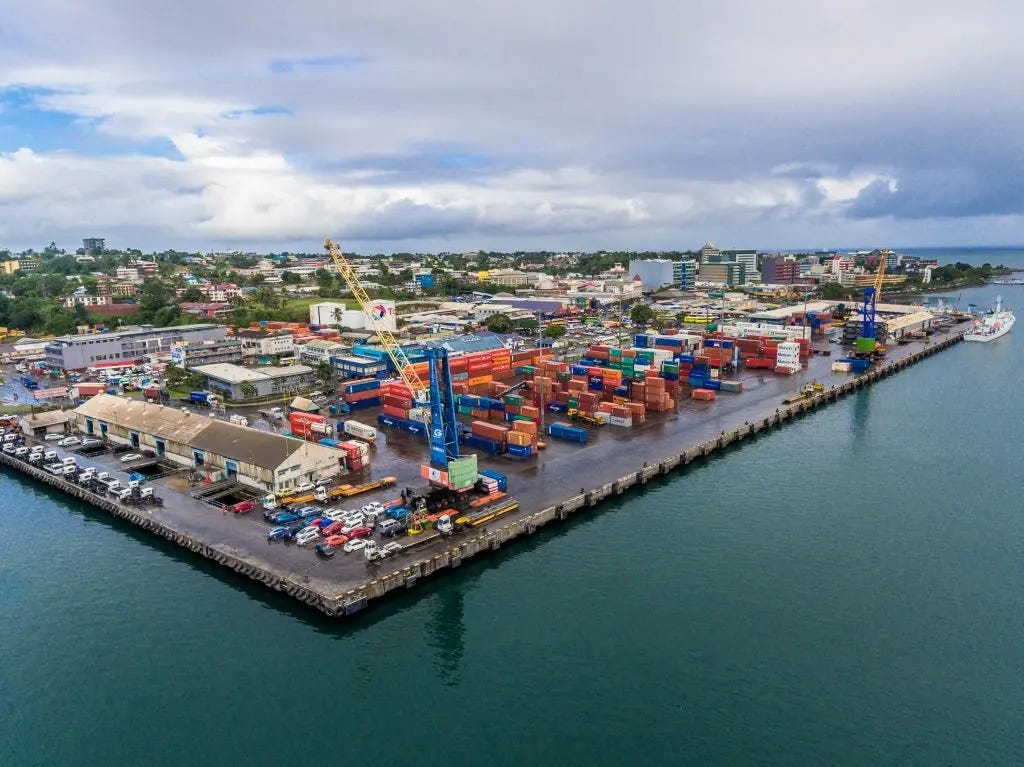
If you were going to start anywhere, Fiji’s a good choice. Fiji is a regional hub, with ambitions to become even more so; exclude the immense LNG outflows from Papua New Guinea and you’re already looking at a significant fraction of the entire Pacific’s trade volume. Its major ports at Suva and Lautoka (which, per foreign minister Sakiasi Ditoka’s later remarks to press, would be the Quad scheme’s top priority) are also getting old. The national port operator has already identified the need for a major buildout to accommodate rising agricultural exports; you might recall it was a topic of discussion at prime minister Rabuka’s first meeting with Xi Jinping back in 2023, though Beijing doesn’t seem to have moved on it. (Extensive Chinese trade exposure and investments in practically every other part of Fiji notwithstanding.)
Earlier this year, Fiji Ports held talks with US officials on two distinct redevelopment concepts: a US$181 million port upgrade plan, and a US$1.82 billion relocation plan for the port of Suva. If Australian foreign minister Penny Wong’s characterisation of the Quad scheme as its ‘strongest ever commitment’ to the Pacific is to be taken at face value, that is the ballpark in which it’s probably playing: a considerable undertaking even at the low end. Wong’s US counterpart Marco Rubio has said that the Fiji project will serve as a model for others in future.
News from the family
A month on from the Pacific Islands Forum’s decision to invoke the Biketawa Declaration, there appears to be no relief on the horizon for the fuel crisis in the Pacific. Samoa announced an ‘amber alert’ last week, meaning the country’s sole power provider will now start load shedding and Samoan schools will move to remote learning. Meanwhile, Fiji and Nauru have increased their fuel price caps, with Nauru’s maximum diesel price to increase by about 40%.
In a small, yet very ‘un-Pacific’ move, Jude Hofschneider, a Northern Mariana Islands legislator, has called for the territory to consider nuclear power in an effort to alleviate its fuel troubles. New Zealand’s defence minister Chris Penk had a very similar idea last week.
New Zealand’s new budget sets aside NZ$1.2 billion for foreign aid next fiscal year—an increase of NZ$116 million over last year’s budget. An additional NZ$110 million will also be spent specifically on Indo-Pacific aid over three years starting in FY 2027/28. On the other hand, the Ministry of Pacific Peoples will be cut by NZ$2.8 million over four years.
Concurrently, the New Zealand Defence Force will see an increase of NZ$3.3 billion in spending, with spending towards combating the trans-Pacific drug trade also to be increased.
The World Meteorological Organization (WMO) has forecast an 80% chance of El Niño conditions forming between June and August, and a 90% chance of it happening sometime later. WMO Secretary-General Celeste Saulo noted the possibility of severe impacts on agriculture, energy, trade, water, and supply chains across the Pacific and beyond.
The Solomon Islands security pact with China will not be publicly released despite new prime minister Matthew Wale’s initial indications he would do so once in power. Wale—a long-time opponent of the agreement—cited a non-disclosure clause within the pact, saying that he cannot release it as ‘the Prime Minister of a responsible government’.
This comes off the back of Prime Minister Wale’s visits to Australia and New Zealand, where he’s publicly entertained hopes of a new treaty with Australia along the lines of those Australia has with Tuvalu, Vanuatu, and PNG.

That’s all for this fortnight. For more timely analysis and commentary, check out The Strategist and ASPI’s Stop the World podcast—or elsewhere on Substack:


Thanks for reading! This post is public, so feel free to share it.
No posts
Comments
Nothing yet. Say the first thing.
Sign in to join the conversation.