
Welcome to the latest edition of ASPI’s Fault Lines.
Each fortnight, ASPI’s Defence Strategy Program monitors the moves and countermoves shaping the regional order and Australia’s security.
This edition covers the period 17 April 2026 - 30 April 2026.
Follow the Australian Strategic Policy Institute on X, on LinkedIn, and on Bluesky.
Terms and conditions apply
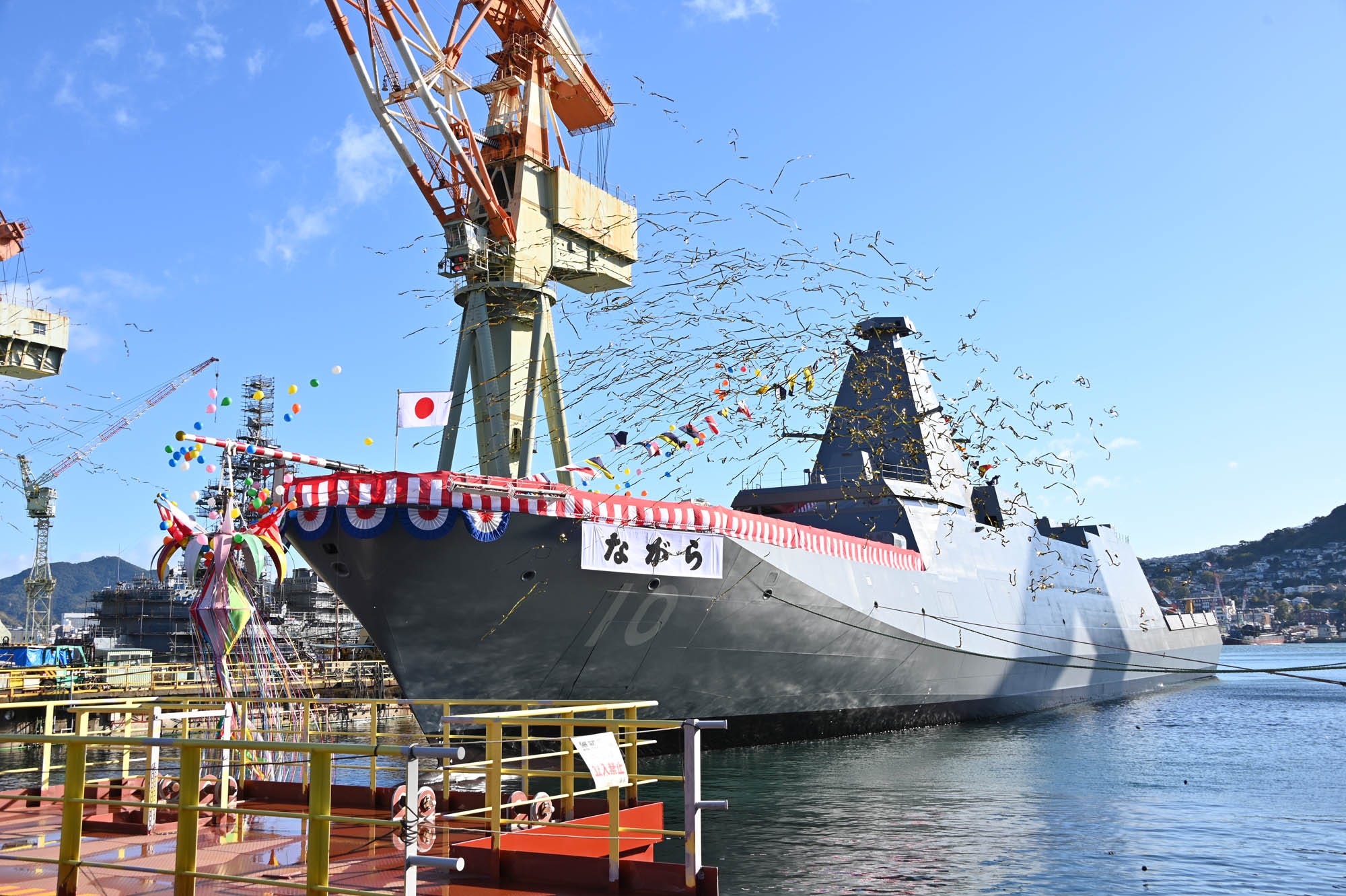
On 21 April, Japan revised its defence export policy. You could just as well argue it’s only now started to have one. For decades, Japan’s defence industries were only permitted to export finished products with non-lethal purposes: search and rescue, transport, minesweeping, and so on. They’re now permitted to export lethal equipment—exactly what you think it means—to a select list of countries, including Australia, Thailand, Malaysia, Vietnam, Indonesia, and the Philippines.
While Japan’s massive economy has long allowed it to sustain a high-tech defence sector about the same size as South Korea’s on a modest trickle of GDP, the impact of the historical policy is clear when you take the comparison further. Aggressive state-directed investment and promotion has brought the value of Korea’s defence exports roughly on par with domestic demand for new military equipment. In Japan, domestic demand is almost the entire industry. Australia’s acquisition of the Mogami-class frigate—for which Japan’s and Australia’s defence ministers put ink to paper on 18 April—is only the second transfer of a Japanese-manufactured piece of defence equipment to a foreign military force on record, the first being a very non-lethal air-surveillance radar system sold to the Philippines in 2023.
How much Japanese defence industry can achieve once it’s taken out of the pot, planted, and properly fed and watered is an open question. Deregulation doesn’t automatically make firms competitive—especially if they’ve never really been able to compete on the world market before. South Korean firms with an eye on the competition seem most concerned about Japan’s ships and submarines, whose high unit costs and relatively low production volumes render Japan’s limited experience in leveraging economies of scale less of a disadvantage.
Save the date
South Korea maintains one of the largest and best-equipped militaries in the world, supported by indigenous defence industries most states of comparable size can only envy. Yet if a war broke out tomorrow, Seoul wouldn’t be in charge of the military response. That would fall to Combined Forces Command, a bespoke binational construct set up under the US alliance in 1978—and CFC has always been led by a four-star general in the US Army, with a Korean four-star as deputy.
This was a Cold War expediency, never really meant to be permanent. Speaking before Congress last week, General Xavier Brunson—who currently commands US Forces Korea—said that a joint US-Korean roadmap for meeting the conditions for transfer of wartime operational control by January-March 2029 had been submitted to the Pentagon. The ‘conditions-based’ framework for OPCON transfer established in 2014 after many missed deadlines and postponements stipulated that Korean forces must meet an agreed standard of warfighting capability before Seoul would be put in charge of the combined force. Brunson’s remarks are the first time a US official has publicly revealed when that’s expected to happen.
If realised, it’ll have been a long time coming—more than two decades since it became US and Korean policy to pursue wartime OPCON transfer in 2007, and thirty-five years since peacetime operational control of Korean forces was handed back to Seoul in 1994. While there’s a lot of political impetus on both sides right now—the Trump administration’s desire to see allies do more needs no introduction, and progressives like President Lee are the traditional constituency for a more independent Korean military posture—OPCON transfer is unlikely to solve the core alliance management problems responsible for these decades of to-ing and fro-ing, and may well make them worse. These are issues of trust: Seoul’s trust in Washington to stay committed to its defence, and Washington’s trust in Seoul to be a responsible steward for its strategic aims on the Peninsula.
News from abroad
So, about that US-Korea trust issue: since about 21 April, the US has begun limiting what intelligence it shares with Seoul on the North’s nuclear program.
While there are few confirmed details yet, it’s looking like Unification Minister Jung Dong-young disclosed—in the National Assembly, no less, back in March—US-origin classified material on a North Korean uranium enrichment facility.
Former South Korean president Yoon Suk Yeol—already serving a life sentence for that whole ‘attempted insurrection’ thing—is back in court.
He’s accused of ordering military drones to overfly Pyongyang in October 2024, with the intent to provoke a North Korean response and create a pretext for imposing martial law. Prosecutors requested an additional 30-year sentence at the closing hearing on 24 April. The court is yet to rule.
Willingness to poke a nuclear-armed neighbour in the eye in preparation for a coup d’état could be characterised in a few ways; ‘trustworthy ally behaviour’ isn’t one of them.
If you’ve been in Pyongyang lately, you might have noticed a few senior Russian officials looking busy. Interior minister Vladimir Kolokoltsev, speaker of the State Duma Vyacheslav Volodin, and defence minister Andrei Belousov have all visited North Korea in the last two weeks for high-level talks with the Kim regime.
The visits were occasioned by the opening of a new memorial to the (probably more than 6,000) North Korean soldiers killed fighting alongside Russia in its war on Ukraine since 2024.
Belousov’s remarks on the trip, alongside Kim Jong Un’s speech at the memorial’s opening, suggest both sides have a mind to sustain military cooperation for the long haul, beyond whatever settlement might be reached in Ukraine. Russia and North Korea will sign a medium-term cooperation plan out to 2031 later this year.
On 24 April China placed seven EU companies—including Belgian small-arms manufacturer FN Herstal—on its export control list. The listing prohibits Chinese-origin dual-use items from being sold to the companies concerned. This sort of US-style entity list is a recent innovation for China, and while it’s been used in the past with certain US and Japanese companies, this is the first time EU companies have been listed by the Ministry of Commerce.
The official line out of MOFCOM is that the EU companies have been listed for selling arms to Taiwan. That’s probably not the whole story: only the day before, the EU’s latest round of Russia sanctions caught a handful of Chinese companies in the crossfire, drawing an unusually direct protest from MOFCOM.
Stuck in the middle with you
The biggest joint US-Philippines exercise of the year, Exercise BALIKATAN, kicked off at Camp Aguinaldo on 20 April. It’s still going, in fact, so we’ll save the details for next time after it wraps up on 8 May. Like every US and allied exercise nowadays, it has produced an equal and opposite PLA Navy (PLAN) exercise. True to form, on 24 April the PLAN held live-fire drills in international waters east of Luzon, led by the Type 055 destroyer Zunyi. Meanwhile the aircraft carrier Liaoning was last seen heading south through the Taiwan Strait on 20 April, and is now believed to be operating with its task group in the South China Sea.
So you’ve currently got two serious PLA naval groupings, one on either side of the Philippines, while a US warfighting exercise plays out in the middle. A gentle reminder, one might conclude. Officially, BALIKATAN’s scenario is defensive and not directed at any country in particular; in practice a good amount of the operational muscle memory it’s designed to build is clearly relevant to a potential US and allied defence of Taiwan—rapidly deploying missiles to the northernmost parts of Luzon, for example.
In the zone
The Pax Silica—a US economic security initiative launched last December, uniting like-minded countries around the idea that semiconductors are somehow important—welcomed the Philippines as its newest partner on 16 April. That announcement had an interesting footnote. Manila will offer 4000 acres of land in the Luzon Economic Corridor as an ‘Economic Security Zone’, which as far as we can tell means a special economic zone with American characteristics.
You can imagine the elevator pitch. Manila has critical minerals, an established high-tech sector, and wants to move up the value chain in both; the US wants to surge (and secure) production for the whole stack supporting modern AI and advanced information technology. A happy marriage between American capital (plus a regulatory environment favourable to same) and Filipino land, labour, and resources.
This isn’t a wholly original idea. The Philippines already has over 400 special economic zones for various purposes, and you can see the DNA of this new ESZ in the Luzon Economic Corridor itself: a Washington-Tokyo-Manila trilateral venture launched back in 2024, with a strong focus on building out semiconductor supply chains. The ESZ idea looks rather like the Trump team putting their own spin on the previous administration’s project. (Let a government that hasn’t done this cast the first stone.) That spin is much more security-forward, and it foreshadows the White House’s vision for Pax Silica’s next step: this ESZ, the announcement claims, will be only the first of a large, interconnected constellation across the Pax Silica partners. The ambition is to turn Pax Silica into ‘a genuine system capable of competing with—and ultimately displacing—the concentrated supply chains on which the world currently depends.’
Sounds good, at least. But ‘concentrated supply chains’ also sounds like a polite euphemism for ‘China’, and if so—well, you’re going to need a lot more ESZs.
I’ve been working on the railroad
China’s foreign minister Wang Yi was in Myanmar the other day, for all the usual reasons: photo, handshake, deepen practical cooperation. Compared to the earlier legs of his trip to Southeast Asia this month—kicking off the new 2+2 mechanism with Cambodia, brokering a five-year Joint Action Plan for partnership with Thailand—the visit to Naypyidaw looked mostly symbolic, with few concrete deliverables. Junta leader Min Aung Hlaing was sworn in as president earlier this month, having won a rather dubious election. Arguably Wang’s trip was about normalising the ‘new’ government, which here means entertaining the pretence that swapping uniforms for civvies has made the junta something other than the junta. There aren’t many international partners willing to do that, and the appointment in January of Tin Maung Swe—ambassador to Beijing since 2022 and something of a China hand—as Myanmar’s foreign minister suggests Naypyidaw wants to capitalise on the one they have.
A few days earlier in the northern city of Lashio, four hundred kilometres of mountains, jungles, and civil war away from the capital, Chinese officials are understood to have held much lower-key meetings with representatives from several of the ethnic armed organisations fighting the junta. What’s interesting isn’t that they’re talking to all sides but that, in Lashio as in Wang Yi’s readout, they’re talking about the same thing: accelerating construction along the China-Myanmar Economic Corridor (CMEC).
CMEC is the white whale of Belt and Road projects. Xi Jinping has spent practically his entire term in office trying to get it built, initially as a joint venture with India and Bangladesh, then as a bilateral project after 2017 as relations soured with the other partners. It hasn’t been going well. Aside from the natural gas and crude oil pipelines (completed 2013 and 2017 respectively) from Kyaukphyu on the Bay of Bengal through to the Chinese border, most of CMEC’s key projects still haven’t left the drawing board. The centrepiece—a high-speed rail link from Kunming in southern China through to Kyaukphyu—has seen rapid progress on the Chinese side, but no construction inside Myanmar.
Understandable, really: megaprojects are hard even when you’re not building them in a war zone. But the strategic case for CMEC—a conduit for trade cutting right from China’s inland Yunnan province to the Indian Ocean, bypassing the eminently disruptable Strait of Malacca—is as compelling as ever. Getting construction on the Kyaukphyu end of the railroad moving as early as May this year (as unconfirmed reports indicate China intends to do) means facing reality: the port of Kyaukphyu is in Rakhine State, and Rakhine State is almost entirely controlled by the Arakan Army, not Naypyidaw. This is the long-term trend: since 2023, in Rakhine as elsewhere, China’s engagement with Myanmar has quietly diversified beyond dealings solely with the junta. Much as Beijing would prefer it otherwise, the military government now controls barely half the country and is no longer capable of securing many Chinese investments. Beijing certainly doesn’t need every armed group fighting the civil war to love CMEC; it just needs a modicum of stability from the ones which hold ground along the corridor. Sometimes it even gets it.
News from the neighbourhood
Speaking of Malacca: last week, Indonesia’s finance minister Purbaya Yudhi Sadewa floated the idea of charging a toll to ships transiting the Strait of Malacca. The revenue (which, given that over a hundred thousand ships transit Malacca every year, would be considerable even with a modest toll) would be shared with Malaysia and Singapore.
The idea didn’t float for long. A firmly negative response from Singapore and Malaysia (not to mention other regional states) induced Jakarta to walk back the proposal the following day.
Still, it’s hard not to see recent events in the Strait of Hormuz as having left many international maritime norms looking more ‘negotiable’ than they did last year.
Deal or no deal
On 21 April, an article appeared in the Vanuatu Daily Post citing an unidentified ‘senior Australian source’ as follows:
“We are aware of reports Vanuatu might soon sign a security deal with China. Obviously, this could affect agreements with Australia, especially on visas that we know Prime Minister Napat has been advocating for,” the source said.
Later reportage from the ABC identified the source as ‘Australian officials in Port Vila’—which does narrow it down, perhaps even to within the walls of the Australian High Commission on Winston Churchill Avenue. It appears now that a China-Vanuatu treaty known as the Namele Agreement has secretly been in the works for several months, content unknown. In an official statement Prime Minister Jotham Napat characterised it as a ‘comprehensive development cooperation agreement’, categorically not a security deal.
It’s no coincidence that negotiations over the still-unsigned Australia-Vanuatu Nakamal Agreement—initialled at the summit of an active volcano last August, for good luck—appear now to be in a critical phase. Unlike Namele, Nakamal is definitely a security deal, among other things: the precise scope of it isn’t public, but the issues that have delayed its signing for eight months are suggestive. In September Vanuatu government sources expressed concerns over Nakamal’s potential to limit engagement with other countries through infrastructure development agreements. That Nakamal would do that at all strongly hints that things aren’t quite so categorical from Australia’s point of view: there’s plenty in an infrastructure agreement that can be security-relevant without the text coming close to a security deal. An agreement like the Falepili Union (which gives Australia a de facto veto over foreign investment in Tuvalu’s critical infrastructure) might here be aspirational for Canberra, but it looks to be a bridge too far for Port Vila. The question now is whether Australia’s diplomats can get Nakamal signed—and what security-relevant assurances they can extract with it—before the Namele Agreement with China goes through.
Fuels rush in
On 24 April Solomon Islands Prime Minister Jeremiah Manele announced that the Pacific Islands Forum had chosen to invoke the Biketawa Declaration—the PIF’s framework for collective emergency response—to address the ongoing fuel crisis in the region.
That announcement was attended by considerable procedural confusion: the decision was made at a meeting of only four PIF heads of government, blindsiding the rest. Manele’s statement to the press may well have jumped the gun on a formal invocation of Biketawa. It’s not the ideal start to a crisis response, but the region has to start somewhere. The Pacific is deeply exposed to oil price shocks: the average PIF member state spends 6.8% of its annual GDP on importing fuel. Electricity generation, inter-island shipping, air transport, road transport, and fisheries—not to mention every economic output downstream of these, such as tourism—all begin at the far end of a very long fossil-fuel supply chain. In the last month we’ve seen Tuvalu and Marshall Islands declare economic states of emergency, with Tuvalu unable to ensure a consistent supply of fuel beyond June. Over the same period, better-resourced states have used fiscal policy to offset price increases: Fiji with F$56 million (AUD$35 million) and PNG with a K$1 billion (AUD$352 million) crisis package. The rest have adopted various suites of measures to stabilise and rein in domestic consumption.
As much of a test as this is for the domestic economies of Pacific states, it’s also a real test for Biketawa—if indeed it has been properly invoked. The regional crisis-response machinery has historically been used only for localised events such as coups or civil unrest. Only its invocation for the COVID-19 response comes anywhere near a precedent for what it now may have to contend with. Not only that: a prolonged oil price rise is likely to seriously impair economic activity across the PIF states, leaving the region in a far more fragile and dependent position against the designs of great powers.
News from the family
Last week, representatives of the United Liberation Movement for West Papua appeared before a parliamentary committee in The Hague to call on the Netherlands to cease arms sales to Indonesia. The ULMWP allege that the arms are used for illegal killings by Indonesian security forces in West Papua.
The call came after the twelve civilians were killed during an Indonesian military operation the week before. The incident is currently being investigated by Indonesia’s National Commission on Human Rights.

That’s all for this fortnight. For more timely analysis and commentary, check out The Strategist and ASPI’s Stop the World podcast—or elsewhere on Substack:


Thanks for reading! This post is public, so feel free to share it.
No posts
Comments
Nothing yet. Say the first thing.
Sign in to join the conversation.