
Welcome to the latest edition of ASPI’s Fault Lines.
Every fortnight, ASPI’s Defence Strategy Program monitors the moves and countermoves shaping the regional order and Australia’s security.
This edition covers the period 6 March 2026 - 19 March 2026.
Follow the Australian Strategic Policy Institute on X, on LinkedIn, and on Bluesky.
Northeast Asia
Missile gap
Here’s how you know it’s spring in Korea: the plums are in blossom, the frost is thawing, and the hills are alive with the sound of US and ROK force elements on a massive joint all-domain combined-arms exercise. FREEDOM SHIELD, running 9 to 19 March this year, is the latest incarnation of an annual tradition dating back to the Cold War. This and its sister ULCHI FREEDOM SHIELD (more of a summer thing) are the alliance’s two major warfighting exercises. As a ‘conditions-based’ transfer of wartime operational control to the ROK inches closer, they’re increasingly something of a driving exam to see if Seoul’s ready to take the wheel. That the US might have trouble keeping its eyes on the road is, alas, a live concern.
The same day FREEDOM SHIELD kicked off, reports came through indicating the US was withdrawing parts of its THAAD battery from Korea, against President Lee’s objections. THAAD—Terminal High Altitude Area Defense to its friends—is a US-made ballistic missile defence system, and a boutique one at that. The US has only eight batteries, each about a billion dollars’ worth and comprising six or so launchers plus a high-resolution radar. For each interceptor those launchers fire, Lockheed Martin will invoice you a cool US$15 million. As far as we know it’s just some of those interceptors and not the launchers themselves that the US has pulled out of the THAAD battery deployed at Seongju in Korea’s southern highlands.
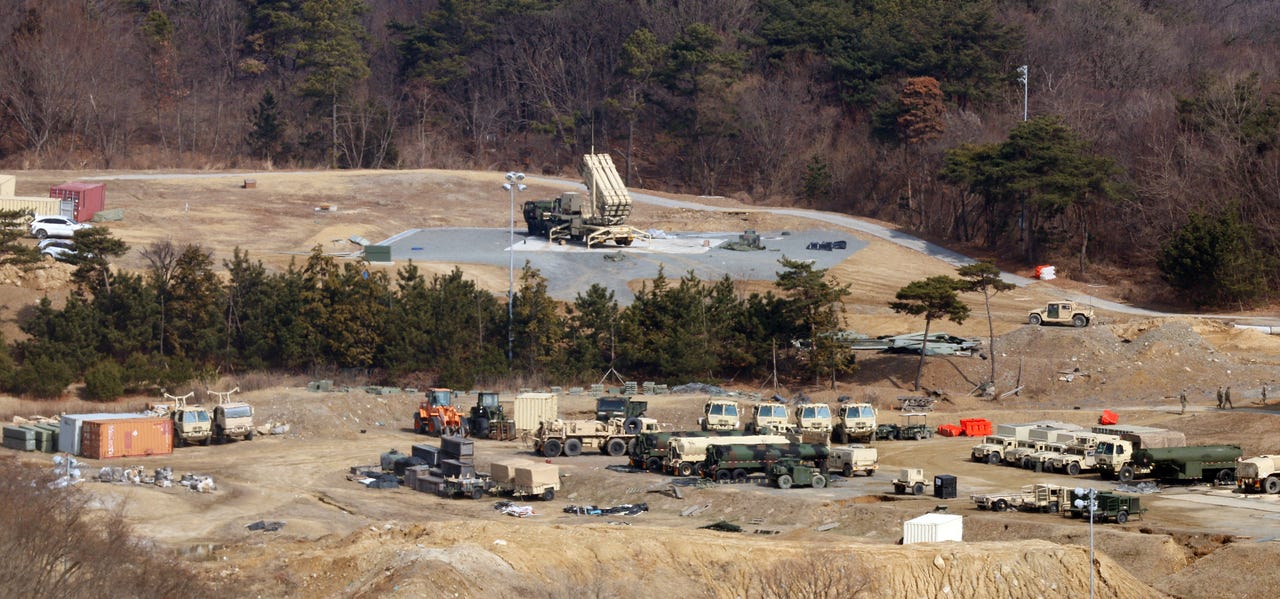
Where are they going? A mystery indeed. Ongoing operations in the Middle East—the White House would like you to know they’re a crushing success, by the way, thanks for asking—have been burning US munition stockpiles at a fantastic rate, interceptors very much included. No hard numbers yet, but considering last April’s campaign against Iran probably consumed a quarter of the American THAAD inventory in less than a fortnight, it’s no surprise Operation EPIC FURY has started raiding the Indo-Pacific pantry.
Surprise or no, the optics of the US quietly shuffling serious missile defence capability out of Korea on the eve of the alliance’s biggest exercise are not great, and North Korea has done its best to make them worse. At sea trials on 3-4 March and again on 11 March the Choe Hyon—the North’s first genuine guided missile destroyer—tested sea-launched cruise missiles, likely to be nuclear-armed when fully operational. When that somehow didn’t convince the South to call off FREEDOM SHIELD immediately, Pyongyang followed up on 14 March with an extraordinary volley of ten ballistic missiles at once. Lockheed couldn’t have written the advert better.
The official line out of Seoul is that this is all regrettable but acceptable. The overall deterrent posture is still intact, despite losing at least some of THAAD. You have to wonder what they’re thinking behind closed doors. While in the medium-term Seoul is relatively well-positioned—their indigenous missile defences have improved greatly since 2017 when THAAD was first deployed, and work on a Korean-built interceptor with THAAD-like performance is expected to deliver by 2028—in the near term their layered air and missile defences are missing at least part of a layer.
The moral of the story (and not just for Korea) is that an America more willing to use force isn’t necessarily more credible for it. Munitions are finite, and for boutique systems they’re very finite. The Pentagon has a global footprint and must prioritise across it. And when the White House can change those priorities on a dime, any ally hosting forward-deployed US capability will start looking for the fine print.
For more on these topics, we suggest:
Informal economic sanctions: the political economy of Chinese coercion during the THAAD dispute (Review of International Political Economy, 2022)—The original THAAD deployment to Korea provoked a sharp Chinese reaction. Why?
After Epic Fury, a munitions supplemental becomes imperative (Breaking Defense, 2026)—The US needs more munitions, and fast. But will Congress pay for them?
Southeast Asia
Anything happen while we were out?
The Indonesian island of Morotai is about the size of the Australian Capital Territory, but warmer, with one-sixth the population and far fewer F-35 overflights. Fair warning: that last part might change. An Australian Army survey team will be dispatched to Morotai later this year; an international all-domain military training facility is to be built there, expanding existing infrastructure, and their job is to figure out how much expansion that’ll be. Thus the readout from Deputy Prime Minister Richard Marles’ trip to Jakarta last week. It’s provided some details about those new initiatives announced alongside the security treaty Australia signed with Indonesia at the beginning of February.
Mind you, as new initiatives go, this one isn’t quite new. Building out Morotai for training with friendly forces on exercises is Jakarta’s idea, and it’s been bouncing around there for a couple of years, at least since Prabowo’s term as Defence Minister. The intent to do so was announced officially in November 2024, and the case for Morotai in particular as an international military training site seems to revolve around its location (somewhat out of the way, lightly-populated, relatively flexible for all-domain operations) and the presence of legacy infrastructure from the Second World War. The broader Indonesian ambit to rebalance its forces to the east of the archipelago is also a factor in what’s intended for Morotai. Plans for a pier suitable for warships and a long-range air defence radar were announced in 2024 and 2025 respectively, though it’s unclear if they’ve gotten beyond the planning stage.
What is new, is an Australian commitment to help build this training facility, which is likely to include refurbishment and extension of WW2-era airstrips. Arguably, it’s very appropriate: Australia helped build those originally. RAAF engineers were at work on Morotai within seventy-two hours of the US landings in 1944. The pace of construction demanded by General MacArthur back then probably won’t be replicated, but the amenities should compare favourably to those Army enjoyed when it was camped out preparing to invade Borneo. And, of course, they’ll be shared. During the Deputy Prime Minister’s trip, Indonesia floated plans for two new trilateral security agreements: one to bring in PNG, the other to bring in Japan. Indonesia also specifically expressed interest in hosting forces from the Philippines and Japan for exercises at Morotai.
The letter of the law
Over the weekend the Chinese embassy in Manila circulated on social media what it claimed was a 1990 letter from the then-Philippine ambassador to Germany, addressed to a German ham radio operator. The letter has the ambassador declare, point blank, that Scarborough Shoal isn’t Philippine territory.
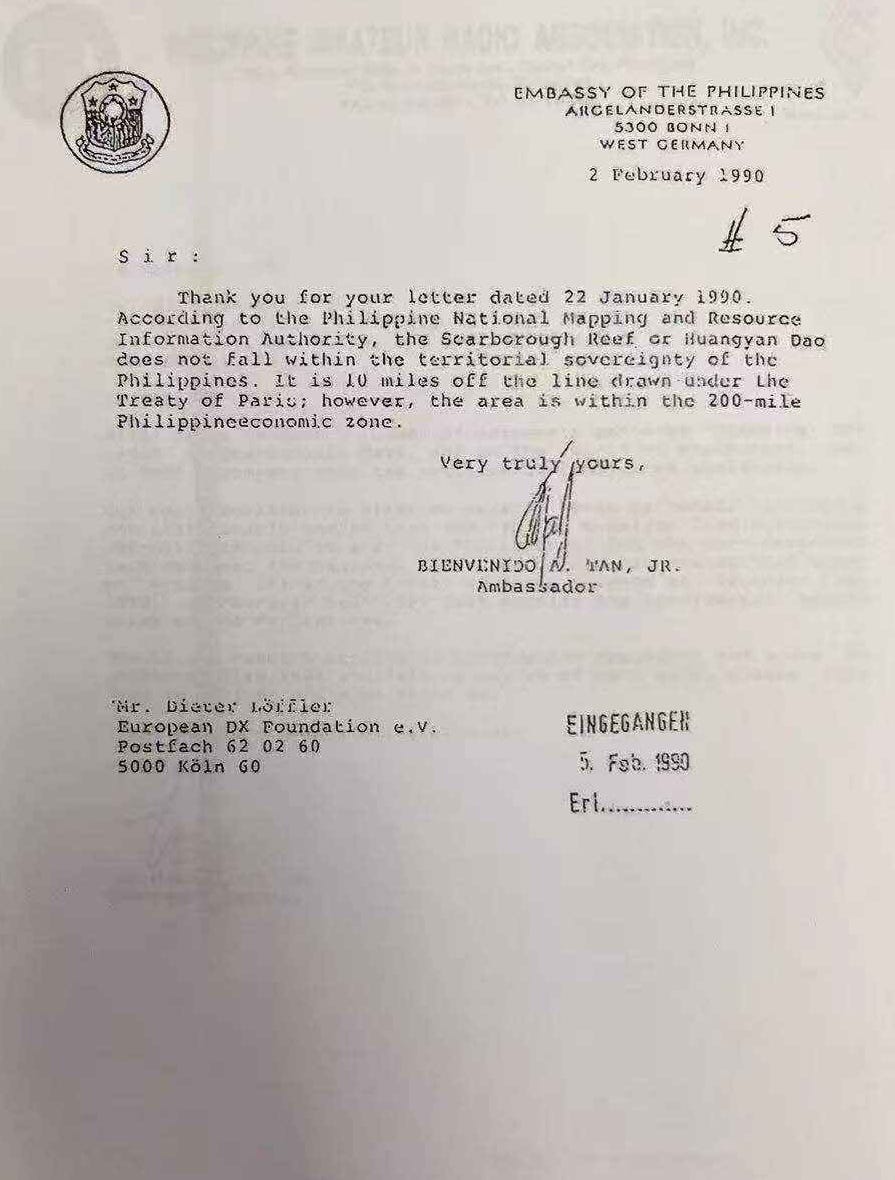
Needless to say, Manila wasn’t impressed: someone at the foreign ministry clearly enjoyed drafting the official response. While all sides in the South China Sea dispute dug in their heels on their respective legal positions years ago, the context in which the debate’s happening now is somewhat interesting. The Chinese embassy posted that letter in the midst of a running online argument with Philippine Coast Guard spokesman RADM Jay Tarriela, who’s become a highly visible social media combatant—no better word for it—on Facebook and X. While institutional accounts and government messaging play their usual role in contesting the information domain, the Philippines has taken the unusual step of putting an individual public servant with a name and a face in the front lines—and giving him considerable liberty to speak as he pleases as long as he gets the message across. While it’s a lot of fun watching Tarriela and the embassy get into brawls on X, he’s contributed (as have they) a fair amount to the escalating war of words between Beijing and Manila that’s been playing out since the start of the year.
This is quite the year for that to happen. ASEAN (which the Philippines presently chairs) and China are slowly grinding through negotiations over the South China Sea Code of Conduct. Both sides are politically committed to getting it done in 2026, and China’s Foreign Minister Wang Yi even seemed upbeat about the possibility at the latest round of talks in Bangkok, while pointedly reminding Manila of its responsibilities as chair. With online fisticuffs in the foreground, recent high-profile espionage arrests—three Filipinos linked to the Department of National Defense, the Navy and the Coast Guard, alleged to have passed details of South China Sea rotation and resupply missions to Chinese handlers—will hardly lower the temperature domestically. Manila’s challenge is keeping the ASEAN process in one lane while fighting an information war in the other. The risk is that they can’t; negotiations can proceed on schedule and still be hollowed out by the politics around them. A Code of Conduct signed in a climate of public acrimony, information warfare and counterintelligence panic may still be a diplomatic achievement. It just won’t necessarily be a stabilising one.
For more on these topics, we suggest:
Australia-Indonesia defence and security partnership: Overcoming asymmetric aspirations to tackle common threats (ASPI, 2025)—What are the opportunities for Jakarta-Canberra cooperation on defence? What are the limits?
China’s Disinformation Narratives in the Philippines (Perry World House, 2025)—Considered by volume, the SCS dispute is an information war with occasional maritime skirmishes.
With the Philippines as ASEAN chair, a South China Sea agreement is unlikely to be concluded in 2026 (Chatham House, 2025)―The pessimistic view.
Oceania
Cooked as, bro
Cook Islands Prime Minister Mark Brown heads to New Zealand this week, and conspicuously absent from the press release announcing that is any mention of a meeting with New Zealand’s Prime Minister, Christopher Luxon. Will there be one? Brown’s office was a bit cagey when asked; Luxon, meanwhile, was in Samoa getting his matai title and hadn’t time to comment.
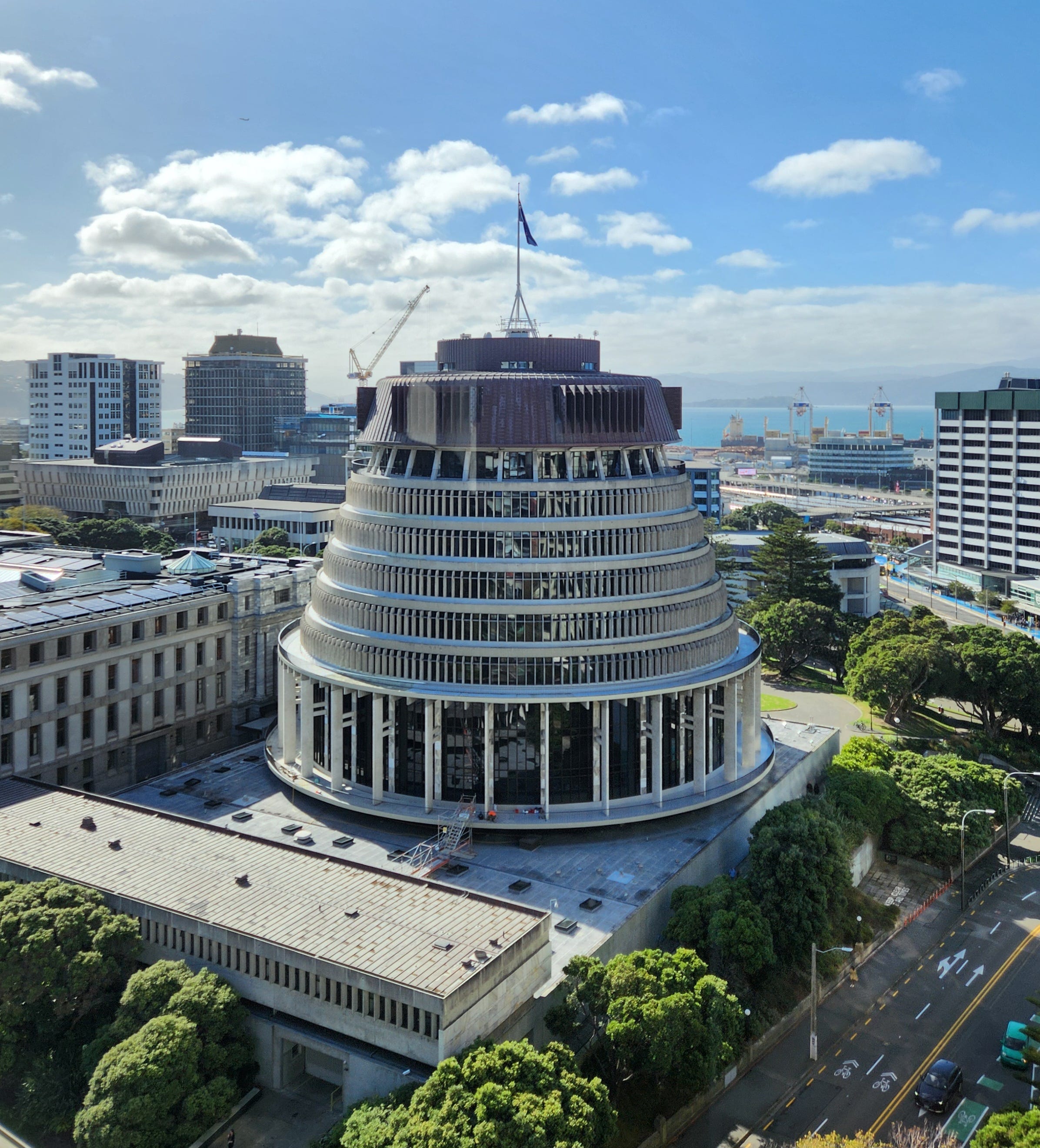
It’d be a calculated snub to send Brown home without so much as a leader-level handshake, but it wouldn’t be the first. Relations between Wellington and Avarua (remember that for trivia night) have been quite fraught this past year, and it’s all to do with—alright, yes, it’s China, but it’s more than that. The two countries have a peculiar constitutional arrangement; it creates a principle (which New Zealand increasingly interprets as a duty) of consultation around defence and foreign policy. Prime Minister Brown believes the suite of MoUs he signed with China in February 2025—which commit to cooperation on a range of activities, including infrastructure, multilateral diplomacy, and seabed mineral resource development—didn’t require prior consultation with New Zealand. Prime Minister Luxon believes otherwise, and his foreign ministry’s had some sharp words for what it views as Cook Islands’ lack of transparency about issues of ‘significant strategic concern’. And not only that: as Cook Islands’ largest development partner Wellington’s got plenty of precision-targetable leverage, and it’s using it. Since mid-2025, NZD$29.8 million in direct public sector support over two financial years has been cut. That’s a big enough hole in the public finances to send Brown to Parliament asking for a new budget, and the buzz from the Beehive is that the money’s not coming back until trust is restored to Wellington’s satisfaction.
If that sounds coercive—well, it is. ‘Free association’, which Cook Islands has with New Zealand, was never really a construct designed to accommodate strategic divergence. If two free associates remain such while trying to go their separate ways, eventually they either demonstrate independence or one dominates the other. For Brown, restoring trust with Wellington is the obvious path forward. He’s under pressure domestically to do it, and it’ll probably mean a fence of risk-mitigation policies around the China MoUs, plus some consultation machinery to make sure it doesn’t happen again. But in the long run, New Zealand’s and Cook Islands’ interests may not be that easy to reconcile. Wellington seems to want to contain great-power competition in its region, which means interpreting its tie to Cook Islands as a veto on security policy. That way it can manage which external players get in, and how. Cook Islands, under Prime Minister Brown, seems to want autonomy. It wants to make the best of great-power competition, and also, ideally, a lot of money. NZD$29.8 million, at least.
How? By opening up its expansive EEZ to foreign capital seeking a return on seabed minerals, of course—many of which are also, conveniently, critical minerals. The usual suspects: cobalt, nickel, manganese, copper, batteries need ‘em, drones need ‘em, China’s got most of the value chain, you’ve heard this song and dance before. That means bringing external players in and, implicitly, reducing dependence on Wellington—and it’s not just China circling. Enter Jared Novelly, President Trump’s billionaire nominee for Ambassador to New Zealand, Niue, Cook Islands and Samoa, very gung-ho about Cook Islands’ potential for seabed mining in his Senate hearing the other day. Witness the freshly-minted critical minerals MoU from last month that does for Washington pretty much exactly what last year’s seabed mining MoU did for Beijing. What did Mark Brown say about it? “It gives Cook Islands options.”
Maybe so. But—and this is Luxon’s leverage—not yet.
For more on these topics, we suggest:
Ramifications of the China-Cook Islands’ Partnership (RUSI, 2025)—What exactly does China get out of its MoUs with Cook Islands?
Geopolitics in the Pacific Islands: Playing for advantage (Lowy, 2024)—How do Pacific Island countries play the great powers against each other? What are the risks?
That’s all for this fortnight. For more timely analysis and commentary, check out The Strategist and ASPI’s Stop the World podcast—or our other Substack newsletters:

Thanks for reading! This post is public, so feel free to share it.
Comments
Nothing yet. Say the first thing.
Sign in to join the conversation.