
Welcome to the latest edition of ASPI’s Fault Lines.
Each fortnight, ASPI’s Defence Strategy Program monitors the moves and countermoves shaping the regional order and Australia’s security.
This edition covers the period 20 March 2026 - 2 April 2026.
Follow the Australian Strategic Policy Institute on X, on LinkedIn, and on Bluesky.
Far and away
Take a look at how Japan’s Ministry of Defense want to spend that 8.8 trillion yen they’ve asked for this year, and you’ll find a considerable portion (a mere trillion, or about AUD $9 billion for those watching at home) earmarked for ‘Stand-off Defense Capabilities’. That means missiles: more, more performant, and longer-ranged missiles than Japan’s ever had. In the last two weeks the MoD has hit not one but three key milestones here. Let’s check ‘em out.
Two new domestically-developed major systems—the Type 25 SSM and the Type 25 HGP Block 1—got their first operational deployments on 31 March. The SSM (‘Surface-to-Ship Missile’, does exactly what you think it does) can range about a thousand kilometres, and there are quite a few things less than a thousand kilometres from its new home at Camp Kengun in Kumamoto. The PLA’s Eastern Theater Command Navy at Ningbo, for instance. Then there’s HGP Block 1. Japan’s homegrown hypersonic weapon is presently in a somewhat ‘minimum viable’ state (the range is probably around 300-500 kilometres) to get it out in the field as fast as possible. HGP Block 2A, planned to finish development in 2027 and deploy before the end of the decade (don’t be surprised if Takaichi’s revised Defense Buildup Program pulls that forward), will exhibit performance about on par with the Chinese DF-17—ranging two thousand kilometres. Beijing and Tokyo, by sheer coincidence, are two thousand kilometres apart.
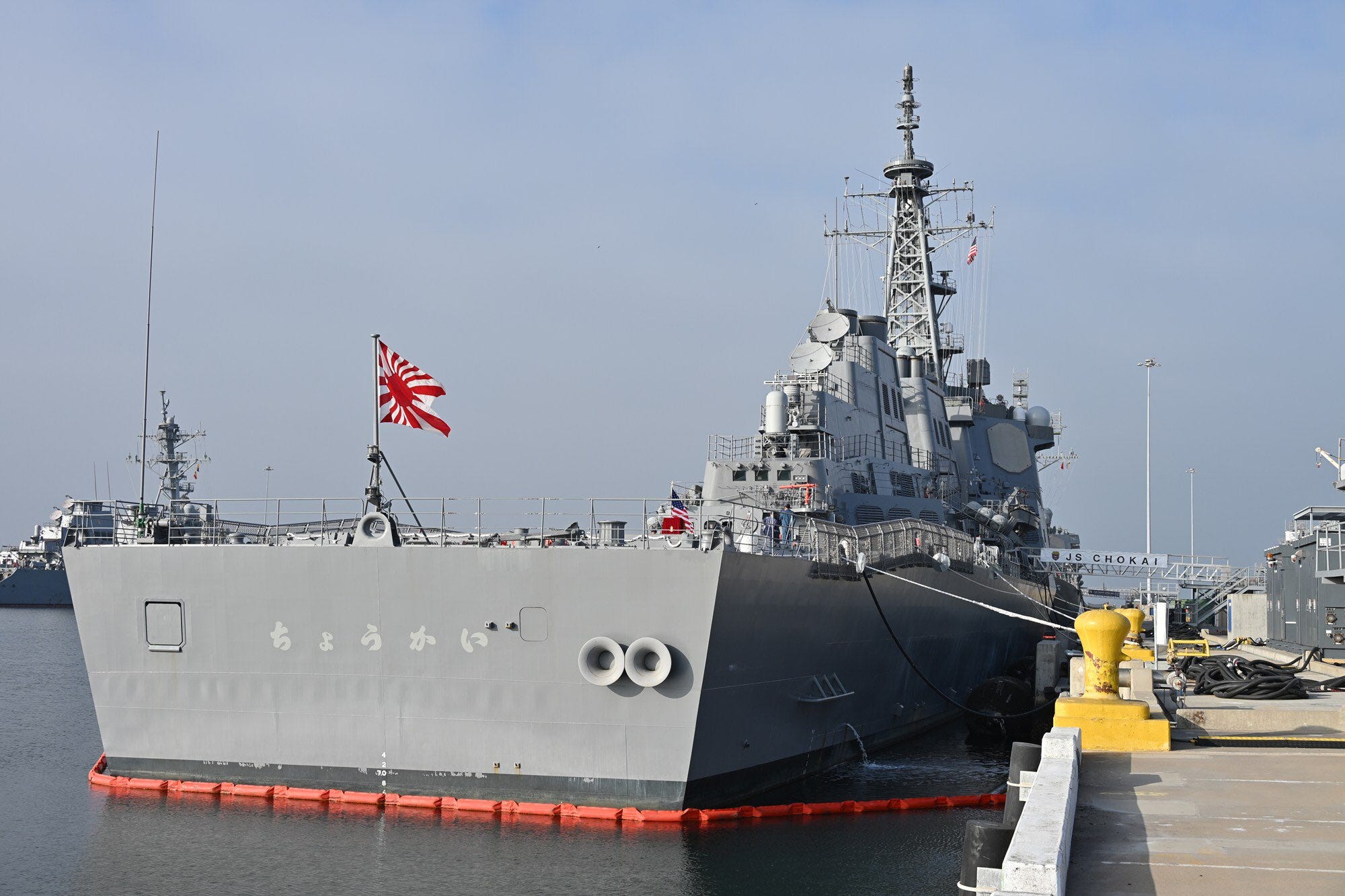
But then there’s Tomahawk. On 27 March the MoD confirmed that the JS Chōkai—a guided-missile destroyer—is now capable of firing the US-made Tomahawk cruise missile. Sea trials later this year will operationalise that. The plan is to eventually have all warships of that type Tomahawk-capable, which is a bigger deal than it sounds. The role of the Chōkai and its siblings in Japanese strategy has up to now been roughly akin to that of Australia’s Hobart-class Air Warfare Destroyer: a mobile shield defending major assets from airborne threats, including ballistic missile threats. With an effective range of about 1600 kilometres, Tomahawk turns the shield into a sword. The overt framing of all this on the Japanese side is, for constitutional reasons, centred on increasingly ingenious ways of characterising weapons designed to strike deep inside enemy territory as ‘defensive’. For a country that’s still technically prohibited from possessing armed forces, it’s doing a very passable imitation.
Show me the money
Useful as missiles are, you do need to pay for them. In Japan that’s a minor issue. Prime Minister Takaichi’s budget got delayed in the Upper House and didn’t pass before the end of the financial year on 31 March. No doubt she’d like it approved there, but it’s not strictly necessary; the Japanese constitution lets the Lower House’s approval take priority, so her budget will become law on 11 April no matter what.
The Taiwanese system is not so convenient. On 30 March a bipartisan delegation from the US Senate visiting Taipei urged the opposition-dominated Legislative Yuan to approve President William Lai Ching-te’s supplementary defence budget. That they felt the need is revealing. Long story short—State of the Strait has the details—Lai wants an extra USD $40 billion for new capabilities, and the KMT-led opposition have spent the last four months not giving it to him.
Budget gridlock is never fun, but the real trouble is that Lai’s been buying things on credit. A lot, in fact. Taiwan is spending big on US-made weapons, including 82 HIMARS missile launchers and munitions from Lockheed Martin—just the sort of high-mobility precision-strike complex you’d need if you wanted to turn an island into a porcupine—at a cost of about USD $4 billion. Lai’s supplementary budget was meant to fund an initial payment for that on 30 March. It hasn’t. Instead the US has allowed Taiwan to defer the initial payment until contract negotiations with Lockheed conclude, which’ll probably be late May.
A deferral of this kind is extremely rare if not unprecedented for US foreign military sales, and seems to have been agreed at the last minute. On the one hand, such unusual generosity is a good omen for the US commitment to Taiwan. On the other hand, Taiwan’s tendency to trip over its own feet on long-range capability development is a problem with no clear solution in the near term. Once that HIMARS contract is signed, President Lai will have five days to front up the cash—or risk further delays to a key acquisition.
German defence minister Boris Pistorius met his Japanese counterpart Shinjirō Koizumi in Yokosuka on 22 March.
The key outcome there was an agreement to establish regular security consultations. The key non-outcome was a Reciprocal Access Agreement, which would have allowed the two countries to deploy troops on each other’s soil more easily for training, exercises, or operations. Looks like Pistorius proposed an RAA, but its absence from the Japanese readout indicates nothing was agreed.
While Japan and Germany have been quietly upgrading defence ties (no jokes, please) for the last few years, German military engagement in Asia is still something of a novelty, as well as modest and intermittent. It’s not yet clear Berlin can sustain the consistent presence that would make an RAA worthwhile.
Belarusian President Alexander Lukashenko made his first-ever visit to North Korea on 25-27 March, where the two countries signed a new Treaty of Friendship and Cooperation.
It’s one of those big-tent framework treaties for enhancing bilateral engagement on basically everything. Unclear if that includes security; few details are public. North Korea and Belarus both already have significant bilateral arrangements with Russia, so this colours in the third side of the triangle.
No sudden moves
Getting ‘painted’ by a warship’s fire-control radar is the naval equivalent of staring down the barrel of a loaded gun: it generally means they’ve got a firing solution, and your remaining lifespan is a function of their trigger discipline. Not very friendly, you’ll agree. On 20 March it was disclosed to the public that the BRP Miguel Malvar—that’s the Philippine Navy’s newest warship—wound up on the pointy end of a PLA Navy corvette’s fire-control radar near the disputed Sabina Shoal on 7 March. That went about as well as you could hope: the Malvar’s captain got on the radio, told his Chinese counterpart to cut it out, and the PLA-N vessel backed down. Diplomacy prevails.
There aren’t many compelling reasons (or at least, any innocent ones) to deliberately give another country’s armed forces the impression you’re seconds away from opening fire. Tends to put people on edge. Unlike the incident last December when Chinese fighter jets intermittently locked radar on Japanese F-15s near Okinawa, there’s far less plausible deniability here—which perhaps explains why China’s ordinarily-talkative diplomats in Manila have been very quiet about the Miguel Malvar incident.
That the Philippines has publicised it, and promptly, merits mention. Confrontations between military vessels are often considered more sensitive than those involving coast guard or civilian ships. In February 2020 a similar incident occurred: the Philippine Navy corvette BRP Conrado Yap visually identified (though couldn’t confirm electronically) that a PLA-N corvette near Commodore Reef had sought a firing solution with its main gun. That didn’t become public for more than two months, and not until after Manila had lodged a diplomatic protest. Where the Duterte government kept the incident under wraps to help manage its relations with Beijing, Marcos Jr. doesn’t seem to find a policy of ‘assertive transparency’ inconsistent with doing the same. Bilateral Philippines-China high-level talks on the South China Sea and energy security restarted on 27 March after more than a year on ice. Maybe diplomacy does prevail after all?
France and the Philippines signed a Status of Visiting Forces Agreement in Paris on 27 March—the first such agreement Manila’s made with an EU member state.
Manila’s been signing SOVFAs at an impressive clip lately; you’d be hard pressed to find another country that’s minted four in only 21 months, and negotiations for a fifth with the UK are ongoing. The speed of it all suggests the value-add they see in any individual country is probably secondary; more important is the network effect.
Inclement weather
Small states can make for big headaches. Vanuatu for instance. Port Vila’s pressing ahead with a UN General Assembly resolution backing the ICJ’s July 2025 advisory opinion on climate change, despite sustained opposition from the United States and other major emitters.
Short version: the International Court of Justice has come around to the view that anthropogenic climate change creates obligations for states beyond what the UN climate treaties say. As a result, breaches of those obligations can engage the ordinary rules of state responsibility. Washington, as often happens when it encounters international law that doesn’t go its way, isn’t too happy. Reporting on a US diplomatic cable indicates the Trump administration ‘strongly objects’ to Vanuatu’s draft resolution and has urged other governments to oppose it, on the grounds that it could be used to advance claims of legal obligation and liability.
Pressure works, let’s be honest. Some of the sharper language in earlier drafts—particularly around liabilities for loss and damage—has reportedly been watered down or removed.
But setbacks don’t imply defeat. An ICJ opinion and ten dollars won’t buy you too much these days, least of all enforcement, but hey; you take what you can get. What Vanuatu wants to get is political endorsement from the same General Assembly that requested the ICJ opinion, and to make it harder at the margin for major emitters to treat the Court’s findings as diplomatically ignorable. UN human rights experts have framed the effort in much the same way, urging states to support a General Assembly resolution upholding the advisory opinion and warning against attempts to block discussion of it.
It’s a familiar tune in much of the Pacific. Those who lack power can use process, institutions, can build legitimacy from legality. What’s a rules-based order, after all, if not one where the smallest states are free to annoy the biggest?
Mind you, the US digging in its heels on this issue hands China yet another opportunity to present itself in the Pacific as the less overtly disagreeable great power, even while its own exposure as a carbon emitter remains significant. That dynamic was already visible in Vanuatu’s policing relationships before this latest UN fight, with Beijing offering equipment and a broader security partnership while Port Vila continued its careful balancing act with traditional partners such as Australia and New Zealand.
In response to the closure of the Strait of Hormuz, New Zealand has quietly ceased attempts to close a loophole which allows for the import of Russian oil if refined in a third country.
When pressed on the issue, Resources Minister Shane Jones stated ‘New Zealanders want to make sure that they can still fill up their bulldozer and fill up their ute’.
Japan and Fiji have signed a 400-million-yen Official Security Assistance agreement.
Japan will provide the Republic of Fiji Military Forces with medical equipment such as ambulances with the goal of strengthening Fiji’s disaster response capabilities and building closer security ties between the two states.
This week, Australia and Fiji began the final round of negotiations to upgrade the Vuvale Partnership to a formal security treaty, the ‘Vuvale Union’.
The treaty will enhance cooperation across areas such as transnational organised crime, terrorism, cybercrime, and illegal fishing. The treaty is expected to be signed after the current round of negotiations wrap up.
That’s all for this fortnight. For more timely analysis and commentary, check out The Strategist and ASPI’s Stop the World podcast—or our other Substack newsletters:

Thanks for reading! This post is public, so feel free to share it.
No posts
Comments
Nothing yet. Say the first thing.
Sign in to join the conversation.