
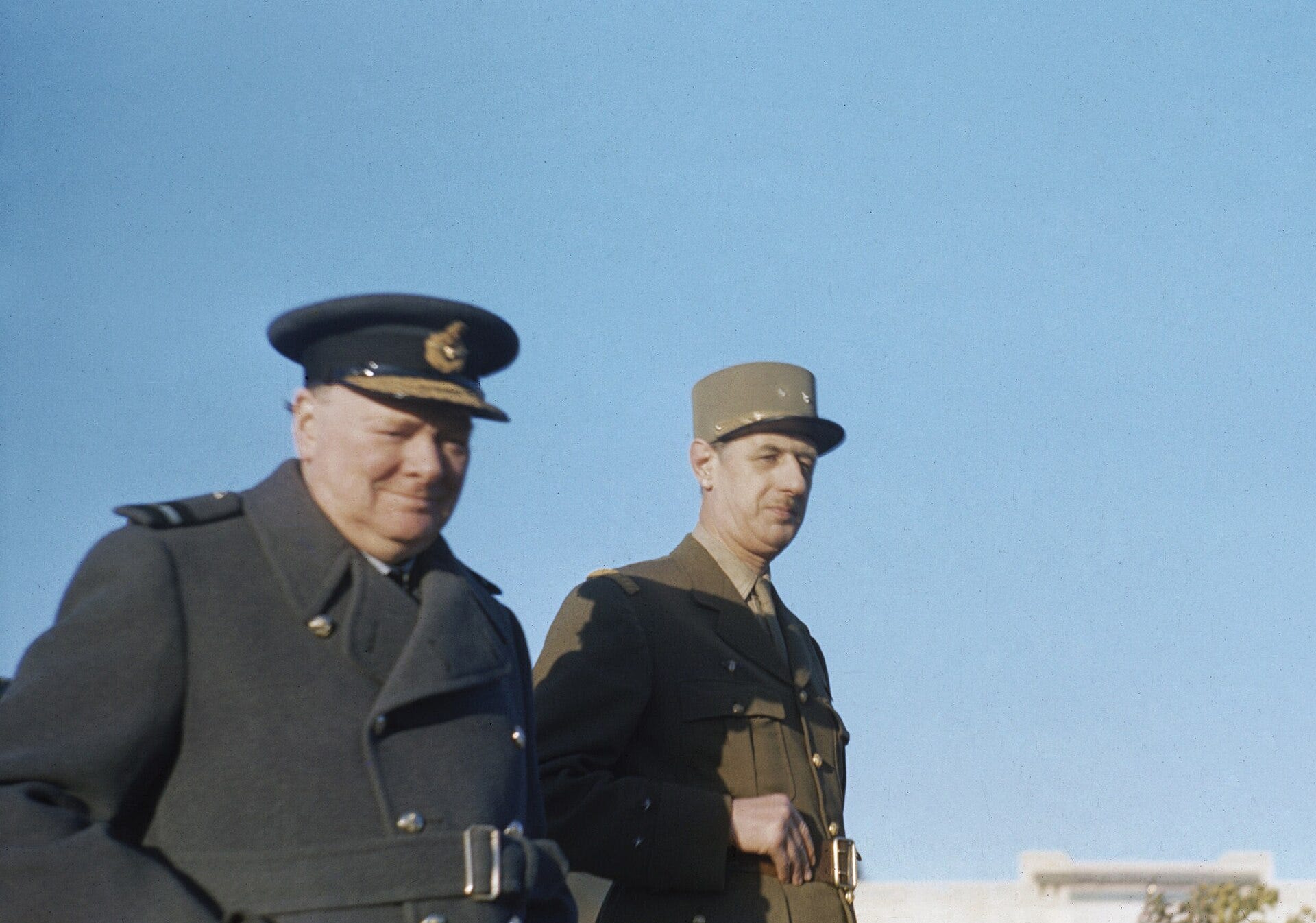
I came out thinking that this was the film I’d wanted the Odyssey to be… its first part Résistance running at a brisk 158 minutes, De Gaulle, a biopic of the eponymous general-later-president spanning World War Two and depicting the rocky journey of his government-in-exile and the troops of Free France, opens in the UK this weekend – taking the morning off to watch a press screening is yet another perk of this gig.
The familiar, slightly exasperated tone of Mark Kermode’s voice, as he signed in ahead of me in the queue, left me starstruck – how many shows of his on BBC Radio 5 Live I would have tuned into over the years, I don’t know. As did the towering figure of the Telegraph’s Robbie Collin, occasional stand-in for Kermode on his slot with Simon Mayo and in whose footprints I once trod when writing for the university newspaper at St Andrews. It was almost like being a real journalist…
The film itself was not as slow and ponderous as surprised as I was that its epic scale didn’t bely its 5-hour duration. It was light-hearted, laugh-out-loud funny at times, but tense, brutal too, and always grand, both in its performances and ambition. Set-pieces like Mers El Kébir (brilliantly retold in the magazine earlier this year by Edward Abel Smith), events at Bir Hakeim, and the efforts to rally the French colonies in sub-Saharan Africa – the entire Francocentric perspective alters my understanding of the conflict on its head, imparting an utterly different viewpoint of, and meaning to, the on-the-ground realities of Nazism, invasion, Vichy collaboration and resistance. It is also telling that it has been a surprise hit among younger audiences in the couple of months since release the other side of the Channel.
Keep an out for a review or two of the film, and do yourself a favour and book in!

In his new book, Paul French discusses how a recently discovered diary from an American tutor who lived with Puyi and Wanrong offers an new perspective on the young couple’s marriage and the usual portrayal of China’s last emperor and empress as political symbols, victims or exotic caricatures.
It’s astonishing how firmly the tragic story of Puyi and Wanrong, the last emperor and empress of China’s Qing Dynasty, remains in the public imagination.
In the West, much of that fascination comes from Bernardo Bertolucci’s lavish 1987 epic The Last Emperor – now 38 years old. In China, the doomed couple, their gilded-cage existence in the Forbidden City and their eventual downfall at the hands of the Japanese continue to inspire histories, novels, soap operas, websites and graphic novels. On weekends, children in Beijing even cosplay as Puyi and Wanrong and wander around the former imperial city.
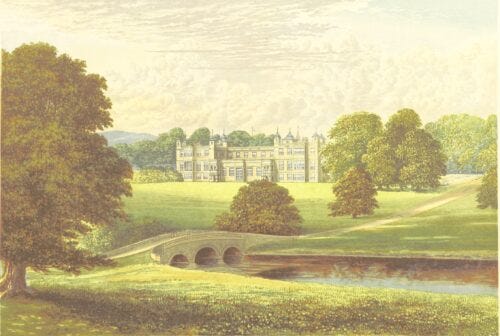
Wartime requisitioning of Britain’s country houses transformed the lives of owners, servants and occupiers, explains Judith S. Lewis in The Country House at War, published by Yale University Press, and the consequences were far-reaching.
What was it like to have your house requisitioned during the war? To share your home with occupiers, whether Land Girls, POWs, soldiers, or spies? What compensation did families receive for the loss of their homes? And how did it all work? These were the questions I initially wanted answered when I began The Country House at War.
The idea for writing a book on requisitioned country houses during World War II came because I couldn’t find a book that answered them. There were memoirs of course, and wonderful architectural histories of individual houses, but as a social historian, I wanted to find patterns in lived experience. And as someone who had written about upper-class women and their houses in the 18th and 19th centuries, I was well-positioned to do so. I just had to enter a new time zone.

The thriller writer discusses his fascination with overlooked corners of history and the inspiration behind his Marcus Riley thrillers and his forthcoming title, The Dolos Legacy.
Welcome to Aspects of History, Mark. What first attracted you to the period or periods you work in?
It’s not periods per se. I like to uncover nuggets of history that I can build on and weave into a modern-day setting. I have an insatiable appetite for trivia and love peering into the dark underbelly of formally taught history.
Can you tell us a little about how you research? Has the process changed over the years?
Once I have an idea it’s like a pebble. I follow the ripples out. It’s surprising how quite disparate events in history can actually collide. Recently there was a tie-up between Romanov treasures, the connection of the Vedic faith brought to India from the Urals and the betrayal of Stalin of his communist colleagues to the Czar’s secret police. Clearly AI, if used correctly, is a fabulous resource that has made obtaining information much quicker. Just don’t take everything it tells you as being 100% correct!
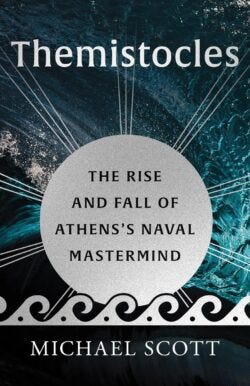
The classicist has achieved one of the hardest tasks for an ancient historian, this portrayal possessing accessibility, narrative zip and a desirable balance between the political and the personal, maintains the Editor.
If one was to conceive of Themistocles’ story as an altarpiece (and it seems the eponymous subject did so!), the central image would be a well-known one: the Athenian slipping surreptitiously out of the Greek naval command’s evening deliberations to send his manservant to invite the Persians fleet into the shallows of Attica. The preparations for Salamis that night tethers together what came before and what followed, but Professor Michael Scott’s stirring account of one of ancient history’s canniest operators offers far more than the events on one single evening across the 65 years of his life.
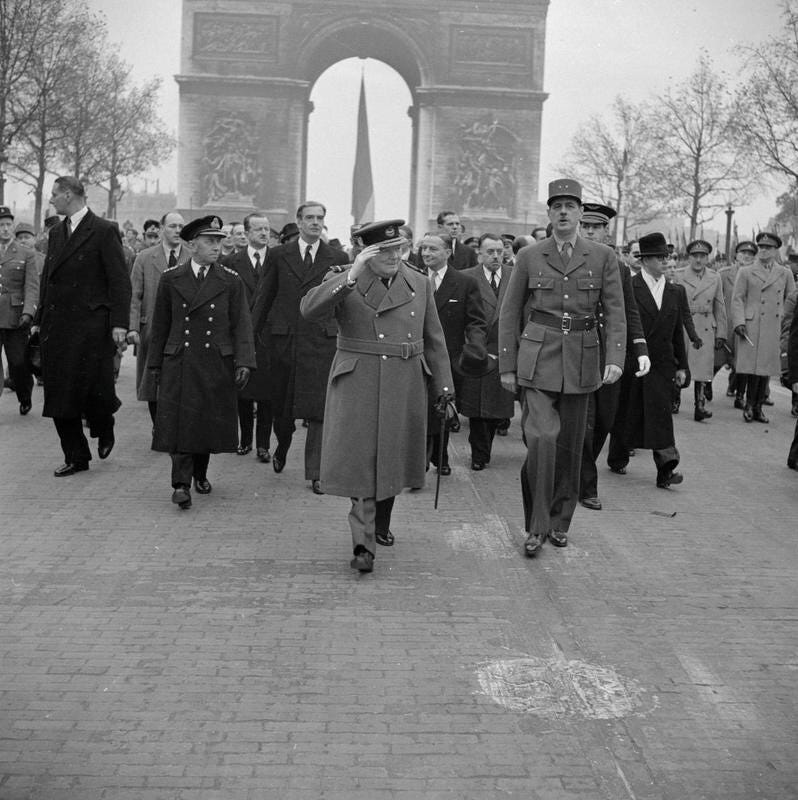
The two Allied leaders were not just makers of history but performers, Richard Vinen argues, selective of their actions and words during wartime and as empires fell.
De Gaulle wrote of Churchill, and might well have written of himself, that he was an ‘artist of history.’ Both men were artists in how they wrote their history, but also lived their lives as thought they were constructing a work of art. They understood that every act of theirs would contribute to an image that would be passed down to posterity. When he went into battle in the Sudan at the age of 23, Churchill left a lancer riding behind the main body of troops so that someone would survive to record the incident if Churchill himself were killed. When, at the age of 71, de Gaulle stepped calmly from a car that had been riddled with the bullets of would-be assassins, he knew that his icy self-control would contribute to the mystical sense that his destiny was intertwined with that of France.

On this week’s episode, Zeb Baker-Smith is joined by author, James P. Cain, whose remarkable career from politics, law and professional sport, to the world of international diplomacy as U.S. Ambassador to Denmark inspired the gripping narrative of Reign of Secrets, the first novel in the Whit Ransom thriller series
The murder of a Danish prince becomes a tale of espionage, diplomacy and ancient secrets, as American and Irish diplomats become caught up in a struggle involving the Crown of Denmark, a thousand-year-old mystery and Vladimir Putin’s schemes for a resurgent Russian empire.
The educator and historian reflects on his pilgrimage to Auschwitz, the enduring legacy of war in Europe and why stories of courage, resistance and reconciliation continue to be of consequence.
Conflict, and the accompanying possibility of nearby wars proliferating across continents, is again making the headlines – whether that be Ukraine or across the Middle East. The temptation might be to assess the Second World War as history, fixed and settled, generations ago now. But Anthony Seldon would claim precisely the opposite. His 1,300 kilometre walk from the French-Swiss border to Auschwitz, the concern of his latest book, The Path of Light, scans not only the landscapes blighted by the deadliest conflict in human history, but also the questions of morality those place names persist in asking us today.
This exclusive feature will only be available to paid subscribers.
Have a great Bank Holiday!
Zeb Baker-Smith, Editor of Aspects of History.
Comments
Nothing yet. Say the first thing.
Sign in to join the conversation.